
The most useful Florida debt relief programs for credit card debt are creditor negotiation, a nonprofit debt management plan, a 0% balance transfer card, a consolidation loan, debt settlement, and bankruptcy. This list ranks them by how much they can cost you and how much damage they do to your credit. If you have steady income and damaged credit, a nonprofit debt management plan usually fits best. If your credit is good, a balance transfer or consolidation loan costs less. If you cannot repay within about five years, settlement or bankruptcy deserves a serious look.
Card balances at 18% to 29% APR can eat a payment before any principal gets paid down. The cause is usually job loss, medical bills, or a few years of spending that outran income. The hard part is not finding options. It is telling the legitimate ones from the companies that profit from your panic.
Credit Card Solution is an educational site founded by people with a financial background, and it is funded by advertising. We are not a lender, a settlement company, or a credit counseling agency, and we do not sell any of these services. Each option below covers how it works, who it fits, and what it costs. After the list, you get the Florida rules that protect you and a simple way to choose.
1. Negotiate directly with your card issuers
Credit card debt negotiation, which means calling your card companies yourself, is the cheapest of all debt relief programs in Florida, because it costs nothing and you can start today. Issuers often prefer a smaller, steady payment to chasing a charged-off account.
How it works
Call the number on the back of each card and ask for the hardship program. Request a lower APR, waived late fees, or a reduced payment for a set period. Do this before a collector gets involved, and ask for every agreement in writing. Keep the letter until your last payment clears.
Here is what that can look like. A $6,000 balance at 27% APR costs $135 in interest every month. If the issuer agrees to 15%, that drops to $75, so $60 more each month goes to principal.
Who it fits
This route suits you when the trouble is temporary and you still have income to make some payment. It works best if you can say yes to most of these:
- You are behind on a few cards, not a dozen.
- You can name a payment you can keep for 12 months.
- No lawsuit has been filed against you yet.
Call before the collector does, because that is when issuers have the most reason to bargain.
Cost and credit impact
There are no fees, but the credit effect depends on the deal. A hardship plan often freezes or closes the card, and late payments made before your call stay on your report. If you miss minimums for four to six months, the issuer may charge off the debt, as the Federal Trade Commission explains in its guide to getting out of debt.
- Fees: none.
- Credit: a closed card can lower your score for a while.
- Risk: no third party backs the deal, so get terms in writing.
2. Nonprofit debt management plan
A debt management plan (DMP) through a nonprofit credit counseling agency is the best default for Floridians with high-interest card debt, steady income, and credit too damaged for a cheap loan. One monthly payment replaces several, at lower rates.
How it works
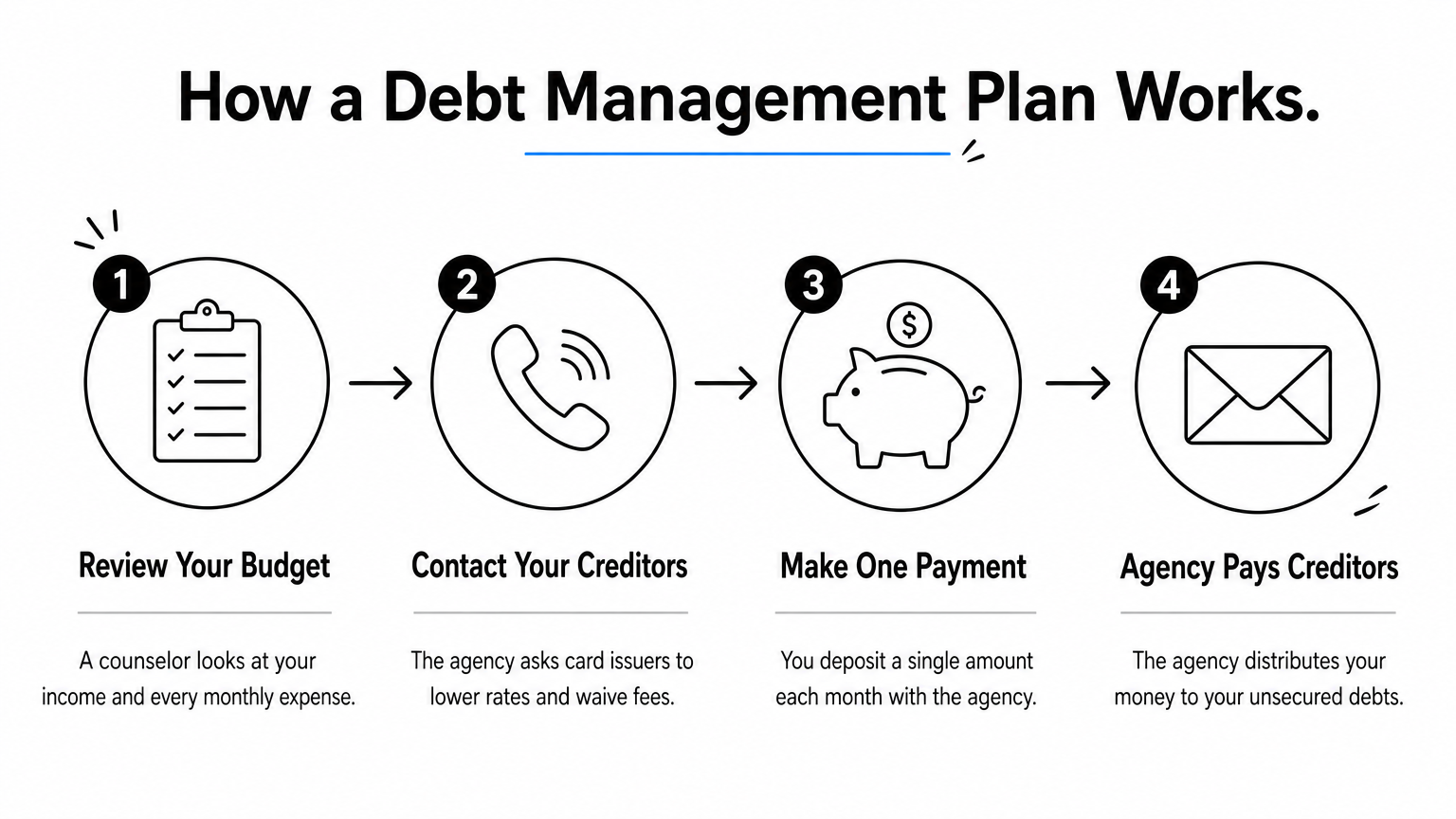
A counselor reviews your budget and contacts your creditors. They may lower your rates or waive fees. You then deposit one amount each month, and the agency pays your unsecured debts from it. Plans commonly run three to five years, and the FTC notes they can take 48 months or more.
Take $10,000 in card debt. At 25% APR, interest alone is about $208 a month, so a $203 payment would not even cover it. If a plan brings the rate to around 8%, a $203 monthly payment clears the debt in 60 months, with about $12,170 paid in total.
Who it fits
A DMP suits you if your income is steady but your rates keep your balances from shrinking. It does not cover mortgages or car loans, only unsecured debt. Enrollment does not depend on a credit score, and that is why it helps people who cannot qualify for a loan.
- You agree to stop using the cards in the plan.
- You can make the same payment every month.
- You owe mostly credit card, medical, or personal loan debt.
A good counselor reviews your whole budget first, so walk away from anyone who calls a DMP your only option.
Cost and credit impact
Agencies usually charge a setup fee and a small monthly fee, so ask for the quote in writing before you sign. Late payments can cancel the rate cuts, so a plan only works if you can keep every payment. Closed accounts may lower your score at first, and on-time payments rebuild it over the life of the plan.
- Fees: setup plus monthly, varies by agency.
- Credit: closed accounts hurt short term, on-time payments help.
- Check: accredited counselors, no charge before help is given.
3. 0% balance transfer credit card
A 0% balance transfer card is the fastest way to stop interest if you have good credit and can repay within the promotional window. Intro periods commonly run 12 to 21 months.
How it works
You apply for a card with a 0% intro APR and move your balances onto it. The issuer charges a transfer fee, typically 3% to 5%. Every dollar you pay then reduces principal until the intro period ends. Whatever remains after that gets the regular APR.
Example: $8,000 at 24% APR costs $160 in interest in the first month alone. A 3% fee adds $240, so you owe $8,240. Over an 18-month window, $458 a month clears it. The payment is higher than a DMP’s, but the total cost is far lower.
Who it fits
This works if your credit is good to excellent, generally 670 or higher, and your approved limit covers most of your balance. The calendar matters more than anything else here. If you cannot pay the balance down within the intro period, a loan or DMP is safer.
- You can repay within 12 to 21 months.
- You will not run the old cards back up.
- Your credit qualifies for a high enough limit.
A 0% card only helps if your monthly payment would clear the balance before the promotion ends.
Cost and credit impact
Expect the fee, a hard credit inquiry, and a limit that may not cover everything. Issuers usually will not accept transfers from their own cards. Higher utilization on the new card can dip your score briefly. Missing a payment can end the 0% rate early, so set autopay for at least the minimum.
- Fees: 3% to 5% of the amount moved.
- Credit: small dip from the inquiry, then improvement as balances fall.
- Risk: the regular APR applies to anything left at the end.
4. Debt consolidation loan
A debt consolidation loan replaces several card balances with one fixed-rate loan. It is the right tool when your credit is fair to good and you need a longer, predictable payoff than a balance transfer allows.

How it works
A bank, credit union, or online lender gives you a personal loan. You use it to pay off the cards and then repay the loan in fixed monthly installments. Here is an illustration. Say you owe $15,000 on cards at 24% and qualify for a 12% loan over 48 months. Your payment is about $395, and you pay about $3,960 in interest.
Pay that same $395 a month on the cards instead. It would take about six years and more than $13,000 in interest. The savings are real, but only if the loan rate is well below your card rates.
Who it fits
A consolidation loan suits you if you qualify for an APR clearly lower than your cards and can stop swiping the old cards. Without a lower rate, it only restructures the debt. Shop for offers that let you check your rate without a hard inquiry, and compare the full cost, not just the payment.
- Your credit is fair to good, and lenders offer you a lower rate.
- You need three to five years of fixed payments.
- You can keep the old cards at zero.
Consolidation helps only when the new rate is clearly lower than your average card rate.
Cost and credit impact
Many loans charge an origination fee of a few percent, deducted from the amount you receive. Avoid turning card debt into a home equity loan or second mortgage. The FTC warns that your home becomes collateral, so missed payments could cost you the house. Paying off cards with an installment loan often lowers utilization, which can help your score.
- Fees: origination fee, sometimes none.
- Credit: a hard inquiry, then a likely improvement.
- Risk: secured loans put your home on the line.
5. Debt settlement
Debt settlement means paying creditors a lump sum smaller than what you owe. It is a high-risk option for people who have already fallen behind and cannot afford a DMP.

How it works
A for-profit company usually tells you to stop paying creditors and deposit money monthly into a dedicated account. Once enough accumulates, the company offers each creditor a settlement. Creditors do not have to accept, and the process often takes two to three years. Meanwhile, late fees grow, collectors call, and you can be sued.
Federal rules bar settlement companies from collecting fees before they settle a debt. A realistic expectation: on $12,000 owed, the net saving after fees and penalties often lands closer to a quarter than a half. That would leave you paying roughly $9,000.
Who it fits
Settlement fits you only if you are already behind, you cannot sustain a DMP payment, and you want to avoid bankruptcy. You also need discipline, because the plan depends on saving every month while creditors stay unpaid. You can try the same negotiation yourself for free, using the steps in section 1.
- You are past the point of making minimum payments.
- Your debt is mostly unsecured card debt.
- You can save a set amount each month for years.
Settlement can be worth it, but only if you accept that your credit takes the hit first.
Cost and credit impact
Companies charge a percentage of the debt enrolled or of the amount saved. Late payments can stay on your credit report for up to seven years. Cancelled debt can also be taxable income, and creditors report cancellations of $600 or more on Form 1099-C. Ask a tax professional how that applies to you.
- Fees: a percentage, charged only after each settlement.
- Credit: severe damage while payments are missed.
- Risk: creditors may sue before you finish saving.
6. Chapter 7 or Chapter 13 bankruptcy
Bankruptcy is the legal reset for card debt you cannot repay within roughly five years. It is the last resort on this list, and it can be the right one. A Florida bankruptcy attorney is worth a consultation before you rule it out or file.
How it works
You file in federal bankruptcy court. In Chapter 7, a trustee sells non-exempt assets to pay creditors, and remaining eligible card debt is discharged, usually within a few months. In Chapter 13, you keep your property and pay through a court-approved plan over three to five years. Florida’s homestead protection is among the strongest in the country, but how it applies depends on your facts.
Before you file, you must complete credit counseling with an approved agency, and Chapter 7 requires passing a means test. After filing, you take a debtor education course.
Who it fits
Bankruptcy fits you when your income cannot realistically clear your debts, you face lawsuits or garnishment, or settlement would still leave you underwater. Try nonprofit counseling first. If it cannot help, a lawyer can tell you which chapter fits.
- Your debts exceed what you can repay in five years.
- You are being sued or your wages are at risk.
- You have tried or ruled out a DMP.
If nonprofit counseling cannot fix your math, bankruptcy may be the cleanest way out.
Cost and credit impact
Court filing fees run several hundred dollars, and attorney fees come on top. Chapter 7 can stay on your credit report for up to 10 years. Chapter 13 generally stays about seven. Bankruptcy usually does not erase child support, alimony, most taxes, or most student loans. See the U.S. Courts bankruptcy basics for details.
- Fees: court fee plus attorney fees.
- Credit: a steep drop that fades over years.
- Check: your Florida attorney for exemptions and timing.
Florida rules that protect you from collectors
Florida law gives you real protections whichever program you choose. Knowing them keeps you from paying a debt that is too old to sue over or from tolerating illegal collection tactics.
How long a card debt can be sued over
Florida’s statute of limitations for most written-contract debt is five years, and some debts carry four. The clock usually starts when you miss a payment. After it expires, the debt is time-barred, and a collector cannot sue or threaten to sue, though the debt itself still exists. In some states a payment or written acknowledgment restarts the clock, so check with an attorney or legal aid before you pay or sign anything on an old debt.
What collectors can and cannot do
Florida’s Consumer Collection Practices Act extends fair-collection rules to original creditors, not just collection agencies. Federal law lets you dispute a debt in writing within 30 days of the collector’s first notice. The collector must then pause collection until it verifies the debt.
- Dispute in writing and keep copies.
- Log every call with the date and the person’s name.
- Report violations to the Florida Attorney General and the FTC.
A time-barred debt cannot be sued on, so check its age before you pay a collector anything.
How to choose a legitimate program and avoid scams
Match the program to your credit and your payoff timeline, then verify the provider before you give anyone money or account access. Most harm in debt relief comes from picking the wrong provider, not the wrong category.
Match the option to your situation
| Your situation | Best fit | Why |
|---|---|---|
| Temporary setback, still paying | Direct negotiation | Free, fast, no third party |
| Steady income, damaged credit | Debt management plan | Lower rates without a credit check |
| Good credit, can repay in under 2 years | Balance transfer card | 0% interest while you pay down |
| Fair to good credit, 3 to 5 year payoff | Consolidation loan | Fixed rate, predictable payment |
| Behind and cannot afford a DMP | Debt settlement | Lower payoff, with credit damage |
| Cannot repay in about 5 years | Bankruptcy | Legal discharge, last resort |
Red flags of a scam
Legitimate providers do not collect fees before they help you, and they do not guarantee results. Walk away from any company that:
- Charges you upfront before doing anything.
- Guarantees to settle all your debts or promises fast forgiveness.
- Tells you to stop talking to creditors without explaining the consequences.
- Claims to run a "government" relief program.
- Enrolls you without reviewing your finances.
Verify before you sign
Ask for fees and terms in writing, and ask whether the company is licensed to operate in Florida. Check complaints with the Florida Attorney General’s office and your local consumer protection agency. Report problems at ReportFraud.ftc.gov. If your trouble is a mortgage, a free HUD-approved housing counselor can help at 800-569-4287.
Start with the cheapest option that works
Most Florida debt relief programs come down to one question: how fast can you repay, and what does your credit allow? Start with free creditor negotiation. Move to a nonprofit debt management plan if you need lower rates, and use a balance transfer or consolidation loan if your credit is strong. Treat settlement and bankruptcy as the steps for debt you cannot repay.
Whatever you choose, get every term in writing and verify the provider first. For more step-by-step guidance, read how to get out of credit card debt, or browse Credit Card Solution for help with balance transfers and credit repair.


