The safest debt relief programs North Carolina residents can use are nonprofit credit counseling, the state’s medical debt relief program, free hardship plans from your creditors, and debt consolidation if your credit is decent. Debt settlement and bankruptcy come last. Match the option to your debt. Hospital bills point to the state program. Card balances with damaged credit point to a nonprofit debt management plan. A score near 700 or higher opens up consolidation.
Credit card interest of 18% to 29% makes minimum payments feel like running in place. Search for help and you get a pile of ads from companies that want a fee. North Carolina law makes it illegal to collect an upfront fee for debt settlement services, so a pitch that asks for money first deserves suspicion.
This guide ranks five options, each with how it works, who it suits, and what it costs. We are an education site, not a debt service, so we have nothing to sell you except clarity. These are the same debt relief programs NC residents should find whether they search by state or by city.
1. Nonprofit credit counseling and debt management plans
A nonprofit credit counselor is the best first call for most people with card debt. The session reviews your whole financial picture and costs little or nothing, and it can lead to a repayment plan that lowers your interest.
How it works
A counselor looks at your income, expenses, and debts. If a budget alone will not fix the problem, they may suggest a debt management plan. You send one monthly deposit to the agency, and it pays your creditors on a schedule worked out with them. Creditors may agree to lower interest rates or waive fees, though you should confirm that with each one. You may have to stop using new credit while you are in the plan.
To find an accredited nonprofit, call the National Foundation for Credit Counseling at 1-800-388-2227.
A debt management plan repays everything you owe, just at a lower cost and on a fixed schedule.
Who it suits and what it costs
This fits you if you can repay your balances in roughly three to five years once interest drops, but you cannot qualify for a good consolidation loan. North Carolina limits what counselors can charge:
- Setup fee: no more than $40.
- Monthly fee: no more than 10% of your monthly payment, capped at $40.
Know the limit. A plan does not reduce what you owe. It only makes paying it cheaper. Start with the free counseling session before you commit to a plan.
2. North Carolina’s medical debt relief program
If your debt is hospital bills, this is the most powerful of the debt relief programs North Carolina offers, and it costs you nothing. It is also automatic.

How it works
The state launched the Medical Debt Relief Incentive Program in 2024 through Medicaid. Hospitals that join receive payments in exchange for wiping out old patient debt. The state reported that all 99 eligible hospitals committed to take part. Qualifying debt dating back to January 1, 2014 is relieved, and you do not apply. Eligible people are notified and the debt is forgiven.
If the debt qualifies, the hospital erases it for you. You never have to apply or pay anyone to enroll.
Who it suits and what it costs
Relief covers debt owed to participating hospitals. It includes unpaid debt of Medicaid enrollees, and older "uncollectable" debt of non-Medicaid patients with incomes at or below 350% of the federal poverty level, or with debt above 5% of annual income. Debt generally must be more than two years old and not under a payment plan.
Going forward, participating hospitals must give 50% to 100% discounts to patients at or below 300% of the poverty level. They must also cap interest at 3% and stop selling medical debt or reporting it to credit agencies.
It does not cover credit cards you used to pay medical bills. Anyone who asks for a fee to "enroll" is a scammer. Check the participation list and the current rules on the NCDHHS medical debt page.
3. Hardship programs from your creditors
You can often get relief for free by calling your own card issuer. Of all the debt relief programs NC residents can try, this one has the lowest barrier. It takes one phone call.
How it works
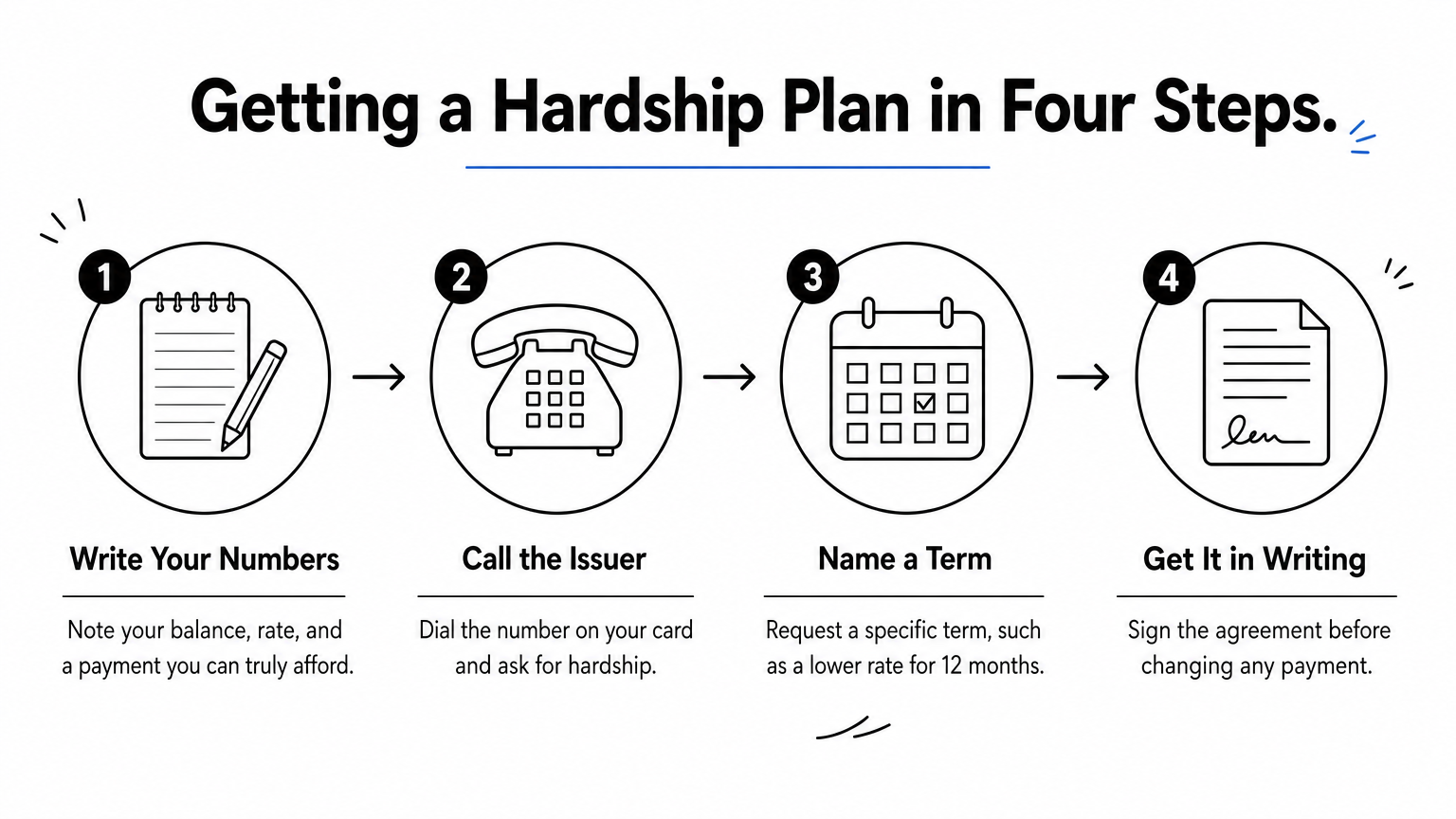
Most card issuers run hardship programs. They may cut your interest rate, waive late fees, or lower your payment for a set period. The North Carolina Department of Justice notes that most companies are willing to set up special arrangements. Use this approach:
- Write down your balance, rate, and the payment you can truly afford.
- Call the number on the card and ask for the hardship or assistance department.
- Request a specific term, such as a lower rate for 12 months.
- Get the agreement in writing before you change any payments.
Ask for a specific number, not "help." A concrete request gets a concrete answer.
Who it suits and what it costs
This suits a temporary setback, like a job gap or a surprise bill, when you can see a path back to full payments. It costs nothing. Be realistic about what you can pay, because a broken arrangement is worse than none.
Expect trade-offs. The issuer may close the card, and the relief usually ends. If you owe several creditors, negotiating with each one gets exhausting, and that is the point where a counselor’s single plan makes more sense.
4. Debt consolidation with a balance transfer or loan
Consolidation replaces several high-rate balances with one lower-rate payment. It works best when your credit is still good and your spending is under control.

How it works
A balance transfer card offers a 0% introductory rate for a limited number of months, usually with a transfer fee of 3% to 5%. A personal loan gives you a fixed rate and a fixed payoff date. The best terms generally go to scores around 700 or higher.
Run the numbers. A $9,000 balance at 24% APR costs about $180 a month in interest alone. A 3% transfer fee on that balance is $270, so a 0% offer pays off quickly if you clear the debt within the promotional window.
Consolidation only works if the new rate is lower and the old cards stay at zero.
Who it suits and what it costs
It suits people who can pay off the balance in the promotional period, or who qualify for a loan rate well below their card rates. It fails if you keep charging on the emptied cards.
Avoid tapping your house to consolidate. A second mortgage or home equity line puts your home up as collateral, and the state attorney general’s office warns that late payments could cost you the home. Turning unsecured card debt into secured debt is a poor trade.
5. Debt settlement and bankruptcy as last resorts
Settlement and bankruptcy belong at the bottom of any list of debt relief programs North Carolina residents consider. They can work, but both carry real damage.
How it works
In debt settlement, you or a company negotiate to pay less than you owe. Settlement firms often tell you to stop paying creditors while money builds in an account. That can mean late fees, collection calls, lawsuits, and a hit to your credit. Forgiven debt may also count as taxable income.
Bankruptcy is a court process. Chapter 7 liquidates qualifying debts, and Chapter 13 sets up a repayment plan. If your situation is especially difficult, the state advises talking to a local bankruptcy attorney.
Settlement firms get paid when your credit gets worse. Ask what they earn before you sign.
Who it suits and what it costs
These options suit people whose debt is far beyond what they can repay in five years, often after a long income loss. Costs include damaged credit, possible taxes, and attorney or filing fees for bankruptcy.
Watch for red flags:
- Any fee charged before a settlement is reached, which is illegal in North Carolina.
- Guaranteed results or a promise to erase "up to" a percentage of your debt.
- Advice to ignore creditors completely.
Report a scam to the NCDOJ at 1-877-5-NO-SCAM.
Start with the free options
Work down this list in order. Use the state medical debt program if hospital bills are your problem, call your creditors, and get a free nonprofit counseling session. Consider consolidation only if your credit is strong, and treat settlement and bankruptcy as the end of the road.
Free and low-cost help exists, and no legitimate program asks for money before it does anything for you. For more plain-English guidance on paying down balances and rebuilding credit, read our guide on how to get out of credit card debt at Credit Card Solution.