
The best debt relief programs NYC residents can use start with free counseling, not with a company that promises to erase what you owe. No city, state, or federal program pays off credit card balances, so real relief comes from lower interest, a structured payoff plan, or a negotiated settlement. If your credit score is 670 or higher and your income is steady, a consolidation loan or a hardship plan is usually the cheapest route. If your credit is damaged but you can still make a payment, a nonprofit debt management plan fits best. If you are far behind or being sued, talk to a bankruptcy attorney before you sign anything.
Most people searching for debt relief programs New York offers are in the same spot. Rent is high, card rates often run from 18% to 29%, and minimum payments barely touch the balance. Every ad says it can help, and the fees, credit damage, and tax bills sit in the fine print. This guide covers eight real options, ordered from free to last resort, with how each one works, who it suits, and what it costs you.
Credit Card Solution is an education site, not a lender or a debt relief company. We do not enroll you in anything, take a fee, or collect your payments, so we can tell you plainly when an option is a poor fit. Use this guide to narrow your choices, then confirm the details with a licensed professional.
Does New York have a government debt relief program?
No. Neither New York State nor the federal government runs a program that pays off or forgives credit card balances for ordinary residents. What exists is a mix of free counseling, legal protections, and benefit programs that free up cash, plus private programs that negotiate lower payments. Keeping those categories separate protects you from ads that use the word "government" to sell you something.
What government help really covers
Public help in this area does three jobs. The city funds free financial counseling, state and federal laws set limits on what collectors can do, and benefit programs lower your household bills so more money reaches your cards. Student loans are the one place where real government forgiveness exists, though those rules are strict and change often.
Anyone advertising a "government credit card forgiveness program" is either exaggerating or collecting your personal data. Treat that phrase as a warning label, then check the offer against the red flags near the end of this guide.
Benefits that free up cash
If rent, food, or heating bills pushed you onto credit cards, a benefits screening may help more than a repayment plan. The state’s Office of Temporary and Disability Assistance runs the main programs:
- SNAP helps eligible low-income households, seniors, and people with disabilities buy groceries.
- HEAP helps eligible households pay for heating, including emergency help if you risk running out of fuel or losing service.
- Temporary Assistance provides cash and support to eligible adults and children who cannot cover food, shelter, and essentials.
- ERAP offers emergency rental help, but funding has been limited and applications have opened and closed by area, so confirm current status before you rely on it.
Eligibility depends on income and household size. Even a few hundred dollars a month in saved grocery or heating costs can fund a real debt payment.
Ways to pay less than you owe
Paying less than the full balance is possible, but it is never free. Debt settlement, nonprofit forgiveness programs, and bankruptcy all reduce what you pay, and each one costs you credit, fees, or taxes. Separately, New York’s Consumer Credit Fairness Act of 2021 cut the statute of limitations on most consumer credit lawsuits to three years, and payday loans are illegal in the state, so collectors cannot lawfully collect on them. Both facts can end a collection without a payment, but check an old debt with a lawyer before you pay or acknowledge anything.
No program erases credit card debt for free, so judge every offer by what it costs you and what it does to your credit.
1. NYC Financial Empowerment Centers
Free city-run counseling is the best first stop among debt relief programs NYC offers, because the advice comes with no product attached. Financial Empowerment Centers are run by the city’s Office of Financial Empowerment, and the counselors earn nothing from the plan you choose.
How it works
You book a session by calling 311 or visiting nyc.gov/talkmoney. A professional financial counselor reviews your income, bills, credit reports, and any collection accounts, then builds a plan with you. That plan might be a budget, a dispute of credit report errors, a call to a creditor, or a referral to a nonprofit repayment program.
Bring the paperwork that lets the counselor see everything at once:
- Recent credit card statements and any collection letters
- Pay stubs or proof of other income
- A free credit report from annualcreditreport.com
- A list of monthly bills, including rent and utilities
Who it suits
This is the right move if you are unsure which program to pick, or if card debt is only one of several problems. When you have collection letters, a credit report you do not trust, student loans, and a tight budget all at once, a counselor can put them in the right order. It is also a good second opinion if a company has quoted you a plan and you want to check it.
It will not fit if you want someone to take over your payments. Counselors mainly advise and refer, so you may still need a separate nonprofit agency to run a repayment plan.
Start with a counselor who earns nothing from your decision, then compare every paid program against that advice.
Cost and credit impact
The service is free and open to New Yorkers, and 311 can tell you about any eligibility rules. A counseling session does not change your credit score.
The only real cost is time. Appointments can fill up, so book early and treat the first meeting as a working session, not a chat.
2. EDCAP for student loan borrowers
If part of your debt is education debt, EDCAP is the program built for it. The Education Debt Consumer Assistance Program is New York’s designated service for student loan borrowers, operated by the Community Service Society of New York, and it helps with federal and private loans at no charge. It belongs among the debt relief programs NYC residents should know because student loans follow different rules than credit cards.
How it works
You call the live helpline at 888-614-5004, and a counselor walks through your loans. They identify whether each loan is federal or private, who services it, and what repayment options exist. The conversation usually covers these topics:
- Income-driven repayment plans for federal loans
- Getting out of default, including loan rehabilitation
- Forgiveness programs such as Public Service Loan Forgiveness
- Disputes with a loan servicer
Federal rules shift, so verify the current details at studentaid.gov as well.
Who it suits
Borrowers who are behind on student loans, in default, or confused by their servicer should call. It also suits anyone choosing between paying cards and paying loans, because the right order depends on the loan type. Federal loans come with protections and flexible plans that credit cards never offer, so you do not want to drain your budget on the wrong balance first.
It is less useful if your debt is only credit cards. In that case, skip ahead to items 3 through 8.
Student loans play by their own rules, so get loan-specific advice before you spend a dollar on any card payoff plan.
Cost and credit impact
The help is free, and a call does not affect your credit score. What you choose afterward does. Forbearance pauses payments but interest can keep growing, which raises your balance.
A defaulted federal loan damages your credit, while rehabilitating it can remove the default notation from your report. Private loans have fewer options, and they are rarely discharged in bankruptcy, so deal with them early.
3. Hardship plan from your card issuer
A hardship plan costs nothing and takes one phone call, which makes it the cheapest of the debt relief programs NY cardholders can set up on their own. Your issuer agrees to temporary relief, such as a lower rate or smaller payment, so you can get back on your feet.

How it works
Call the number on the back of your card and ask for the hardship or financial assistance department. Explain what changed, give a payment amount you can sustain, and ask for specific terms: a reduced APR, waived late fees, or a lower minimum for six to twelve months. Issuers set their own terms, so results vary and you may need to ask twice.
Use a script so you stay focused:
Hi, I'm calling about my account ending in 1234. My income dropped because of [reason], and I want to keep this account in good standing. I can pay $___ a month. Can you enroll me in a hardship program with a lower interest rate and waived late fees? Please send the terms to me in writing.
Do not hang up until you know the end date and what happens to the rate afterward.
Who it suits
This works best when your trouble is temporary and you are current or only a payment or two behind. Job loss, a medical bill, or reduced hours are the kinds of reasons issuers respond to. It also suits you if you have just one or two cards, since each issuer has to be called separately.
It falls short when your total debt is more than you could repay in about five years, or when you have many cards. At that point, a coordinated plan, covered in item 4, saves you effort and money.
Call before you miss a payment, because issuers usually offer more flexibility to customers who are still current.
Cost and credit impact
There is no fee. Expect the issuer to suspend or close the card while you are enrolled, and interest may still accrue on the lowered rate. The account may be noted as a partial payment or hardship arrangement.
Even so, the effect is usually milder than months of missed payments. Get the terms in writing, and keep paying on time during the program.
4. Nonprofit debt management plan
A debt management plan, or DMP, is the workhorse of nonprofit debt relief programs NYC residents with damaged credit can still qualify for. A credit counseling agency negotiates lower rates with your issuers, and you repay everything through one monthly payment, usually within three to five years.
How it works
A counselor reviews your income and expenses, then calculates a payment you can afford. The agency asks each issuer to lower your rate, often to around 8%, and to waive late fees. Once issuers agree, you send one payment to the agency, which distributes it to your creditors. Plans cover unsecured debt such as credit cards and medical bills, not mortgages or car loans.
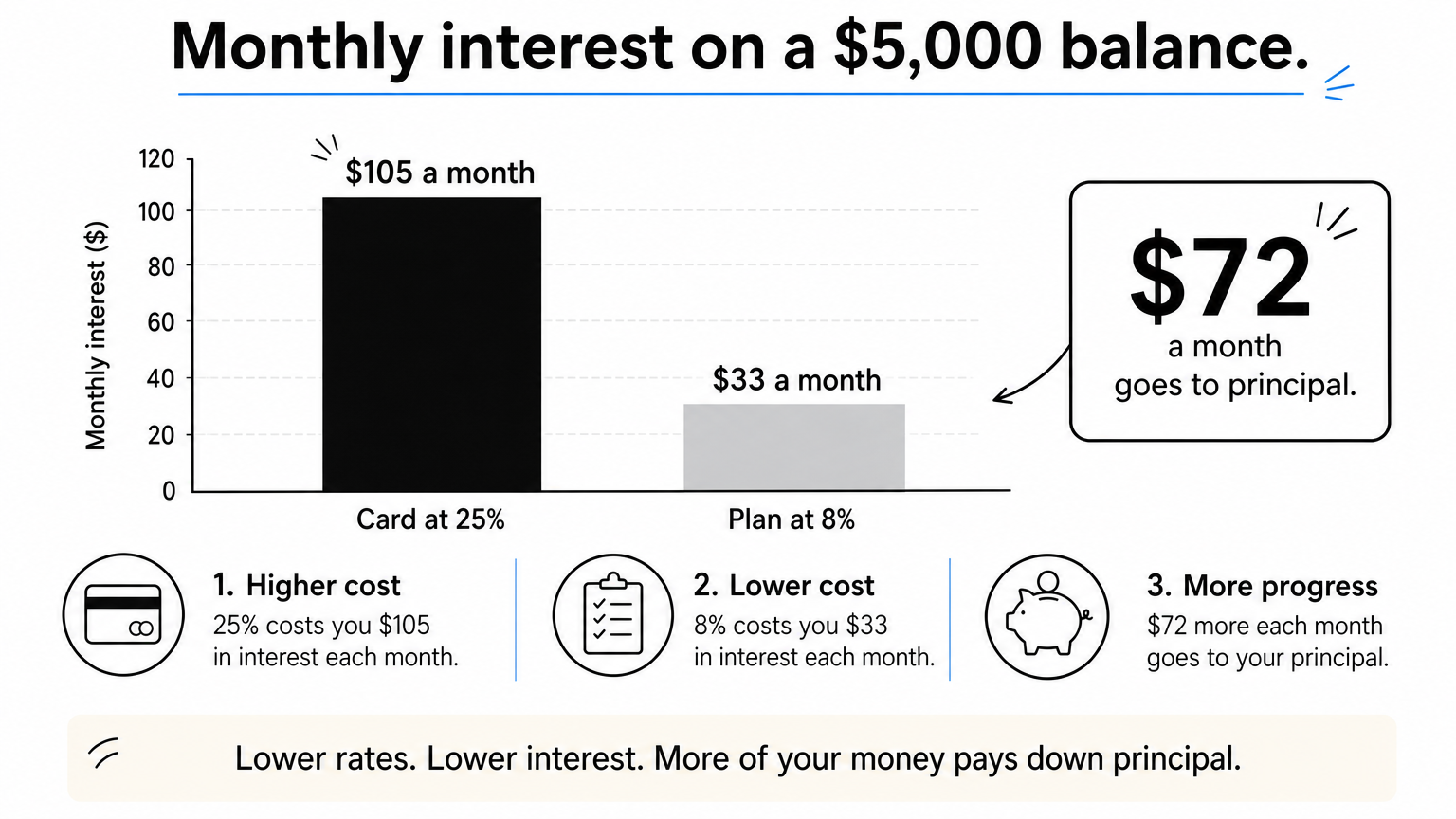
The savings are easy to see. On a $5,000 balance at 25%, interest runs about $105 a month. At 8%, it drops to about $33. That $72 difference goes straight to principal, which is why plans finish in three to five years instead of never.
Who it suits
A DMP fits people with steady income, mostly credit card debt, and no chance at a good loan rate. Your credit score is generally not an enrollment requirement, so people with lower scores often benefit most. You must also be willing to stop using the enrolled cards, because most issuers close them.
If the plan payment does not fit your budget, a good counselor will say so and point you to another option. That honesty is a sign you picked a reputable agency.
A good plan lowers your interest rate and your payment, and a good agency tells you when it is not the right fit.
Cost and credit impact
Agencies typically charge a setup fee and a monthly fee. Ask for the fee schedule in writing before you enroll. Confirm the agency is a nonprofit, accredited by the National Foundation for Credit Counseling, and authorized to operate in New York through the state Department of Financial Services.
Enrolling does not lower your score by itself. Closed cards reduce your available credit and can shorten your average account age, so expect a small early dip. On-time payments rebuild the score over the life of the plan. If you quit, issuers can restore your original rates.
5. Debt consolidation loan or balance transfer card
Among debt relief programs New York lenders sell, consolidation is the one that works only if your credit is still decent. You replace several high-rate card balances with one lower-rate payment through debt consolidation, either with a personal loan or a 0% balance transfer card.
How it works
With a consolidation loan, the lender sends money to pay off your cards, and you repay the loan at a fixed rate over a fixed term. With a balance transfer card, you move balances to a new card that charges little or no interest for a promotional period, then pay it off before the regular rate kicks in. The two products compare like this:
| Feature | Consolidation loan | Balance transfer card |
|---|---|---|
| Rate | Fixed APR set by your credit | 0% intro APR, commonly 12 to 21 months |
| Fees | Origination fee on some loans, often 1% to 10% | Transfer fee, commonly 3% to 5% |
| Term | Usually 2 to 7 years | Pay off before the promo ends |
| Risk | Cards stay open and can be run up again | Rate jumps after the promo period |
Who it suits
Consolidation suits borrowers with a score around 670 or higher, stable income, and the discipline to leave the cards alone. Lenders price risk, so better credit gets a lower rate, and a loan only helps when its APR is clearly below what you pay now.
It does not suit you if overspending caused the debt. Then you end up owing the loan and a fresh card balance. If your score is lower, a loan may cost nearly as much as the cards, so item 4 is the better path.
Consolidation moves debt to a cheaper place, but it only works if the old cards stay quiet.
Cost and credit impact
Applying causes a hard inquiry, which usually costs a few points. Paying off the cards cuts your utilization, which often lifts your score within a few months, as long as you pay on time.
Do the math before you accept: add fees to the interest and compare the total with your current payoff path. For a transfer card, divide the balance by the promo months to see the monthly payment that clears it in time.
6. Nonprofit credit card debt forgiveness
For people who cannot repay in full, nonprofit forgiveness programs are among the more unusual debt relief programs NYC residents may be offered. Participating creditors agree up front to accept a portion of the balance, commonly 50% to 60%, paid over a fixed schedule, often 36 months.
How it works
A nonprofit credit counseling agency presents your case to participating issuers. If they agree, you make fixed monthly payments for 36 months, usually with no interest charged while you pay on time. You cannot skip payments or extend the term. A missed payment can cancel the arrangement.
Not every agency or issuer participates, and programs typically expect your accounts to be seriously behind already. Ask exactly which of your creditors are included before you commit, because a plan that covers two of five cards leaves you with three open problems.
Who it suits
This is for people with overwhelming card balances and income that cannot support a full repayment plan, but who still have enough to make a fixed payment every month. It compares with for-profit settlement, which is covered in item 7. The nonprofit version offers more certainty because creditors agree to terms before you start, instead of after years of negotiation.
It does not suit you if your income is unstable, since one missed payment can end the deal. It is also limited to unsecured card debt.
The appeal here is certainty: terms are agreed before you pay, not guessed at after years of saving.
Cost and credit impact
You still carry credit damage. Accounts already past due keep their late-payment history, and settled accounts are reported as settled for less than owed, which lenders read as a negative. Late payments can stay on your report for up to seven years.
Taxes matter too. The IRS may treat canceled debt of $600 or more as income, though exceptions such as insolvency exist. Talk to a tax professional before you finish the program.
7. For-profit debt settlement
For-profit debt settlement for credit cards is the riskiest of the mainstream debt relief programs NY residents get pitched. A company negotiates with your card issuers to accept a lump sum smaller than the balance, but you pay for it in credit damage, collection activity, and fees.
How it works
You stop paying your cards and deposit a monthly amount into a dedicated account. After two to three years, the company tries to settle each debt for a lump sum from the account. Issuers are under no obligation to accept, and some refuse to work with settlement firms at all.
Meanwhile, late fees and interest keep growing, and you may get collection calls or a lawsuit. Under the FTC’s Telemarketing Sales Rule, a company that sells debt relief by phone cannot charge fees before it settles at least one of your debts and you have made a payment toward that settlement. A firm that asks for upfront fees is breaking the rule.
Who it suits
Settlement is for people with large unsecured balances and real hardship who have been told by a nonprofit that a DMP will not fit and who want to avoid bankruptcy. You must be able to stomach months of delinquency and the risk of being sued.
For most readers it should come after items 1, 4, and 6. Ask a counselor to compare it with a plan that keeps your accounts current.
Settlement can work for large debts, but most people are better served by a nonprofit option that keeps them out of delinquency.
Cost and credit impact
Fees commonly run 15% to 25% of enrolled or settled debt, so a "50% settlement" is smaller after you add fees, penalties, and interest. Your credit takes a serious hit, and the delinquencies remain on your report for seven years. As with item 6, canceled debt over $600 may count as taxable income.
Before you sign, check the company’s complaint history with state regulators and the Consumer Financial Protection Bureau, and read the contract line by line.
8. Bankruptcy
Bankruptcy is the last resort among debt relief programs NYC residents can use, but it is a legitimate legal tool, not a moral failing. It can eliminate most credit card debt and stop collection, in exchange for long-lasting credit damage.

How it works
Most individual filers choose one of two chapters:
- Chapter 7 sells non-exempt assets to pay creditors, then discharges eligible debts. Most filers keep their property, because exemptions protect essentials such as a primary home, a car, and retirement funds, within limits. Cases typically close in a few months.
- Chapter 13 lets you keep your assets while repaying part of your debt through a court-approved plan over three to five years.
In New York City, cases are filed in the federal bankruptcy courts: the Southern District covers Manhattan and the Bronx, and the Eastern District covers Brooklyn, Queens, and Staten Island. You must complete credit counseling from an approved agency before filing.
Who it suits
Bankruptcy fits people who cannot repay their debts within about five years, or who face lawsuits, garnishment, or repossession. A bankruptcy attorney can run the numbers, apply New York’s exemptions to your assets, and tell you which chapter you qualify for. Many offer a free first consultation, and legal services organizations help low-income New Yorkers.
It is a poor fit if your debt is manageable with a DMP, since bankruptcy leaves a heavier mark than any other option here.
Bankruptcy is a tool, and the right time to see an attorney is before the garnishment starts, not after.
Cost and credit impact
Expect a court filing fee of a few hundred dollars plus attorney fees. Low-income filers can ask the court about paying in installments or seeking a waiver in Chapter 7. Your credit score may drop 100 to 200 points, though the effect fades with time and good habits.
A Chapter 7 stays on your credit report for up to 10 years, and a Chapter 13 for up to seven. Student loans are rarely discharged, so item 2 still matters.
How to choose the right program for you
Choose by matching three things: your credit score, your monthly cash flow, and how far behind you are. Using any of these debt relief programs is a good idea when the fit is right and the provider is a nonprofit or licensed professional. It is a bad idea when the fit is wrong or a company wants money before it does anything.
Quick decision guide
Use this list to find your starting point:
- Credit around 670 or higher, income steady: hardship plan, then consolidation loan or balance transfer card.
- Lower credit, income steady, mostly card debt: nonprofit debt management plan.
- Behind on payments, income limited: nonprofit forgiveness program, or a bankruptcy consultation.
- Student loans in trouble: EDCAP, then your servicer.
- Not sure: a free session with a Financial Empowerment Center.
Side-by-side comparison
| Program | Best fit | Typical timeline | Main drawback |
|---|---|---|---|
| Financial Empowerment Center | Anyone starting out | One or more sessions | Advice only |
| EDCAP | Student loan borrowers | Varies by loan | Not for card debt |
| Hardship plan | Short-term setbacks | Often 6 to 12 months | Issuer sets terms |
| Debt management plan | Lower credit, steady income | 3 to 5 years | Cards usually closed |
| Consolidation loan or transfer card | Good credit | 2 to 7 years, or the promo period | Needs discipline |
| Nonprofit forgiveness | Overwhelming balances | About 36 months | Limited participation |
| For-profit settlement | Large debt, real hardship | 2 to 3 years | Fees and credit damage |
| Bankruptcy | Cannot repay in 5 years | Months to 5 years | Longest credit impact |
Questions to ask before you enroll
Ask every provider the same questions, and walk away from anyone who dodges them:
- What are the total fees, and when are they charged?
- Is the organization a nonprofit, and is it authorized in New York?
- Which of my debts are included?
- What happens to my credit and taxes?
- What do I owe if I quit?
Whatever the program, get fees and terms in writing before you hand over a dollar or a bank account number.
Red flags and your rights with debt collectors
The surest sign of a bad deal is a request for money before any service is delivered. Whatever debt relief programs NYC advertisers push, you have legal rights, and knowing them keeps you from paying a scammer or a collector who has overstepped.
Warning signs of a debt relief scam
Walk away if you see any of these:
- A fee demanded before any debt is settled
- A guarantee that your debt will be erased or that you will be approved
- Claims of a special "government" or "federal" forgiveness program
- Pressure to decide today, or to stop talking to creditors without an explanation of the consequences
- No written contract, or one you are not allowed to take home
Also be wary of anyone who asks you to wire money or pay with gift cards. Legitimate lenders and agencies do not.
What collectors cannot do
Federal law bars collectors from calling before 8 a.m. or after 9 p.m., using obscene language, threatening violence, or harassing you with repeated calls. They cannot threaten you with arrest for unpaid consumer debt. If a collector contacts you about a debt you do not recognize, request written verification within 30 days of first contact, and they must provide it.
New York adds protections. Collectors cannot tell your employer about the nature of your debt before getting a judgment. Keep records of every call, and send disputes in writing, by certified mail if possible.
What to do if you are sued
Respond. Ignoring a summons can lead to a default judgment, which opens the door to wage garnishment or a bank account freeze. Check the filing date against New York’s three-year statute of limitations, and do not admit the debt or make a payment until you know whether the clock has run out. Many legal services organizations in New York City help low-income defendants, and your Financial Empowerment Center counselor can point you to one. You can also file complaints with the Consumer Financial Protection Bureau, the New York Department of Financial Services, or the state Attorney General.
If a collector or a company breaks the rules, the best response is a paper trail, not a phone argument.
Where to start
Free, unbiased advice comes first, and paid or risky options come last. Book a session with a city Financial Empowerment Center, call your issuer about a hardship plan, and compare a nonprofit debt management plan with a consolidation loan. Treat settlement and bankruptcy as tools for specific situations, not shortcuts. Whichever of these debt relief programs NYC offers you pick, get the fees and terms in writing, and never pay upfront.
You do not have to solve everything in one call. Pick the first step that matches your situation, take it, and reassess in a month. For more plain-English guidance on balance transfers, consolidation loans, and rebuilding your score, or on how to get out of credit card debt for good, browse the guides at Credit Card Solution.