
You want to raise credit score 100 points overnight, and honestly, nobody can promise that. But before you close this tab, here’s the truth: real, fast jumps of 50 to 100 points do happen, just not while you sleep. They happen because someone finds the exact error or leverage point dragging their score down and fixes it within days or weeks, not months.
So how fast can you raise your credit score for real? If you have thin, isolated damage like one maxed-out card or a single reporting error, you can sometimes see 50 to 100 points in 30 to 60 days once the bureaus update. If your credit history has years of missed payments or collections, expect a slower climb measured in months, not days. The gap between those two outcomes comes down to which levers you pull first.
This list covers nine tactics that actually move the needle: disputing errors, timing your balance paydowns around statement dates, requesting credit line increases, and more. Each one includes what kind of score jump to realistically expect and how long it takes to show up on your report.
1. Dispute errors on your credit reports
Errors on credit reports are more common than most people think. A 2012 FTC study found that one in five consumers had an error on at least one of their three credit reports, and one in twenty had an error significant enough to affect loan terms. If you’ve never pulled your own reports, this is the first place to look before trying anything else, and it’s often the fastest legitimate path to answering how to raise your credit score by 100 points.
How it works
Start by pulling your reports from all three bureaus at AnnualCreditReport.com, the only site authorized by federal law for free weekly reports. Go line by line looking for accounts that aren’t yours, balances reported higher than reality, accounts marked late when you paid on time, or old debts that should have aged off after seven years. Once you spot something wrong, file a dispute directly with the bureau reporting it (Equifax, Experian, or TransUnion) online, by mail, or by phone, and it helps to follow a correct credit dispute letter sample when you mail it in. Include copies of supporting documents like payment confirmations or account statements. The bureau has 30 days under the Fair Credit Reporting Act to investigate and respond.
Here’s a quick reference for what typically needs fixing and where:
| Error type | Where to dispute | Typical resolution time |
|---|---|---|
| Wrong balance or limit | Bureau + creditor | 15-30 days |
| Account not yours (fraud/mixed file) | All three bureaus | 30 days |
| Late payment reported in error | Bureau + creditor | 30 days |
| Debt older than 7 years still listed | Bureau | 30-45 days |
How many points it can add
This is the tactic most likely to deliver an actual overnight-feeling jump. If the error involves a false late payment, a duplicate collection account, or someone else’s debt mixed into your file, correcting it can add 50 to 100 points within a single reporting cycle once the bureau confirms the fix. Smaller errors, like a slightly wrong balance, might only move you 10 to 20 points. The size of the jump depends entirely on how much weight that specific error carried in your score calculation, since payment history alone makes up 35% of your FICO score.
The fastest 100-point jumps almost always start with someone finding a mistake, not a magic trick.
Who it’s best for
Disputing errors works best if you suspect identity theft, went through a bankruptcy or debt settlement where accounts weren’t updated correctly, or simply haven’t checked your reports in over a year. It’s less useful if your reports are accurate and your score is low because of genuine missed payments or high balances. If you’re unsure whether an error is driving your score down or you’re dealing with a mix of real delinquencies, our look at whether credit repair services are reliable walks through when to handle disputes yourself versus when professional help is worth the cost.
2. Pay down your credit card balances
Credit utilization, the percentage of your available credit you’re actually using, makes up 30% of your FICO score, second only to payment history. If you’re carrying balances anywhere near your limits, this is often the single fastest lever you can pull when you want to raise credit score 100 points without waiting on a dispute investigation. Unlike error correction, this method works even when everything on your report is accurate.
How it works
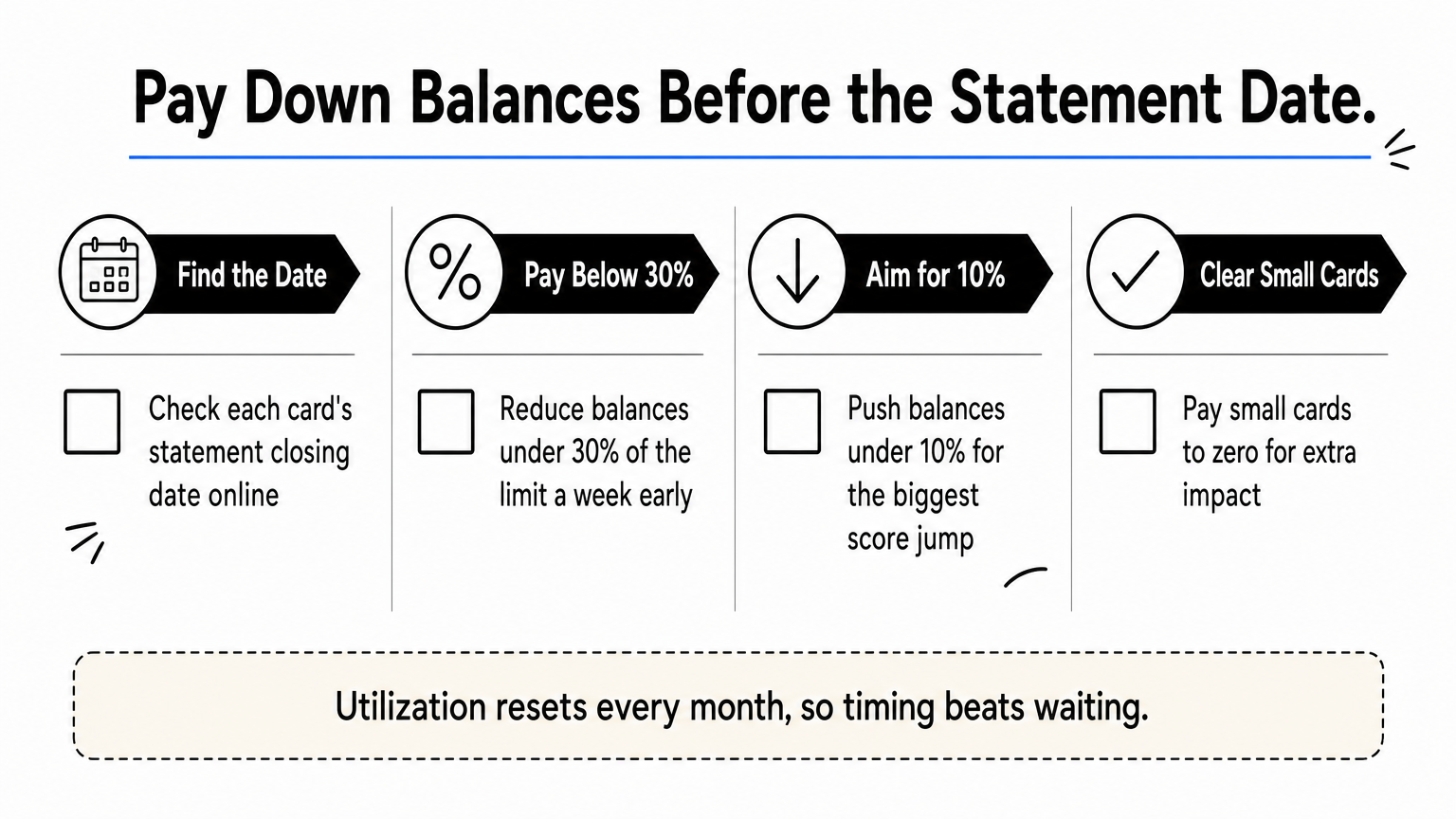
Pay your balances down before your statement closing date, not just before the due date. Card issuers report your balance to the bureaus on the statement date, so a payment made after that date won’t show up until the next cycle. To get the fastest result:
- Check each card’s statement closing date (not the due date) in your online account
- Pay balances down to under 30% of the limit at least a week before that date
- For the biggest jump, aim for under 10% utilization on every card
- Pay off small cards completely if you can, since a $0 balance on one account helps more than a partial paydown across several
How many points it can add
Someone maxed out on a single card who pays it down to 9% utilization can genuinely see 50 to 100 points within one billing cycle, which is why this tactic shows up constantly in searches for how to raise credit score 100 points in 30 days. Smaller reductions, like going from 60% to 40% utilization, typically add 15 to 30 points.
Utilization updates faster than almost anything else on your report, because it resets every month with your statement.
Who it’s best for
This works best for people with real income or savings to throw at the balance, not those relying on new credit to shuffle debt around, so it pairs well with a plan for paying off credit card debt fast. If your balances are too high to pay down quickly, one of the best credit cards for balance transfers can buy you the breathing room to get there.
3. Ask for a credit limit increase
Raising your available credit without adding a single dollar of new debt is one of the quietest ways to drop your utilization ratio overnight. Since credit utilization compares your balance to your limit, a bigger limit shrinks that percentage even if you never touch the new credit. This tactic often gets overlooked by people asking how to raise credit score by 100 points because it feels too easy to actually work.
How it works
Call your card issuer or use the online request form and ask for a credit limit increase on an existing card. Many issuers, including Chase, Citi, and Discover, let you request this directly through your account dashboard without a hard inquiry. Some approve increases automatically after 6 to 12 months of on-time payments. Be direct about your reason (lowering utilization, planning a large purchase) and mention your income if it’s grown since you opened the account, since issuers weigh your ability to repay.
How many points it can add
Doubling your limit on a card carrying a $4,000 balance against a $5,000 limit (80% utilization) down to 40% can add 30 to 60 points within one statement cycle. Stack a limit increase across two or three cards and you can realistically stack your way toward the full 100-point goal, or further if you’re aiming to raise my credit score 300 points, especially when combined with the paydown strategy above.
A higher limit lowers your utilization instantly, without you spending or paying off a single extra dollar.
Who it’s best for
This move suits people with a solid payment history but balances that crept up over time relative to their original limits. It’s not for anyone tempted to spend up to the new ceiling, since that erases the benefit fast. If your income has recently increased or you’ve had the card over a year without a limit bump, getting credit card approval for the increase is easy and this belongs near the top of your list.
4. Become an authorized user on someone else’s card
Borrowing someone else’s good credit habits sounds almost too easy, but it’s a legitimate tactic that’s helped plenty of people looking for how to raise their credit score by 100 points without opening a single new account of their own. When a family member adds you as an authorized user on their card, that account’s entire history, including its age and payment record, can start showing up on your credit report within weeks.

How it works
Ask a parent, spouse, or close relative with a long-standing card in good standing to add you as an authorized user. You don’t need to ever use the card or even carry the physical card in your wallet. Most issuers, including Capital One, Chase, and Amex, report authorized user accounts to all three bureaus automatically, usually within one to two billing cycles. Before you ask, confirm two things:
- The card issuer actually reports authorized user activity to the bureaus (not all of them do)
- The primary cardholder has a clean payment history and low utilization on that card
Adding yourself to a card with high balances or late payments will drag your score down instead of up.
How many points it can add
If the card is old (10+ years), has a low balance, and has never been late, you can see 20 to 45 points within one to two months once it reports. Stack two or three well-aged authorized user accounts and you can get meaningfully closer to that 100-point target, especially if you’re just starting to build credit.
Someone else’s decade of on-time payments can become part of your credit story almost overnight.
Who it’s best for
This works best for people with a thin credit file, like young adults or recent immigrants, who want to build a credit score in 6 months rather than years. It’s less useful if you already have several years of accounts, since one added tradeline won’t move the needle as much.
5. Report rent, utility, and phone bills with Experian Boost
Most credit scores ignore your rent, phone, and utility payments entirely, even if you’ve paid them on time for years. Experian Boost changes that by letting you add those payment records directly to your Experian file, and it’s free. If you’re wondering how to raise your credit score by 100 points without touching a credit card at all, this is one of the few tactics that adds brand-new positive history instead of just fixing or shrinking existing debt.
How it works
Sign up at Experian’s website and connect the bank account or accounts you use to pay rent, utilities, streaming services, and phone bills. The tool scans your transaction history and identifies recurring payments it can verify as on-time. You choose which ones to add, and Experian updates your file within minutes. Unlike most credit changes, this one only affects your Experian-based score, not TransUnion or Equifax, so lenders pulling those bureaus won’t see any difference.
How many points it can add
Experian reports that most users see an increase, with many gaining 13 points or more the moment eligible payments post, according to Experian’s own published data. People with thin files or lower starting scores tend to see the biggest jumps, sometimes 20 to 40 points, since a few months of rent payments can meaningfully pad a short credit history. It won’t single-handedly get you the full 100 points, but it stacks well with the other tactics on this list.
A payment you’ve already made can still boost your score, if you just tell the bureau about it.
Who it’s best for
Boost suits renters, especially those without much other credit history, and anyone whose phone or utility bills have been paid faithfully for years without credit getting the benefit. It’s less useful if you’re already carrying several well-aged credit cards, since the added points shrink as your file thickens.
6. Negotiate a pay-for-delete on old collections
Old collection accounts can sit on your report for up to seven years, dragging your score down long after you’ve moved on financially. A pay-for-delete agreement asks the collection agency to remove the account entirely in exchange for payment, rather than just marking it as paid. It’s not guaranteed, and it’s not officially sanctioned by the credit bureaus, but plenty of readers researching how to raise credit score 100 points have used it successfully on smaller, independently owned collection agencies.

How it works
Call the collection agency (not the original creditor) and use basic credit card debt negotiation tactics: offer to pay the debt in full, or a negotiated partial amount, if they agree in writing to delete the tradeline from all three bureaus. Get everything in writing before you send a single dollar. Some agencies refuse outright, since major creditors sometimes bar deletion requests in their contracts, but smaller debt buyers are often willing to negotiate:
- Ask for the deletion agreement in writing before paying
- Offer a lump sum rather than a payment plan, since agencies prefer certainty
- Send payment by certified mail or a traceable method
- Follow up in 30 days to confirm the deletion actually posted
How many points it can add
Removing a collection account entirely can add 30 to 100 points, depending on how recent it is and how much other negative history surrounds it. A single old collection removed from an otherwise clean file tends to deliver the biggest jump, sometimes within one reporting cycle.
A collection account you actually paid off does you no favors if it’s still sitting on your report unresolved.
Who it’s best for
This tactic suits anyone with one or two isolated collections, especially medical debt or small unpaid balances sold to third-party agencies, and the same approach applies when you’re working out how to remove a charge off from your credit report. It’s less reliable for collections tied to major banks that prohibit deletion clauses, so check the agency type before you negotiate.
7. Catch up on past-due and delinquent accounts
A late payment sitting on your report right now does more damage than almost anything else in your credit file, since payment history carries 35% of your FICO score. Getting current on any account that’s past due is one of the most direct answers to how to raise your credit score by 100 points if delinquency is what’s dragging you down in the first place. Bringing an account back to good standing doesn’t erase the late mark from your history, but it stops the bleeding and starts the clock on recovery.
How it works
Call every creditor showing a past-due account and ask what it takes to bring the account current, not just what the minimum payment is. Many issuers will remove a single late fee or even ask their goodwill adjustment team to consider deleting a one-time late mark if you’ve otherwise paid reliably for years. Set up autopay immediately after catching up so you don’t repeat the cycle. If you’re 90 or more days behind, prioritize accounts closest to falling into collections first, since that’s a much steeper score hit once it happens.
How many points it can add
Catching up on a single 30-day late payment before it worsens can preserve 20 to 40 points you’d otherwise lose. If you already have multiple delinquencies and clear even one, expect smaller but real gains of 10 to 25 points per resolved account as your payment history slowly rebuilds.
The fastest way to stop losing points is to stop being late, even one payment at a time.
Who it’s best for
This tactic fits anyone currently juggling multiple past-due accounts or facing the threat of a collections referral, where the priority is simply to not let your credit score drop further. It’s a foundation move, not a quick trick, so pair it with the other tactics here once you’re current.
8. Keep your oldest credit cards open
Length of credit history makes up 15% of your FICO score, and it’s the one factor you can’t speed up with a phone call or a payment. Closing your oldest card doesn’t erase its history immediately, but it starts an aging clock that eventually shrinks your average account age. If you’re trying to figure out how to raise your credit score 100 points, this tactic is less about adding points fast and more about not accidentally losing them.
How it works
Resist the urge to close a card just because you stopped using it or switched to a better rewards card. Instead, follow the basic tips for using a credit card and put a small recurring charge, like a streaming subscription, on your oldest card with autopay so it stays active without you thinking about it. Check whether the issuer charges an annual fee; if it does, call and ask about downgrading to a no-fee version rather than closing the account entirely. Keeping the account open preserves both its age and its available credit limit, which also helps your utilization ratio.
How many points it can add
Keeping an old card open won’t hand you a sudden 50-point jump. But closing one can quietly cost you 10 to 30 points over the following months as your average account age drops and your total available credit shrinks. Avoiding that loss is effectively the same as gaining points elsewhere.
Protecting the points you already have is just as valuable as chasing new ones.
Who it’s best for
This matters most for anyone with a card older than five years, especially your very first one, since it anchors your credit history’s average age. It’s also worth prioritizing if you want to maintain good credit ahead of a mortgage or auto loan application in the next year or two, when lenders scrutinize account age closely.
9. Request rapid rescoring before a big loan
Most of the tactics on this list take weeks to show up because standard credit bureau processing follows its own slow schedule. If you’re about to close on a mortgage or auto loan and just paid down a balance or corrected an error, a rapid rescore can get that update reflected in days instead of a full billing cycle. It’s the closest thing to an actual overnight fix, but it’s only available through a mortgage lender, not something you can request yourself directly from the bureaus.
How it works
Your loan officer or mortgage broker submits documentation, like a paid-down balance statement or a dispute resolution letter, to the bureaus through a specialized rapid rescoring service. The bureaus verify the update and repost your file, usually within 3 to 5 business days instead of the standard 30 to 45. There’s typically a fee per account rescored, often $25 to $50, which the lender passes along to you. This only works for verifiable, already-resolved changes, not disputes still under investigation.
How many points it can add
Because rapid rescoring just speeds up an update that would eventually happen anyway, the point gain matches whatever triggered it. Paying down a maxed-out card before a rescore can still deliver 50 to 100 points, just compressed into under a week instead of a month.
Rapid rescoring doesn’t create new points, it just delivers points you already earned faster than the calendar normally allows.
Who it’s best for
This tactic fits anyone mid-mortgage-application whose loan officer flags a score just short of the next rate tier in the standard credit score ratings. It’s not available to consumers browsing for how to raise a credit score 100 points on their own timeline, since only lenders can request it.
Keeping Your Score Moving in the Right Direction
None of these nine tactics require magic, just the right lever pulled at the right time. Getting your score up 100 points overnight isn’t realistic, but 50 to 100 points in 30 to 60 days is achievable when you stack a few of these together, like disputing an error while paying down utilization and asking for a limit increase in the same month. Real gains come from fixing what’s actually wrong in your file, not from gimmicks or paid "quick fix" services promising results they can’t deliver.
Your next move is simple: pull your three credit reports this week and figure out which of these nine tactics matches your situation. If disputes, negotiated settlements, or a structured debt payoff plan feel overwhelming to tackle alone, see the best credit score improvement services to raise your score fast and pick the one that fits your credit and your timeline.