
Pennsylvania carries its own rules around debt collection, statutes of limitations, and consumer protections, so what works for a friend in Ohio or the Texas debt relief programs you’ve read about won’t always apply to you. If you’re staring at credit card statements with 22% APR and wondering where to turn, searching for debt relief programs pennsylvania is the right first move, but the results usually mix legitimate nonprofits with debt settlement outfits charging steep fees for shaky promises.
This article breaks down the real pa debt relief programs available to you right now: nonprofit credit counseling agencies accredited to operate in the state, debt management plans that can cut your interest rates without touching your loan principal, and the consolidation loan and balance transfer options that make sense depending on your credit score.
You’ll also get a clear look at debt settlement warnings specific to Pennsylvania consumers, since that industry attracts more complaints here than almost any other debt relief category. By the end, you’ll know which debt relief programs in pa actually fit your income, your credit standing, and how fast you want to be debt free, instead of guessing based on a radio ad.
Why Pennsylvania residents turn to debt relief programs
Most people don’t search for debt relief programs pennsylvania because they overspent on vacations. They search because a medical bill, a layoff, or a rate hike turned a manageable balance into something that grows faster than they can pay it down. Pennsylvania’s mix of aging manufacturing towns, expensive healthcare markets in Philadelphia and Pittsburgh, and stagnant wage growth in smaller cities like Scranton and Erie means a lot of households are carrying credit card debt that outpaces their paychecks. Add a 22% to 29% APR on top of that, and you’ve got a balance that can double in under four years just from interest, even if you stop swiping the card entirely.
The math behind the minimum payment trap
Credit card issuers set minimum payments low on purpose, usually 1% to 3% of the balance plus interest, because it keeps you in debt longer while they collect more in finance charges. Minimum payments feel manageable month to month, which is exactly the problem: they hide how little progress you’re actually making.

A $6,000 balance at 24% APR, paid at the minimum, can take over 15 years to clear and cost more than $7,000 in interest alone.
Here’s how that plays out with a typical Pennsylvania household balance:
| Starting balance | APR | Minimum payment | Time to pay off | Total interest paid |
|---|---|---|---|---|
| $4,000 | 22% | ~$100/mo | 6 years | $2,900 |
| $6,000 | 24% | ~$150/mo | 8+ years | $5,600 |
| $10,000 | 26% | ~$250/mo | 12+ years | $11,800 |
Those numbers explain why so many Pennsylvanians eventually look past minimum payments toward something structured, like a debt management plan or consolidation loan, that actually shortens the timeline.
Medical debt and job disruption hit harder here
Pennsylvania’s healthcare costs run above the national median in several counties, and a single ER visit or surgery without full coverage can land a family with a bill in the thousands. Job losses tied to manufacturing contraction in the Lehigh Valley and parts of western PA add another layer, since credit cards often become the bridge between paychecks. When both hit at once, a household that was current on every bill six months ago suddenly finds itself juggling three or four cards near their limits, which is exactly the scenario nonprofit credit counseling agencies are built to handle.
Pennsylvania’s legal timeline makes waiting expensive
Unlike some states with shorter windows, Pennsylvania gives creditors up to four years to sue on most credit card debt, but once they win a judgment, that judgment can be renewed and enforced for up to 20 years. That’s not a typo. A creditor who sues you today and wins can attach that judgment to your finances for two decades, including wage garnishment in certain circumstances and liens against property you buy later. Residents who understand this tend to act sooner rather than waiting for a collection call to escalate into a courtroom summons, because the earlier you enroll in a debt relief program, the more leverage you keep.
Why nonprofit options specifically gain traction in PA
Given the state’s consumer protection statutes and its active Attorney General’s office pursuing debt settlement complaints, Pennsylvania residents lean toward accredited nonprofit agencies more than the national average. These agencies, certified through organizations like the National Foundation for Credit Counseling, negotiate directly with your creditors for reduced interest rates rather than telling you to stop paying altogether. That distinction matters in a state where debt settlement companies have drawn repeated scrutiny for charging upfront fees while advising clients to default, a practice that can trigger the very lawsuits residents are trying to avoid. If you want a full breakdown of how those settlement warnings apply specifically to Pennsylvania consumers, keep reading, because the next sections walk through exactly what separates a legitimate debt relief programs pa option from one built to profit off your desperation.
How to choose the right debt relief option for you
Picking the right path starts with an honest look at three numbers: your credit score, your total unsecured debt, and how much you can realistically pay each month. Debt relief programs in pa aren’t one-size-fits-all, and knowing what debt relief programs are and how to choose one matters, since the option that saved your coworker $400 a month might bury you deeper if your credit profile doesn’t match theirs. A 720 credit score opens doors to 0% balance transfer cards that a 580 score never will, while someone with $30,000 in credit card debt across six accounts usually needs a debt management plan or consolidation loan, not a single new card with a $5,000 limit.
Start with your credit score and total debt
Before you call anyone, pull your credit report for free at AnnualCreditReport.com and add up every credit card balance you’re carrying. This gives you a real starting point instead of a guess, and it determines which programs will even approve you. Use this as a rough filter:
| Credit score range | Total debt | Best-fit option |
|---|---|---|
| 700+ | Under $10,000 | Balance transfer card |
| 650-720 | $5,000-$25,000 | Personal consolidation loan |
| Below 650 | Any amount | Nonprofit debt management plan |
| Below 600 | $15,000+ | Debt management plan or bankruptcy consultation |
That table isn’t a guarantee of approval, since lenders weigh income and existing debt-to-income ratio too, but it narrows your search fast and keeps you from wasting weeks applying for products you won’t qualify for.
Match your income and timeline to the right program
Next, be realistic about your monthly budget and how fast you actually want out of debt. Debt consolidation loans typically demand a fixed payment for three to five years, which works if your income is stable, but it can strain a household with irregular hours or gig income. Debt management plans through nonprofit agencies usually stretch three to five years too, but the payment adjusts based on what creditors agree to, and the agency handles the negotiating for you.
The right debt relief option is the one that matches your actual credit score and income today, not the one with the best commercial.
Ask yourself these questions before committing to anything:
- Can I qualify for a 0% intro APR card, or will fees and a lower limit eat the savings?
- Would a fixed loan payment fit my budget better than a variable one tied to negotiated rates?
- Am I comfortable closing credit cards, which most debt management plans require?
- Do I need debt forgiveness on the principal, or just relief from the interest rate?
Know when to walk away from an offer
Finally, treat any program promising to erase most of your balance in months with heavy suspicion. Genuine pa debt relief programs, whether a consolidation loan or a nonprofit plan, work with math you can verify: a fixed rate, a clear payoff date, and a monthly statement showing your balance actually shrinking. If a company won’t show you exactly how your payment breaks down between principal, interest, and fees, that’s your signal to keep looking rather than sign anything on the spot.
Types of debt relief programs available in Pennsylvania
Once you know your credit score and total debt, the next step is matching yourself to the actual program, not just the category. Pennsylvania residents typically choose from five paths, and each one works differently depending on whether you need lower interest, a shorter timeline, or actual forgiveness of principal.
Nonprofit debt management plans
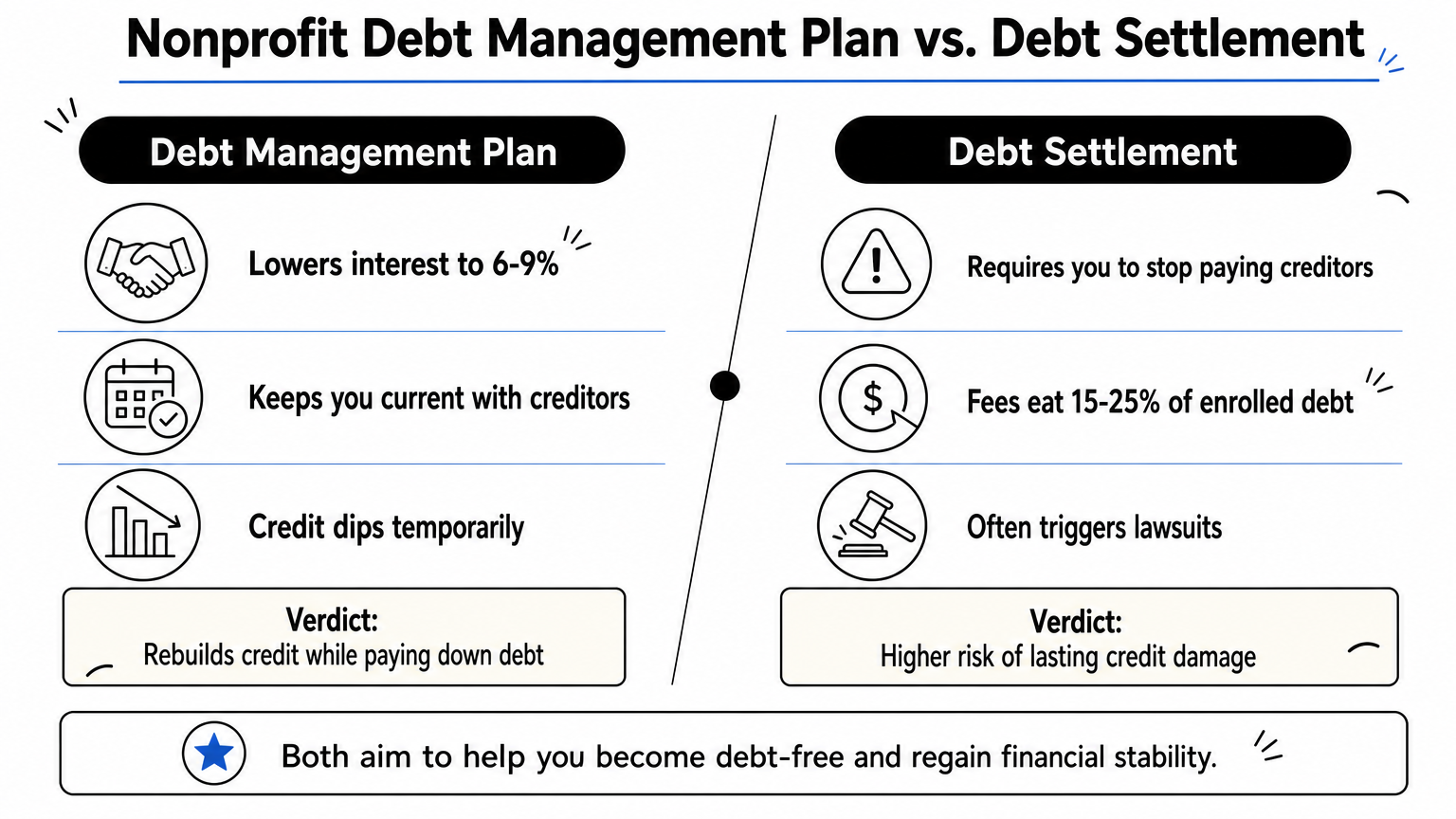
A debt management plan, run through an agency accredited by the National Foundation for Credit Counseling, consolidates your credit card payments into one monthly payment while the agency negotiates lower interest rates with your creditors. Nonprofit credit counseling agencies operating in Pennsylvania typically get rates down to 6% to 9%, compared to the 22%+ you’re paying now, and most plans run three to five years. You’ll usually need to close the credit cards involved, which protects you from adding new debt but does ding your credit utilization ratio temporarily.
Debt consolidation loans
A personal loan that pays off multiple credit cards leaves you with one fixed payment at a lower rate, assuming your credit score qualifies you for decent terms. Debt consolidation loans work best for the 650+ credit score range discussed earlier, since rates below 650 often land near 20% anyway, which defeats the purpose. If you’re weighing this against a balance transfer card, our guide on credit card debt consolidation breaks down which one saves more depending on your balance size.
Balance transfer credit cards
For Pennsylvania residents with a 700+ credit score and under $10,000 in card debt, one of the best credit cards for balance transfers with a 0% intro APR can eliminate interest entirely for 12 to 21 months. The catch is the transfer fee, usually 3% to 5% of the balance, and the fact that any unpaid amount reverts to a high standard APR once the intro period ends.
The card with 0% APR only saves you money if you pay off the balance before the promotional period expires.
Debt settlement
Debt settlement companies negotiate with creditors to accept less than you owe, but they typically require you to stop paying your cards for months while fees accumulate in a separate account. This approach tanks your credit score, often triggers collection lawsuits, and comes with fees that can eat 15% to 25% of your enrolled debt. Pennsylvania’s Attorney General has pursued multiple actions against settlement firms operating in the state, which is worth remembering before you sign anything.
Bankruptcy as a last resort
Chapter 7 or Chapter 13 bankruptcy can discharge or restructure credit card debt, but it stays on your credit report for up to 10 years, so weigh bankruptcy against debt settlement and consult a licensed attorney rather than relying on a DIY search.
Here’s a quick comparison of how these five options actually differ:
| Program | Typical credit score needed | Credit impact | Timeline |
|---|---|---|---|
| Debt management plan | Any | Moderate, temporary | 3-5 years |
| Consolidation loan | 650+ | Minimal if paid on time | 3-5 years |
| Balance transfer card | 700+ | Minimal if paid off | 12-21 months |
| Debt settlement | Any (damaging) | Severe | 2-4 years |
| Bankruptcy | Any | Severe, long-term | 3-5 years (Ch. 13) |
Weigh these against your own numbers before you commit, since the wrong fit costs more than just money, it costs years.
Pennsylvania debt collection laws and your rights
Understanding your legal footing matters just as much as picking a debt relief program, because Pennsylvania gives you specific protections that a debt collector won’t volunteer. Pennsylvania debt collection laws work alongside the federal Fair Debt Collection Practices Act, but the state adds its own layer through the Fair Credit Extension Uniformity Act, which lets the Attorney General’s office pursue collectors who harass, mislead, or misrepresent what you owe. Knowing these rules before you answer a collection call changes the conversation entirely.
The four-year clock and what resets it
Pennsylvania sets a four-year statute of limitations on most credit card debt, counted from your last payment or last activity on the account, not from when the debt originated. Making a partial payment or even verbally acknowledging the debt to a collector can restart that clock, which is why consumer advocates warn against confirming anything on a recorded call before you know your rights. If a collector calls about a balance older than four years, they can still ask you to pay, but they generally can’t sue you successfully once that window closes, though they may try anyway hoping you won’t check.
Never make a payment on old debt before confirming the statute of limitations, since even $5 can restart the clock.
Wage garnishment protections that go beyond federal law
Pennsylvania stands out because it prohibits wage garnishment for most consumer debts, including credit card balances, unless a creditor has already won a court judgment and the debt falls into specific exceptions like child support or certain taxes. State law protections here are stronger than in many other states, where garnishment for ordinary credit card debt is routine once a judgment exists. That said, a judgment creditor in Pennsylvania can still freeze your bank account or place a lien on real property, so a lawsuit is still worth avoiding even if garnishment itself is limited.
Your rights when a collector contacts you
Federal law already bars debt collectors from calling before 8 a.m. or after 9 p.m., threatening you, or contacting your employer about the debt, and Pennsylvania’s Fair Credit Extension Uniformity Act reinforces those rules with state-level enforcement. You have the right to request debt validation in writing, and once you do, collectors must pause collection efforts until they prove the debt is yours and accurate. The Consumer Financial Protection Bureau outlines exactly how to send a validation letter if you’re unsure where to start.
If you get sued, respond
Ignoring a collection lawsuit is the single most common mistake Pennsylvania consumers make, since failing to respond within the required 20 or 30 days (depending on the court) usually results in an automatic default judgment against you. Responding to the summons, even briefly, preserves your right to negotiate the credit card debt, request proof of the debt, or raise the statute of limitations as a defense. If you’re already enrolled in a debt management plan or working toward consolidation, tell the agency immediately if legal papers arrive, since it can affect their negotiations with that creditor.
How to spot and avoid debt relief scams in Pennsylvania
Pennsylvania’s Attorney General has filed multiple actions against debt settlement firms that promised relief and delivered damaged credit instead, so recognizing a scam before you sign a contract matters more than almost any other decision in this process. A debt consolidation scam in this state tends to follow a predictable script: a cold call or slick ad promises to cut your debt in half, asks for an upfront fee, and tells you to stop paying your creditors while the company "negotiates" on your behalf. That advice alone should end the conversation, because legitimate agencies never ask you to default first.

Red flags that signal a scam
Watch for these warning signs whenever a company reaches out about pa debt relief programs, since scammers rely on urgency and vague language to keep you from asking questions:
- Upfront fees charged before any debt is actually settled or reduced
- Guarantees that your debt will drop by a specific percentage, which no honest negotiator can promise in advance
- Pressure to stop communicating with your original creditors entirely
- Refusal to put fee structures and terms in writing before you enroll
- No physical Pennsylvania address or a customer service number that never gets answered
If a company asks for money before it has settled a single account, walk away immediately.
Verify credentials before you sign anything
Credentials separate the agencies that help from the ones that profit off desperation, so check them before you hand over a bank account number. Accredited nonprofit agencies carry certification through the National Foundation for Credit Counseling or the Financial Counseling Association of America, and both organizations let you search their member directories online. Confirm the company is registered to operate in Pennsylvania by checking with the state’s Department of Banking and Securities, and search the company name alongside "complaint" through the Consumer Financial Protection Bureau’s complaint database before committing to anything. A five-minute search here can save you thousands in fees and years of damaged credit.
What to do if you’ve already paid a scam company
Sometimes you find this information after you’ve already enrolled, and if that’s you, act quickly rather than staying quiet out of embarrassment. Filing a complaint with the Pennsylvania Attorney General’s Bureau of Consumer Protection starts a paper trail that regulators use to build cases against repeat offenders, and it may help you recover fees through restitution programs tied to prior settlements. Contact your bank about disputing any recurring charges tied to the company, since many settlement outfits set up automatic withdrawals that continue even after you try to cancel. From there, pivot to a verified nonprofit agency for a fresh assessment of your actual debt relief programs pa options, since the damage from a scam doesn’t disqualify you from a legitimate debt management plan or consolidation loan. Every dollar you stop sending to a fraudulent company is a dollar that can start paying down real debt instead.
Other financial assistance programs for pa residents
Debt relief programs handle credit card balances, but if you’re also behind on utilities, rent, or medical bills, Pennsylvania runs several programs that free up cash for those specific pressures. Financial assistance programs exist alongside debt relief options, and stacking them together often does more for your monthly budget than any single consolidation loan or debt management plan on its own.
Utility and housing assistance
The Low Income Home Energy Assistance Program (LIHEAP) helps Pennsylvania households cover heating bills each winter, and eligibility runs higher than most people assume, often up to 150% of the federal poverty line depending on household size. LIHEAP assistance pairs well with a debt management plan, since freeing up $200 or $300 a month in utility costs gives you more room to hit your DMP payment without falling behind elsewhere. For housing, the Pennsylvania Housing Finance Agency and county-level programs offer emergency rental assistance and mortgage relief for residents who’ve missed payments due to job loss or medical emergencies, which matters if a mortgage delinquency is what pushed your credit cards into overdrive in the first place.
Freeing up utility or rent money through a state program often does more for your monthly budget than negotiating a slightly lower interest rate.
Medical debt and hospital financial assistance
Pennsylvania nonprofit hospitals are required under federal law to offer financial assistance policies, and many will reduce or forgive bills entirely for patients below certain income thresholds, something few consumers ever ask about before the bill goes to collections. Medical debt relief through a hospital’s own charity care program can eliminate the exact balance that’s dragging down your credit utilization, and it costs nothing to apply since hospitals are legally required to screen you regardless of insurance status. Check the hospital’s billing department directly and ask for their Financial Assistance Policy application, since this step gets skipped constantly, even though it can wipe out debt that a settlement company would otherwise charge you a fee to negotiate down.
Food and cash assistance programs
SNAP benefits, the Supplemental Nutrition Assistance Program, and Pennsylvania’s Temporary Assistance for Needy Families (TANF) program exist for households whose income has dropped due to job loss or reduced hours, and qualifying for either frees up grocery money that can go straight toward a debt management plan payment instead. Cash assistance programs like these aren’t a long-term fix, but they buy breathing room during the exact stretch when someone typically falls behind on credit card minimums.
Where to start looking
Use this quick list to find the right office before you assume nothing is available:
- LIHEAP: apply through the PA Department of Human Services or your county assistance office
- Hospital financial assistance: contact the billing department at the hospital directly and ask for their charity care policy
- SNAP and TANF: apply through COMPASS, Pennsylvania’s online benefits portal
- Rental and mortgage assistance: check with the Pennsylvania Housing Finance Agency or your county’s community action agency
Stacking one or two of these programs with a nonprofit debt management plan or consolidation loan often does more to stabilize your finances than chasing a slightly better interest rate ever will.
Finding your own path out of debt
You now know more about debt relief programs pennsylvania than most people do before they sign a contract, and that’s the real advantage here. Your credit score and total balance point you toward a specific option, whether that’s a balance transfer card, a consolidation loan, or a nonprofit debt management plan, and Pennsylvania’s four-year statute of limitations and wage garnishment protections give you leverage most residents never use.
Getting out of debt isn’t about finding a secret program nobody else knows about. It’s about matching the right tool to your actual numbers and avoiding the settlement companies that profit off delay and fear. Start by pulling your credit report, adding up what you owe, and running the math against the tables above before you call anyone.
If you want a step-by-step walkthrough tailored to your situation, read our guide on how to get out of credit card debt and take the next step today.