
When your credit card balances have gone past the point where a balance transfer or a debt management plan can fix things, you’re left with two harder choices. Bankruptcy or debt settlement both promise a way out, but they get you there through very different routes, with different costs and different scars left on your credit report.
The short answer to is debt settlement better than bankruptcy is: it depends on how much you owe, how fast creditors are coming after you, and whether you can survive years of collection calls while you negotiate. Bankruptcy wipes out debt through a court process and stops collections immediately. Debt settlement negotiates your credit card balances down, but you keep dealing with creditors directly (or through a company) until each account settles, and there’s no guarantee every creditor agrees.
This article breaks down the real differences in cost, credit impact, and timeline between the two, so you can see which fits your specific numbers. We’ll walk through when Chapter 7 or Chapter 13 makes more sense than settlement, what settlement actually costs in fees and taxes, and how each option shows up on your credit report years later.
Why this decision matters more than you think
Picking between bankruptcy or debt settlement isn’t like choosing between two credit cards. It’s a decision that follows you for years, shows up on background checks, and shapes what interest rate you’ll pay on your next car loan or mortgage. Too many people treat this choice the way they’d treat picking a debt management plan: something to research for an afternoon and move on. That mindset gets people into trouble, because the wrong choice here can cost tens of thousands of dollars in wasted fees, extra interest, and lost time.

The stakes are higher than a missed payment
Understand this before anything else: bankruptcy stays on your credit report for up to 10 years under Chapter 7, and up to 7 years under Chapter 13, according to the Consumer Financial Protection Bureau. Debt settlement doesn’t carry a fixed timeline in the same way, but each settled account gets marked as "settled for less than owed," and that notation combined with months of missed payments before settlement can drop your score by 100 points or more.
A decision that shapes your credit for the better part of a decade deserves more than a quick Google search and a gut feeling.
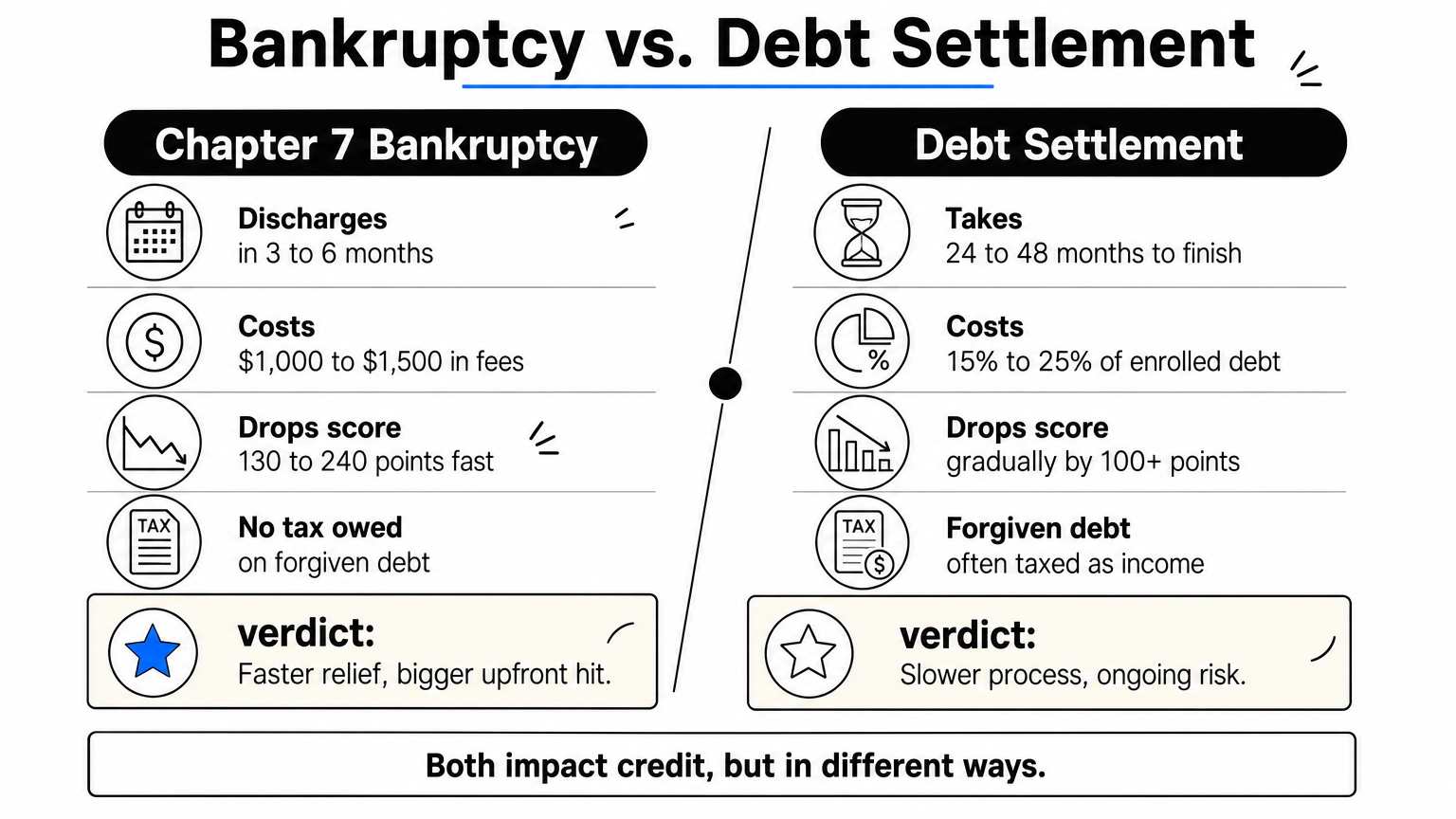
Don’t assume the damage is identical either. Bankruptcy hits your score hard and fast, often 130 to 240 points depending on where you started, but then it stabilizes because there’s a defined end date and a fresh start. Debt settlement drags the pain out over the months or years it takes to negotiate each account, which means your score stays depressed longer even if the total point drop ends up smaller.
What’s actually on the line financially
Money matters just as much as the credit score. Nobody warns people upfront that forgiven debt counts as taxable income in most cases. If a creditor writes off $8,000 of your balance through settlement, the IRS treats that as income you have to report, and you’ll get a 1099-C form the following January. Bankruptcy doesn’t trigger this problem because discharged debt in bankruptcy is excluded from taxable income under federal law.
Legal fees differ too, and they add up fast if you don’t plan for them:
| Cost factor | Chapter 7 bankruptcy | Debt settlement |
|---|---|---|
| Attorney or program fees | $1,000 to $1,500 typical | 15% to 25% of enrolled debt |
| Court filing fee | $338 (2024 rate) | None |
| Tax exposure | None on discharged debt | Forgiven amount often taxable |
| Time to resolution | 3 to 6 months | 24 to 48 months |
Running these numbers before you commit is exactly why our debt consolidation guide walks readers through a full cost comparison first. Ignore this step and you risk paying a settlement company thousands of dollars only to still owe taxes on the debt they "eliminated."
The legal protections you give up or gain
Something people underestimate until it’s too late: automatic stay stops garnishment immediately the moment you file for bankruptcy. Every collection call, every lawsuit, every wage garnishment order freezes the day your case is filed. Creditors have to stop contacting you or face court sanctions.
Settlement offers nothing close to that protection. While you’re saving up funds to negotiate a settlement, debt settlement offers no legal shield against your creditors, and several may still sue you during that window. If a creditor gets a judgment before you settle, they can garnish your wages or freeze your bank account in most states, undoing months of progress in a single court date.
Timing determines which door stays open
Here’s the part people miss until they’re already behind: each state’s statute of limitations on debt collection matters enormously if you’re leaning toward settlement. In some states, that window is only 3 years; in others, it stretches to 10. If you’re closer to that deadline, waiting out settlement negotiations might work in your favor. If you’re nowhere near it, you’re exposed to lawsuits the entire time you’re negotiating.
Once a judgment lands against you, your options shrink fast. Some states let judgment creditors add interest on top of what you already owe, and a judgment can sit on public record for years even after you’ve paid it off. That’s why the timing of your decision, not just the decision itself, often determines whether bankruptcy or debt settlement actually solves your problem or just delays a bigger one.
How to decide which option fits your situation
Deciding between bankruptcy or debt settlement starts with an honest look at your numbers, not with what a debt relief commercial promises. Most people who call our team or read through tips on consolidating debt are looking for a shortcut, but the real answer sits in three questions: how much you owe relative to your income, whether you have assets worth protecting, and how much time you can give the process before creditors escalate. Skip this self-assessment and you’ll likely pick the option that sounds less scary rather than the one that actually fits.
Start with your debt-to-income math
Before anything else, calculate what percentage of your gross monthly income goes toward unsecured debt payments. If that number is above 40%, and you don’t see it dropping in the next year, debt settlement rarely closes the gap fast enough. Settlement companies typically need 24 to 48 months to negotiate all your accounts, and during that stretch you’re expected to save money in a dedicated account instead of paying creditors. If your income can’t cover both living expenses and that savings target, you’re setting yourself up to default on the settlement plan itself.
If your debt-to-income ratio is already unsustainable, bankruptcy resolves the math faster than settlement ever will.
Compare that math against Chapter 7 eligibility. The means test compares your income to your state’s median, and if you fall below it, you likely qualify for a Chapter 7 discharge in a matter of months rather than years. Above the median, Chapter 13 becomes the more likely path, structuring your debt into a 3 to 5 year repayment plan instead of wiping it out entirely.
Look at what you have to protect
Assets change the calculation completely. Bankruptcy exemptions vary by state, and some states let you protect very little beyond basic household goods, while others shield significant home equity or retirement accounts. If you own a home with equity above your state’s exemption limit, or a car worth more than what’s protected, Chapter 7 could force a sale you didn’t expect. Debt settlement, by contrast, doesn’t touch your assets directly, since it’s a private negotiation rather than a court proceeding.
Homeowners in particular need to run this comparison carefully:
- Check your state’s homestead exemption before assuming bankruptcy protects your house automatically.
- List every asset above $1,000 in value, including vehicles, retirement accounts, and valuable personal property.
- Compare that list against your state’s exemption chart, available through your state court’s website or a bankruptcy attorney’s free consultation.
- Estimate what a trustee could sell if any asset falls outside the exemption limits.
Weigh how much time and stress you can absorb
Timing your own tolerance for stress matters just as much as the legal details. Bankruptcy resolves in months and gives you a hard stop, a court date, a discharge order, and a fresh start on a set calendar. Debt settlement stretches out over years, and during that time you’re likely still fielding collection calls, watching your credit score sit at rock bottom, and hoping every creditor eventually agrees to a deal instead of suing you first.
Ultimately, matching your situation to the right option means being honest about your income trajectory, your assets, and your capacity to wait out a slower process. Readers weighing a debt management plan through credit counseling against these two heavier options should revisit our broader debt consolidation guide before committing to either path, since the fit depends entirely on numbers only you can run.
Comparing costs, timelines, and credit impact
Numbers tell the story better than any sales pitch. When you line up bankruptcy versus debt settlement side by side, three factors decide which one actually saves you money and time: what you pay to get through the process, how long that process drags on, and how fast your credit recovers once it’s over. Skip this comparison and you’re gambling with years of your financial life.
What each option costs beyond the sticker price
Settlement companies advertise their fee as a percentage, but the real cost includes what creditors tack on while you’re saving up to negotiate. Interest and late fees keep accruing on unsettled balances the entire time you’re in a settlement program, since creditors have no obligation to freeze anything. Bankruptcy fees are fixed and disclosed upfront, but you’ll also pay for a mandatory credit counseling course before filing and a debtor education course before discharge, usually $10 to $50 each.
- Settlement fees: 15% to 25% of enrolled debt, charged only after each account settles
- Bankruptcy attorney fees: $1,000 to $1,500 for Chapter 7, often $2,500 to $3,500 for Chapter 13
- Court and course fees: roughly $400 to $500 combined for bankruptcy filers
- Tax bill on forgiven debt: can run into the thousands depending on your tax bracket
How long recovery really takes
Speed is where the two paths diverge hardest. Chapter 7 typically discharges in three to six months, and Chapter 13 runs three to five years but with court protection the entire time. Debt settlement rarely wraps up before two years, and that’s assuming every creditor cooperates, which they don’t always do.
| Recovery factor | Chapter 7 bankruptcy | Debt settlement |
|---|---|---|
| Time to resolution | 3 to 6 months | 24 to 48 months |
| Score drop (typical) | 130 to 240 points | 100+ points, gradual |
| Time to rebuild to pre-crisis score | 2 to 4 years | 3 to 5 years |
| Mortgage eligibility again | 2 years (FHA), 4 years (conventional) | Case by case, no fixed waiting period |
Qualifying for a mortgage sooner is one reason many people lean toward Chapter 7 despite the stigma. The Federal Housing Administration allows FHA loan applications as soon as two years after a Chapter 7 discharge, while conventional lenders often want four years. Debt settlement has no such published waiting period, but lenders still see the settled accounts and factor them into underwriting for years afterward.
Comparing the credit score hit side by side
Owning up to how far your credit score can drop matters more than most people expect. Bankruptcy causes a sharp, immediate drop because it’s a single public record event that credit scoring models weigh heavily. Debt settlement causes a slower bleed: missed payments precede most settlements, since creditors typically won’t negotiate until an account is 90 to 180 days delinquent, and each of those missed payments dings your score before the settlement notation even appears.
The account that settles for less than owed still carries the scars of every missed payment that got you there.
Rebuilding afterward looks different too. Bankruptcy gives you a clean slate on a fixed date, so responsible use of a secured credit card can start rebuilding your score over time within months. Debt settlement leaves scattered settlement notations across your report, and each one needs to age before its weight on your score fades.
Real-life scenarios that show each path in action
Numbers on a chart only tell part of the story. Seeing how bankruptcy or debt settlement plays out for real people, with real paychecks and real family obligations, makes the tradeoffs concrete instead of theoretical. Below are three situations built from the kinds of cases that show up again and again in credit counseling offices and bankruptcy filings across the country.

The single parent who needed a hard stop
Maria, a 34-year-old dental hygienist earning $48,000 a year, carried $42,000 in credit card debt after a divorce and two medical emergencies. Her minimum payments alone ate 55% of her take-home pay, and two creditors had already threatened lawsuits. She qualified for Chapter 7 under her state’s median income test, filed with an attorney for $1,200, and received her discharge four months later. The debt vanished entirely, no tax bill followed, and within eight months she’d opened a secured credit card to start rebuilding.
When your income can’t stretch far enough to cover both bills and negotiations, the fastest legal exit usually wins.
Maria’s case answers is bankruptcy better than debt settlement for anyone in a similar spot: when the math shows no realistic path to saving money for a settlement fund while creditors are already suing, the court process resolves things faster and with fewer surprises.
The steady earner who chose to negotiate
Derek, a 41-year-old IT project manager making $85,000 a year, owed $28,000 across four cards after a business investment went bad. His income was stable and above his state’s median, which would have pushed him into a five-year Chapter 13 repayment plan. Instead, he enrolled in a settlement program, stopped paying creditors directly, and built up a dedicated savings account over 30 months.
| Outcome for Derek | Amount |
|---|---|
| Original balance | $28,000 |
| Total settled for | $16,400 |
| Settlement program fees | $4,100 |
| Tax owed on forgiven debt | $2,350 |
| Net savings after fees and taxes | $5,150 |
Settling worked for Derek because he had enough income cushion to absorb two lawsuits that landed mid-process (both resolved with negotiated payment plans before judgment), and because keeping bankruptcy off his record mattered for a security clearance tied to his job.
The homeowner who almost filed the wrong way
Growing equity nearly cost Priya her house. She and her husband owed $31,000 in credit card debt and were ready to file Chapter 7 until a consultation revealed their state’s homestead exemption only protected $25,000 of home equity, while they’d built up $60,000. A trustee could have forced a sale to pay creditors from the difference. Their attorney redirected them toward debt settlement instead, and they resolved the debt over 26 months without touching the house.
Stories like Priya’s show why running the numbers before choosing matters more than the label on the option. If you’re still unsure which category your situation falls into, our step-by-step guide to erasing debt walks through the same asset and income checks these three people used before committing to either path.
Mistakes that can derail your debt relief plan
Even a well-researched choice between bankruptcy or debt settlement can go wrong in execution. The people who end up worse off after two years usually didn’t pick the wrong option so much as they mishandled the right one. Here are the errors that show up again and again in the cases attorneys and credit counselors see, and how to avoid repeating them.
Skipping the paperwork trail in bankruptcy
Failing to disclose every asset is the single fastest way to lose your discharge entirely. Trustees cross-check bank statements, tax returns, and property records, and if they find an undisclosed retirement account or a car sitting in a relative’s name, the court can dismiss your case or even refer it for fraud. Undisclosed assets can void your discharge, which means you’ve paid attorney fees and filing costs for nothing and still owe every dollar you started with.
Hiding one asset can undo the protection bankruptcy was supposed to give you.
Gathering documents before you ever meet an attorney solves most of this. Bring pay stubs, tax returns for the last two years, a list of every account and its balance, and titles for any vehicle or property you own. Skipping the credit counseling course required before filing is another common slip; miss that step and the court will reject your petition outright, costing you weeks of delay while creditors keep calling.
Signing up with the wrong settlement company
Not every credit card debt settlement agency operates in good faith. Some charge upfront fees before settling a single account, which violates Federal Trade Commission rules for most debt relief services, according to the FTC. Others promise results they can’t deliver, since they have no legal authority to force a creditor to negotiate.
Before signing anything, run through this checklist:
- Confirm fees are charged only after settlement, never before, per FTC rules on telemarketed debt relief services.
- Ask for the company’s settlement success rate in writing, not just a verbal estimate.
- Check for complaints with your state attorney general’s office and the Better Business Bureau.
- Read the contract for early termination penalties in case you need to switch to bankruptcy later.
Missing lawsuit deadlines while you wait to negotiate
Owing money doesn’t stop a creditor from filing suit while you’re saving for a settlement offer. Missing a court date is one of the costliest mistakes in this entire process, because a default judgment gives the creditor legal power to garnish wages or freeze bank accounts, often for the full balance plus court costs. A default judgment locks in the full amount, erasing any leverage you had to negotiate a lower payoff.
Respond to every summons, even if you can’t afford a credit card debt lawyer, since many courts allow a written answer that at minimum buys time and forces the creditor to prove the debt is valid. Treating a lawsuit notice as something to deal with later is how settlement plans collapse mid-process.
Underestimating the tax bill until it arrives
Forgetting about the 1099-C is the mistake people regret most, usually in April rather than the month the debt settled. Settlement companies rarely walk you through the tax consequences in detail, and by the time the form shows up, you’re already budgeting around a smaller monthly payment, not a surprise tax bill. Setting aside 20% of forgiven amounts for taxes as you go, rather than after the fact, keeps this from turning a win into a fresh financial emergency.
Finding the path that fits your finances
Choosing between bankruptcy or debt settlement comes down to three things: your debt-to-income math, what assets you need to protect, and how long you can tolerate the process dragging on. Bankruptcy gets you a faster, court-protected exit but leaves a longer mark on your report. Debt settlement costs less upfront and skips the public filing, but it demands patience and exposes you to lawsuits along the way. Neither option is universally "better", and anyone claiming otherwise hasn’t looked at your actual numbers.
Run your own income, debts, and state exemptions through the checklists above before you sign anything. That homework is what separates people who rebuild their credit in two years from people still untangling a bad decision five years later. If you’re still weighing your options, see how debt settlement compares to debt consolidation and run the same comparisons with your specific numbers in mind.


