
Your credit card balances keep growing even though you’re making payments every month. That’s the interest doing its job, not yours. At 22% APR, a huge chunk of what you send in disappears before it touches the principal, which is exactly why so many people start searching for a program for debt relief instead of white-knuckling it alone.
Here’s the short answer: a debt relief program is any structured approach, run by a company, nonprofit, or lender, designed to lower what you owe or make it payable in a fixed timeframe. That umbrella covers debt settlement, debt management plans, and debt consolidation loans, and each one works completely differently depending on your credit score and how much you owe.
This guide breaks down the real options available across the us debt relief industry, what each one actually costs you, and how to spot good debt relief programs versus the ones that just drain your remaining cash. By the end, you’ll know which category fits your situation and which questions to ask before signing anything.
Why debt relief programs matter for your finances
Carrying a credit card balance at today’s average rate, north of 20% APR according to the Federal Reserve, isn’t just expensive. It’s mathematically designed to keep you paying for years. Minimum payments are calculated to cover interest plus a token sliver of principal, which means a $6,000 balance can take over 15 years to clear if you only send the minimum each month instead of working out how to pay off credit card debt fast. That’s not a moral failing. That’s how the product works, and it’s exactly why relief from debt becomes a math problem you can’t out-discipline your way through once the balance gets big enough.

The minimum payment trap in numbers
Seeing the actual payoff timeline tends to change how people think about their options faster than any warning ever could. Here’s what a typical balance looks like under minimum payments alone:
| Starting Balance | APR | Minimum Payment | Time to Pay Off | Total Interest Paid |
|---|---|---|---|---|
| $5,000 | 22% | ~$125 | 13+ years | $4,900+ |
| $10,000 | 24% | ~$250 | 16+ years | $11,800+ |
| $20,000 | 26% | ~$500 | 18+ years | $27,000+ |
The interest on a maxed-out card can cost you more than the original purchase, twice over.
Those numbers assume nothing goes wrong. No missed payment, no medical bill, no job gap. Add any one of those and the timeline stretches further while your score takes the hit.
What happens if the balance just sits there
Unaddressed debt doesn’t stay quiet. Once you miss a payment, issuers report it to the credit bureaus within 30 days, and that single ding can drop a good score by 60 to 100 points. Continue missing payments and the account eventually charges off, usually around 180 days late, at which point it’s sold to a collection agency that can call you daily and, in some states, sue you for the balance plus court costs. A debt relief programme entered before that point gives you leverage you lose once an account is in collections, because creditors are far more willing to negotiate with someone still making some form of payment than with someone who’s gone silent.
Why acting early changes the outcome
Structured debt program relief options exist because lenders would rather recover 60 cents on the dollar through a settlement or reduced-interest plan, which is why credit card debt negotiation works at all, than nothing through a lawsuit that drags on for years. That’s the leverage point most people don’t realize they have. Enrolling in a legitimate program, whether that’s a nonprofit debt management plan, a consolidation loan, or negotiated settlement, converts an open-ended interest bleed into a fixed, visible finish line. You know the total cost. You know the end date. That predictability alone is often worth more to your financial health than the interest savings, because it stops the anxiety spiral that keeps people avoiding their mail and their bank app altogether.
How debt relief programs work: types and processes
Most programs for debt relief fall into four buckets, and each one treats your balance differently. Debt settlement companies negotiate a lump-sum payoff for less than you owe, usually 40-60% of the balance, but it tanks your score first because you stop paying creditors while funds build up in a dedicated account. A debt management plan, run through a nonprofit credit counseling agency, doesn’t reduce principal but slashes interest rates and rolls everything into one monthly payment. Credit card debt consolidation loans pay off your cards entirely with a new personal loan, ideally at a lower fixed rate, so you owe one lender instead of five. Bankruptcy or debt settlement sits at the far end as a legal reset, wiping out unsecured debt but staying on your credit report for up to ten years.
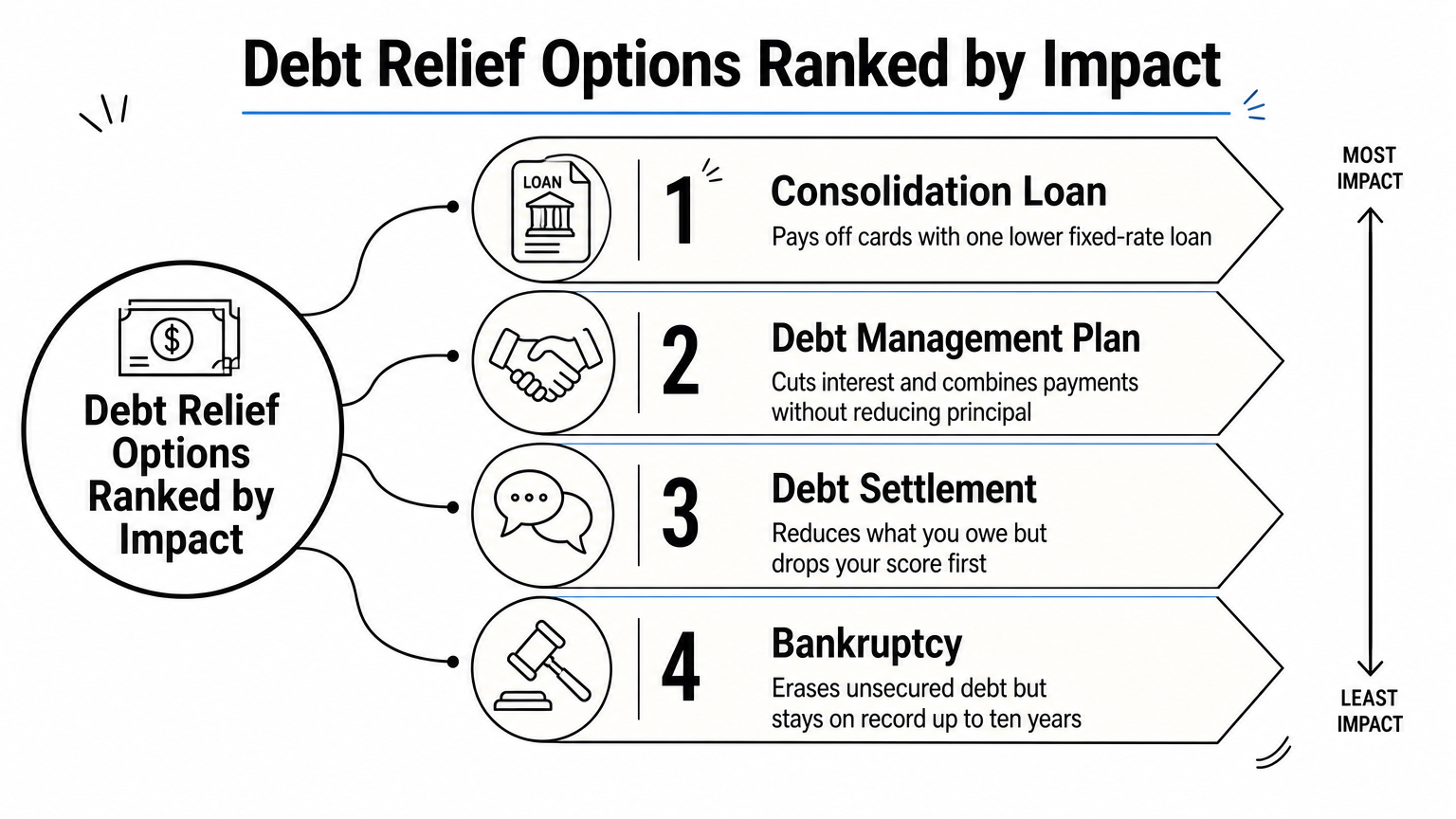
Every debt relief program trades something, your credit score, your timeline, or your principal balance, for a faster path out.
Comparing the main paths
| Type | Reduces Principal? | Credit Impact | Typical Timeline |
|---|---|---|---|
| Debt settlement | Yes | Significant, short-term drop | 24-48 months |
| Debt management plan | No | Minimal to none | 36-60 months |
| Consolidation loan | No | Small dip, then recovers | 24-60 months |
| Bankruptcy (Chapter 7/13) | Yes | Severe, long-term | 3-6 months to 5 years |
What the process actually looks like
Once you pick a lane, the mechanics follow a fairly predictable sequence:
- A counselor or company reviews your total debt, income, and credit report.
- You agree on a plan, whether that’s a negotiated settlement, a fixed monthly payment through an agency, or a new loan.
- Payments start flowing through the new structure instead of directly to each card issuer.
- Creditors update your accounts as paid, settled, or included in the plan.
- You track progress until the balance hits zero.
That last step matters more than people expect. Our guide on credit card debt payoff tips walks through how to structure that final stretch once you’ve picked a program, so the plan doesn’t quietly stall out in year three.
How to choose the right debt relief program
Picking the right path starts with an honest look at your credit score, which credit score improvement services can help you raise, and how much you can actually pay each month, not which company has the best ads. Someone with a 720 score and $8,000 in debt has completely different options than someone with a 580 score and $30,000 spread across eight cards. Matching the tool to your actual numbers is what separates good debt relief programs from ones that sound good on a sales call but don’t fit your situation at all.
Start with your credit score
If your score sits above 680, the debt settlement vs. debt consolidation question usually lands on consolidation or a balance transfer card, because you’ll qualify for a low rate and keep your credit intact. Below 600, a nonprofit debt management plan or settlement becomes more realistic, since lenders are less likely to approve you for new credit anyway.
The right debt relief program is the one that matches your credit score today, not the one you wish you still had.
Ask these questions before you enroll
Run through this list with any company or agency before signing anything:
- What percentage of my debt will this actually reduce, in writing?
- What are the total fees, and when are they charged?
- How will this affect my credit score in month one, month twelve, and at completion?
- Is the counselor or company accredited by the National Foundation for Credit Counseling or a similar recognized body?
- What happens if I miss a payment mid-program?
Compare the real cost, not just the pitch
A program that promises to erase half your debt but charges 25% of the enrolled amount in fees isn’t necessarily cheaper than a consolidation loan at 11% APR. Calculate the total dollars you’ll hand over under each option, including fees, before deciding. Nonprofit agencies are required to disclose fees upfront and typically charge far less than for-profit settlement firms, which is one reason a relief debt program through a nonprofit is often the safer first call, especially if you’re still unsure which category fits.
Is there really a government debt relief program?
Search "debt relief america" long enough and you’ll hit ads promising a federal program that erases credit card debt. There isn’t one. The government debt relief myth persists because it sounds plausible, especially after headlines about student loan forgiveness or pandemic mortgage relief, but no federal agency runs a program that pays off or reduces your credit card balances directly. What the government does offer is regulation and oversight of the companies and nonprofits that help you manage debt, plus a handful of narrowly targeted relief programs for specific debt types.

There is no federal program that erases credit card debt. That claim is the single biggest red flag in the industry.
What actually exists at the federal level
Agencies like the Federal Trade Commission and the Consumer Financial Protection Bureau enforce rules against deceptive debt relief marketing, and they publish free guidance on your real options. Beyond enforcement, government-backed relief is real but limited to specific categories:
| Debt Type | Government Program | What It Actually Does |
|---|---|---|
| Federal student loans | Income-driven repayment, forgiveness plans | Adjusts payments or forgives balance after set years |
| Mortgages | HAMP successors, FHA loss mitigation | Modifies loan terms during hardship |
| IRS tax debt | Offer in Compromise, installment agreements | Settles or spreads out tax balances |
| Credit card debt | None | No federal program reduces or forgives this debt |
Notice what’s missing. Credit card balances simply aren’t covered by any federal relief structure, no matter what a cold call or Facebook ad claims.
Why the confusion sticks around
Marketing language does the heavy lifting here. Companies use phrases like "government approved" or "federally backed" to describe programs that are really just standard debt settlement or consolidation, dressed up to sound official. Some nonprofits do receive limited government funding or oversight for housing counseling, which is a separate category from credit card work, and that overlap gets stretched into misleading pitches. Understanding this distinction protects you before you ever pick up the phone, because the moment a caller says "government program" in connection with credit card debt, you’re talking to a sales script, not a benefit you qualify for. Real relief of debt for cards comes from private lenders, nonprofit counseling agencies, or a licensed credit card debt settlement agency, not a federal check.
How to avoid scams and find a legitimate provider
Scammers know exactly what a desperate searcher wants to hear, and they’ll say "guaranteed," "pre-approved," or "government certified" without blinking. Spotting a consolidation scam early saves you thousands, because these outfits often collect upfront fees, do little or no negotiating, and leave you worse off than before you called.
Red flags that should end the call
Watch for these warning signs before you hand over a single dollar or your bank account information:
- Any request for upfront fees before a single debt is settled or enrolled, which violates federal law under the FTC’s Telemarketing Sales Rule
- Pressure to stop talking to your current creditors entirely
- Promises of a specific percentage reduction before reviewing your actual accounts
- No physical address or a company that only communicates through a call center script
- Refusal to put fees and terms in writing
If a company asks for money before it’s done any work, walk away, no exceptions.
How to verify a provider before you sign
Legitimate agencies welcome scrutiny because they have nothing to hide. Start by checking accreditation through the National Foundation for Credit Counseling, then search the company name alongside your state attorney general’s office and the Better Business Bureau for open complaints. Nonprofit credit counseling agencies are required to offer a free initial consultation, so treat any provider that charges just to explain your options as a bad sign.
Searching for a debt relief programme online will surface plenty of paid ads before you reach the accredited nonprofits, so don’t assume the first result is the safest one. Cross-reference every company against the CFPB’s complaint database, and ask directly whether they’re a nonprofit or a for-profit settlement firm, since the fee structures and risks differ significantly between the two. Once you’ve confirmed a provider is accredited, licensed in your state, and transparent about total costs, you’ve cleared the two biggest hurdles standing between you and a program that actually works instead of one that just collects fees while your balance keeps growing.
Deciding what’s right for your situation
Your credit score and monthly budget point you toward one lane long before any salesperson does. A program for debt relief only works if it matches those two numbers honestly, not the version of your finances you wish were true. Above 680, lean toward consolidation or a balance transfer. Below 600, a nonprofit management plan or settlement fits better, since new credit likely isn’t approving you anyway.
Whatever you choose, verify accreditation, get every fee in writing, and remember that no federal check is coming for your card balances. The math on that $6,000 balance won’t fix itself, but a legitimate plan gives it an actual end date.
Ready to map out your own numbers? Start with our step-by-step guide on how to get out of debt and build a plan around what you can realistically pay each month.