
If you’re staring at four or five credit card statements wondering how to get out of debt before the interest eats your entire paycheck, you’re not alone. The average cardholder carrying a balance pays somewhere between 18% and 29% APR, which means a chunk of every minimum payment goes straight to the bank instead of shrinking what you actually owe. That math is exactly why so many people feel like they’re running in place.
Getting out of debt isn’t about willpower or one magic trick. It comes down to picking the right payoff method for your situation, whether that’s a balance transfer card, a consolidation loan, or a structured debt management plan, and then sticking to a plan you can actually follow with your real income and credit score.
This guide walks you through the process step by step, starting with how to size up what you owe, then comparing your fastest options if you want to get out of credit card debt fast, and finally showing you how to avoid the traps that keep people stuck in the same cycle for years. No generic advice here, just the moves that actually work.
What it really takes to get out of debt
Before you pick a strategy, you need to understand why credit card debt behaves so differently from a car loan or a mortgage. Revolving debt compounds daily on many cards, which means the balance you see today already includes interest charged since your last statement, so it helps to understand how credit cards work before you plan around them. Ask ten people how do you get out of debt and most will say "pay more than the minimum," but that advice only works if you know exactly how much more and where that extra money is supposed to come from. Getting out of debt for real requires three things working together: an accurate picture of what you owe, a payoff method suited to your credit and cash flow, and a system that keeps you from re-charging the balance while you’re paying it down.
Interest is the real enemy, not the balance
A $6,000 balance at 24% APR costs you about $120 a month in interest alone before a single dollar touches the principal. That’s why two people with the same debt total can have wildly different payoff timelines depending on their interest rate. Look at how the math shifts:
| Balance | APR | Monthly Payment | Time to Pay Off | Total Interest Paid |
|---|---|---|---|---|
| $6,000 | 24% | $200 | 44 months | $2,750 |
| $6,000 | 12% | $200 | 34 months | $1,150 |
| $6,000 | 0% (intro) | $200 | 30 months | $0 |
Cutting your rate in half doesn’t just save money, it can shave a full year off your payoff timeline. That single fact is why lowering your APR, through a balance transfer, a consolidation loan, or a hardship program, matters as much as any budgeting trick.
The fastest way to get out of debt is almost never spending less. It’s paying less interest.
The three variables you actually control
When people ask how can i get out of debt faster, they’re usually looking for a shortcut. There isn’t one, but there are three levers that genuinely move the needle:
- Your interest rate. Every point you shave off through a transfer or consolidation loan is money that goes toward principal instead of the bank.
- Your monthly payment. Even an extra $50 a month, found through a trimmed budget, cuts months off a payoff timeline.
- Your spending behavior. Paying down a card only to run it back up erases every bit of progress from the first two levers.
Miss any one of these and the other two can only do so much. This is the piece most quick-fix articles skip: consolidation without a spending fix just resets the clock.
Myths that keep people stuck
One persistent myth is that carrying a small balance helps your credit score. It doesn’t. Utilization above 30% of your limit drags your score down regardless of intent, and paying it off only helps you. Another myth is that debt settlement is a shortcut with no cost, when in reality it can tank your credit for years and trigger tax consequences on forgiven amounts. Understanding these traps now saves you from a decision you’ll regret two years into your payoff journey, which is exactly what the next five steps are designed to prevent.
Step 1. Take stock of everything you owe
Before you can answer how do i get out of debt, you need a full, honest inventory of every debt balance you’re carrying. Most people underestimate their total debt by hundreds or even thousands of dollars because they mentally track cards separately instead of adding them up. Pull your latest statement for every credit card, store card, and personal loan, then log the balance, interest rate, and minimum payment for each one in a single place. This isn’t busywork. It’s the foundation every payoff strategy in this guide depends on.

Build your debt inventory
Grab a spreadsheet or a sheet of paper and list every account like this:
| Creditor | Balance | APR | Minimum Payment | Due Date |
|---|---|---|---|---|
| Chase Freedom | $2,400 | 22.9% | $65 | 5th |
| Discover It | $3,100 | 26.4% | $85 | 12th |
| Store Card | $850 | 29.9% | $35 | 20th |
| Personal Loan | $5,000 | 11.5% | $180 | 1st |
Add up the balances, then add up the minimum payments, since that total is the number you’ll eventually need to pay off your credit card debt in full. Those two numbers tell you exactly what you’re up against and how much of your monthly income is already spoken for before you buy groceries.
You can’t fix what you haven’t measured, so the debt list comes before the payoff plan, not after.
Check your credit reports for accuracy
Once your list is built, pull your credit reports from all three bureaus at AnnualCreditReport.com, the only site authorized by federal law to provide free reports. Compare what’s listed there against your own inventory, and while you’re at it, run a free credit score check so you know where you stand. Old debts sometimes show up that you forgot about, and occasionally you’ll spot an account that isn’t yours at all, a sign of a reporting error or identity theft that needs to be disputed before you build a payoff plan around bad data.
Getting this step right matters more than people expect. Someone who tries to figure out how can you get out of debt without a complete list often ends up throwing extra payments at the wrong card, the one with the lowest rate instead of the highest. Ranking your accounts by APR, highest to lowest, sets you up perfectly for the strategy decision in Step 3. Skip this and every later step gets harder, because you’re guessing instead of working from real numbers.
Step 2. Build a budget that frees up cash
Once your debt inventory is done, the next question is where the extra payment money actually comes from. Most people asking how do you get out of debt fast assume they need a second job or a windfall, but the truth is a real budget almost always uncovers cash that’s already leaking out of your account. Track every dollar for one full month, categorize it, and you’ll usually find $150 to $400 sitting in subscriptions, food delivery, and impulse purchases you barely remember making.
Run the numbers with a zero-based budget
A zero-based budget forces every dollar of income to have a job, whether that’s rent, groceries, or extra debt payments. List your take-home pay, subtract fixed bills, then subtract flexible spending categories until you hit zero. Anything left unassigned goes straight to your highest-priority debt payment.
Monthly income: $3,800
- Rent/Mortgage: $1,200
- Utilities: $220
- Groceries: $450
- Transportation: $300
- Insurance: $180
- Minimum debt payments: $365
- Subscriptions/streaming: $60
- Discretionary spending: $400
= Remaining before assignment: $625
> Assign to extra debt payment: $500
> Assign to emergency buffer: $125
That $500 extra payment is what actually shortens your payoff timeline, not the minimums you were already covering.
Cut categories that don’t hurt
Before assuming your budget is already lean, check these five spots first. They’re where most people find money without feeling deprived:
- Subscription audit. Cancel unused streaming, apps, and gym memberships. The average household pays for at least two services nobody uses.
- Grocery trimming. Switching from name brand to store brand on staples alone often saves $50 to $80 a month.
- Insurance shopping. Rerunning quotes on auto and renters insurance every year can uncover 10-15% savings.
- Dining out. Capping restaurant spending to twice a month frees up real cash fast.
- Impulse buffer. A 24-hour rule on non-essential purchases over $50 kills a surprising number of them.
A budget doesn’t restrict your life, it redirects money you were already spending toward the debt that’s costing you the most.
Running through this exercise once tells you exactly how much extra you can commit each month, which is the number every payoff strategy in the next step depends on, and the number you’ll quote when negotiating with your creditors.
Step 3. Pick a payoff strategy: snowball or avalanche
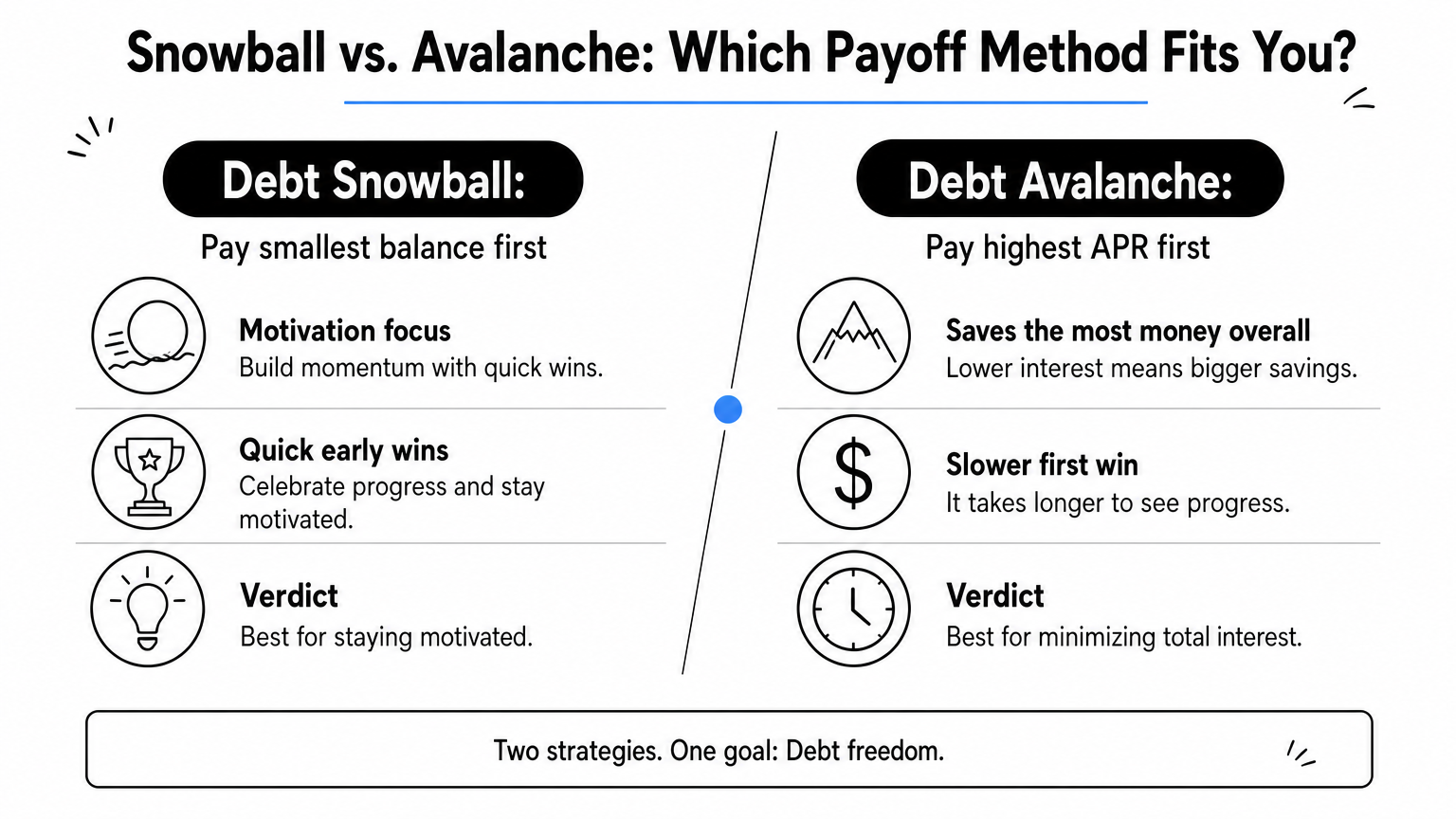
With your debt list ranked and your extra payment amount locked in from Step 2, you’re ready to decide how to get out of debt faster using a structured method instead of paying whatever card feels most urgent that month. The two proven approaches, debt snowball and debt avalanche, both work, but they solve different problems, so picking the right one for your personality matters as much as the math.
The debt snowball builds momentum
With the debt snowball, you pay minimums on everything except your smallest balance, then throw every spare dollar at that one until it’s gone. Once it’s paid off, you roll its payment into the next smallest balance, and so on. This method ignores interest rate entirely and instead banks on psychology: knocking out a whole account, even a small one, gives you proof the plan works and keeps you from quitting three months in.
The debt avalanche saves the most money
Otherwise, if you’re disciplined and mainly care about the total dollar cost, the debt avalanche has you attack the account with the highest APR first, regardless of balance size, while paying minimums on the rest. Because you’re eliminating the most expensive interest first, this method almost always costs less overall and gets you to zero balance sooner in raw math terms, even if the emotional wins come later.
Pick the method you’ll actually stick with for a year, not the one that looks best on a spreadsheet.
Comparing the two side by side
| Feature | Snowball | Avalanche |
|---|---|---|
| Pays off first | Smallest balance | Highest APR |
| Best for | Motivation, quick wins | Minimizing total interest |
| Total interest paid | Usually higher | Usually lower |
| Time to first payoff | Faster | Can take longer |
Someone asking how to get out of a debt with five scattered balances and low motivation usually does better with the snowball, since early wins keep the habit alive. Someone with strong discipline and one card at 29% APR dragging down everything else should run the avalanche and stop the bleeding where it hurts most. Either choice beats the no-strategy approach of splitting extra cash evenly across every card, which stretches your timeline and wastes the momentum you built in Step 2, and the right credit cards for paying off debt can speed up whichever method you choose.
Step 4. Lower your interest rates and consolidate smartly
Whichever payoff order you picked in Step 3, the math improves dramatically the moment you cut your interest rate. This is where how to get out of debt fast stops being about willpower and starts being about which financial product actually fits your credit profile. Two tools do most of the heavy lifting here: balance transfer cards and debt consolidation loans, and each works best in a different situation.

Balance transfer cards work best with good credit
If your credit score sits above 690, a balance transfer card offering 0% APR for 15 to 21 months can wipe out interest charges entirely while you attack the principal. Watch for the transfer fee, usually 3% to 5% of the balance moved, and make sure you can realistically pay off the full amount before the promotional period ends, because the rate jumps to a standard 18% to 29% APR afterward. Our guide on the best credit cards for balance transfers walks through which cards currently offer the longest 0% windows and how to qualify.
A 0% balance transfer only helps if you have a real plan to pay it off before the promo rate expires.
Consolidation loans work best with damaged credit or big balances
Otherwise, if your credit score is lower or your total balance exceeds what a transfer card’s limit can absorb, credit card debt consolidation rolls everything into one fixed-rate installment loan, often between 8% and 20% APR depending on credit. The fixed term means you know your exact payoff date on day one, which removes the guesswork that keeps revolving debt dragging on for years.
| Option | Best Credit Range | Typical Rate | Payoff Structure |
|---|---|---|---|
| Balance transfer card | 690+ | 0% intro, then 18-29% | Revolving, self-paced |
| Consolidation loan | 580+ | 8-20% fixed | Fixed term, set end date |
Regardless of which tool fits, and whether you’re weighing debt settlement versus debt consolidation, consolidation only works long-term if you close or freeze the cards you just paid off. Otherwise you end up with a shiny new loan payment sitting on top of the old balances creeping back up, which is exactly the trap Step 5 covers next.
Step 5. Know when to get outside help
Sometimes the math simply doesn’t work no matter how tight your budget gets or how aggressively you attack the highest-rate card. If your minimum payments alone exceed 40% of your take-home pay, or if you’re only asking how can you get out of debt because collectors are already calling, it’s time to bring in a professional instead of white-knuckling it alone. Recognizing that moment early saves years compared to waiting until accounts charge off.
Nonprofit credit counseling and debt management plans
Agencies certified by the National Foundation for Credit Counseling offer free consultations and can set up a debt management plan that consolidates your unsecured debts into one monthly payment, usually at a negotiated rate of 6% to 10% APR instead of the 20-plus percent you’re currently paying. These plans typically run three to five years, and because the agency negotiates directly with your creditors, you’re not gambling on a company you found through a late-night ad, though it pays to see how credit counseling works first. Our complete guide to credit repair and debt management options walks through how to vet an agency before you sign anything.
If a debt management plan can cut your interest rate in half, that alone often beats any DIY payoff method you could run on your own.
Be wary of debt settlement, and know when bankruptcy makes sense
Debt settlement companies promise to negotiate your balances down for pennies on the dollar, but the process usually requires you to stop paying creditors entirely for months while fees accumulate, tanking your credit score and exposing you to lawsuits in the meantime. Forgiven debt over $600 also typically counts as taxable income, a surprise that catches people off guard every tax season, so weigh bankruptcy or debt settlement carefully before committing. Compare your realistic paths:
| Option | Credit Impact | Timeframe | Best For |
|---|---|---|---|
| Debt management plan | Mild, temporary dip | 3-5 years | Steady income, want fixed payoff date |
| Debt settlement | Severe, lasts years | 2-4 years | Already delinquent, no other option |
| Chapter 7 bankruptcy | Severe, 10-year record | Months | Debt exceeds any realistic repayment |
Getting outside help isn’t giving up. It’s recognizing that the fastest way to get out of debt fast sometimes runs through someone with more negotiating leverage than you have alone, which is when a debt settlement attorney earns their fee.
Your next move toward being debt-free
Getting out of debt isn’t about finding one perfect trick. It’s about stacking small, correct decisions: an honest inventory, a budget that actually frees up cash, a payoff method that fits your personality, and a lower interest rate wherever you can get one. Skip any of those five steps and you’re back to guessing, which is how most people end up stuck for years instead of months.
Right now, you have everything you need to answer how to get out of debt for your own numbers, not someone else’s example. Pull your statements tonight, run the zero-based budget this weekend, and pick snowball or avalanche before the month ends. That’s the whole plan.
If your numbers show you need a rate cut or a structured plan rather than a DIY fix, don’t wait around. Start with our guide on how to pay off credit card debt and get a real payoff date on the calendar.