
If you served your country and now you’re staring down credit card statements you can barely cover, you’re not alone. Military pay, deployments, and the jump back to civilian life all create gaps that high-interest balances fill fast. Veteran debt relief exists for exactly this situation, but most guides lump you in with generic advice that ignores the benefits and protections you’ve actually earned.
This article cuts straight to what works. You’ll get a clear breakdown of VA debt relief programs, from Veterans Affairs debt management assistance to nonprofit credit counseling agencies that specialize in military households, plus how the Servicemembers Civil Relief Act can lower your interest rates on existing accounts.
We’ll also rank your options by credit score and balance size, comparing balance transfer cards, consolidation loans, and debt management plans against the settlement offers that sound too good to be true. By the end, you’ll know which veterans debt relief programs fit your actual numbers, not just a sales pitch, and what steps to take this month to start paying down what you owe.
Why veterans face unique financial pressures
Civilian debt advice assumes a steady paycheck and a stable household budget, but that’s not the reality most veterans come home to. Transitioning out of active duty often means a pay cut, a gap in benefits processing, or months of underemployment while you retrain for a civilian career. Add in relocation costs, family separation during deployments, and medical bills tied to service-connected injuries, and it’s easy to see why so many veterans lean on credit cards just to get through a rough stretch. That’s the entry point for most searches around debt relief for veterans: not reckless spending, but a financial gap that credit cards were never designed to fill long-term.

The income gap after service
Active duty pay comes with housing allowances, healthcare, and other benefits baked in. Once you separate, those disappear overnight, even if your VA disability claim or GI Bill benefits eventually cover part of the difference. Claims processing can take months, and in that gap, rent, groceries, and car payments don’t wait. Veterans routinely put those costs on plastic, expecting to pay it off once benefits kick in, and instead watch balances grow at 22% to 29% interest while they wait.
Medical bills and disability claim delays
Medical debt hits veterans differently than most civilians. VA healthcare covers a lot, but not everything, and gaps in coverage during PCS moves or claim appeals leave you paying out of pocket. Private specialists, dental work not covered under VA benefits, and prescriptions during a lapse in enrollment all add up fast. If you’re also carrying a disability rating that limits your work hours or job options, that medical debt compounds an income problem you’re already fighting.
Veteran debt rarely comes from bad decisions. It comes from timing gaps that credit cards were built to exploit.
Deployment and family financial strain
Deployments create their own financial pressure. A spouse managing the household solo, unexpected repairs, or a permanent change of station move that costs more than the reimbursement covers all push families toward revolving credit. Multiply that across a 20-year career with several deployments and PCS moves, and you understand why so many veterans reach retirement with balances that never fully cleared.
Why generic advice falls short
Here’s the problem: most debt relief programs for veterans searches lead to the same generic content aimed at any consumer, ignoring protections you’re specifically entitled to. The Servicemembers Civil Relief Act (SCRA), for example, can cap interest rates at 6% on debts incurred before active duty, a benefit most people never claim because they don’t know it exists. You can read the official protections directly from the Department of Justice’s SCRA overview.
| Financial pressure | Civilian equivalent | Veteran-specific factor |
|---|---|---|
| Income gap | Job loss | Benefits processing delays |
| Medical debt | Uninsured care | VA coverage gaps |
| Relocation costs | Moving for work | PCS reimbursement shortfalls |
| Family strain | Single-income periods | Deployment separations |
Understanding these pressures matters because it changes which solutions actually make sense. A veteran with a pending disability claim and a temporary income gap needs a very different plan than someone with a permanent, high, stable income who simply overspent. The next section walks through exactly how to match your situation to the right relief option, step by step.
How to get veteran debt relief step by step
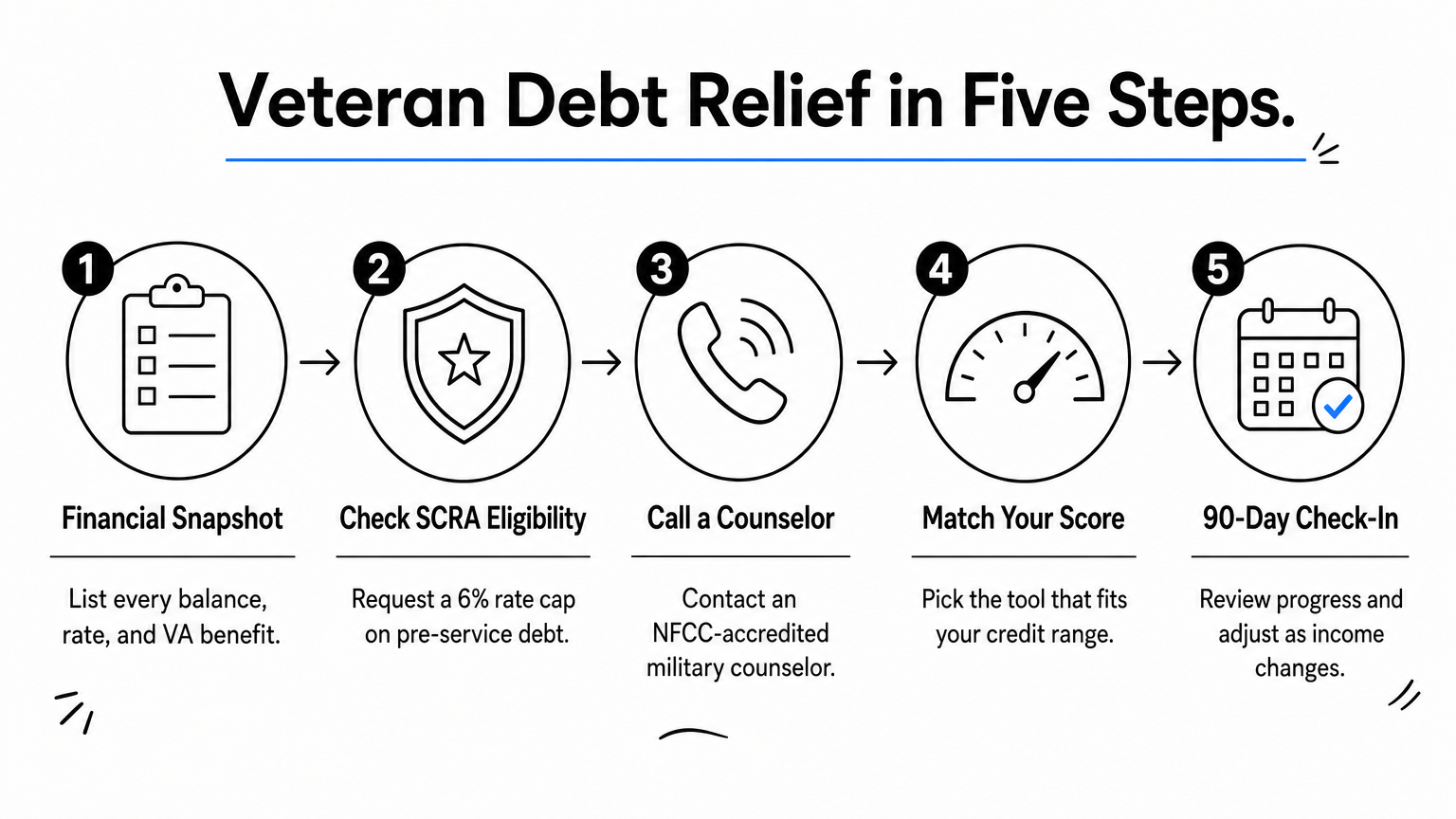
Getting veteran debt relief started isn’t complicated, but skipping steps costs you money, and the same sequencing rules apply to getting out of credit card debt fast. Most veterans jump straight to calling a debt settlement company because it’s the first ad they see, when a free VA benefits check or an SCRA interest rate cap could solve half the problem before you touch a consolidation loan.
Start with a full financial snapshot
List every credit card balance, interest rate, and minimum payment, then add your VA disability compensation, GI Bill payments, and any pending claims. You need this before you can compare debt relief va options honestly, because a debt management plan and a balance transfer card solve very different problems.
Check your SCRA eligibility first
If any of your debt was opened before you entered active duty, try negotiating directly with your creditors and request SCRA protection. This step alone can drop your interest rate to 6% and save hundreds a month, and it costs nothing to ask.
The fastest debt relief move for a veteran often isn’t a new loan, it’s a phone call to your existing creditor.
Contact a nonprofit credit counselor who works with military households
Agencies accredited by the National Foundation for Credit Counseling offer free budget counseling and can flag veterans affairs debt relief resources you might not know exist, like emergency VA grants for housing or utilities.
Match your credit score to a solution
Once you know your numbers, and once you know whether services that raise your credit score could widen your options, follow this order:
- Score above 700 and steady income: apply for a 0% balance transfer card and pay it off during the promo window.
- Score 620-700 with multiple cards: look at a debt consolidation loan through your credit union or USAA-affiliated lender.
- Score below 620 or income still unstable: enroll in a nonprofit debt management plan before considering settlement.
Set a 90-day check-in
Relief plans stall when nobody tracks progress. Mark a date 90 days out to review your balances, confirm SCRA protections are applied, and adjust your plan if your VA claim resolves and your income changes.
Veteran debt relief programs worth knowing
Beyond the SCRA and general credit counseling, several VA debt relief programs exist specifically for veterans, and most go unused simply because nobody explains them clearly. Knowing which agency handles which type of debt saves you from calling the wrong office and getting bounced around for weeks.
VA Debt Management Center
If your debt is actually owed to the VA itself, like an overpayment on disability compensation or a GI Bill housing allowance error, the VA Debt Management Center is your first stop. They offer repayment plans stretched over 12 to 60 months, and in cases of financial hardship you can request a compromise offer or a full waiver. This is separate from credit card debt, but clearing it frees up cash flow for everything else.
If Uncle Sam sent the bill, Uncle Sam also has a program to work it out.
Nonprofit and military-focused counseling
Military OneSource provides free financial counseling to veterans within 365 days of separation, and it connects you to specialists who understand PCS moves and deployment pay gaps. Pair that with an NFCC-accredited agency, and you get both military-specific context and a formal debt management plan if your credit card balances need structured repayment, which is easier to judge once you’ve seen how credit counseling actually works. Credit unions like Navy Federal and USAA also run hardship programs for members, often lowering rates or waiving late fees for a defined period.
State veteran benefit funds
Most states run a veteran affairs office with emergency grants for housing, utilities, or transportation, and these can cover a gap that would otherwise land on a credit card. Check your state’s department of veterans affairs directly, since eligibility and award amounts vary widely.
| Program | Handles | Typical relief |
|---|---|---|
| VA Debt Management Center | VA overpayments, GI Bill errors | Payment plans, waivers |
| Military OneSource | Budget and debt counseling | Free financial coaching |
| NFCC-accredited agencies | Credit card debt | Debt management plans |
| State veteran affairs offices | Housing, utility gaps | Emergency grants |
For the credit card balances specifically, our guide to dealing with credit card debt breaks down how enrollment works and what it does to your credit score, which matters before you sign anything.
Credit card debt relief options for veterans
Once you’ve checked SCRA eligibility and talked to a nonprofit counselor, the real decision is which credit card strategy fits your balance and credit score. Veterans credit card debt relief isn’t one product, it’s a menu, and picking the wrong one wastes months you don’t have if a claim decision or PCS move is coming up.
Balance transfer cards for strong credit
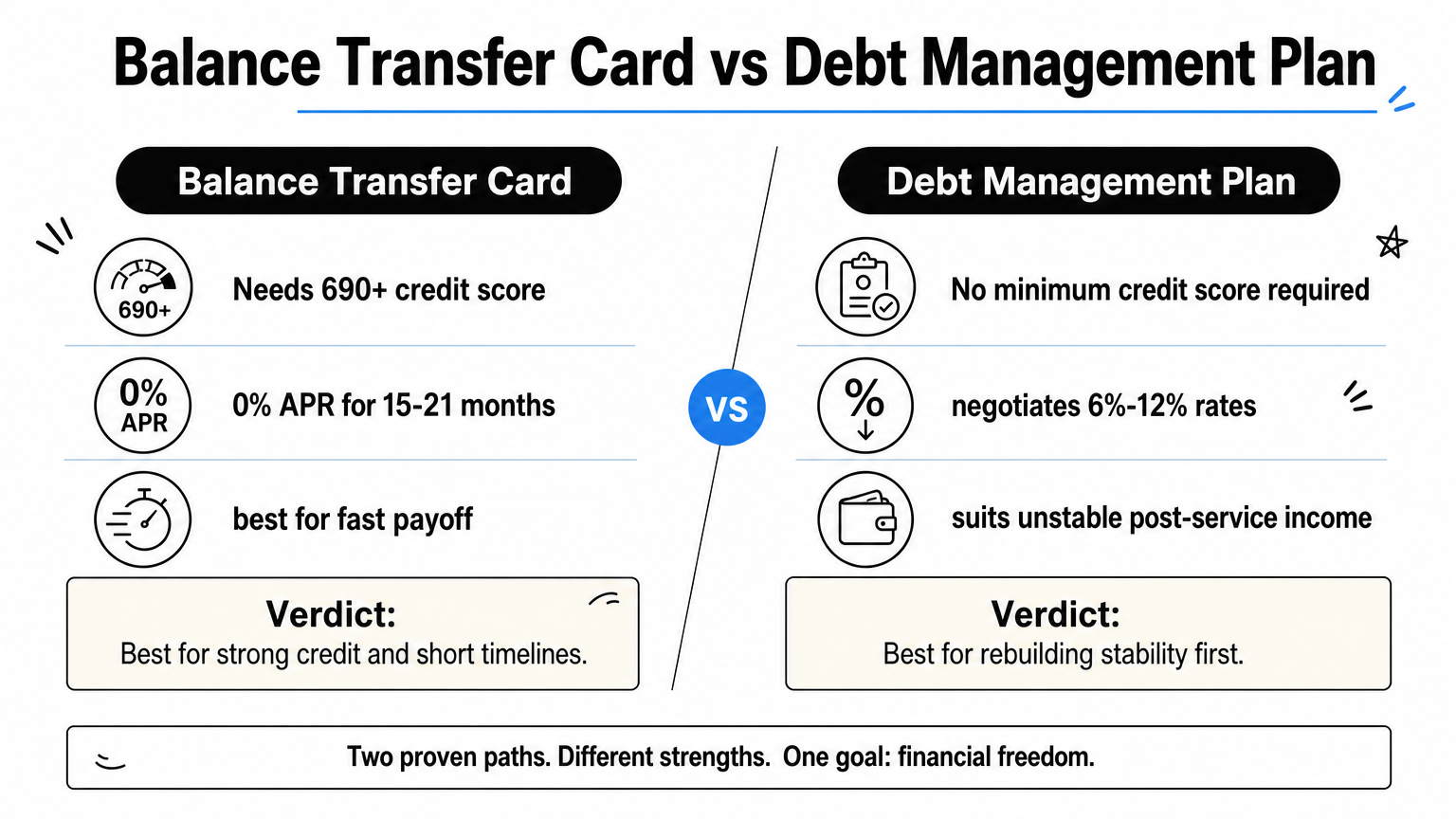
Approval odds are best above a 690 score, and a 0% intro APR for 15 to 21 months lets you attack principal instead of interest. USAA and Navy Federal both offer cards with military-friendly terms, and some waive the transfer fee for members with active accounts, so compare them against the best credit cards for balance transfers before applying. This works only if you can realistically pay off the balance before the promo ends, otherwise the deferred interest wipes out the savings.
Debt consolidation loans through credit unions
Borrowers with a 620 to 700 score often do better with a fixed-rate personal loan than a card. Military-affiliated credit unions frequently underwrite these loans with more flexibility around VA disability income than commercial banks, since it counts as stable, verifiable income. One monthly payment at a locked rate replaces the juggling act of five different card due dates, which is the core appeal of consolidating credit card debt.
Debt management plans for structured repayment
A nonprofit debt management plan bundles your cards into a single payment and negotiates lower rates directly with issuers, typically 6% to 12% instead of your current 22% to 29%. This route suits veterans whose income is still stabilizing after separation, since it doesn’t require perfect credit or a lump sum.
The right credit card fix depends on your score and your timeline, not on whichever ad shows up first.
Where debt settlement fits, and where it doesn’t
Settlement companies advertise heavily to veterans, but they ask you to stop paying creditors while fees accumulate, which tanks your credit and can trigger lawsuits, so weigh debt settlement against debt consolidation before you commit.
| Option | Best credit range | Typical rate/result |
|---|---|---|
| Balance transfer card | 690+ | 0% for 15-21 months |
| Consolidation loan | 620-700 | 7%-15% fixed |
| Debt management plan | Below 620 or unstable income | 6%-12% negotiated |
| Debt settlement | Any (use caution) | Credit damage, tax risk |
Compare these against your VA income timeline before signing anything, since a claim payout in three months changes which option makes sense today.
How to qualify and avoid debt relief scams
Qualifying for most veteran debt relief programs comes down to documentation, not perfect credit. Nonprofit agencies want proof of income (including VA disability award letters), a list of your balances, and evidence you’re actually struggling to make minimum payments. Consolidation loans through military credit unions typically require six months of on-time payments and a debt-to-income ratio under 50%, while SCRA protection just requires your active duty orders and a written request to each creditor.
Watch for scams targeting military households
Scammers specifically target veterans because they know you’re searching for debt relief va help and trust anything with a military-sounding name. Legitimate agencies never guarantee results before reviewing your file, and they never ask you to stop paying creditors directly, which is one of the clearest signs of a debt consolidation scam.
If a company promises to erase your debt before it even sees your balances, that’s your signal to hang up.
Use this checklist before you sign anything:
- Verify accreditation through the NFCC or the Financial Counseling Association of America, not just a website badge.
- Confirm they’re free or low-cost. Nonprofit counseling sessions typically run $0 to $50, not hundreds upfront.
- Reject upfront fees. The FTC prohibits debt settlement companies from charging fees before they settle a debt, a rule outlined by the Federal Trade Commission.
- Check for a physical address and phone number, not just a form on a landing page.
- Ask how they’re paid. Legitimate credit counselors disclose fair-share funding from creditors; scammers dodge the question.
Report bad actors and protect your file
Before committing to any veteran debt relief programs, cross-reference the company with the Better Business Bureau and your state attorney general’s consumer complaint database. If a representative pressures you to sign same-day or claims a special
Finding the right path forward
Veteran debt relief isn’t a single program, it’s a sequence: check your SCRA eligibility, talk to a nonprofit counselor, then match your credit score to the right tool, whether that’s a balance transfer card, a consolidation loan, or a structured debt management plan. Skipping straight to a settlement offer because it sounds fast usually costs you more in credit damage and lost time than working the steps in order.
Your situation isn’t generic, and your plan shouldn’t be either. A pending disability claim, a recent PCS move, or a stable post-service income all point toward different solutions, so use the comparisons above to figure out where you actually fall before you commit to anything. Take the documentation you gathered, run it against a real counselor, and start this week.
If credit card balances are your main obstacle right now, start with our credit card debt relief tips to compare rates and next steps side by side.