
You’ve got collectors calling, balances that won’t shrink, and a credit score that’s already taken a hit. At this point you’re not looking for another lecture on budgeting, you want a real list of debt settlement companies that actually negotiate your balances down instead of just talking about it. That’s the exact search that brought you here, and it’s the right one to be running before you sign anything.
Here’s the direct answer: a handful of accredited firms have the track record, the credit card debt negotiation leverage, and the transparent fee structures that make debt settlement worth considering, while dozens of others will drain your savings and leave your credit worse off. Choosing the right debt settlement program matters more than choosing to settle at all.
Below, we rank the seven companies worth your time, based on accreditation, average debt reduction, fees, and complaint history. We’ll also flag the red flags that separate a legitimate debt settlement service from an operation that profits off your desperation, so you can walk away with a provider you can actually trust.
1. National Debt Relief
National Debt Relief is the largest debt settlement company in the country, having resolved more than $10 billion in unsecured debt since 2009. National Debt Relief accepts clients with roughly $7,500 or more in credit card and personal loan balances, and it carries accreditation from both the American Fair Credit Council and the International Association of Professional Debt Arbitrators. That combination of scale and third-party oversight is why it consistently ranks at the top among debt settlement companies reviewed by consumer watchdogs.

How it works
You stop sending payments to your creditors and instead deposit money each month into a dedicated, FDIC-insured account that stays in your name. National Debt Relief’s negotiators use that growing balance as leverage, haggling with your creditors after you’ve missed a few payments to propose a lump-sum settlement, usually 40% to 60% of what you owe once fees are included. Settlements happen one account at a time, so your first debt might close out in four to six months while the last one could take two to four years depending on your total balance and monthly deposit.
The company you pick to negotiate your debt matters just as much as the decision to settle in the first place.
Who it’s best for
This debt settlement program fits borrowers carrying $10,000 or more in unsecured debt who’ve already been turned down for one of the top balance transfer credit cards or a consolidation loan because their credit score took a hit. National Debt Relief also suits people who want a pay-on-success model, since nothing is owed until a specific debt actually settles. If your total balance sits under $7,500, look at other options first, because the fee math rarely favors smaller debt loads.
Costs and fees
| Detail | National Debt Relief |
|---|---|
| Fee structure | Percentage of enrolled debt |
| Typical fee | 15% to 25% of enrolled debt |
| Upfront cost | $0 |
| Minimum debt | $7,500 |
| Program length | 24 to 48 months |
Fees are charged only after a debt settles, never before enrollment, which keeps the company compliant with the FTC’s Telemarketing Sales Rule governing debt relief services.
Pros and cons
- Pro: No upfront fees; you pay only when a debt actually settles
- Pro: Dual accreditation from AFCC and IAPDA, plus strong BBB standing
- Pro: Free, no-obligation savings estimate before you enroll
- Con: Your credit score will drop while accounts sit unpaid during negotiation, so plan on services that raise your score fast afterward
- Con: Creditors can still call, send notices, or sue while you’re in the program, which is when hiring a debt settlement attorney starts to matter
- Con: Not available in every state, including Connecticut and Vermont
2. Freedom Debt Relief
Freedom Debt Relief has settled debt for more than a million clients since 2002, making it the second-largest name among debt settlement companies operating today. It holds accreditation from the American Fair Credit Council and maintains an A+ rating with the Better Business Bureau, though it has drawn CFPB scrutiny in the past over disclosure practices. Freedom requires at least $7,500 in unsecured debt to enroll, putting it in direct competition with National Debt Relief for the same pool of borrowers.
How it works
Enrollment works the same way as most debt settlement programs: you redirect creditor payments into a dedicated savings account, and Freedom’s negotiators contact creditors once your balance builds enough leverage. Settlements typically land between 30% and 50% of the original balance before fees, and the company assigns you a personal negotiator who reviews every settlement offer with you before you approve it.
A negotiator who explains every offer before you sign is worth more than a slightly lower advertised fee.
Who it’s best for
Freedom suits people who want a hands-on relationship with their negotiator and value a company with a long public track record over a newer entrant. It works well if you carry debt across five or more accounts, since Freedom prioritizes settlement order strategically.
Costs and fees
| Detail | Freedom Debt Relief |
|---|---|
| Typical fee | 15% to 25% of enrolled debt |
| Upfront cost | $0 |
| Minimum debt | $7,500 |
| Program length | 24 to 48 months |
Pros and cons
- Pro: Personal negotiator assigned to your case
- Pro: Large settlement volume and long operating history
- Con: Past regulatory scrutiny over disclosures
- Con: Not available in all states
3. Accredited Debt Relief
Accredited Debt Relief has negotiated settlements for tens of thousands of clients since 2011 and holds accreditation from the American Fair Credit Council. This mid-sized player among debt settlement companies requires a lower entry point than the two names above, accepting clients with as little as $5,000 in unsecured debt, which opens the door to borrowers who got turned away elsewhere for not owing enough.

How it works
Signing up starts with a free debt analysis where a certified debt specialist reviews your accounts and builds a projected settlement timeline before you commit to anything. Once enrolled, you deposit funds into an FDIC-insured account you control, and negotiators reach out to creditors as that balance grows, typically closing settlements at 35% to 55% of the original balance. Because the company caps its client load per negotiator, turnaround on individual settlements tends to run slightly faster than the industry average of six months per account.
A lower debt minimum means more people can qualify, but only if the fee percentage stays reasonable.
Who it’s best for
Borrowers with $5,000 to $10,000 in credit card debt who got told they don’t qualify for larger debt settlement firms should start here. It also fits people who want a shorter estimated program length, since Accredited Debt Relief markets an average payoff window of 24 to 36 months.
Costs and fees
| Detail | Accredited Debt Relief |
|---|---|
| Typical fee | 15% to 25% of enrolled debt |
| Upfront cost | $0 |
| Minimum debt | $5,000 |
| Program length | 24 to 36 months |
Pros and cons
- Pro: Lower minimum debt requirement than most competitors
- Pro: Free upfront analysis with a projected timeline
- Con: Fewer years of operating history than National Debt Relief or Freedom
- Con: State availability varies, so confirm coverage before applying
4. Pacific Debt Relief
Pacific Debt Relief has operated out of San Diego since 2002 and holds accreditation from both the American Fair Credit Council and the International Association of Professional Debt Arbitrators, the same dual credential that puts National Debt Relief at the top of this list. This debt settlement firm stays smaller than the industry giants by design, and that smaller client base is exactly what it markets as its edge over bigger debt settlement agencies.
How it works
Quoting a fixed monthly deposit based on your total unsecured debt, Pacific Debt Relief routes those funds into a third-party FDIC-insured account you control the entire time. Negotiators here work a smaller caseload than at the largest firms, and the company says that translates into settlements closing at 40% to 50% of the original balance, typically within three to four years for a full roster of accounts.
A negotiator juggling fewer client files usually has more time to fight for a better settlement on yours.
Who it’s best for
Suited to borrowers who want more direct access to their assigned negotiator, Pacific Debt Relief works best for people carrying $10,000 to $25,000 in credit card debt across three to six accounts. Anyone put off by the call-center feel of larger firms tends to prefer this size of operation.
Costs and fees
| Detail | Pacific Debt Relief |
|---|---|
| Typical fee | 27% of enrolled debt |
| Upfront cost | $0 |
| Minimum debt | $10,000 |
| Program length | 24 to 48 months |
Fees run slightly higher than the two largest firms above, so weigh that against the more personal service before enrolling.
Pros and cons
- Pro: Dual AFCC and IAPDA accreditation
- Pro: Smaller caseloads per negotiator
- Con: Fee percentage runs higher than National Debt Relief or Freedom
- Con: Higher minimum debt requirement of $10,000 excludes smaller balances
5. CreditAssociates
CreditAssociates markets itself as a leaner alternative among debt settlement companies, built specifically for people who feel lost in a call center at the bigger firms. Founded in 2018, it’s newer than most names on this list, but it holds accreditation from the American Fair Credit Council and requires only $7,500 in unsecured debt to enroll. That combination of low barrier to entry and third-party oversight makes it a reasonable pick if you want a debt settlement service without the corporate scale of National Debt Relief or Freedom.
How it works
Applying starts with a phone consultation where a debt consultant reviews your accounts and quotes an estimated monthly deposit into a dedicated FDIC-insured account. Negotiators then approach creditors once that account holds enough to make a credible offer, and CreditAssociates reports typical settlements landing between 35% and 50% of the original balance. Most clients finish their program in 24 to 36 months, somewhat faster than the industry norm, since the company keeps its enrolled debt minimums modest.
A faster payoff timeline only helps if the settlements themselves are still favorable.
Who it’s best for
Borrowers with $7,500 to $20,000 in credit card debt who want a straightforward, no-frills debt settlement program should look here first. It also suits people who prefer text and app-based updates over frequent phone calls.
Costs and fees
| Detail | CreditAssociates |
|---|---|
| Typical fee | 15% to 25% of enrolled debt |
| Upfront cost | $0 |
| Minimum debt | $7,500 |
| Program length | 24 to 36 months |
Pros and cons
- Pro: Modest debt minimum opens the door to more borrowers
- Pro: App-based tracking of settlement progress
- Con: Shorter operating history than the top four firms
- Con: Fewer independent reviews available to verify claims
6. ClearOne Advantage
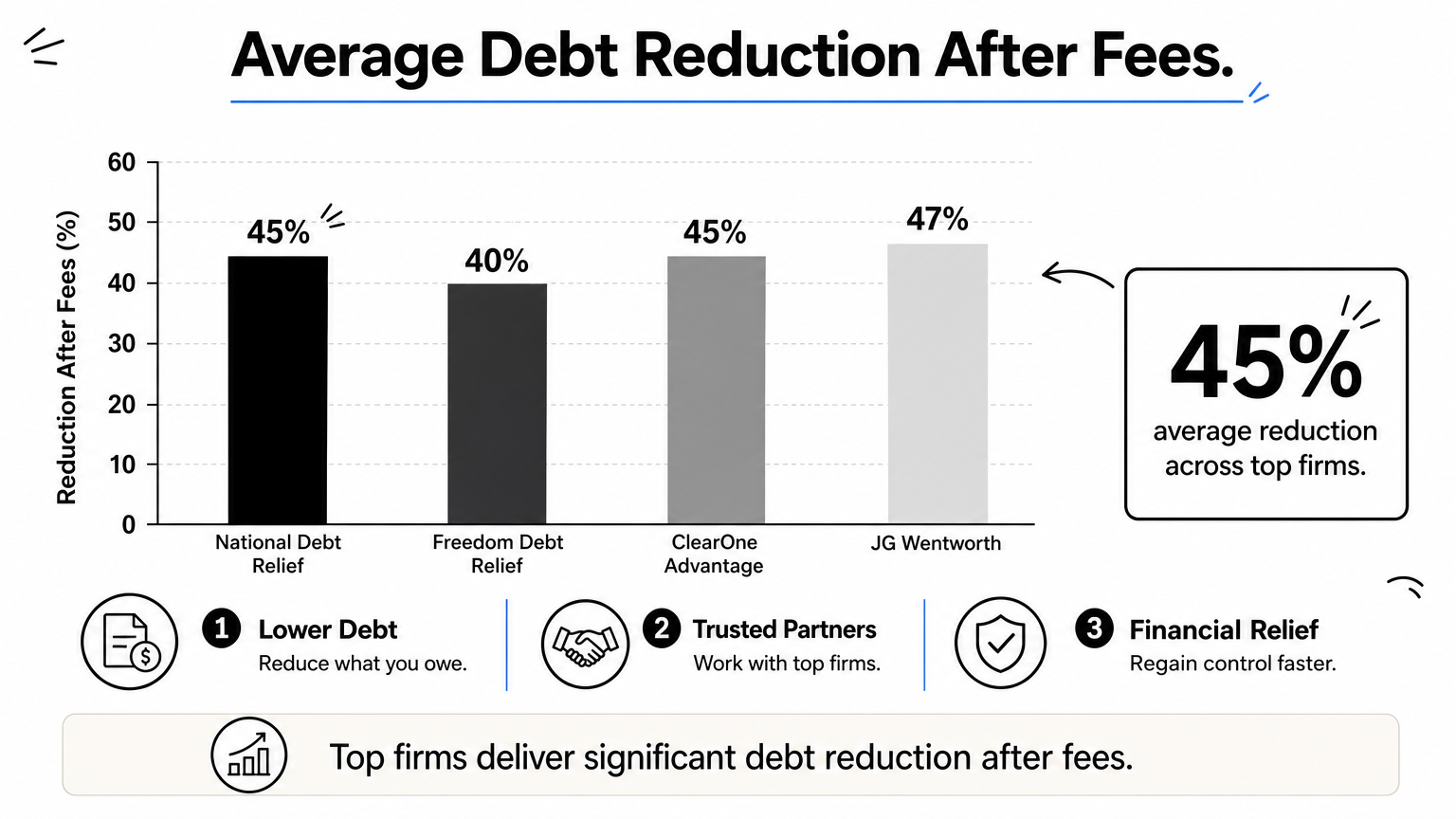
ClearOne Advantage has settled debt for clients since 2010 and carries accreditation from the American Fair Credit Council, the same credential backing most of the debt settlement firms already covered here. What sets this company apart among debt settlement agencies is its published performance data: ClearOne reports an average debt reduction of around 45% after fees, and it publishes that figure openly rather than burying it in fine print. The minimum enrollment is $7,500 in unsecured debt, keeping it in line with the mid-size players on this list.
How it works
Enrollment follows the standard structure: you stop paying creditors directly and instead fund a dedicated FDIC-insured account that ClearOne’s negotiators draw from once your balance grows large enough to make a credible settlement offer. The company assigns a negotiation team rather than a single point of contact, which means your file gets attention from whichever negotiator has bandwidth that week. Most clients see their first settlement within four to seven months, with full program completion running 24 to 48 months depending on total debt.
Published settlement averages tell you more about a company’s real performance than any marketing claim.
Who it’s best for
This debt settlement service suits borrowers who want documented performance numbers before committing, since ClearOne is more transparent about its average outcomes than several competitors. It also fits people carrying $10,000 to $30,000 across multiple credit cards who don’t need a single dedicated negotiator throughout the process.
Costs and fees
| Detail | ClearOne Advantage |
|---|---|
| Typical fee | 18% to 25% of enrolled debt |
| Upfront cost | $0 |
| Minimum debt | $7,500 |
| Program length | 24 to 48 months |
Pros and cons
- Pro: Publishes average settlement results publicly
- Pro: No fees charged until a debt actually settles
- Con: Negotiator team model means less continuity than a dedicated contact
- Con: Not available in every state
7. JG Wentworth
JG Wentworth built its brand name on structured settlement purchases, but the company also runs a full debt settlement arm that’s been operating since 2011. It holds accreditation from the American Fair Credit Council and requires at least $10,000 in unsecured debt to enroll, the highest minimum on this list. Brand recognition helps here: JG Wentworth is a household name from decades of advertising, and that familiarity is often what gets hesitant borrowers to pick up the phone in the first place.
How it works
Once you enroll, funds get diverted into a dedicated FDIC-insured account instead of going to creditors, the same mechanism every firm on this list uses. Negotiators contact creditors after enough balance accumulates, and JG Wentworth reports settlements averaging 40% to 55% of the original debt before fees. Program length typically runs 24 to 48 months, with the timeline stretching longer for clients carrying debt across six or more accounts.
Name recognition gets you in the door, but it’s the settlement percentage and fee structure that determine whether the program actually saves you money.
Who it’s best for
Borrowers with $10,000 or more spread across several creditors, who feel more comfortable trusting a name they’ve already heard of, tend to gravitate here. Quicker approval also makes this debt settlement firm a reasonable fit for people who want to start the enrollment process without a long back-and-forth.
Costs and fees
| Detail | JG Wentworth |
|---|---|
| Typical fee | 18% to 25% of enrolled debt |
| Upfront cost | $0 |
| Minimum debt | $10,000 |
| Program length | 24 to 48 months |
Pros and cons
- Pro: Strong brand recognition and long operating history
- Pro: No fees owed until a debt settles
- Con: Higher debt minimum shuts out smaller balances
- Con: Reviews are more mixed than the top-ranked firms above
Choosing the right path out of debt
Every firm on this list settles debt through the same basic mechanism: you stop paying creditors, build a dedicated account, and let negotiators work that balance into a lump-sum offer. What separates them is fee structure, minimum debt required, and how much attention your file gets once you’re enrolled. National Debt Relief and Freedom Debt Relief lead on scale and track record, while Accredited Debt Relief and CreditAssociates open the door for smaller balances that other firms turn away.
Getting the best debt settlement companies to work in your favor still means running the numbers before you sign anything. Compare projected settlement percentages against total fees, and confirm your state is covered before you commit a single deposit. Debt settlement isn’t your only route out, and it isn’t always the cheapest one, so it’s worth weighing bankruptcy against settlement too. Before you enroll anywhere, read our breakdown of debt settlement vs. debt consolidation to see which route actually gets you out of debt for less.