
You’re behind on credit card payments, the calls won’t stop, and you’re wondering whether you need a lawyer just to make it stop. That’s the moment most people start searching for a debt settlement attorney, and it’s a fair question. Not every debt problem needs legal muscle, but some absolutely do, especially once lawsuits or wage garnishment enter the picture.
A debt settlement attorney negotiates directly with your creditors to reduce what you owe, often settling accounts for 40 to 60 cents on the dollar, and they can represent you in court if a creditor sues. Unlike a debt settlement company, an attorney offers legal protection alongside negotiation, which matters if you’re already facing collection lawsuits or threats of one.
This article breaks down exactly what these attorneys do day to day, how their fees typically work, and the specific situations where hiring one makes more sense than a debt management plan or a nonprofit counselor. You’ll also learn how to vet lawyers for debt settlement in your area and what a free consultation should actually cover before you commit.
Why hire a debt settlement attorney
Most people don’t wake up wanting to hire a lawyer. You get there because the situation outgrew what a phone call to your credit card company can fix. A debt settlement attorney earns their fee in a handful of specific situations, and understanding those situations helps you decide whether you really need a debt settlement lawyer or whether a cheaper option would do just as well.

When you’re already facing a lawsuit
Once a creditor files suit, or sends a letter threatening to, the game changes. You now have court deadlines, and missing one can mean a default judgment against you, which opens the door to wage garnishment or a bank levy in most states. An attorney can respond to the summons, appear in court on your behalf, and often negotiate a settlement before the case ever goes to a judge. Debt settlement companies can’t do any of this. They aren’t licensed to practice law, so if a lawsuit lands on your desk, they’ll typically refer you out anyway.
If a creditor has sued you or threatened to, that’s the line where a debt settlement attorney stops being optional and starts being necessary.
When your debt load is large or complicated
Someone with $8,000 spread across two cards has different needs than someone carrying $60,000 across seven accounts, a repossession, and a medical collection. The more creditors involved, the more moving parts attorney debt settlement can manage at once, negotiating with each creditor under attorney-client privilege, which means creditors can’t use anything you say against you later. That protection doesn’t exist when you’re negotiating on your own or through a non-attorney company.
When creditor harassment has crossed a line
Repeated calls, threats, or contact after you’ve asked a creditor to stop can violate the Fair Debt Collection Practices Act, which the Consumer Financial Protection Bureau enforces alongside the FTC. An attorney can send a formal cease-and-desist letter that carries legal weight, and if a collector keeps violating the law, they can pursue damages on your behalf. That’s leverage a settlement company simply doesn’t have.
Here’s a quick way to sort where you land:
| Your situation | Best fit |
|---|---|
| No lawsuit, moderate debt, want lower payments | Debt management plan or balance transfer |
| Already sued or expecting to be | Debt settlement attorney |
| Multiple large accounts, complex negotiations | Debt settlement attorney |
| Ongoing collector harassment | Debt settlement attorney |
| Small balance, decent credit score | DIY negotiation or nonprofit counselor |
Regardless of which category you fall into, the underlying math is the same: creditors settle because they’d rather recover part of what’s owed than risk recovering nothing in bankruptcy. An attorney’s job is to make that argument credibly, backed by the implicit threat of a bankruptcy filing they’re qualified to actually pursue if talks fail. That credibility is worth something a settlement company can’t replicate, since creditors know a lawyer’s next move could be filing Chapter 7 paperwork rather than another phone call.
How a debt settlement attorney negotiates your debt
Negotiation isn’t a single phone call. Credit card debt negotiation is a process that usually runs three to four months per account, sometimes longer, and it starts long before anyone dials a creditor. A debt settlement attorney first pulls your full account history, verifies what’s actually owed, and checks whether the debt is even still within your state’s statute of limitations. That last step matters more than most people realize: creditors sometimes try to collect on debt that’s legally too old to sue over, and a good attorney catches that immediately.
Building leverage before making an offer
Once the accounts are mapped out, the attorney typically advises you to stop making minimum payments and instead redirect that money into a dedicated settlement fund, held either by the attorney’s firm or a linked account. This feels counterintuitive, since it means your account goes further into default, but it’s the leverage that makes settlement possible. Creditors negotiate harder once an account is charged off, usually around 180 days delinquent, because at that point they’re deciding whether to sell the debt to a collector for pennies on the dollar or take a real settlement now.
Creditors don’t settle out of kindness. They settle because a lump sum today beats a maybe later.
The offer and counteroffer process
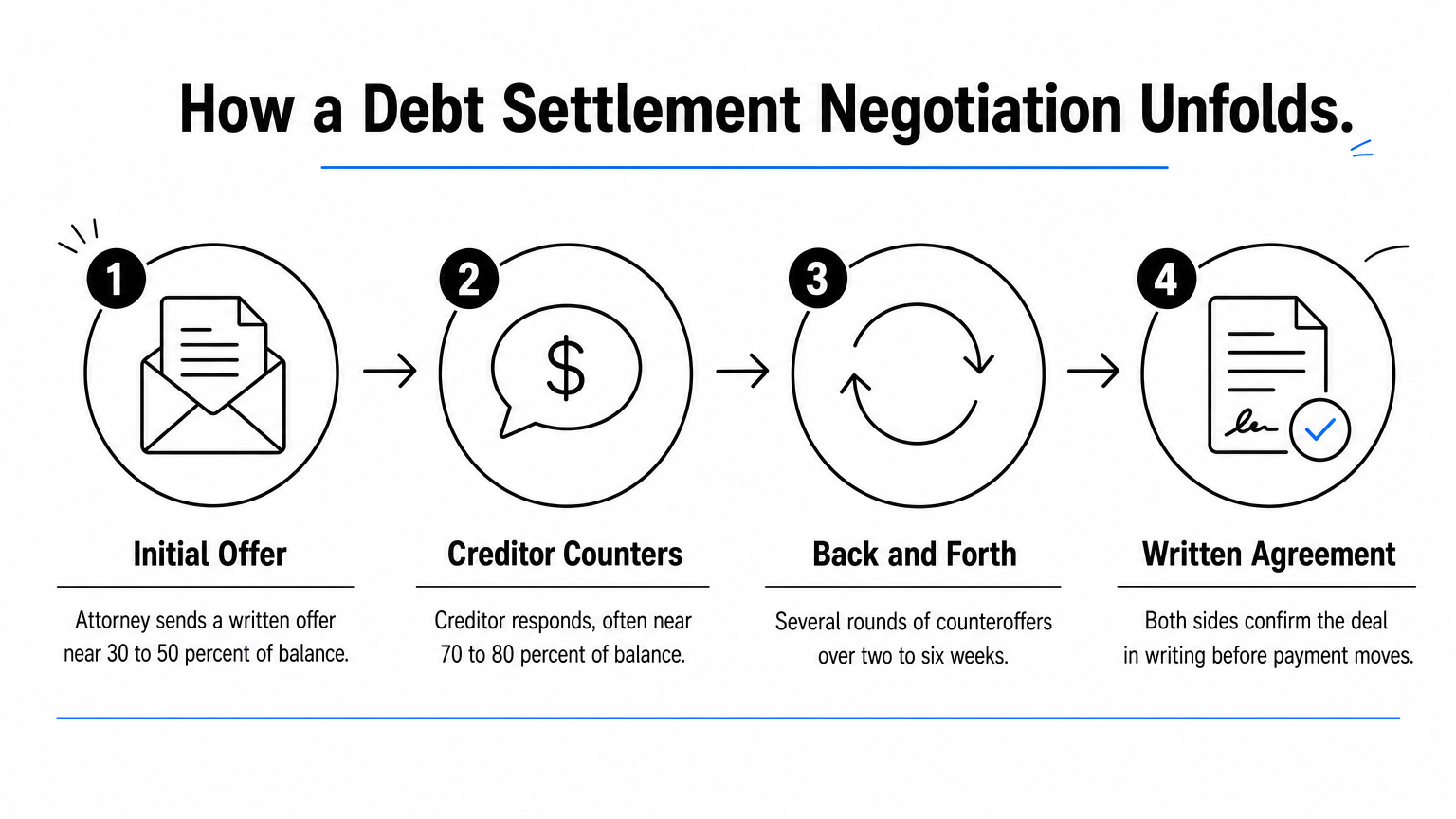
Here’s roughly how haggling with your creditors typically unfolds:
- The attorney sends a written settlement offer, often 30 to 50 percent of the balance.
- The creditor counters, sometimes at 70 to 80 percent.
- Several rounds of counteroffers follow, usually over two to six weeks per account.
- Once both sides agree, the attorney gets the deal in writing before a single dollar moves.
Getting the agreement in writing isn’t optional. Verbal promises from a collections rep mean nothing if the account gets sold to another agency next month, and a documented settlement letter is your only real proof the debt is resolved once payment clears.
How much does a debt settlement attorney cost
Cost is where a lot of people hesitate, and rightly so. Most debt settlement attorney fees fall into one of three structures, and knowing which one you’re being quoted matters just as much as the number itself. A firm that charges nothing until your debt is actually settled behaves very differently than one billing by the hour with no results guarantee.
The three common fee structures
Here’s what you’re likely to see when you call around for quotes:
| Fee structure | Typical range | How it works |
|---|---|---|
| Percentage of debt enrolled | 15% to 25% of total debt | Charged as accounts settle, not upfront |
| Percentage of debt saved | 20% to 30% of the amount forgiven | You only pay based on actual savings |
| Flat fee per account | $500 to $3,000 per creditor | Common for lawsuit defense specifically |
On a $30,000 balance settled down to $16,000, a percentage-of-savings model at 25% would run you around $3,500, spread across the negotiation period rather than paid in one lump.
Why upfront fees are a red flag
Federal law under the FTC’s Telemarketing Sales Rule bars companies from charging upfront fees before settling even one debt, and legitimate attorneys generally follow the same standard even where the rule technically exempts licensed lawyers. If someone asks for a large payment before touching your accounts, that’s your cue to walk.
Pay for results, not promises. A fee structure tied to actual settlements protects you far more than a flat retainer collected before any work happens.
Always ask for the fee agreement in writing before signing anything, and compare it against what a nonprofit debt management plan from a credit counseling agency would cost, since those typically run $25 to $50 a month with no percentage cut of your balance at all.
Debt settlement attorney vs. debt settlement company
Confusion between these two options costs people money every year, mostly because both promise the same outcome: paying less than you owe, and the same confusion shows up in debt settlement versus debt consolidation. The difference is who’s actually doing the work and what protections back it up. A debt settlement company is a for-profit business, usually staffed by negotiators who aren’t licensed to practice law. A debt settlement attorney is a licensed professional bound by state bar rules, malpractice liability, and attorney-client privilege, none of which apply to a settlement company’s staff.

What each one can and can’t do
Understanding the practical gap matters more than the marketing language both sides use. Here’s how they stack up on the things that actually affect your case:
| Capability | Debt settlement attorney | Debt settlement company |
|---|---|---|
| Represent you in a lawsuit | Yes | No, must refer out |
| Attorney-client privilege | Yes | No |
| Send legally binding cease-and-desist letters | Yes | Limited or none |
| Licensed and bar-regulated | Yes | No |
| Typical fee | 15% to 30% of debt or savings | 15% to 25% of enrolled debt |
| Speed to first settlement | Similar, 3 to 6 months | Similar, 3 to 6 months |
Speed and fee percentages often land in similar ranges, so the real decision comes down to risk. If your accounts are anywhere near a courtroom, that gap in legal authority stops being theoretical.
The moment a lawsuit becomes possible, a settlement company’s limits become your problem, not theirs.
Larger settlement companies also enroll thousands of clients at once, which means your account gets a negotiator working a high-volume script rather than a lawyer reviewing your specific documents. Nothing about that makes them dishonest, but it does mean less individual attention when your situation has unusual wrinkles, like a debt near the statute of limitations or a creditor already known for suing quickly. Reviewing the easy steps to erasing debt can help you map out where your accounts fall before you decide which route fits your risk level.
How to choose the right debt settlement attorney
Finding a lawyer’s name in a search result is easy. Finding one who actually specializes in consumer debt, rather than treating it as a side practice, takes a little more digging. Start with your state bar association’s referral service, since it verifies licensed lawyers in your area and often flags any disciplinary history. Search results for lawyers for debt settlement near you will turn up plenty of paid ads, so treat organic bar listings and verified reviews as more reliable signals than ranking position alone.
Questions to ask during the free consultation
Almost every reputable firm offers a free consultation, and how they handle it tells you a lot. Bring a list of questions and pay attention to how directly they’re answered:
- How many debt settlement cases has the attorney personally handled, not just the firm?
- What percentage of enrolled accounts typically settle within a year?
- Is the fee based on debt enrolled or debt actually saved?
- Who holds the settlement fund, the firm or a separate escrow account?
- Will the same attorney handle a lawsuit if one gets filed, or does it go to someone else?
Red flags that mean you should walk away
Slow down if a firm guarantees a specific settlement percentage before reviewing your accounts. No honest attorney promises a number sight unseen, since every creditor negotiates differently. Pressure to sign immediately, vague answers about fee structures, or reluctance to put anything in writing are all reasons to keep looking elsewhere.
An attorney who won’t put their fee agreement in writing before you sign isn’t someone you want negotiating your debt.
Verification takes ten minutes and saves you months of regret. Check the attorney’s bar status online, look for actual client reviews outside the firm’s own website, and confirm they’ve handled cases in your state specifically, since debt collection laws and statutes of limitations vary widely from one state to the next.
Deciding your next step out of debt
Hiring a debt settlement attorney makes sense once lawsuits, large balances, or harassment push your situation past what a phone call can fix. If none of those apply yet, cheaper routes like a debt management plan or balance transfer often get you to the same result without legal fees eating into your savings. The right choice depends on where your accounts actually stand today, not on which option sounds most reassuring in an ad.
Before you call around for consultations, get a clear picture of your full debt load, what’s charged off, and what’s still current. That single step tells you whether you’re a lawsuit risk or a candidate for a simpler fix. Our guide to how to get out of credit card debt fast walks you through exactly how to map that out, so you can decide with facts instead of guesswork.


