
If you’re staring down credit card balances at 24% interest and living in Texas, you already know the state offers zero legal protections that cap what card issuers can charge you. That’s exactly why so many Texans go looking for texas debt relief programs instead of waiting for the problem to fix itself, and why they want to know how to get out of credit card debt fast before the interest compounds further. The right program can cut your interest rate, consolidate multiple payments into one, or in some cases reduce the principal you owe, but the wrong choice can drain your savings and wreck your credit further.
This article answers the real question behind that search: which texas credit card debt relief options actually work, and which ones are legitimate versus predatory. We break down nonprofit debt management plans, debt consolidation loans, balance transfer cards, and debt settlement companies, ranked by who they actually help.
You’ll find eligibility requirements, realistic timelines, and the red flags that separate a trustworthy provider from a company that just wants your upfront fee. Whether your credit score is solid or already damaged, one of these seven debt relief programs in texas is likely built for your exact situation.
1. National Debt Relief
National Debt Relief is a debt settlement company that has operated since 2009 and holds an A+ rating with the Better Business Bureau. It’s one of the largest players in the space, and it accepts clients across Texas without requiring a physical branch visit, since everything happens by phone and online portal. If you’re comparing texas debt relief programs, this is usually the first name that comes up because of its size and its willingness to negotiate with major card issuers like Chase, Citi, and Discover.

How it works
You stop paying your creditors directly and instead deposit money into a dedicated FDIC-insured account each month. Once that account builds up enough, National Debt Relief negotiates with your creditors to settle each debt for less than the full balance, often 40% to 60% of what you originally owed. The company only collects its fee after a debt actually settles, which aligns its incentive with getting you results rather than just enrolling you.
Who it’s for
This program suits Texans carrying at least $7,500 in unsecured debt across multiple cards, especially if you’ve already missed payments or your credit is taking a hit anyway. It’s not the right fit if your credit is still strong, since the strategy requires you to fall behind before creditors will negotiate.
Debt settlement trades your credit score for a real chance at reducing what you owe, so it only makes sense once you’re already struggling to keep up.
Costs and fees
Expect to pay 15% to 25% of your total enrolled debt in fees, charged only as accounts settle. A typical program runs 24 to 48 months depending on how much debt you’re carrying and how aggressively you can save.
Pros and cons
- Pro: No upfront fees, in compliance with FTC rules on debt settlement companies
- Pro: Free consultation and debt analysis before you commit
- Con: Your credit score will drop while accounts go unpaid during negotiation, so plan on rebuilding your score afterward
- Con: Not all creditors agree to settle, so some debts may remain unresolved
- Con: Settled debt over $600 can count as taxable income under IRS rules
2. Accredited Debt Relief
Accredited Debt Relief has settled debt for clients since 2011 and carries an A+ BBB rating alongside accreditation from the American Fair Credit Council. It works well as an option among texas debt relief programs because it partners with a network of attorneys in states that require legal representation, though Texas doesn’t mandate that, so it’s worth knowing whether you really need a debt settlement lawyer at all. Texans looking for a settlement company with a slightly smaller footprint than National Debt Relief often land here.
How it works
You fund a dedicated savings account monthly, and once enough cash accumulates, negotiators contact your creditors to settle each account for less than the balance owed. Accredited Debt Relief typically settles debts for 45% to 60% of the original amount, and it assigns you a personal negotiator who tracks your case from enrollment through payoff.
Who it’s for
This program fits Texans with $10,000 or more in unsecured debt who’ve already fallen behind or expect to soon. It works less well if you’re still current on payments, since creditors have little reason to negotiate with someone who’s paying on time.
A settlement company only has leverage once your accounts are already delinquent, so timing your enrollment matters as much as picking the right provider.
Costs and fees
Fees run 20% to 25% of enrolled debt, collected only after each account settles. Programs typically last 24 to 48 months.
Pros and cons
- Pro: No fee unless a debt actually settles
- Pro: Assigned negotiator provides consistent case management
- Con: Late fees and interest keep accruing while you save toward settlement
- Con: Some creditors refuse to negotiate, leaving certain balances unresolved
3. Freedom Financial Network
Freedom Financial Network operates under the Freedom Debt Relief brand and has worked with clients since 2002, making it one of the longest-running names among texas debt relief programs. It holds accreditation from the American Fair Credit Council and has settled billions in consumer debt nationwide, including a steady base of Texas clients drawn to its size and track record. If you want a provider with two decades of settlement history behind it, this one belongs on your shortlist.
How it works
You redirect your monthly payments into a dedicated FDIC-insured savings account instead of paying creditors directly. Freedom’s negotiators then reach out once your balance builds up, aiming to settle each account for a fraction of what you owe. The company assigns a certified debt specialist to walk you through the process and answer questions as accounts get resolved one by one.
Who it’s for
Freedom Financial Network works best for Texans carrying $10,000 to $100,000 in unsecured debt who are already behind or falling behind fast. It’s a poor match if you’re current on every card, since creditors rarely budge for someone still making on-time payments.
The bigger your debt load, the more sense a settlement network like this makes, since fixed percentage fees scale with balances that smaller programs can’t handle.
Costs and fees
Fees range from 18% to 25% of enrolled debt, charged only after settlement. Most programs finish within 24 to 48 months.
Pros and cons
- Pro: Long operating history with documented settlement results
- Pro: Personalized debt specialist assigned to your case
- Con: Enrollment can pause payments on some accounts longer than others
- Con: Not available in every state for every debt type
4. TurboDebt
TurboDebt entered the debt settlement space more recently than the names above, but it has quickly built an A+ BBB rating and accreditation from the American Fair Credit Council. Texans searching for texas debt relief programs with a leaner, tech-forward application process often end up here, since TurboDebt handles most enrollment through an online dashboard rather than lengthy phone calls. It also negotiates debt management plans in addition to settlement, giving it more flexibility than pure settlement-only competitors.
How it works
Depending on your situation, TurboDebt either sets you up with a dedicated settlement account or connects you to a nonprofit-style debt management plan through its partner network. For settlement, you stop paying creditors directly and instead build savings that negotiators use to strike deals once your accounts fall behind. A single online portal lets you track balances and settlement offers as they come in.
Who it’s for
Eligibility generally starts around $10,000 in unsecured debt, and TurboDebt tends to attract Texans who want a digital-first experience over frequent phone check-ins. It’s a weaker fit if you prefer face-to-face guidance or a long-established brand name.
A tech-forward process only helps if you actually check the dashboard, so this program rewards borrowers who stay engaged with their own case.
Costs and fees
Settlement fees run 15% to 25% of enrolled debt, billed only after each account resolves, with programs typically wrapping up in 24 to 48 months.
Pros and cons
- Pro: Online dashboard simplifies tracking multiple settlements
- Pro: Offers both settlement and debt management plan options
- Con: Newer track record than legacy competitors
- Con: Credit score still takes a hit during the settlement phase
5. ClearOne Advantage
ClearOne Advantage has settled consumer debt since 2010 and holds an A+ BBB rating along with American Fair Credit Council accreditation. Among texas debt relief programs, it stands out for a hands-on approach, since each client gets a dedicated negotiator rather than a rotating call center team. Texans who want a mid-size company with a strong track record on customer service reviews often shortlist ClearOne alongside the bigger national names.
How it works
Enrollment works the same way as most settlement companies: you stop paying creditors directly and instead build funds in a dedicated FDIC-insured account. ClearOne’s negotiators then contact creditors once enough cash accumulates, aiming to settle each balance for less than what you owe. The company reports settling debts for roughly 45% to 60% of the original balance on average.
Who it’s for
Eligibility generally starts at $7,500 in unsecured debt, making this accessible to Texans with smaller balances than some competitors require. It suits people who value consistent communication with one negotiator over a large, impersonal operation, but it’s not ideal if you’re still current on payments.
The negotiator you’re assigned matters almost as much as the company name, so ask how often you’ll actually speak with the same person.
Costs and fees
Fees run 18% to 25% of enrolled debt, collected only after settlement closes each account. Programs typically finish in 24 to 48 months.
Pros and cons
- Pro: Dedicated negotiator assigned per client
- Pro: Lower minimum debt requirement than several competitors
- Con: Settlement still damages your credit score temporarily
- Con: Not every creditor will agree to negotiate
6. JG Wentworth
JG Wentworth built its original reputation on structured settlement buyouts, but the company now runs a debt resolution division that competes directly with the settlement names above. It holds an A+ BBB rating and works with clients across Texas through phone consultations and an online application. Among texas debt relief programs, JG Wentworth appeals to people who already recognize the brand from television ads and want a household name behind their case.
How it works
Joining the program means you redirect payments into a dedicated savings account instead of paying creditors directly. Once that account grows large enough, JG Wentworth’s negotiators reach out to each creditor to settle the balance for less than what you owe. The company assigns a case advisor to walk you through paperwork and settlement offers as they arrive.
Who it’s for
Qualifying generally requires $10,000 or more in unsecured debt, and the program suits Texans already behind on payments or close to it. It’s a mismatch if you’re current on every card, since creditors have little reason to negotiate.
A recognizable brand name doesn’t change the math: settlement only works once your accounts are genuinely delinquent.
Costs and fees
Fees typically run 18% to 25% of enrolled debt, charged only after each settlement closes. Most programs run 24 to 48 months from enrollment to payoff.
Pros and cons
- Pro: Established brand recognition and long operating history
- Pro: No upfront fees before settlement occurs
- Con: Credit score drops during the delinquency phase
- Con: Some creditors decline to negotiate with the company
7. Americor
Americor rounds out this list of texas debt relief programs as a California-based company that has expanded nationwide since 2016, earning an A+ BBB rating and accreditation from the American Fair Credit Council along the way. It offers both debt settlement and debt consolidation loans, so Texans get a choice depending on their credit and how far behind they already are. Americor markets itself as a one-stop shop, which appeals to readers who don’t want to compare a settlement company and a lender separately.
How it works
Applicants first go through a free debt analysis where a specialist reviews your balances and credit profile to recommend settlement or consolidation. If settlement fits, you fund a dedicated account monthly until negotiators can offer creditors a reduced payoff. If a loan fits better, Americor connects you with lending partners who handle credit card debt consolidation by paying off your cards directly and replacing them with one fixed monthly payment.
Who it’s for
Americor works for Texans with $10,000 or more in unsecured debt and for people whose credit still qualifies for a consolidation loan instead of settlement. It’s less useful if you only want one specific solution, since the sales process pushes whichever product fits Americor’s model that day.
A company offering both settlement and consolidation only helps you if it recommends the option that actually fits your credit, not just the one that pays the biggest commission.
Costs and fees
Settlement fees run 18% to 25% of enrolled debt, while consolidation loans carry standard origination fees and APRs based on your credit score.
Pros and cons
- Pro: Offers both settlement and consolidation loans under one roof
- Pro: Free upfront analysis before you commit
- Con: Sales-driven process may favor whichever product suits the company
- Con: Settlement path still damages your credit temporarily
8. How to choose a legitimate debt relief program in Texas
Spotting a legitimate provider among texas debt relief programs starts with checking three things before you sign anything: accreditation, fee structure, and how the company talks about your timeline. Legitimate settlement companies belong to the American Fair Credit Council, carry a strong Better Business Bureau rating, and never ask for payment before a debt actually settles. The Federal Trade Commission requires this fee structure by law, so any company demanding upfront money is already breaking the rules.
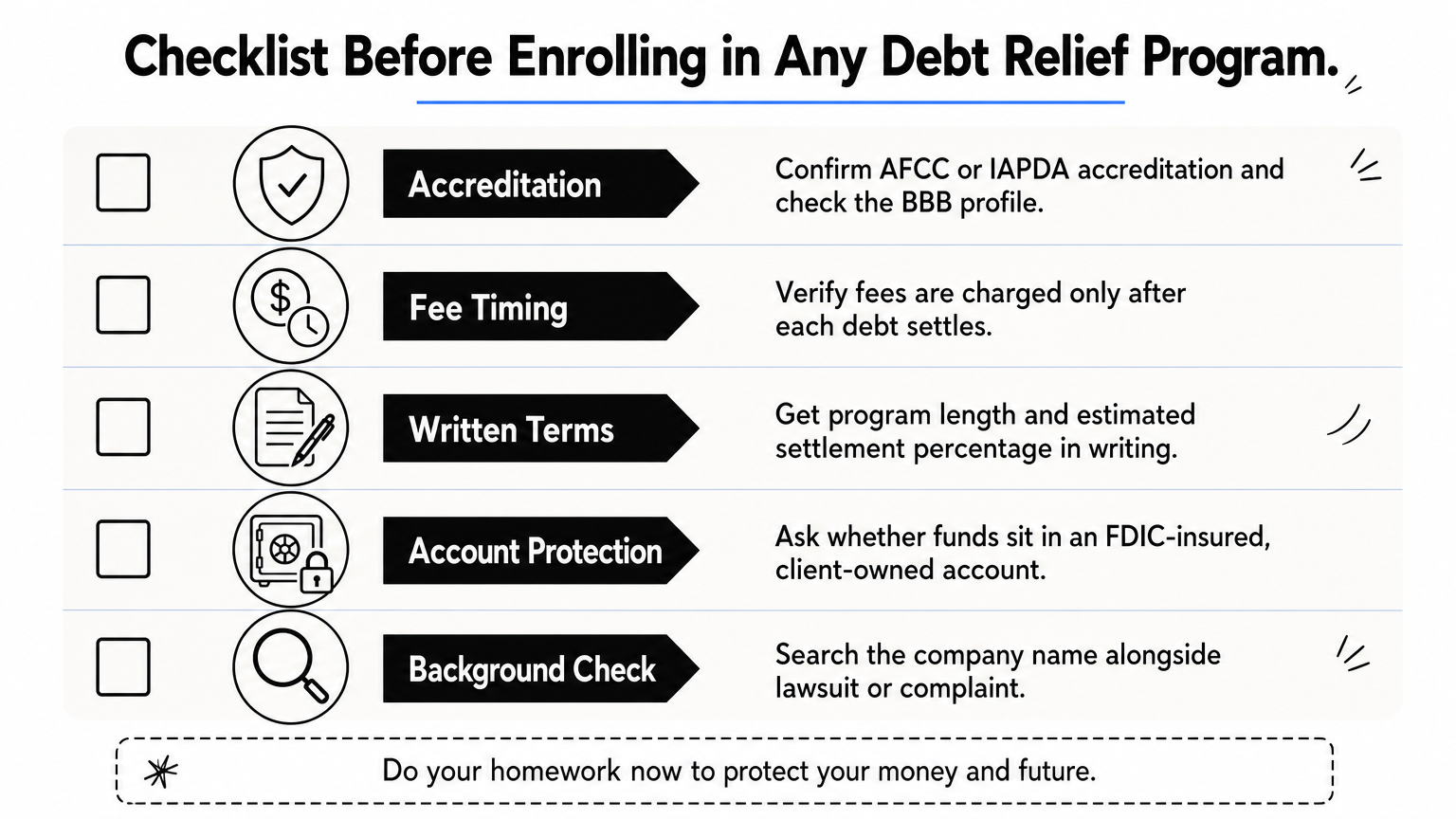
If a company asks for money before it settles a single debt, walk away, because that alone tells you it isn’t playing by federal rules.
Beyond fees, look for a written contract that spells out which debts are enrolled, the estimated settlement percentage, and the total program length. Ask how many negotiators you’ll work with and whether you get a direct phone line or a rotating call center.
Use this checklist before enrolling in any debt relief programs in texas:
- Confirm AFCC or IAPDA accreditation and check the BBB profile for complaint patterns
- Verify fees are charged only after each debt settles, never upfront
- Get the total program length and estimated settlement percentage in writing
- Ask whether your funds sit in an FDIC-insured, client-owned account
- Search the company name alongside "lawsuit" or "complaint" before enrolling
A program that hesitates to answer these questions plainly is a program worth skipping, regardless of how polished its advertising looks.
9. Texas debt laws that affect your debt relief options
Texas gives consumers a few legal advantages that shape how debt relief programs work here, and knowing them puts you in a stronger position for any credit card debt negotiation. The state enforces a four-year statute of limitations on most consumer debt, meaning creditors generally can’t sue you for a credit card balance once four years have passed since your last payment or charge. That’s shorter than many states, and it’s one reason some Texans choose to wait out old debts rather than enroll in a settlement program at all.
Texas also offers unusually strong wage garnishment protection. Under state law, creditors can’t garnish your wages for ordinary credit card debt, unlike states where a court judgment leads straight to payroll deductions. This changes the calculus for texas credit card debt relief, since the usual pressure tactic that pushes people toward quick settlements carries less weight here.
Texas won’t let a credit card company touch your paycheck, so you can afford to negotiate rather than panic into a bad settlement deal.
Community property rules matter too. If you’re married, debt taken on during the marriage can sometimes be considered joint, even if only one spouse’s name is on the account, so both incomes may factor into a lender’s or negotiator’s assessment. Check current guidance from the Consumer Financial Protection Bureau before assuming a debt is solely yours to resolve.
10. Alternatives to debt settlement programs
Settlement isn’t the only path out of credit card debt, and for many Texans it isn’t even the best one. If your credit score is still above 650 and you’re current on payments, a balance transfer credit card or a debt consolidation loan usually costs less and protects your credit far better than settlement ever will, which is the heart of the debt settlement vs. debt consolidation question. Nonprofit debt management plans, offered through agencies certified by the National Foundation for Credit Counseling, negotiate lower interest rates instead of reduced principal, and they don’t require you to fall behind first, so it helps to see how credit counseling actually works.
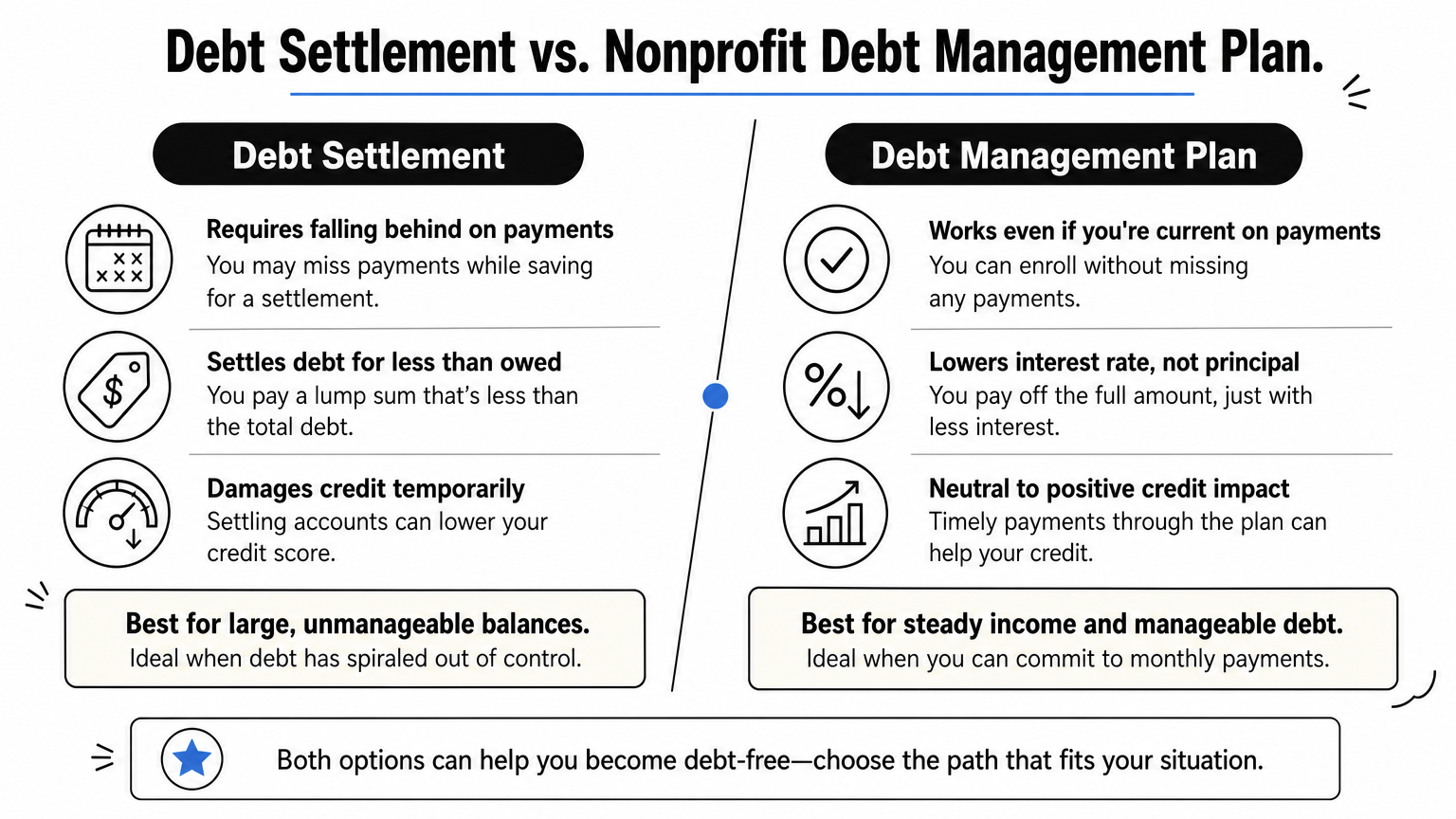
Settlement should be your last resort, not your first call, because every alternative on this list does less damage to your credit.
Here’s how the main alternatives stack up against settlement:
| Option | Credit needed | Impact on credit | Typical cost |
|---|---|---|---|
| Balance transfer card | 670+ | Minimal if paid off during promo period | 3-5% transfer fee |
| Debt consolidation loan | 640+ | Minor dip, recovers fast | Origination fee + APR |
| Nonprofit debt management plan | Any score | Neutral to positive over time | $25-50/month |
| Chapter 7 or 13 bankruptcy | Any score | Severe, 7-10 year record | Court and attorney fees |
Our guide to balance transfer credit cards walks through which cards actually work for Texans carrying five figures in balances, and it’s worth reading before you sign with any settlement company. Weighing these options first, including whether bankruptcy or debt settlement fits your situation, often saves you thousands in fees down the road.
Choosing your next step toward becoming debt-free
Seven programs, one decision that actually matters: does your situation call for settlement, or does it call for something gentler on your credit? Texans with damaged credit and five figures in unsecured debt tend to fit National Debt Relief, ClearOne, or Freedom Financial. Readers still current on payments almost always come out ahead with a balance transfer card or a nonprofit debt management plan instead. Ranking every option side by side, like we did above, only helps if you’re honest about which category you fall into before you enroll.
Understand your statute of limitations, your wage garnishment protections, and your actual monthly cash flow before you sign anything. Those three facts, more than any company’s marketing, determine which texas debt relief programs will genuinely work for you.
If your credit still qualifies for a lower rate, compare the best credit cards for balance transfers before you commit to settlement fees you may not need to pay.