
Carrying a balance at 22% interest feels like running on a treadmill that never stops. Every payment you make gets eaten up by finance charges before it even touches the principal. That’s exactly why so many people go searching for credit cards offering 0 apr, and it’s the smartest first move you can make if you’re trying to pay off debt or finance a big purchase without bleeding money to interest.
This article gets straight to it: nine cards worth applying for in 2026, based on intro period length, ongoing rates once the promotion ends, and who each card actually fits. Some of these give you a full 15 to 21 months interest-free, whether you’re moving an existing balance or making new purchases. We’ll also break down how 0% APR offers really work, including the balance transfer fees and credit score requirements that catch people off guard.
If you’ve been burned by fine print before, or you just want to know which card matches your situation, whether that’s paying down debt fast or spreading out a large purchase, keep reading. You’ll walk away knowing exactly which card to apply for and how to use it without landing back in the same interest trap.credReddit.
1. Wells Fargo Reflect® Card
Wells Fargo built the Reflect card around one single selling point, and it delivers on it better than almost anything else on the market. This card offers one of the longest 0% intro APR windows you’ll find anywhere, which makes it a strong pick if you need serious runway to pay off a balance or spread out a big purchase without interest piling on. It’s not flashy on rewards, but that’s not why anyone applies for it.

Intro APR terms
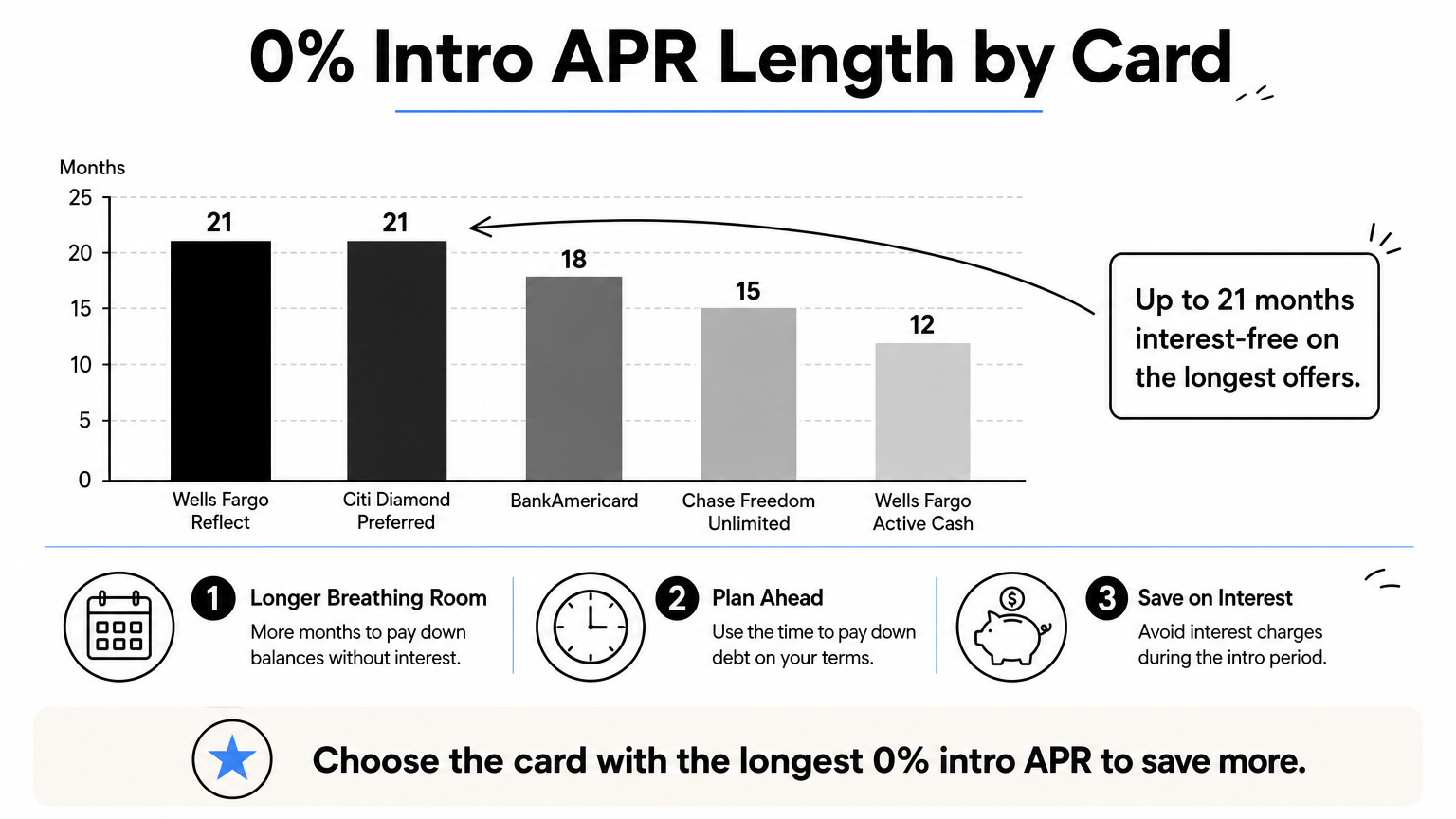
The Reflect card starts you off with 18 months at 0% APR on purchases and qualifying balance transfers, and if you make your minimum payments on time during that window, Wells Fargo extends it another 3 months, for a maximum of 21 months total. That’s the longest 0% APR for a year credit cards offer typically caps out at, and stretching it to nearly two years gives you real breathing room.
Twenty-one months of 0% APR means you can pay off a $6,000 balance for roughly $286 a month with zero interest, something a treadmill of minimum payments at 22% would never let you do.
After the promotional period ends, the ongoing APR jumps to a variable 17.24% to 28.99%, so you need a payoff plan before month 22, not after.
Rewards and fees
There’s no rewards program here, and Wells Fargo doesn’t pretend otherwise. What you get instead:
- $0 annual fee
- Balance transfer fee of 5% (minimum $5) during the intro period, then up to 5% ($5 minimum) after
- Cell phone protection when you pay your bill with the card
- No foreign transaction fee waiver, so skip this one for travel
The absence of a rewards program is the tradeoff for the longer intro window. Cards that pack in cash back or points almost always shorten the 0% period to offset the cost.
Who it’s best for
This card fits people who need maximum time to dig out of a specific balance, whether that’s from a medical bill, a move, or a big-ticket purchase you’re financing instead of dipping into savings. If you’re the type who wants a firm deadline and a spreadsheet tracking your payoff, the Reflect card’s structure works in your favor. Skip it if you’re chasing cash back on everyday spending, since that’s simply not what this card does.
Credit score needed
Wells Fargo typically approves the Reflect card for applicants with good to excellent credit, generally a FICO score of 690 or higher. If your score sits below that range, you’ll likely get a better shot with a card built for building or rebuilding credit rather than one designed around a long 0% promotional period.
2. Citi Diamond Preferred® Card
Citi’s Diamond Preferred card sits right behind the Reflect card in terms of intro length, and it’s a favorite among people specifically trying to move debt off a higher-interest card. It doesn’t try to be a rewards card at all, it’s built purely as a balance transfer tool, and it does that job well.
Intro APR terms
You get 0% APR for 21 months on balance transfers and 12 months on purchases, both from account opening. That’s a long enough runway to tackle a serious balance, though the purchase window is noticeably shorter than the transfer window, so don’t plan on financing new spending here for as long as you’d like.
If your main goal is escaping high-interest debt rather than financing a new purchase, the Citi Diamond Preferred’s 21-month transfer window does exactly that job.
Once the intro period ends, the ongoing APR becomes a variable 18.24% to 28.99%, so mark your calendar well before month 22.
Rewards and fees
There’s no cash back or points program attached to this card, which keeps things simple:
- $0 annual fee
- Balance transfer fee of 3% (minimum $5) if transferred within the first 4 months, then 5% (minimum $5) after
- Free access to your FICO score
- No foreign transaction fee waiver
That lower balance transfer fee window early on is worth acting on fast if you’re moving debt from another card.
Who it’s best for
This card fits anyone carrying a balance on a high-APR card who wants a long, predictable window to pay it down without earning distractions. It’s less useful if you also want rewards on everyday spending, since you’d need a second card for that.
Credit score needed
Citi generally approves the Diamond Preferred for applicants with good to excellent credit, typically a FICO score of 670 or above. Lower scores tend to get declined or routed toward cards with shorter promotional periods.
3. BankAmericard® credit card
Bank of America’s original no-frills card keeps things simple, and that simplicity is the whole point. The BankAmericard skips rewards entirely and puts all its effort into a long 0% intro period for both purchases and balance transfers, making it a solid pick if you want one card to handle debt payoff without any extra bells and whistles competing for attention.
Intro APR terms
BankAmericard offers 0% APR for 18 billing cycles on purchases and balance transfers made within 60 days of account opening. That’s roughly a year and a half of interest-free room, putting it in the same tier as the Reflect and Diamond Preferred cards, just with a slightly shorter window than either.
Eighteen billing cycles at 0% gives you a full year and a half to knock out debt before interest charges start eating into your payments again.
After the promo ends, the ongoing variable APR runs 16.24% to 26.24%, which sits a bit lower than some competitors on this list once you’re back to paying standard interest.
Rewards and fees
There’s no rewards structure here, and the fee list is short:
- $0 annual fee
- Balance transfer fee of 3% (minimum $10) for transfers made in the first 60 days, then 4% (minimum $10) after
- No foreign transaction fee waiver
Keeping the fee structure this plain makes it easy to calculate exactly what you’ll owe before you commit.
Who it’s best for
Anyone who wants a straightforward card for paying off debt without juggling a rewards program fits well here. It particularly suits people who already have a rewards card for everyday spending and just need a dedicated tool for tackling one specific balance.
Credit score needed
BankAmericard typically requires good credit, generally a FICO score around 670 or higher. Applicants with fair credit sometimes get approved but usually with a shorter promotional window or lower credit limit than advertised.
4. Chase Freedom Unlimited®
Chase built the Freedom Unlimited to do double duty: a genuine cash back card that also happens to carry a solid 0% intro period. It’s the first card on this list that doesn’t ask you to sacrifice rewards for a payoff window, which makes it a smart pick if you want one card for both new spending and an existing balance.
Intro APR terms
You get 0% APR for 15 months on purchases and balance transfers from account opening. That’s shorter than the Reflect or Diamond Preferred cards, but still enough runway to knock out a moderate balance or finance a purchase without interest eating your payments.
Getting 15 months of 0% APR alongside real cash back rewards is a tradeoff most single-purpose payoff cards can’t match.
After the intro period, the ongoing variable APR runs 19.24% to 27.99%, so plan your payoff before month 16.
Rewards and fees
This is where Freedom Unlimited separates itself from every card above it on this list:
- Unlimited 1.5% cash back on everyday purchases
- 5% cash back on travel booked through Chase
- 3% cash back on dining and drugstore purchases
- $0 annual fee
- Balance transfer fee of 3% (minimum $5) during the intro period, then 5% (minimum $5) after
That combination of cash back rewards and a real intro window is rare, and it’s why this card shows up on so many recommendation lists beyond just 0% APR searches.
Who it’s best for
This card suits people who want a single everyday card that also handles a balance transfer or a big purchase without opening a second account. It’s not the longest 0% window here, so skip it if you need maximum time.
Credit score needed
Chase generally approves the Freedom Unlimited for applicants with good to excellent credit, typically a FICO score of 670 or higher.
5. Wells Fargo Active Cash® Card
Wells Fargo’s Active Cash card takes the flat-rate cash back approach and pairs it with a shorter but still useful 0% window. It’s a strong pick if simplicity matters more to you than squeezing out every possible month of interest-free time, and it’s one of the more balanced 0 apr credit cards on this list because it doesn’t force you to choose between rewards and a payoff period.
Intro APR terms
You get 0% APR for 12 months on purchases and qualifying balance transfers from account opening. That’s the shortest window among the cards covered so far, so it fits smaller balances or purchases you’re confident you can pay off within a year rather than a large debt load.
A 12-month runway works fine for a $2,000 to $3,000 balance, but stretch beyond that and you’ll want a card with a longer intro period instead.
Once the promotional period ends, the ongoing variable APR runs 19.24% to 29.99%, which sits on the higher end compared to some competitors here.
Rewards and fees
The rewards structure is refreshingly simple:
- Unlimited 2% cash rewards on every purchase, no categories or caps
- $0 annual fee
- Balance transfer fee of 3% (minimum $5) during the intro period, then up to 5% (minimum $5) after
- Cell phone protection when you pay your bill with the card
That flat 2% rate beats most category-based cards for people who don’t want to track rotating bonuses.
Who it’s best for
Anyone wanting one card that earns solid cash back year-round while still offering breathing room on a moderate balance fits this card well. Wells Fargo built it for everyday spenders first and debt payoff second.
Credit score needed
Wells Fargo typically approves the Active Cash card for applicants with good to excellent credit, generally a FICO score of 670 or above.
6. U.S. Bank Shield™ Visa® Card
U.S. Bank’s Shield Visa card is one of the newer entries on this list, and it blends a respectable intro window with tiered cash back that rewards people for specific spending categories rather than a flat rate across the board. It’s a solid middle-ground option if you want more than a plain payoff card but don’t need the longest 0% window available.
Intro APR terms
Shield gives you 0% APR for 18 billing cycles on purchases and balance transfers made within the first 90 days of account opening. That puts it right alongside the BankAmericard in terms of length, giving you a year and a half to work through a balance before interest kicks back in.
Eighteen billing cycles at 0% interest gives you enough runway to pay off a $5,000 balance at roughly $278 a month without a dime going to finance charges.
Once the promo ends, the ongoing variable APR runs 19.24% to 29.99%, so treat month 19 as your hard deadline.
Rewards and fees
Rewards come in tiers rather than a flat percentage:
- 4% cash back on gas station and EV charging purchases
- 4% cash back on streaming service subscriptions
- 2% cash back on grocery store purchases
- 1% cash back on everything else
- $0 annual fee
- Balance transfer fee of 3% (minimum $5) during the intro period, then 5% (minimum $5) after
Those category bonuses make this one of the more generous 0 percent interest credit card options for households with predictable recurring spending.
Who it’s best for
This card suits people who spend steadily on gas, groceries, and streaming and want those categories rewarded while they also chip away at a balance. It’s less useful if your spending doesn’t fit neatly into those buckets.
Credit score needed
U.S. Bank generally approves the Shield Visa for applicants with good to excellent credit, typically a FICO score of 670 or higher.
7. Capital One Quicksilver Cash Rewards Credit Card
Capital One’s Quicksilver has built a reputation as a no-nonsense flat-rate rewards card, and its 0% intro offer makes it just as useful for people juggling a balance as for everyday spenders. It’s a good fit if you want simple, uncapped rewards without worrying about rotating categories, while still getting real breathing room on a purchase or transfer.
Intro APR terms
Quicksilver offers 0% APR for 15 months on purchases and balance transfers from account opening. That matches Chase Freedom Unlimited’s window and sits comfortably in the middle of this list, long enough for a moderate balance but short of the 18-to-21-month cards further up.
Fifteen months at 0% gives you room to pay off a balance while still earning cash back on every dollar you spend in the meantime.
After the intro period, the ongoing variable APR runs 19.24% to 29.24%, so build your payoff plan around month 16 at the latest.
Rewards and fees
The rewards structure here is about as simple as it gets:
- Unlimited 1.5% cash back on every purchase, no categories or caps
- 5% cash back on hotels and rental cars booked through Capital One Travel
- $0 annual fee
- Balance transfer fee of 3% during the intro period, then up to 4% after
That flat rate makes Quicksilver one of the easier credit cards with 0 percent apr to actually track, since you never need to remember which category applies each month.
Who it’s best for
Anyone who wants one card handling both a balance transfer and everyday cash back, without tracking bonus categories, fits well here. It suits people who value simplicity over squeezing out the last few months of interest-free time.
Credit score needed
Capital One typically approves the Quicksilver for applicants with good to excellent credit, generally a FICO score of 670 or higher. Applicants below that range usually get steered toward Capital One’s credit-building cards instead.
8. Blue Cash Everyday® Card from American Express
American Express built the Blue Cash Everyday around grocery and gas spending, and it backs that up with a respectable 0% intro window. If your household spends heavily on supermarket runs, this card pairs a 0 interest apr credit card offer with rewards that actually match everyday budgets rather than niche categories few people use.

Intro APR terms
You get 0% APR for 15 months on purchases and balance transfers from account opening. That matches Chase Freedom Unlimited and Quicksilver, giving you over a year to pay down a balance or spread out a purchase without interest charges stacking up.
Fifteen months of 0% APR paired with grocery cash back means you’re saving on interest and earning on the exact spending most households can’t avoid.
Once the promo ends, the ongoing variable APR runs 19.24% to 29.99%, so treat month 16 as your deadline for paying off whatever you financed.
Rewards and fees
The rewards structure rewards categories most families spend on weekly:
- 3% cash back at U.S. supermarkets (on up to $6,000 per year, then 1%)
- 3% cash back on U.S. gas stations and U.S. online retail purchases
- 1% cash back on everything else
- $0 annual fee
- Balance transfer fee of 3% (minimum $5) during the intro period, then up to 5% after
That supermarket bonus alone can offset the annual grocery bill increases most households have felt over the past few years.
Who it’s best for
This card fits families and individuals whose biggest expense categories are groceries and gas, and who want a 0% window to handle a balance transfer or a big purchase at the same time. Skip it if you rarely shop at U.S. supermarkets, since the rewards lose most of their value.
Credit score needed
American Express generally approves the Blue Cash Everyday for applicants with good to excellent credit, typically a FICO score of 670 or higher.
9. Bank of America® Unlimited Cash Rewards credit card
Bank of America closes out this list with a flat-rate cash back card that pairs nicely with its BankAmericard sibling but adds rewards into the mix. If you already bank with Bank of America and want the Preferred Rewards bonus boost, this card becomes even more valuable than the numbers alone suggest.
Intro APR terms
Unlimited Cash Rewards gives you 0% APR for 15 billing cycles on purchases and balance transfers made within the first 60 days of account opening. That’s on par with Chase Freedom Unlimited, Quicksilver, and Blue Cash Everyday, giving you well over a year to pay off a balance without interest working against you.
Fifteen billing cycles at 0% APR, combined with flat 2% cash back, makes this one of the easiest cards on this list to use for both debt payoff and everyday spending.
After the intro window closes, the ongoing variable APR runs 19.24% to 29.24%, so treat month 16 as your firm cutoff for clearing whatever you financed.
Rewards and fees
The rewards here are as simple as Wells Fargo Active Cash, just from a different issuer:
- Unlimited 2% cash rewards on every purchase
- Up to 75% more cash back for Bank of America Preferred Rewards members
- $0 annual fee
- Balance transfer fee of 3% (minimum $10) during the intro period, then 4% (minimum $10) after
That Preferred Rewards boost can push your effective rate closer to 3.5%, which few flat-rate cards on this list can match.
Who it’s best for
This card suits Bank of America customers who already keep checking or savings balances there, since the Preferred Rewards multiplier rewards existing relationships. It also works well for anyone wanting a no-fuss flat rate alongside a solid intro period.
Credit score needed
Bank of America typically approves Unlimited Cash Rewards for applicants with good to excellent credit, generally a FICO score of 670 or higher.
Finding the right 0% APR card for your situation
Every card on this list solves the same core problem in a slightly different way. If you need maximum time to pay off a large balance, the Wells Fargo Reflect or Citi Diamond Preferred give you the longest runway. If you want rewards while you pay things down, Chase Freedom Unlimited or Wells Fargo Active Cash make more sense than a single-purpose payoff card. Where your credit score stands and how fast you can realistically pay off what you owe should drive the decision, not the card with the flashiest headline offer.
Whatever you pick, treat the intro period as a countdown, not a cushion. Write down the exact month your 0% APR expires and build a payment plan backward from that date. If you want help figuring out which strategy fits your specific debt load before you apply, see how credit card debt consolidation works and build a payoff plan that actually sticks.