
You’ve got credit card balances that won’t budge, minimum payments that barely touch the principal, and interest rates in the 20% range eating whatever you throw at them. Somewhere online you’ve read about two very different fixes, and now you’re trying to figure out debt settlement vs debt consolidation without getting burned by either one. That confusion is normal. The two get lumped together constantly, even though they work in almost opposite ways.
Here’s the short answer: debt consolidation combines your balances into one loan or card at a lower rate and keeps your accounts in good standing, while debt settlement negotiates to pay less than you owe on accounts you’ve typically stopped paying, which tanks your credit score for years. One protects your credit while you dig out. The other trades your credit for a smaller payoff amount.
Below, we break down how each option actually works, what they cost, how they hit your credit score, and which one fits your situation depending on your balance size, your credit standing, and how much financial pain you can tolerate along the way.
Why this choice matters for your credit and your wallet
Most people compare debt settlement vs debt consolidation by looking only at the payoff number, but that’s the wrong lens. The real difference is what happens to your accounts while you’re working through the plan, and that difference follows you for years. Pick wrong and you could end up with a lawsuit, a tax bill, or a credit score in the 500s when you thought you were fixing your finances.
What debt consolidation does to your accounts
Debt consolidation rolls your existing balances into a new loan or a balance transfer credit card, then you pay that one account down at a lower interest rate. Your original creditors get paid off in full, immediately, so there’s no default, no collections calls, and no derogatory marks tied to the consolidation itself. Your credit utilization often drops right away too, since a personal loan doesn’t count toward your revolving utilization ratio the way credit card balances do. That’s why people with scores above 680 or so tend to see their credit improve within a few months of consolidating, not collapse.
What debt settlement does to your accounts
Settlement works from the opposite direction. You (or a settlement company) stop paying your creditors, redirect that money into a savings account, and wait until the balance is delinquent enough that the creditor is willing to accept a lump sum for less than you owe through negotiating your credit card balances down. During that waiting period, which often runs 24 to 36 months, your accounts get reported as late, then charged off. Each missed payment dings your score, and a charge-off can sit on your credit report for seven years from the original delinquency date. Some creditors sue instead of settling, which adds legal fees, the risk of a wage garnishment, and often the need for a credit card debt lawyer on top of the damage already done.
Consolidation protects the credit you already have; settlement gambles it to shrink what you owe.
The cost and credit impact side by side
Numbers make this easier to see than descriptions do. Here’s how the two options typically compare for someone carrying $15,000 to $20,000 in credit card debt:
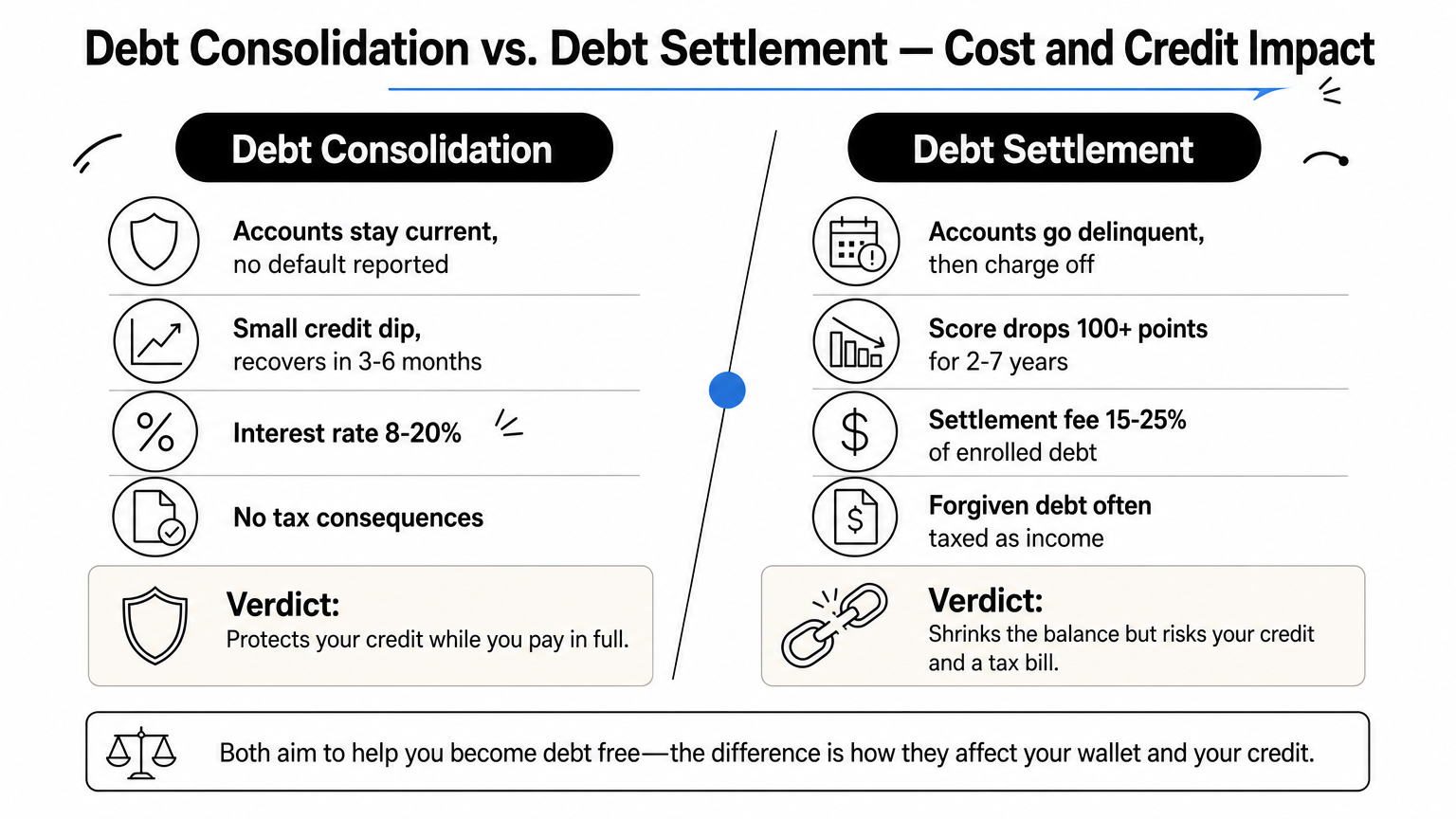
| Factor | Debt Consolidation | Debt Settlement |
|---|---|---|
| Accounts stay current | Yes | No, they go delinquent |
| Typical credit score impact | Small dip, then recovery in 3-6 months | Drop of 100+ points, lasting 2-7 years |
| Interest rate | Often 8-20% (vs. 20-29% cards) | 0% once settled, but fees apply |
| Fees | Origination fee, 1-6% of loan | Settlement fee, 15-25% of enrolled debt |
| Tax consequences | None | Forgiven debt over $600 is often taxable income |
| Timeline to resolution | 2-5 years, fixed schedule | 2-4 years, unpredictable |
| Risk of lawsuit | Very low | Real, if creditor won’t negotiate |
Settling frequently looks cheaper on paper because you’re paying back less principal, but the tax bill on forgiven debt, the settlement company’s cut, and years of credit damage often erase that savings. The IRS treats forgiven debt as taxable income in most cases, so a $10,000 settlement can generate a 1099-C form and a real tax bill the following spring, according to the IRS’s own guidance on cancellation of debt. Consolidation avoids that trap entirely because you’re repaying the full balance, just at better terms. That’s the wallet math most articles skip, and it’s exactly why the choice matters more than the marketing for either option lets on.
How to decide which option fits your situation
Deciding between debt settlement vs debt consolidation comes down to three questions: what’s your credit score doing right now, how much do you owe, and how much financial stress can you actually absorb for the next few years. Skip the marketing pitches from either industry, learn to spot a consolidation scam, and answer these honestly before you sign anything.
Start with your credit score and income
If your credit score sits above 650 and you have steady income, consolidation almost always wins. You’ll qualify for a balance transfer credit card with a 0% intro period or a personal loan in the 8-15% range, both of which beat the 20%+ rates you’re likely paying now. Check out our guide to picking the best credit card for balance transfers if your score falls in that range. Below 600, most lenders won’t approve you for consolidation at a rate worth taking, which is usually when settlement or a nonprofit debt management plan enters the conversation.
Weigh your total balance against your budget
Smaller balances, say under $10,000, are often better handled through consolidation or even an aggressive payoff plan, since the interest savings alone can close the gap in two to three years. Larger balances, especially $25,000 or more spread across several cards, sometimes make settlement’s reduced payoff tempting, but that’s exactly when the tax bill and credit damage hit hardest too.
If you can still make minimum payments without missing a month, you almost certainly qualify for consolidation and don’t need settlement’s risk.
Use a quick self-check
Run through this list before you decide:
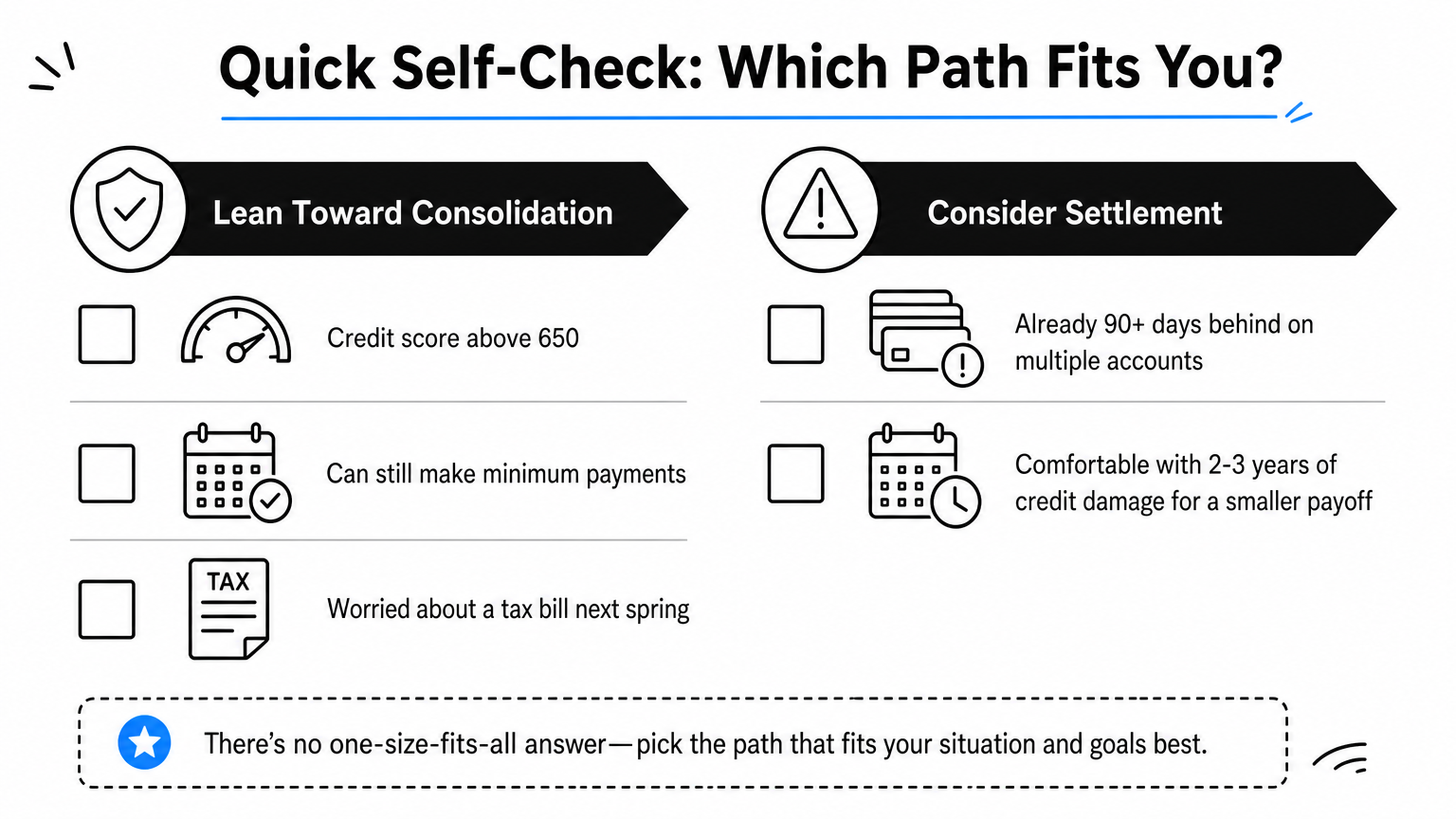
- Credit score above 650? Lean toward consolidation.
- Can you make current minimum payments, even if it hurts? Lean toward consolidation.
- Already 90+ days behind on multiple accounts? Settlement becomes a realistic option.
- Worried about a tax bill next spring? Consolidation avoids it entirely.
- Comfortable with 2-3 years of credit damage for a smaller payoff? Settlement fits that trade-off, not everyone else’s.
When it comes to weighing credit consolidation vs debt settlement, most readers find the self-check points them toward consolidation faster than they expected, simply because their credit and income are better than they assumed.
What to do if neither option is a clean fit
Sometimes the math doesn’t split neatly between debt settlement vs debt consolidation. Maybe your score sits at 610, too low for a decent consolidation rate but not so damaged that settlement makes sense yet. Maybe you owe $30,000 across six cards and neither option alone covers the gap. That gray zone is common, and it’s where a nonprofit debt management plan or a hybrid approach usually beats forcing yourself into either camp.
Consider a nonprofit debt management plan
Agencies accredited by the National Foundation for Credit Counseling negotiate lower interest rates directly with your creditors, often down to 6-10%, without you missing a single payment or damaging your score the way settlement does. You make one monthly payment to the agency, they distribute it, and most plans close out balances in 3-5 years. Unlike settlement, your accounts stay marked as current the entire time. Unlike consolidation, you don’t need a credit score high enough to qualify for a new loan.

When your score is too low for consolidation but your accounts aren’t delinquent enough for settlement, a debt management plan often fills the gap both options leave open.
Blend strategies instead of picking one
Occasionally the right move is splitting your debt rather than choosing one path for everything. You might consolidate two cards with a personal loan while enrolling three older, already-delinquent accounts in a settlement program, treating each balance according to its own status rather than forcing a single strategy across all of them. Readers weighing debt consolidation vs settlement as an all-or-nothing choice often miss this option entirely, and it’s usually the one that saves the most money with the least credit damage.
Get a second opinion before signing anything
Before committing to either path, or a blend of both, talk to a nonprofit credit counselor first. Most offer a free session, and they’ll run the actual numbers on your accounts rather than a generic estimate. Our own breakdown of easy-to-do credit card debt payoff solutions walks through how to combine these options based on your specific balances, so you’re not guessing which combination fits your situation.
Common questions about settlement and consolidation
Readers comparing debt settlement or debt consolidation tend to ask the same handful of questions once they’ve read the basics, so here are direct answers instead of more theory.
Which one hurts your credit score more?
Settlement wins that contest every time, and not in a good way. A charge-off from settlement can knock 100 points or more off your score and stay on your report for seven years, while consolidation usually causes a small dip from the credit inquiry that recovers within a few months of fixing your credit score over time. If credit score protection is your priority, this question alone should settle debt consolidation vs debt settlement in most cases.
Can you switch from one to the other mid-process?
Yes, though it gets harder the further along you are. Someone who enrolled in a settlement program but later got a raise or a tax refund can often pay off the remaining balances directly and pivot to a consolidation loan once accounts are current again. Going the other direction, from a consolidation loan into settlement, usually only makes sense if you default on the new loan itself, which defeats the purpose of consolidating in the first place.
Switching paths mid-stream is possible, but it costs you time and fees you won’t get back.
Do debt settlement companies actually deliver savings?
Results vary widely, and the Federal Trade Commission warns that outcomes depend heavily on the company and your specific creditors. Some clients settle for 40-60% of their balance; others miss so many payments waiting for a deal that a creditor sues before settlement happens. Reading the contract’s fee structure matters as much as the advertised savings percentage.
Is there a middle ground between the two labeled correctly?
Sometimes people search credit consolidation vs debt settlement hoping for a third option, and the honest answer is that a nonprofit debt management plan, covered above, fills that gap better than either headline option alone. It’s worth ruling out before committing to either path.
Finding the right path forward
At this point, the debt settlement vs debt consolidation question probably has a clearer answer for you than it did when you started reading. If your credit is solid and you can keep making payments, consolidation gets you out of high-interest debt without wrecking your score. If you’re already behind and can’t see a way to catch up, settlement might be the only realistic move, even with the tax bill and credit damage that come with it. And if you’re stuck in between, a nonprofit debt management plan or a blended approach often beats forcing yourself into either camp.
Whatever you choose, don’t guess your way through it. Run the numbers on your actual balances, check your real credit score, and get a second opinion before you sign a contract with either type of company. Start with our step-by-step guide to getting out of debt within 3 years and build a plan around your situation instead of someone else’s marketing pitch.