
Watching your credit card balance grow while your paycheck barely covers the minimum payment feels like running on a treadmill that never stops. Interest rates between 18% and 29% mean a huge chunk of every payment disappears before it even touches what you actually owe. If you’re searching for how to get out of credit card debt, you already know the math doesn’t work in your favor, and generic advice like "spend less" isn’t going to fix a $12,000 balance.
The real answer depends on your credit score and how much debt you’re carrying. A balance transfer card can wipe out interest for 12 to 21 months if your score is above 680. A debt consolidation loan locks in a fixed payoff date. If your credit is already damaged, a nonprofit debt management plan often beats debt settlement, which can tank your score further before it helps.
This guide walks through each option side by side, ranks them by situation, and gives you a step-by-step payoff strategy so you can move fast without making a costly mistake.
Why credit card debt is so hard to escape
How credit cards work makes this debt behave differently than a car loan or a mortgage. There’s no fixed end date, no amortization schedule pushing you toward zero. Instead, compounding interest works against you every single day, calculating charges on your balance and then charging interest on that interest the next billing cycle. A $6,000 balance at 24% APR generates roughly $120 in interest every month before you’ve paid down a single dollar of principal. That’s why so many people asking how do you get out of credit card debt feel like they’re stuck no matter how much they pay.
Minimum payments are built to keep you paying
Card issuers calculate minimum payments to cover interest plus a sliver of principal, usually 1% to 3% of your balance. That structure isn’t an accident. It’s designed to keep the account profitable for the bank for as long as legally possible.
A minimum payment isn’t a payoff plan. It’s a subscription to your own debt.
Here’s what that looks like in real numbers, using a $6,000 balance at 22% APR with a 2% minimum payment:
| Payment Strategy | Monthly Payment | Time to Pay Off | Total Interest Paid |
|---|---|---|---|
| Minimum only | Starts at $120, shrinks over time | Over 25 years | Roughly $8,900 |
| Fixed $200/month | $200 | 3 years, 4 months | Roughly $2,100 |
| Fixed $350/month | $350 | 1 year, 8 months | Roughly $970 |
That table tells you almost everything you need to know about why sticking to minimums traps people for decades. The gap between paying $120 and paying $350 a month isn’t just about speed, it’s the difference between $8,900 and $970 in wasted interest.
The psychological trap of "just a little more"
Even people who understand the math still get stuck, because debt payoff isn’t purely a numbers problem. Watching a balance barely move after a $200 payment feels discouraging, and discouragement leads to skipped payments or new charges "just this once." Behavioral finance research backs this up: the Consumer Financial Protection Bureau has documented how revolving debt structures make it psychologically harder for consumers to see progress compared to installment loans with a visible finish line.
Multiple cards make it worse
Situations get messier fast when you’re juggling three or four cards with different rates, due dates, and minimum payments. Without a system, it’s easy to pay the wrong card first, miss a due date on a smaller balance, and trigger a penalty APR that can jump your rate to 29.99% or higher. Anyone wondering how can I get out of credit card debt while managing multiple accounts needs a single, organized view of every balance before choosing a strategy, which is exactly where step one comes in.
Understanding these mechanics matters because it changes how you approach payoff. You’re not fighting a lack of willpower. You’re fighting a financial product engineered to extend repayment as long as possible while collecting maximum interest. Once you see the trap clearly, the best way to get out of credit card debt stops looking like a mystery and starts looking like a series of concrete, sequential moves. The next five steps walk through exactly what those moves are, starting with getting a full, honest picture of what you owe.
Step 1. Add up everything you owe
Before you can pay off credit card debt, you need a complete, unflinching list of every balance, rate, and due date. Most people underestimate what they owe by hundreds or even thousands of dollars because they never actually total the numbers, they just react to whichever bill feels most urgent that week. Pull up every statement, whether that’s five cards or two, and write down the real numbers instead of guessing.

Grab your last statement for each account and record four things: the current balance, the APR, the minimum payment, and the due date. Do this in a spreadsheet or on paper, whatever gets it done today. Skipping this step is the number one reason people trying to figure out how to get out of debt with credit cards end up bouncing between strategies without ever finishing one.
You can’t out-strategize debt you haven’t fully counted.
Here’s a simple template to fill in for each card you carry:
Card name: ___________
Current balance: $______
APR: ______%
Minimum payment: $______
Due date: ______
Promo rate expiration (if any): ______
Once every card is logged, add up the totals. You want three numbers at the end of this exercise:
- Total balance owed across all cards
- Total minimum payments due each month
- Weighted average APR, which tells you how much interest is really costing you overall
Seeing these three numbers together is often the moment things click for people asking how do I get out of credit card debt on their own. A person with $9,000 spread across four cards at rates from 19% to 27% is in a very different situation than someone with a single $9,000 balance at 22%, even though the total looks the same on paper.
Getting your credit reports at this stage helps too, since a card you forgot about or a balance transfer offer already sitting on file can change your plan. You can pull all three reports free once a year at AnnualCreditReport.com, the only site authorized by federal law for that purpose. Cross-check those reports against your own list to make sure nothing’s missing.
With the full picture in front of you, the fog usually lifts. Instead of a vague, overwhelming sense of "I owe too much," you have concrete numbers you can act on. That clarity is what makes step two, building a budget that actually frees up cash, possible in the first place.
Step 2. Free up cash with a bare-bones budget
Once you know exactly what you owe, the next move is finding money you didn’t know you had. A bare-bones budget strips your spending down to needs only, for a defined window of three to six months, so every extra dollar goes toward your balances instead of subscriptions, takeout, or upgrades you can live without temporarily. This isn’t a forever budget. It’s a short, aggressive push designed to generate real payoff cash fast, which is exactly what people asking about the best way to get out of credit debt are usually missing: a plan that actually produces spare money instead of just tracking where it went.
Start by separating true needs from everything else. Housing, utilities, groceries, insurance, minimum debt payments, and transportation to work stay. Nearly everything else gets paused or cut for the trial period.
A temporary bare-bones budget beats a permanent vague one every single time.
Here’s a quick checklist to run through your own spending:
- Cancel or pause streaming services, subscription boxes, and unused gym memberships
- Renegotiate phone, internet, and insurance bills by calling providers directly and asking for retention rates
- Cook at home for the trial period instead of ordering delivery or eating out
- Sell unused items like electronics, furniture, or clothes for quick lump-sum cash toward a balance
- Redirect windfalls such as tax refunds, bonuses, or side gig income straight to your highest-priority card
Most people find $150 to $400 a month hiding in categories they never scrutinized before, and those small wins are the easy steps to erasing debt that add up. That number matters more than it looks, because it’s the extra fuel that turns a 25-year minimum-payment slog into a payoff measured in months, not decades.
Tracking this doesn’t need fancy software. A simple monthly comparison works fine:
Category: ___________
Old monthly spend: $______
Bare-bones spend: $______
Difference (extra payoff cash): $______
Once you total the differences across every category, you’ll have a real number, not a guess, to add on top of your minimum payments. That extra amount is what actually accelerates payoff, and it’s the fuel both strategies in the next step depend on. Whether you’re wondering how can you get out of credit card debt in six months or two years, this freed-up cash is what makes either timeline realistic instead of theoretical.
Step 3. Choose your payoff method: avalanche vs. snowball
With extra cash freed up, you need a system for where that money goes first. Two methods dominate the advice on how can you get out of credit card debt, and both work, but they work differently depending on whether you need math efficiency or motivation. Pick one, commit to it, and stop switching between the best ways to pay off a $10,000 credit card balance every time a blog tells you the other one is better.
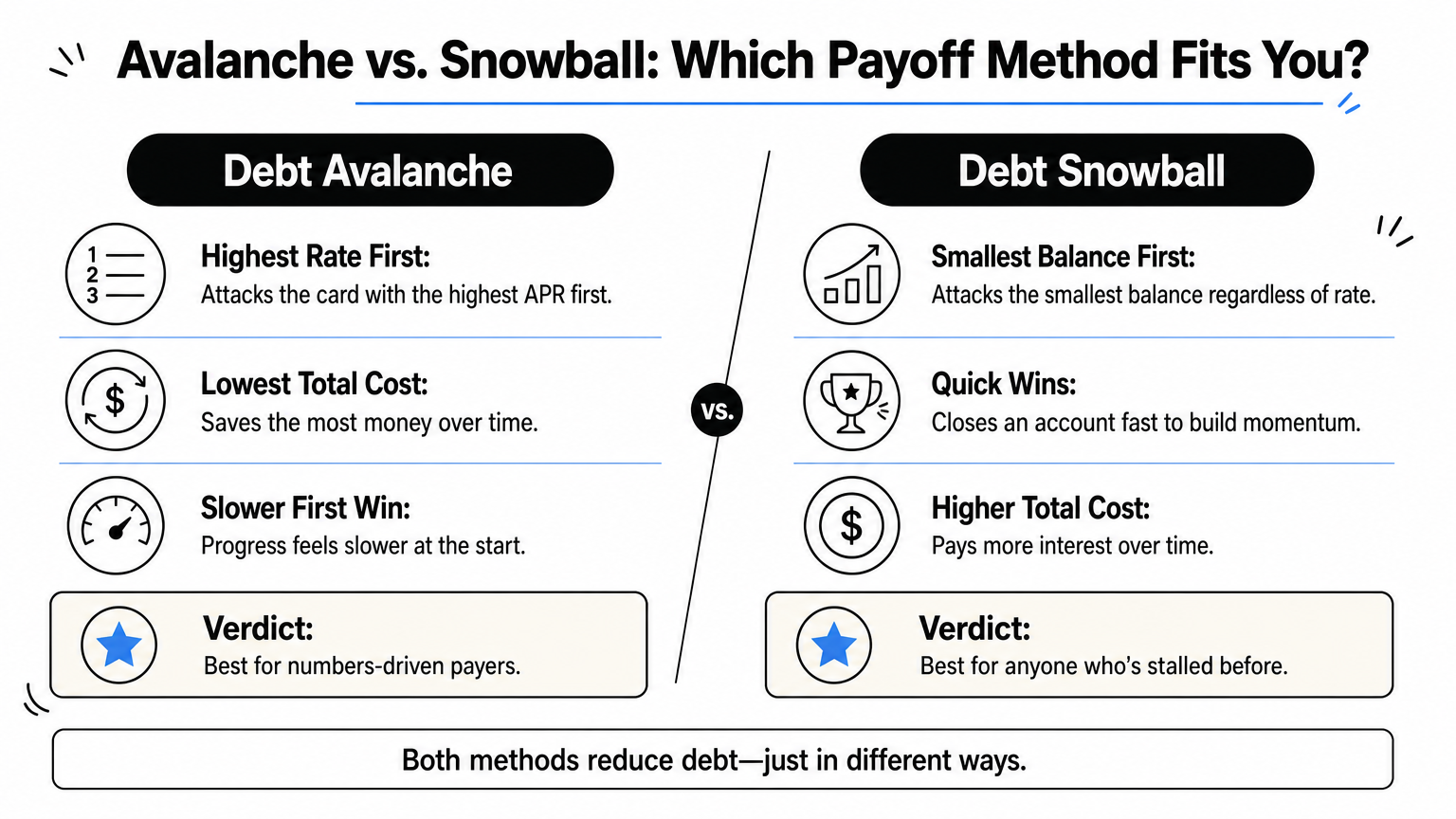
The debt avalanche targets your highest APR first
Under the avalanche method, you make minimum payments on every card except the one with the highest interest rate, and you throw every extra dollar at that card until it’s gone. Then you roll that payment into the card with the next-highest rate. Mathematically, this is the best way to get out of credit card debt if your only goal is paying the least amount of total interest, because you’re cutting off the most expensive debt first.
The avalanche saves you the most money. The snowball keeps you in the game long enough to use it.
The debt snowball targets your smallest balance first
The snowball method ignores interest rates entirely and orders your cards from smallest balance to largest. You attack the smallest one first, get the psychological win of closing an account fast, then roll that payment into the next-smallest balance. It costs more in total interest, but it builds momentum for people who’ve stalled out on previous payoff attempts.
Here’s how the two compare directly:
| Factor | Avalanche | Snowball |
|---|---|---|
| Order of attack | Highest APR first | Smallest balance first |
| Total interest paid | Lowest | Higher |
| Time to first "win" | Slower | Faster |
| Best for | Disciplined, numbers-driven payers | Anyone who’s given up before |
Which one actually fits how you get out of a credit card debt hole
Choose the avalanche if you’ve stuck with budgets before and want the cheapest path out. Choose the snowball if past attempts fizzled after a few months because progress felt invisible. Either method beats no method, so if you’re still stuck deciding, run both on paper using the balances from step one, then start with whichever list feels less overwhelming to look at today.
Step 4. Lower your interest rate through negotiation or transfer
Once your budget is generating extra payoff cash, the next lever is cutting the rate that cash has to fight against. Two tools do this well: calling your issuer directly, or moving your balance to a card built for payoff. Both attack the same problem from different angles, and combining them often produces the fastest results for anyone asking the best way to get out of credit card debt without waiting years.
Call and ask for a lower rate
Issuers would rather lower your rate than lose you to a competitor or a charge-off. Call the number on the back of your card, ask for retention or account services, and open a credit card debt negotiation by requesting a rate reduction based on your payment history. Keep the call short and specific:
"I've been a customer for [X years] with on-time payments.
My rate is currently [X]%. Other offers I've received are lower.
Can you match a lower APR to keep my business?"
A five-minute phone call can save you more than an hour of extra work at your job.
Haggling with your creditors works best if your score is decent and you’ve never missed a payment. Even a drop from 26% to 18% meaningfully changes how fast your avalanche or snowball plan clears a balance.
Balance transfer cards reset the clock
If your score sits above 680, a balance transfer credit card can move your balance to a new account offering 0% APR for 12 to 21 months. Every dollar you send goes straight to principal instead of interest during that window, which is exactly what people searching how to get out of debt credit card style problems need when negotiation alone won’t cut the rate enough.
| Option | Typical requirement | Rate relief | Best for |
|—|—|—|
| Rate negotiation | Fair to good credit, on-time history | Moderate reduction | Smaller balances, quick wins |
| Balance transfer | Score above 680 | 0% for 12-21 months | Larger balances, disciplined payoff plan |
Watch for the transfer fee, usually 3% to 5% of the balance moved, and calculate whether the interest saved still beats that upfront cost. Our guide to the best credit card for balance transfers breaks down which offers actually pay off versus which ones just look good on paper.
Step 5. Know when to bring in professional help
Sometimes the avalanche, snowball, and rate-cutting moves from steps three and four aren’t enough on their own, and that’s the moment to bring in outside help instead of grinding through another year of stalled progress. If your debt-to-income ratio is above 40%, if you’re already missing payments, or if your total balance would take more than five years to clear even with a tight budget, self-directed methods alone probably won’t get you there fast enough. Recognizing that isn’t failure. It’s often the best way to get out of credit card debt when the math has moved past what budgeting can fix.

Nonprofit credit counseling and debt management plans
Agencies certified by the National Foundation for Credit Counseling offer free consultations and can set up a debt management plan (DMP) that consolidates multiple cards into one monthly payment, often at a negotiated rate between 6% and 10%, and it helps to have credit counseling explained before you sign anything. Most DMPs pay off balances in three to five years, and because the agency negotiates directly with your issuers, you skip the awkward retention calls entirely.
A debt management plan trades a little control for a lot of certainty.
Compare your options before committing to any single path, starting with debt settlement versus debt consolidation:
| Option | Typical cost | Credit impact | Timeline |
|---|---|---|---|
| Nonprofit DMP | Small monthly fee | Minimal, cards close but score often recovers | 3-5 years |
| Debt settlement | Percentage of settled debt | Significant score drop | 2-4 years |
| Bankruptcy | Court and attorney fees | Severe, stays 7-10 years | Immediate discharge |
Why debt settlement deserves caution
Companies promising to settle your debt for pennies on the dollar usually require you to stop paying your cards entirely first, which tanks your score and invites collection calls before any settlement happens, so it’s worth knowing whether you really need a debt settlement lawyer. Watching your credit score drop 100+ points while waiting for a settlement offer isn’t a shortcut, it’s a gamble, and one of the riskiest paths anyone researching best ways to get out of credit card debt can take.
Signs it’s genuinely time to call for help
- You’ve missed two or more payments in the last six months
- Your minimum payments alone exceed 20% of your take-home pay
- Collections calls have already started
- You’ve tried a DIY plan for three months with no measurable progress
Getting professional guidance at this stage isn’t giving up on how to get out of credit debt fast, it’s making sure the fast path doesn’t backfire.
Staying debt-free once you get there
Paying off your last card feels like crossing a finish line, but the habits that help you maintain good credit matter more once the balance hits zero. Keep the bare-bones budget mindset for at least a few more months, redirecting what used to be your payment toward a small emergency fund instead of new spending. Build that cushion to at least $1,000, then grow it to cover three months of expenses, so a car repair or medical bill doesn’t send you back to a revolving balance.
Remember the five steps whenever a new balance starts creeping up: total what you owe, free up cash, pick avalanche or snowball, cut your rate, and call for help before things spiral. That sequence works whether you’re paying off $3,000 or $30,000. If you want a deeper breakdown of which payoff tools fit your exact numbers, see how to get out of credit card debt fast and build a plan that actually sticks.