The best debt relief programs in NJ are the ones that match your credit score, your income, and how much you owe. If you have steady income and can repay in three to five years, start with nonprofit credit counseling and a debt management plan. If your credit is good, a consolidation loan or a 0% balance transfer card costs less. If you are far behind and cannot repay in full, settlement, free legal aid, or bankruptcy come next.
New Jersey does not run a state program that forgives credit card debt, so every real option comes from a nonprofit, a lender, a court, or a legal aid group. That makes the choice confusing, and it makes scams easy. Companies that promise to cut your balance in half rarely mention the fees, late penalties, and credit damage that come with it.
Credit Card Solution is an educational site, not a lender or a settlement company, so we have nothing to enroll you in. Below you get six options, each with how it works, who it suits, and what it costs. Then you get the New Jersey rules that protect you and a simple way to choose.
1. Nonprofit credit counseling and debt management plans
Nonprofit credit counseling is the best first call for most New Jersey residents with credit card debt. The first session is usually free, and it can lead to a debt management plan (DMP) that cuts your interest.
How it works
A certified counselor reviews your income, bills, and debts, then builds a budget with you. If a DMP fits, the agency asks your card issuers to lower your interest rate and waive some fees. You make one monthly payment to the agency, and it pays your creditors. Plans usually run three to five years and cover unsecured debt such as credit cards and medical bills, not mortgages or car loans.
Look for an agency that is a nonprofit and accredited, for example through the National Foundation for Credit Counseling. The New Jersey Department of Banking and Insurance publishes a list of financial counseling organizations that you can check an agency against before you share your finances.
Who it suits
A DMP fits you if you have steady income, can commit to a fixed payment, and your main problem is interest rather than the balance itself. Your credit score is generally not the gate for enrollment, so this is the main route for people whose scores are too low for a loan or a good 0% card.
- Good fit: you can repay the full balance within five years, your cards charge high interest, and you want one payment instead of five.
- Weak fit: your income is unstable, most of your debt is secured, or you cannot afford even the reduced payment.
Costs and risks
Agencies typically charge a setup fee and a small monthly fee, so ask for the schedule in writing. Enrolled cards are usually closed, and a missed payment can cause creditors to withdraw the reduced rate. Creditors may also refuse to join a plan, so the counselor can only tell you what is likely, not guarantee it.
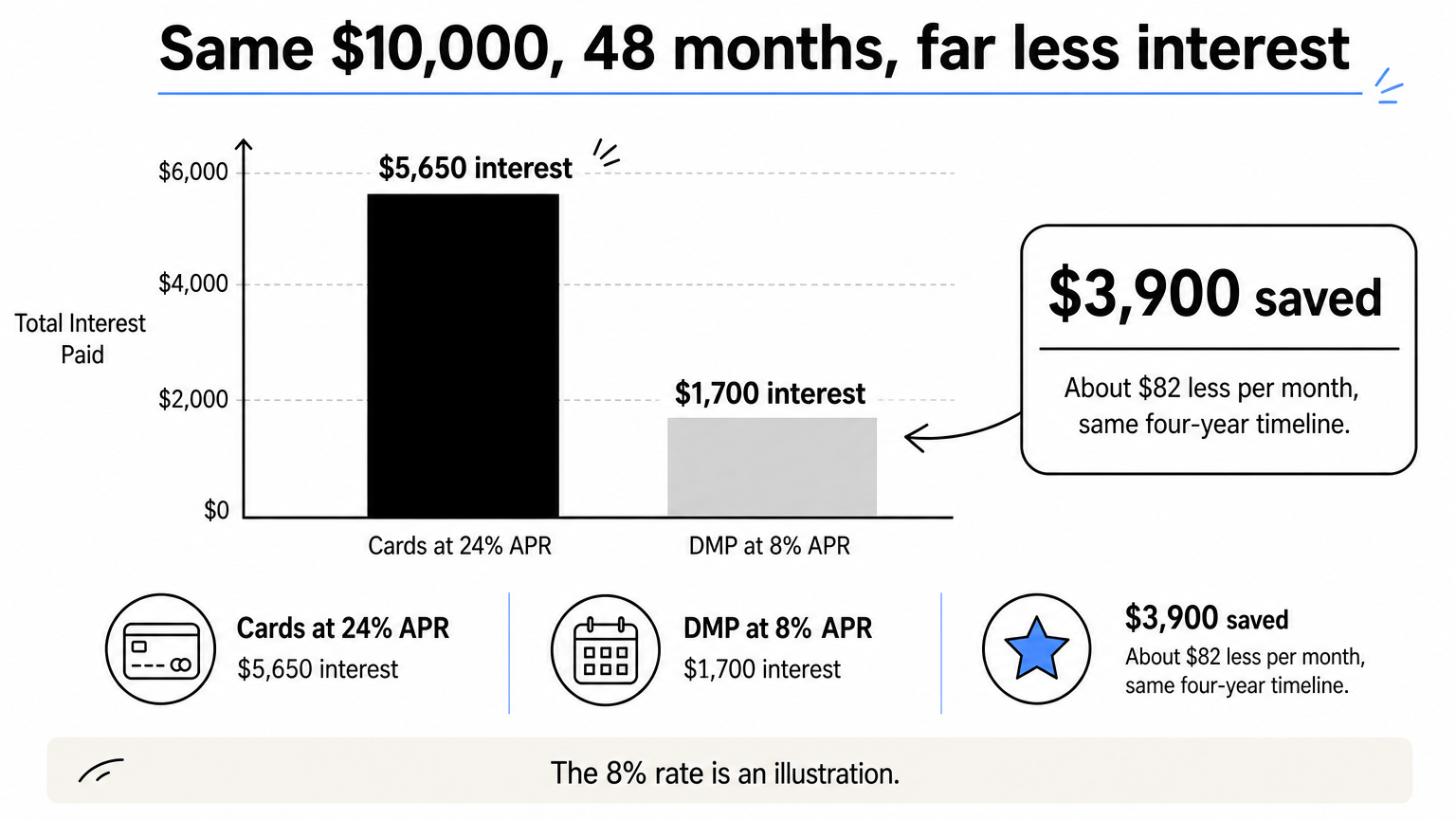
Here is a worked example. Take $10,000 in card debt paid off over 48 months. The 8% rate is an illustration, because the rate you get depends on your creditors.
| Path | Monthly payment | Total interest |
|---|---|---|
| Cards at 24% APR | about $326 | about $5,650 |
| DMP at 8% APR | about $244 | about $1,700 |
That is roughly $82 a month and $3,900 in interest saved, with the same debt and the same four-year timeline.
A debt management plan does not shrink what you owe, it shrinks what the debt costs you.
2. Debt consolidation loans
A debt consolidation loan is a personal loan that pays off your cards so you owe one lender one fixed payment. It saves money only when its rate is lower than the rates on your cards.
How it works
You apply at a bank, credit union, or online lender. If approved, the money pays your card balances, either sent to the card issuers directly or deposited to you. Terms usually run two to five years, and the payment never changes. Your rate depends on your credit score, income, and existing debt, so shop at several lenders and compare the full APR, not just the monthly payment.
Who it suits
A consolidation loan suits you if your score is in the good range, roughly 670 or higher, your income is steady, and you are ready to stop using the cards. Lower scores can still qualify, but the rate may be close to what your cards charge, which defeats the purpose.
Consolidation works best on unsecured debt like credit cards and medical bills. It is a poor fit if your balance is small enough to clear in a year or if you tend to run cards back up.
Costs and risks
Some lenders charge an origination fee, often a few percent of the loan, so a loan with a lower rate can still cost more than one with a slightly higher rate and no fee. A hard credit check can dip your score for a short time. The bigger danger is behavioral: if you keep charging after the loan clears your cards, you end up with the loan payment and new card balances.
As a benchmark, $10,000 at 12% over 48 months is about $263 a month and $2,640 in interest. Compare that with the 24% card figure above, and you can see why the rate gap is everything.
A consolidation loan fixes the payment, not the spending that created the balance.
3. Balance transfer credit cards
A balance transfer card moves your debt to a new card with an introductory 0% APR, so every payment goes to principal. It is the cheapest option on this list if you can clear the balance before the promotion ends.

How it works
You apply for the card, then request a transfer from your old card to the new one. Promotional periods commonly run 12 to 21 months, and most cards charge a transfer fee of 3% to 5%. The fee is added to your balance on day one. Most issuers will not let you transfer a balance between two of their own cards.
Here is a worked example. You move $6,000 with a 3% fee. The fee is $180, so your new balance is $6,180. To clear it in an 18-month promotion, you pay about $343 a month. Divide your balance plus the fee by the promotional months before you apply, and you know immediately whether the plan is realistic.
Who it suits
This option suits you if you have good to excellent credit, a balance you can realistically repay within the promotional window, and the discipline to leave the old cards alone. Approval is also limited by the credit line you receive, which may be lower than your total debt.
Costs and risks
When the promotion ends, any remaining balance starts accruing at the card’s regular APR, which is often above 20%. Many cards end the promotional rate if you pay late, and new purchases may not get the 0% rate. The fee, the shorter deadline, and the credit check all count against the savings. If you need more than two years, a loan or a DMP is safer.
Treat the 0% window as a deadline, not a discount.
4. Debt settlement
Debt settlement means paying a creditor less than you owe in a negotiated deal. It can work when you are already far behind, but it damages your credit, can trigger a tax bill, and carries the highest scam risk of any option here.
How it works
With a for-profit settlement company, you typically stop paying your cards and deposit money each month into a dedicated account. When the balance is large enough, the company offers creditors a lump sum. The process usually takes two to three years, and creditors are not required to accept any offer. Meanwhile, interest and late fees keep adding to what you owe.
A few nonprofit agencies also offer structured settlement-style programs with participating creditors. Availability is narrow, so ask a nonprofit counselor whether your issuers take part before you pay a for-profit company.
Who it suits
Settlement is a hardship tool. It fits you if you carry a large unsecured balance, have lost income through job loss, illness, or medical bills, and cannot repay in full even over five years, but you want to avoid bankruptcy. It does not suit you if you can afford a DMP, because a DMP does less damage.
Costs and risks
Expect these costs:
- Missed payments hit your credit, and the settled accounts stay on your report for about seven years.
- Collection calls continue, and a creditor can sue you before a deal is reached.
- Forgiven debt of $600 or more is generally reported to the IRS and may count as taxable income, unless an exception such as insolvency applies. Ask a tax professional.
- Company fees come on top of the settlement amount.
Federal rules bar debt settlement companies that sell by phone from charging a fee before they have settled at least one of your debts. Walk away from anyone who asks for money up front.
Settlement is a hardship tool, not a discount program.
5. Free legal aid for debt problems
If your income is low and a collector is suing, garnishing, or harassing you, free legal aid is a real debt relief option in New Jersey. It is the only item here that protects your rights rather than restructuring payments.

How it works
Volunteer Lawyers for Justice runs a Debt Relief Legal Program that gives legal help to New Jerseyans experiencing poverty who face debt problems, including bankruptcy help. Eligibility is income-based, and you apply through intake. You can also dial 2-1-1 for NJ 211, which refers residents to financial coaching and counseling programs in their area.
A lawyer can check whether a collector can prove the debt, whether the statute of limitations has passed, and whether your income is protected. They can also tell you honestly if bankruptcy makes sense.
Who it suits
This route suits you if you have received a court summons, have a judgment against you, or are facing wage garnishment, and you cannot afford an attorney. It also suits you if you are considering bankruptcy but have no money for filing and attorney fees.
Ignoring a summons is the costliest mistake in this whole topic. A default judgment can open the door to wage garnishment and bank levies, so respond before the court deadline.
Costs and risks
The service is free to those who qualify, but capacity is limited and income rules apply. Legal aid will not lower your interest rates, consolidate your cards, or build a budget. Pair it with credit counseling if you also need a repayment plan.
If a collector has sued you, a lawyer comes before any payment plan.
6. Chapter 7 and Chapter 13 bankruptcy
Bankruptcy is the strongest form of debt relief and the heaviest on your credit. It makes sense when you cannot repay your debts within about five years, even with lower interest.
How it works
You file a petition in federal bankruptcy court, and an automatic stay halts most collection calls, lawsuits, and garnishments. You must complete credit counseling with an approved agency before filing and a financial course before the court discharges your debts. The two main types work differently.
| Chapter 7 | Chapter 13 | |
|---|---|---|
| What happens | A trustee sells non-exempt assets to pay creditors, and remaining unsecured debt is discharged | You repay part or all of your debt through a court-approved plan |
| Typical length | A few months | Three to five years |
| Income test | Means test compares your income to the state median | Requires regular income |
| On your credit report | Up to 10 years | Up to 7 years |
Who it suits
Bankruptcy suits you if your debts are large compared with your income, you have few assets to protect, and every other option takes longer than five years. Chapter 13 suits people with steady income who want to keep property or catch up on a mortgage. Before you file, talk to a New Jersey bankruptcy attorney, and call legal aid first if money is tight.
Costs and risks
Expect a sharp drop in your credit score, plus court filing fees and attorney fees. Student loans and most tax debts are usually not discharged. Credit for a home or car will be harder and pricier for years, though many people find that their score recovers faster than they expected once the debt is gone.
Bankruptcy is the right answer when every other option takes longer than five years.
New Jersey rules that protect you from collectors
Federal and state law limit what collectors and debt relief sellers can do to you in New Jersey. Knowing these rules helps you spot illegal behavior and avoid paying a debt that a court could no longer enforce.
Collector conduct and consumer protections
These are the rules that matter most when a collector calls or a company pitches you a program:
| Rule | What it means for you |
|---|---|
| Federal Fair Debt Collection Practices Act | Collectors cannot harass, deceive, or threaten you. You can sue over violations and may recover damages and attorney fees. |
| NJ Consumer Fraud Act | Bans deceptive and unconscionable practices in selling services, including debt relief offers. Winning consumers can recover triple damages and attorney fees. |
| Wage garnishment limits | A creditor needs a court judgment first. New Jersey caps garnishment at 10% for lower earners and 25% for others, tighter than the federal minimum. |
| Interest cap | New Jersey generally caps interest at 30% on personal loans under $50,000. |
When a collector contacts you, ask for written validation of the debt and dispute it in writing within 30 days of the first notice. Keep copies of everything.
Time limits on old debts
The statute of limitations on most consumer debt in New Jersey is six years, and it is generally shorter for auto loan debt. After it expires, a collector can still ask you to pay, but it should not win a lawsuit if you raise the time limit as a defense. You must show up in court and raise it yourself.
Be careful with old accounts. A payment or a written acknowledgment of the debt can restart the clock, so confirm the debt’s age and your legal position before sending money on anything that is years old.
Never pay on a very old debt until you know whether the clock has run out.
How to choose the right option for your situation
Pick based on two questions. Can you repay in full within five years, and is your credit in good shape? Your answers point to one of the six options above.
Match the option to your situation
| Your situation | Best first move |
|---|---|
| Good credit, steady income, balance payable in 18 to 21 months | Balance transfer card |
| Good credit, steady income, payoff takes two to five years | Consolidation loan |
| Fair or poor credit, steady income, can repay in three to five years | Nonprofit counseling and a DMP |
| Behind on payments, hardship, cannot repay in full | Counseling first, then compare settlement and bankruptcy |
| Sued, garnished, or low income | Free legal aid |
| Cannot repay within five years | Consult a bankruptcy attorney |
If you are unsure, book the free counseling session first. A good counselor will tell you when a loan, a card, or bankruptcy beats their own program.
Spot a scam before you sign
Walk away if a company does any of the following:
- Charges fees before it settles or reduces any debt
- Guarantees a result, such as cutting your balance by half
- Tells you to stop communicating with creditors or to ignore a lawsuit
- Will not explain fees, risks, and credit impact in writing
- Pressures you to sign the same day
Ask every agency what it charges, how long the program lasts, which creditors participate, and what happens if you miss a payment. A legitimate provider answers all four plainly.
Free counseling first, then decide, and never pay anyone to promise results.
Your next step
New Jersey has no single state program for credit card debt, but you have six real options. Nonprofit counseling and a DMP fit most people with steady income. Loans and 0% cards reward good credit. Settlement, legal aid, and bankruptcy handle debt you cannot repay in full. The rules above keep collectors and scammers in check while you decide.
Pick one move this week: book a free counseling session, check your credit score, or call legal aid if you have been sued. For more help comparing balance transfers, consolidation, and repayment plans, read the credit card debt relief guides on Credit Card Solution.