The legitimate credit card debt relief for nurses is the same toolkit any consumer has: a nonprofit debt management plan, a consolidation loan or balance transfer card, help through your employer, and debt settlement as a last resort. No federal program forgives credit card balances because you are a nurse. Match the option to your credit score and income. Good credit and steady pay suit a loan or transfer card. Damaged credit suits a debt management plan. Real hardship may justify settlement.
Nursing pay is solid, but shift patterns, contract gaps, and student loans can push monthly expenses onto cards. At 18% to 29% APR, minimum payments barely touch the principal. Then you search for relief and find pages that blur real options with sales funnels.
This article ranks four options from lowest to highest risk, shows what each costs, and explains how to check whether an offer is legit. Credit Card Solution is an educational site funded by advertising. We do not lend, settle, or enroll anyone in anything, so you can use this to decide what to ask a counselor or lender.
1. Nonprofit debt management plan
A debt management plan (DMP) is the lowest-risk way to repay card debt on a fixed schedule. You make one monthly payment to a nonprofit credit counseling agency, which pays your issuers and usually finishes the job in three to five years.

How it works
A counselor reviews your income, expenses, and balances. If you qualify, the agency asks your issuers for lower interest rates and waived fees. Then it collects one payment from you each month and splits it among your cards. You still repay the full principal, but far more of each payment goes to it.
A DMP does not shrink what you owe, it shrinks the interest that keeps you from paying it off.
Who it suits
A DMP fits nurses whose credit is too damaged for a good loan rate but who still earn steady pay. If your take-home covers the reduced payment with room for rent and groceries, this is usually the best first call. It fits poorly if you cannot afford the plan payment, because missed payments can get you dropped from the plan.
Cost and risks
Agencies may charge a setup fee and a small monthly fee, so get the schedule in writing. Most plans require you to close the enrolled cards. That lowers your available credit and can dip your score at first. Before you enroll, confirm:
- The agency is a nonprofit.
- You have the full fee schedule in writing.
- You know which cards must close.
- You know what happens if you miss a payment.
2. Consolidation loan or balance transfer card
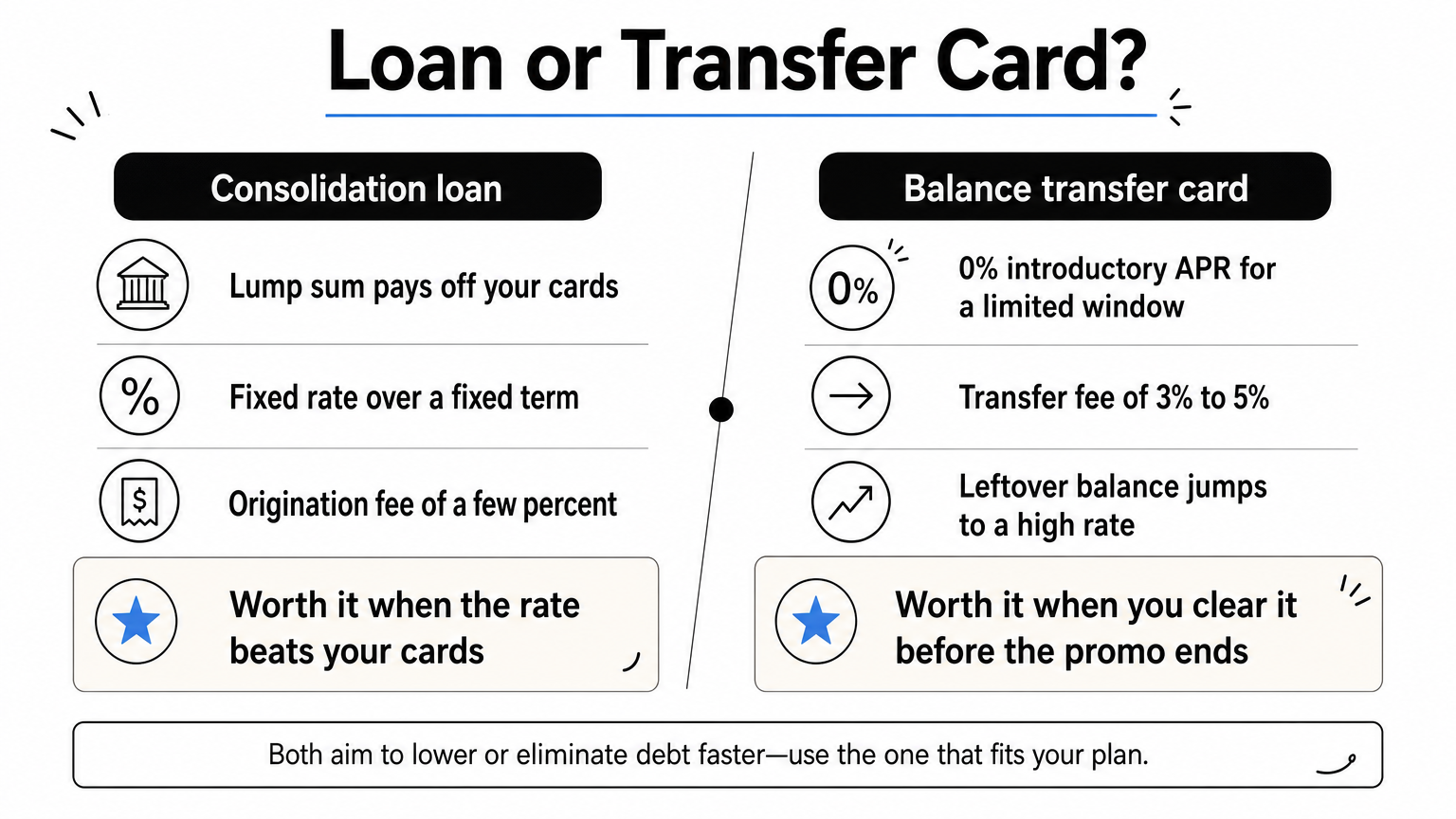
Both tools swap several high-rate balances for one cheaper balance, and both work best with good credit. If your score is around 700 or higher, this is usually the cheapest route. The savings depend on the rate you actually get.
How it works
A personal loan pays off your cards with a lump sum. You then repay it at a fixed rate over a fixed term. A balance transfer card moves balances to a 0% introductory APR, usually for a limited window, and typically charges a transfer fee of 3% to 5%.
Take a nurse with $15,000 across three cards at 24%. The first month’s interest alone is about $300. A 60-month loan at 12% costs about $334 a month and about $5,000 in total interest. A transfer card with a 4% fee costs $600 upfront. You would need about $833 a month to clear $15,000 in 18 months.
Consolidation only works if the cards stay at zero afterward.
Who it suits
This route suits nurses with steady income and a score that earns a real rate cut. Check credit unions first, including any that serve your hospital’s employees, since they often price personal loans below banks. If the best rate you are offered sits near your current card rates, skip the loan, because the fees will eat the savings.
Cost and risks
Loans often carry an origination fee of a few percent, which comes out of the loan or adds to it. Transfer cards punish slow payoff, because the leftover balance jumps to a high regular rate once the promo ends. The bigger risk is behavioral. Running the emptied cards back up leaves you with the new loan and a new pile of card debt.
3. Hospital and employer programs
Your employer will not erase card debt, but it can cut the cost of every other option. No hospital program forgives credit cards. What exists is counseling, cheaper credit, and student loan help that frees cash for your cards.
How it works
Ask HR what your employer offers, because benefits vary widely. Look for these:
- An employee assistance program that includes financial counseling
- An employee credit union with low-rate personal loans
- Financial wellness benefits or loan repayment help
- Options to pick up extra shifts
Skip fee-based paycheck advances. They replace one expensive debt with another.
The cheapest relief is the one your employer already pays for, so ask HR before you apply anywhere else.
Who it suits
Every nurse should check this first, especially those with student loans. The Nurse Corps Loan Repayment Program pays up to 85% of unpaid nursing education debt for RNs, APRNs, and nurse faculty. Public Service Loan Forgiveness can forgive a Direct Loan balance after 120 qualifying payments with a qualifying nonprofit or government employer.
Cost and risks
Neither program touches your card balances. Their value is cash flow. If a freed-up student loan payment goes straight to your highest-rate card, you shorten payoff by years. Nurse Corps requires a service commitment at an eligible facility, and awards are not guaranteed. PSLF demands a long stretch of on-time payments. Treat both as a long-term supplement, not a rescue.
4. Debt settlement as a last resort
Debt settlement means paying a creditor less than you owe to close the account. It can be legit, but it is the riskiest option here. Use it only when you cannot repay in full, even on a DMP.

How it works
You or a settlement company negotiate a lump-sum payoff below the balance. Companies usually have you stop paying your cards and save into a dedicated account while the debts go delinquent. Then they negotiate. Under the FTC’s telemarketing rules, a company cannot charge fees until it settles a debt and you agree to the deal.
If a settlement company asks for money before it settles a debt, walk away.
Who it suits
Settlement fits nurses facing real hardship, such as illness, a long layoff, or a major income drop, with unsecured balances they cannot clear within about five years. Debt relief does not by itself threaten your nursing license. Some employers do check credit, so ask about their policy if a job change is coming.
Cost and risks
While you stop paying, late fees and interest keep piling up, and collection calls or a lawsuit are possible. Your score takes a heavy hit. Forgiven debt of $600 or more is typically reported to the IRS, and the forgiven amount may count as taxable income unless you were insolvent. Settlement companies charge a percentage of the debt. If settlement cannot work, talk to a bankruptcy attorney about Chapter 7 or Chapter 13 before the situation worsens.
Is nurse credit card debt relief legit?
Nurse credit card debt relief is legit when it is one of the four options above from a transparent provider. It is not legit when it promises special forgiveness for nurses. Judge the provider and the contract, not the nurse label on the landing page.
What is real and what is marketing
No government or hospital program cancels credit card balances because of your profession. Pages that say "nurse debt relief" usually sell standard consolidation or settlement with a nurse label. The truly nurse-specific help is on the student loan side and in employer benefits, which is why option 3 comes first in your research even though it ranks third here.
Red flags that signal a scam
Walk away if a company does any of the following:
- Charges fees before settling a debt
- Guarantees a result or a "forgiveness" amount
- Tells you to stop paying without explaining the credit damage
- Will not give you a written contract and fee schedule
- Pressures you to sign today
Verify a counseling agency’s nonprofit status, and check complaints with your state attorney general’s office before you hand over account information.
How the four options compare
| Option | Best for | Typical timeline | Credit impact |
|---|---|---|---|
| Debt management plan | Fair or damaged credit, steady pay | 3 to 5 years | Cards close, then score recovers with on-time payments |
| Consolidation loan | Good credit | Fixed term, often 3 to 5 years | Small dip, then improves as balances fall |
| Balance transfer card | Good credit, fast payoff | Promo window, often 12 to 21 months | Small dip, high risk after the promo |
| Debt settlement | Hardship, cannot repay in full | Typically 2 to 4 years | Heavy damage |
Employer help sits outside the table because it combines with any row. Start there, then choose by credit score and income stability.
Pick the option you can finish
Credit card debt relief for nurses comes down to four real tools, and the best one is the one you can complete without missing a payment. Check employer benefits first. Then use a loan or transfer card if your credit is good, a nonprofit debt management plan if it is not, and settlement only when full repayment is out of reach.
Before you sign anything, get the fees in writing and refuse any provider that wants money upfront or promises forgiveness. A few hours of checking now protects months of paychecks. For more step-by-step guides on payoff strategies and credit repair, read more debt relief guides from Credit Card Solution.