
Booking flights and hotels can put a few thousand dollars on your card in a week. If you pay it all off before the bill is due, you’re fine. If you don’t, 18% to 29% interest turns a great trip into a long hangover. Travel credit cards with 0 APR solve part of that problem by letting you earn rewards while you pay trip costs over time with no interest.
Here is the short answer. The best 0 APR travel credit cards pair a 0% intro APR on purchases, usually 12 to 15 months, with a solid rewards rate and a low or waived annual fee. Most of them require good to excellent credit, so a score of 700 or higher gives you the best shot at approval.
Below you’ll find nine cards we ranked by intro APR length, rewards value, fees, and sign-up bonuses. For each one, you’ll see who it fits and what to watch for. We’ll also flag the trap that catches many travelers: the intro rate ends, and any balance left over starts accruing interest at a high rate.
1. Wells Fargo Autograph Card
The Autograph takes the top spot because it does the most for $0 a year. Few travel credit cards with 0 APR pair a 3X travel category with a 12-month intro window and no annual fee.
Intro APR and ongoing APR
New cardholders get 0% intro APR for 12 months on purchases and qualifying balance transfers. After that, a variable APR applies. At last check it ranged from 18.24% to 28.74%, depending on your credit. Rates change, so confirm the current terms on the issuer’s page before you apply. Picture a $3,600 trip. Split over 12 months, that is $300 a month, and you pay no interest if you hit that pace.
A 12-month 0% window only helps if the balance reaches zero before month 13.
| Feature | Details (verify before applying) |
|---|---|
| Intro APR on purchases | 0% for 12 months |
| Ongoing APR | 18.24% to 28.74% variable |
| Annual fee | $0 |
| Foreign transaction fee | $0 |
| Welcome bonus | 20,000 points after $1,000 in 3 months |
Rewards and annual fee
You earn 3X points on restaurants, travel, gas stations, transit, popular streaming services, and phone plans. Everything else earns 1X. Points are worth about one cent each, so you get roughly 3% back on trip spending. The 20,000-point welcome bonus is worth about $200. The card also skips foreign transaction fees, which matters once you leave the country. Cell phone protection of up to $600 per claim is a useful extra if you pay your monthly phone bill with the card.
Who it is best for
Pick this card if you have good to excellent credit, ideally 700 or higher, and want one no-fee card for flights, hotels, dining out, and gas. It suits travelers who plan to finance a $2,000 to $4,000 trip over about a year. It also works well if you want simple rewards without tracking rotating categories or transfer partner charts.
Drawbacks to know
The 12-month intro period is shorter than the 15 to 18 months some competitors offer. Plan a payoff schedule on day one, because any leftover balance starts accruing interest at the ongoing rate. Points are worth a flat one cent for most redemptions, so you will not get outsized value from luxury awards. You also get no lounge access, travel credits, or trip delay perks. Groceries and general shopping earn only 1X, so this card is not your best choice for everyday spending outside its bonus categories.
2. Capital One VentureOne Rewards Credit Card
The VentureOne trades some rewards for a longer runway. It gives you three more interest-free months than the Autograph, which helps when your trip bill is big and your budget is tight.
Intro APR and ongoing APR
New cardholders get 0% intro APR for 15 months on purchases and balance transfers. After that, a variable APR applies. At last check it landed in the high teens to high twenties, so confirm current terms with Capital One before you apply. Run the same $3,600 trip through 15 months and your payment drops to $240 a month.
Three extra months of 0% cut the monthly payment on a $3,600 trip from $300 to $240.
| Feature | Details (verify before applying) |
|---|---|
| Intro APR on purchases | 0% for 15 months |
| Ongoing APR | About 19% to 29% variable |
| Annual fee | $0 |
| Foreign transaction fee | $0 |
| Welcome bonus | 30,000 miles after $500 in 3 months |
Rewards and annual fee
You earn 1.25 miles per dollar on every purchase, with no categories to track. Hotels, vacation rentals, and rental cars booked through Capital One Travel earn 5 miles per dollar. The welcome bonus is worth about $300 when you redeem miles at one cent each against travel purchases. There is no annual fee, and no foreign transaction fee either. You can also transfer miles to airline and hotel partners, but the ratio is less generous than on Capital One’s premium cards.
Who it is best for
Choose this card if you have good to excellent credit and need 15 months to pay off a larger trip. It also suits anyone who wants flat, predictable rewards on all spending. If you search for 0 APR credit cards travel planners recommend and want the longest window so far on this list, this is the first to reach 15 months.
Drawbacks to know
The flat 1.25X rate is weaker than the Autograph’s 3X on restaurants, gas, and travel. The 5X bonus only applies through Capital One Travel, so you give up the chance to shop around on other booking sites. Transfer partners convert at a discount, which trims the value of airline awards. You get no lounge access or travel credits. Once month 16 arrives, any leftover balance starts accruing interest at the ongoing rate.
3. Discover it Miles
The Discover it Miles has a trick no other card here can match: it doubles your first-year rewards. It also matches the VentureOne’s 15-month interest-free window.
Intro APR and ongoing APR
New cardholders get 0% intro APR for 15 months on purchases and balance transfers. After that, a variable APR applies. At last check it sat in the high teens to mid-twenties, so confirm current terms with Discover before you apply. Put a $3,600 trip on the card and you pay $240 a month to clear it in time.
The 15-month window is a payoff deadline, not a discount.
| Feature | Details (verify before applying) |
|---|---|
| Intro APR on purchases | 0% for 15 months |
| Ongoing APR | About 17% to 26% variable |
| Annual fee | $0 |
| Foreign transaction fee | $0 |
| Welcome bonus | All first-year miles matched |
Rewards and annual fee
You earn 1.5 miles per dollar on every purchase, with no categories to track. Miles are worth one cent each when you redeem them as a statement credit against travel purchases or as cash. At the end of your first year, Discover matches all the miles you earned. Spend $5,000 and your 7,500 miles become 15,000, worth about $150. There is no annual fee and no foreign transaction fee.
Who it is best for
This card suits you if you have good to excellent credit and want a flat rewards rate without chasing bonus categories. It works best when you expect to spend $4,000 to $8,000 in the first year, so the match has something to double. It is one of the few travel credit cards 0 APR shoppers can pair with a built-in first-year bonus, and the 15-month runway gives you room to pay off a bigger trip.
Drawbacks to know
Acceptance is the main catch. Discover is accepted in fewer places abroad than Visa or Mastercard, so carry a backup card on international trips. There are no airline or hotel transfer partners, so miles are worth a flat cent each. The 1.5X rate is also half of what the Autograph pays on restaurants, gas, and travel. The match applies only in year one, and you get no lounge access or travel credits. If a balance remains after month 15, it starts accruing interest at the ongoing rate.
4. Citi Strata Card
The Strata Card matches the 15-month window of the VentureOne and Discover, but it pays more at grocery stores and gas stations. That makes it a smart pick when your trip prep includes a lot of everyday spending.
Intro APR and ongoing APR
New cardholders get 0% intro APR for 15 months on purchases and balance transfers, and transfers must post within the first four months. After that, a variable APR applies. At last check it ran from the high teens to the high twenties, so confirm current terms with Citi. On a $3,600 trip, 15 months works out to $240 a month.
Fifteen months of 0% only helps if your payoff plan starts the day you book.
| Feature | Details (verify before applying) |
|---|---|
| Intro APR on purchases | 0% for 15 months |
| Ongoing APR | About 18% to 29% variable |
| Annual fee | $0 |
| Foreign transaction fee | 3% |
| Welcome bonus | 20,000 points after $1,000 in 3 months |
Rewards and annual fee
You earn 5X points on hotels, car rentals, and attractions booked through Citi’s travel portal. Supermarkets, gas and EV charging stations, and select transit earn 3X. Most other purchases earn 1X. Citi’s category lineup changes from time to time, so check the current list. The welcome bonus is worth about $200 when you redeem through the portal. The annual fee is $0.
Who it is best for
Pick this card if you have good to excellent credit and want one of the travel credit cards with 0 APR that also rewards groceries and gas. It suits you if you spend heavily on everyday categories while saving for a trip. It also fits travelers who are happy to book hotels through Citi’s portal and want 15 months to pay the bill.
Drawbacks to know
Foreign purchases carry a 3% transaction fee, which wipes out most of the rewards you earn abroad. Skip this card for international trips and bring a no-fee option like the Autograph instead. The 5X rate applies only through Citi’s portal, so you lose the chance to compare prices elsewhere. You get no lounge access or travel credits. Any balance left after month 15 starts accruing interest at the ongoing rate.
5. Chase Freedom Unlimited
The Freedom Unlimited is a cash back card, not a miles card, but it earns its place here. It is one of the few travel credit cards with 0 APR that pays 5% on travel booked through Chase and also covers your everyday spending.
Intro APR and ongoing APR
New cardholders get 0% intro APR for 15 months on purchases and balance transfers. After that, a variable APR applies. At last check it ran from the high teens to the high twenties, so confirm current terms with Chase. On a $5,000 trip, 15 months works out to about $333 a month.
Divide your trip bill by 15 on the day you book, and that is your monthly payment.
| Feature | Details (verify before applying) |
|---|---|
| Intro APR on purchases | 0% for 15 months |
| Ongoing APR | About 19% to 28% variable |
| Annual fee | $0 |
| Foreign transaction fee | 3% |
| Welcome bonus | Extra 1.5% back on up to $20,000 spent in year one |
Rewards and annual fee
You earn 5% back on travel booked through Chase Travel and 3% on dining, takeout, delivery, and drugstores. Everything else earns 1.5%. The first-year bonus adds 1.5% on up to $20,000 of spending, worth as much as $300. The annual fee is $0. Rewards come as Ultimate Rewards points, which you can redeem for travel or cash.
Who it is best for
Choose this card if you have good to excellent credit and want one card for trip bookings and daily spending. It suits you when you book hotels or flights through Chase and also eat out often. It also fits anyone who wants the 15-month window plus a first-year bonus that rewards a big spending year.
Drawbacks to know
Foreign purchases carry a 3% transaction fee, so leave this card at home on international trips. The 5% rate applies only through Chase’s portal, which limits your booking options. Points transfer to airline and hotel partners only if you also hold a premium Chase card. You get no lounge access or travel credits. Any balance left after month 15 starts accruing interest at the ongoing rate.
6. Bank of America Travel Rewards credit card
This is the simplest card on the list. Among travel credit cards with 0 APR, it pairs a 15-billing-cycle intro window with a flat 1.5X rewards rate and no foreign transaction fee.
Intro APR and ongoing APR
New cardholders get 0% intro APR for 15 billing cycles on purchases. Balance transfers made in the first 60 days qualify too. After that, a variable APR applies. At last check it ran from about 18% to 28%, so confirm current terms with Bank of America. On a $3,600 trip, 15 cycles works out to $240 a month.
Billing cycles are not calendar months, so aim to finish paying a few weeks early.
| Feature | Details (verify before applying) |
|---|---|
| Intro APR on purchases | 0% for 15 billing cycles |
| Ongoing APR | About 18% to 28% variable |
| Annual fee | $0 |
| Foreign transaction fee | $0 |
| Welcome bonus | 25,000 points after $1,000 in 90 days |
Rewards and annual fee
You earn 1.5 points per dollar on every purchase, with no categories to track. The welcome bonus is worth about $250 as a statement credit against travel and dining. There is no annual fee. Preferred Rewards members, who keep qualifying balances at Bank of America or Merrill, get a 25% to 75% points boost. That can lift the flat rate to roughly 2.6X.
Who it is best for
Pick this card if you have good to excellent credit and want flat rewards with a long payoff runway. It is especially strong if you already bank with Bank of America, because the Preferred Rewards boost beats most cards here. It also suits international travelers who want a no-fee card with predictable earnings.
Drawbacks to know
Without a Preferred Rewards balance, 1.5X trails the Autograph’s 3X on dining, gas, and travel. Points are worth a flat cent for statement credits, and there are no airline or hotel transfer partners. You get no lounge access or travel credits. Any balance left after cycle 15 starts accruing interest at the ongoing rate.
7. Citi Custom Cash Card
This card flips the usual travel-card logic. It has no fixed bonus list. Instead, it automatically pays 5% on your top spending category each billing cycle, and travel can be that category when you are booking a trip.
Intro APR and ongoing APR
New cardholders get 0% intro APR for 15 months on purchases and balance transfers, and transfers must post within the first four months. After that, a variable APR applies. At last check it ran from the high teens to the high twenties, so confirm current terms with Citi. A $3,000 trip works out to $200 a month over 15 months.
| Feature | Details (verify before applying) |
|---|---|
| Intro APR on purchases | 0% for 15 months |
| Ongoing APR | About 18% to 28% variable |
| Annual fee | $0 |
| Foreign transaction fee | 3% |
| Welcome bonus | $200 cash back after $1,500 in 6 months |
Rewards and annual fee
You earn 5% cash back on the first $500 you spend each billing cycle in your top eligible category. Select travel is on the list, along with restaurants, gas stations, and grocery stores. Everything else earns 1%, and so does spending past the cap. The annual fee is $0, and rewards arrive as ThankYou points you can redeem for cash or travel.
Travel earns 5% only when it is your top category that cycle, and only on the first $500.
Who it is best for
Pick this card if you have good to excellent credit and book trips in pieces. Put a $500 flight deposit on it one cycle and a hotel payment on it the next, and each one earns the full 5%. It also suits people whose biggest monthly expense is groceries or gas, because the card then rewards your daily spending while you carry the trip balance interest-free.
Drawbacks to know
The cap is the biggest limit. A $3,000 booking in one cycle earns 5% on only $500 of it and 1% on the rest. Foreign purchases carry a 3% transaction fee, so use a no-fee card abroad. You also get no lounge access, travel credits, or transfer partners on this card. Any balance left after month 15 starts accruing interest at the ongoing rate.
8. Blue Cash Everyday Card from American Express
This one is the outlier. The Blue Cash Everyday is a cash back card, not a travel card. It earns a spot because it pairs 15 months at 0% with strong rewards on the gas and groceries you buy while saving for a trip.
Intro APR and ongoing APR
New cardholders get 0% intro APR for 15 months on purchases and balance transfers. After that, a variable APR applies. At last check it ran from the high teens to the high twenties, so confirm current terms with American Express. A $3,000 trip works out to $200 a month.
| Feature | Details (verify before applying) |
|---|---|
| Intro APR on purchases | 0% for 15 months |
| Ongoing APR | About 18% to 29% variable |
| Annual fee | $0 |
| Foreign transaction fee | 2.7% |
| Welcome bonus | $200 statement credit after $2,000 in 6 months |
Rewards and annual fee
You earn 3% cash back at U.S. supermarkets, U.S. gas stations, and U.S. online retail. Each category caps at $6,000 per year, then drops to 1%. Everything else earns 1%, including flights and hotels. The annual fee is $0. Rewards arrive as Reward Dollars that you redeem as a statement credit.
A card that pays 1% on travel is a financing tool, not a travel card.
Who it is best for
Pick this card if you have good to excellent credit and your trip is a small part of a bigger budget. It suits households that spend heavily on groceries and gas and want to float a vacation interest-free. It also works as a second card next to a no-fee travel card like the Autograph. Book the trip on the travel card and put daily spending here.
Drawbacks to know
This card does not reward trip spending. Flights, hotels, and rental cars earn just 1%, so the Autograph’s 3X beats it for bookings. The 2.7% foreign transaction fee makes it a poor choice abroad. American Express is also accepted in fewer places overseas than Visa or Mastercard. You get no miles, transfer partners, lounge access, or travel credits. Any balance left after month 15 starts accruing interest at the ongoing rate.
9. Premium travel cards that skip the 0% APR
Premium cards such as the Chase Sapphire Preferred, Capital One Venture, and Chase Sapphire Reserve pay richer rewards. They do not belong among travel credit cards with 0 APR, but you should know what you give up when you choose them.
Intro APR and ongoing APR
These cards do not offer a 0% intro APR on purchases. If you carry a balance, interest starts right away. At last check, variable rates ran from roughly 20% to 28%, so confirm current terms with each issuer. Amex’s Platinum and Gold are charge cards with a Pay Over Time feature that also charges interest on balances you carry.
Rewards and annual fee
The rewards are strong, and so are the fees. Compare the three cards at a glance.
| Card | Annual fee | Top earn rate |
|---|---|---|
| Chase Sapphire Preferred | $95 | 5X on travel via Chase Travel, 3X dining |
| Capital One Venture | $95 | 2X miles on everything |
| Chase Sapphire Reserve | $795 | 8X on Chase Travel bookings (verify) |
Both $95 cards let you transfer points to airline and hotel partners, which can stretch each point past one cent. The Reserve adds lounge access and travel credits. Fees and bonuses change often, so verify them before you apply.
Who it is best for
Choose a premium card if you pay your balance in full every month and spend heavily on travel. You get the most from one if you book award flights through transfer partners or fly often enough to use lounges. If you need months to pay off a trip, pick one of the first eight cards instead.
Drawbacks to know
The obvious drawback is no interest-free financing. A $3,600 trip balance at 24% APR costs about $72 in interest the first month, which can erase the roughly $108 in points that trip earns.
A premium card rewards people who pay in full, and it punishes people who don’t.
Annual fees add to the cost, and the top-tier cards need excellent credit. A smart workaround is to pair a premium card with a 0% card. Book the trip on the 0% card and keep the premium card for everyday travel spending you can clear each month.
How to choose a 0% APR travel card
Picking among travel credit cards with 0 APR comes down to three questions. How fast can you pay, where will you spend, and what will the card cost you abroad? Answer them in that order and the list above shrinks to one or two cards. Skip the order and you risk choosing on rewards rate alone.
Start with your payoff math
Divide your trip bill by the intro months. A $4,800 trip needs $400 a month over 12 months or $320 over 15. If the bigger payment strains your budget, take a 15-month card. If you can clear it in a year, the rewards rate matters more than the extra three months.
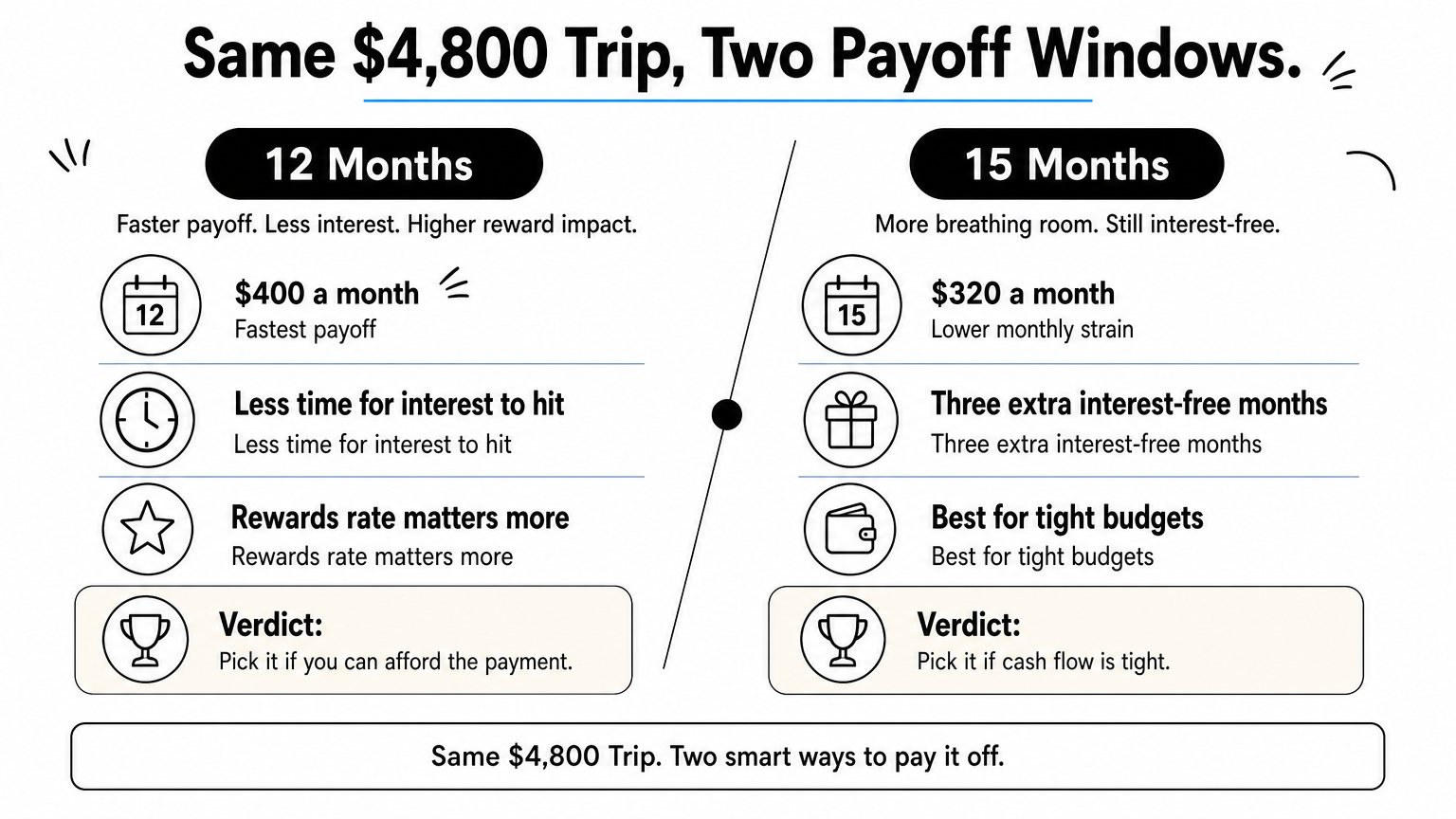
Pick the window your budget can finish, then pick the rewards.
Match the card to how you spend
Use this table to find your starting point.
| If you… | Check first |
|---|---|
| Want the best travel rewards for $0 a year | Wells Fargo Autograph |
| Want flat rewards and a long window | Bank of America Travel Rewards or Discover it Miles |
| Book hotels and flights through Chase | Chase Freedom Unlimited |
| Spend mostly on groceries and gas | Citi Strata or Blue Cash Everyday |
| Book a trip in small pieces | Citi Custom Cash |
Each row points to a card, not a final answer. Read its drawbacks section before you apply, because a portal-only bonus rate or a spending cap can change the math.
Check fees and approval odds
Fees break ties when rewards look close. Four cards here charge no foreign transaction fee, and the other four charge 2.7% to 3%, so that gap matters for international trips. Most of these cards expect good to excellent credit, so use the issuer’s pre-qualification tool first. It runs a soft check and does not touch your score. Then apply for one card, not three, since each hard inquiry can cost a few points.
How to use your 0% period without getting burned
A 0% offer is a loan with a deadline, and the deadline is the part people forget. Treat travel credit cards with 0 APR as a payoff tool, not as extra room to spend. Three habits keep you out of trouble.
Set the payoff schedule on day one
Divide the trip bill by one month fewer than your intro period. On a $3,600 trip with a 15-month window, that is 14 payments of about $257. The spare month is your cushion if a billing cycle runs short, and autopay keeps you honest.

Autopay the payoff amount, not the minimum payment.
- Set the fixed amount as the automatic payment, not the minimum due.
- Schedule it a few days before the due date.
- Add a calendar reminder 60 days before the intro period ends.
Protect the 0% rate
Never miss a payment. Some issuers can end your intro rate after a late payment, and the terms sit in your cardholder agreement, so read that section. Cash advances are the other trap. They usually skip the 0% offer, carry a fee, and start accruing interest right away.
Treat the welcome bonus as a spending target you will hit anyway, not a reason to overspend. Minimums on the cards in this list run from $500 to $2,000, and most trip bookings clear them alone. Keep everyday purchases on a card you pay in full each month, so the trip balance stays clean and easy to track.
Plan for the end of the window
Check your balance three months before the intro period ends. If more than a few hundred dollars remains, cut other spending and send the extra to the card. Do not add new purchases late in the window, because they leave you less time to clear them.
Fallback options exist if you still come up short. A new 0% balance transfer card or a fixed-rate personal loan can absorb the rest, though transfer fees of 3% to 5% and a credit check apply. Both usually cost less than the 18% to 29% ongoing rate. If the balance feels unmanageable, a nonprofit credit counseling agency can set up a debt management plan before interest piles up.
Pick the card, then plan the payoff
Travel credit cards with 0 APR work best when you treat them as a payoff tool. The Wells Fargo Autograph gives you the strongest rewards for $0 a year, while the 15-month cards give you more room when the trip bill is large. Pick the window your budget can finish, then choose the rewards rate that fits how you spend.
The card matters less than the plan. Divide your trip bill by one month fewer than the intro period, autopay that amount, and set a reminder 60 days before the window closes. Do that and the 0% offer saves you real money instead of just delaying a bill.
If your balance is already bigger than one new card can fix, you still have options. Our guides on credit card debt consolidation and relief explain balance transfers, loans, and nonprofit debt management plans, so you can escape high interest before it grows.