
If you live in Maryland and your credit card balances keep growing, you have likely found that Maryland debt relief programs come in two kinds: legitimate help and expensive traps. Interest rates of 18% to 29% make minimum payments feel pointless, and the ads promising to "erase" your debt do not help you tell the difference.
Here is the short answer. Legitimate debt relief programs in Maryland include nonprofit credit counseling, debt management plans, debt consolidation, debt settlement, bankruptcy, and state tax assistance. Which one fits depends on your credit score, your income, and how much you owe. A score above 700 opens up balance transfers and consolidation loans. Damaged credit usually points toward a nonprofit debt management plan.
Below, we explain how each option works, who it suits, and what it costs. We also cover the red flags of debt relief scams, such as large upfront fees and guaranteed results, so you can choose a program with confidence and keep your money where it belongs.
Why Maryland debt relief programs are worth vetting
One label, very different services
Debt relief is not one product. It is a label stretched over services that work in opposite ways. A nonprofit counselor negotiates lower interest and has you repay in full, which is how credit counseling works at its core. A for-profit settlement firm tells you to stop paying and hopes creditors accept less later. Both get called debt relief programs in Maryland, yet they affect your credit, your budget, and your risk of being sued very differently, so it helps to know what a debt relief program actually is and how to choose one.
Money is the second reason to be careful. People with high balances are stressed and short on time, which makes them easy targets. Companies know a worried caller will sign quickly. Pressure to enroll today is a sales tactic, not a service, and a legitimate counselor will let you take the paperwork home and think it over.
A debt relief program is only as good as its fees, its licensing, and its honesty about what happens to your credit.
What the wrong pick can cost you
The damage rarely shows up on day one. It builds over months while you believe you are making progress. This table shows where each type of program tends to go wrong when the provider is not trustworthy.
| Program type | Main risk with a poor provider |
|---|---|
| Debt settlement | Stopped payments trigger late fees, collection calls, and possible lawsuits, while your score drops |
| Debt management plan | High monthly or setup fees that cancel out the interest savings |
| Consolidation loan | Origination fees and an APR no better than your cards |
| "Relief" or credit repair package | Upfront fees for work you could do yourself for free |
Taxes add another wrinkle. When a creditor cancels $600 or more, it generally reports the amount to the IRS, and the forgiven portion can count as income unless you qualify for an exception such as insolvency. The IRS explains canceled debt rules in plain terms. A settlement that looked like a bargain can arrive with a tax bill on forgiven debt you did not budget for.
Vetting starts before you share your numbers
You do not need a finance degree to screen a provider. You need a few questions, asked before you hand over account numbers or a bank login. Maryland residents have an advantage here, because state regulators and the Attorney General’s Consumer Protection Division take complaints and can tell you whether a company has a troubled record.
Before any call goes further, confirm these three points:
- Who runs the program, and whether it is a nonprofit or a for-profit business.
- What you pay, in writing, including setup and monthly fees.
- What happens to your credit, stated honestly and not as a promise.
The next section turns these into a full checklist you can use on any provider.
How to choose a legit Maryland debt relief program
Run every provider through the same checklist
A checklist keeps emotion out of the decision. Ask the same questions of every company, whether you found it through an ad, a mailer, or a friend. Write down the answers, and walk away from any provider that dodges one. This is the fastest way to sort real debt relief programs Maryland residents can trust from the lookalikes.
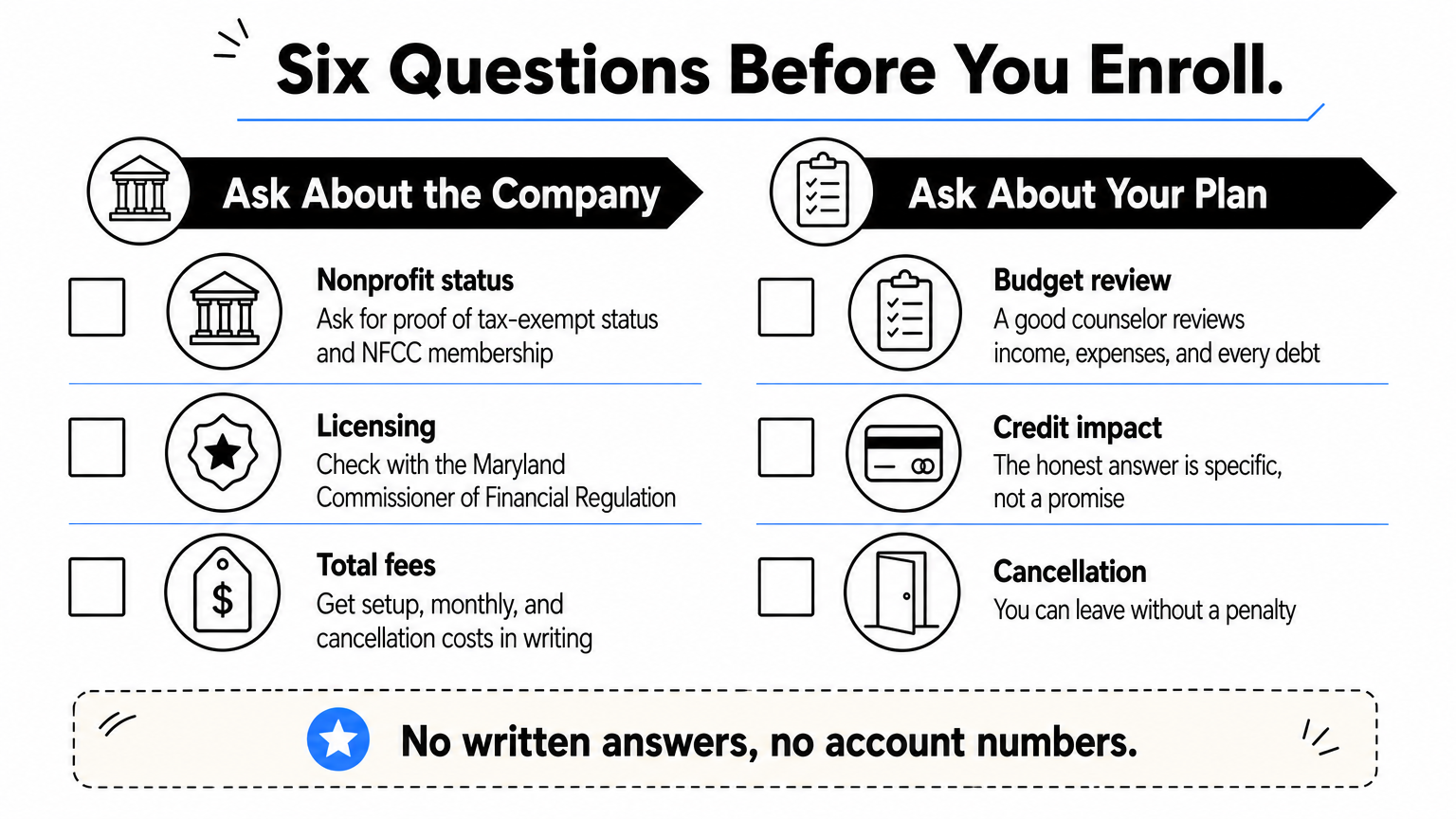
- Is it a nonprofit? Ask for proof of tax-exempt status, and ask whether the agency is an NFCC member.
- Is it licensed? Check with the Maryland Office of the Commissioner of Financial Regulation before you enroll.
- What are all the fees? Get setup, monthly, and cancellation costs itemized in writing.
- Will it review your whole budget? A good counselor looks at income, expenses, and every debt, then tells you if you do not need the program.
- What happens to your credit? The honest answer is specific, not "we will fix it."
- Can you leave? You should be able to cancel without a penalty.
If a provider cannot answer all six questions in writing, it has not earned your account numbers.
Judge the fees and the timeline
Fees tell you more than any brochure. Nonprofit debt management plans usually charge a modest setup fee and a monthly fee, often under $50, and the plan typically runs three to five years. Compare that fee against the interest you will save. If your cards charge 24% and the plan drops them to 8%, the math works. If the fee eats most of the savings, keep looking.
Settlement is different. Under the FTC’s Telemarketing Sales Rule, a for-profit debt settlement company selling debt relief by phone cannot collect fees until it has settled at least one of your debts and you have agreed to the terms. A company asking for money first is breaking that rule.
Test the counselor, not just the program
Treat the first call as an interview. A legitimate counselor asks about your budget before recommending anything, and explains the downsides of each path, including how a plan closes your cards. A salesperson jumps straight to a monthly payment. Request a free budget review, take the paperwork home, and compare at least two providers before you sign.
Maryland debt relief options compared
No single option wins for every household. The comparison below lines up the main Maryland debt relief programs by cost, credit impact, and timeline, so you can narrow the field before you call anyone.
Side-by-side comparison
Figures are typical ranges, not quotes, so always confirm exact terms in writing before you enroll.
| Option | Best for | Typical cost | Credit impact | Timeline |
|---|---|---|---|---|
| Nonprofit credit counseling | Anyone unsure where to start | Free or low-cost budget review | None | One session |
| Debt management plan | Fair or damaged credit, steady income | Setup fee plus monthly fee, often under $50 | Cards close, but on-time payments help | 3 to 5 years |
| Consolidation loan or balance transfer | Scores of 700 or higher | Origination or 3% to 5% transfer fee | Small dip, then gains | 1 to 5 years |
| Debt settlement | Severe hardship, no other path | Fees on settled debt, plus possible taxes | Heavy damage | 2 to 4 years |
| Bankruptcy | Debt you cannot realistically repay | Court and attorney fees | Stays 7 to 10 years | 3 to 6 months (Ch. 7), 3 to 5 years (Ch. 13) |
| State tax assistance | Overdue Maryland tax bills | Interest and penalties continue | Varies | Set by payment plan |
Matching an option to your situation
Start with your score. With a 700-plus score and steady income, a balance transfer or consolidating your debt into one loan is usually the cheapest route. With a lower score, a nonprofit debt management plan is the safer first call, because it needs no new credit.
Pick the cheapest option you can realistically finish, not the one with the biggest promise.
Settlement and bankruptcy sit at the far end of the table. Both leave lasting marks on your credit, so treat them as last resorts after a counselor has reviewed your budget. Tax debt follows its own track, and the Comptroller of Maryland can set up a payment plan, so never lump it in with credit card programs.
Red flags and scams to avoid in Maryland
Warning signs in the sales pitch
Scammers rely on a short script, and once you know it you can hang up early. These are the clearest warning signs in any pitch for Maryland debt relief programs, and a single one is enough reason to walk away:

- Upfront fees. For phone sales, collecting payment before settling a debt breaks the FTC rule.
- Guaranteed results. No one can promise creditors will accept a set amount.
- "Stop paying your creditors" advice before anyone has reviewed your budget.
- Government claims, such as a "new federal card debt program." No such program exists.
- Pressure to sign today, or a refusal to put terms in writing.
- Requests for bank logins, prepaid cards, or wire transfers.
Any company that wants your money before it has done anything for you is not helping.
How these scams hurt you
Stopping payments on a scammer’s advice is the costliest mistake. Late fees pile up, your score falls, and a creditor can sue you while your fee sits with the company instead of your debt. Many people are worse off after six months than the day they called.
Consolidation scams with lookalike names cause trouble too. Some operators copy the wording of real nonprofits, so a friendly name proves nothing. Confirm the exact company name with the Maryland Office of the Commissioner of Financial Regulation and ask for proof of nonprofit status in writing. The FTC keeps a useful page on debt relief and credit repair scams if you want examples of how they sound.
If you already paid
Act fast, because early reports give you the best chance of recovering money. You are not foolish for getting caught, since these pitches are built to sound reasonable. Document everything you can before you start making calls:
- Stop any further payments and cancel the autopay or bank authorization in writing.
- Save contracts, emails, call dates, and receipts.
- Contact your creditors directly to confirm balances and try working out a payment arrangement yourself.
- File a complaint with the Maryland Attorney General’s Consumer Protection Division and at ReportFraud.ftc.gov.
Then go back to the checklist above and start over with a vetted provider.
Maryland help beyond debt programs
Sometimes the fastest relief has nothing to do with enrolling in anything. Lowering your monthly bills or stopping a lawsuit can free up more cash than a plan will. Before you commit to any of the Maryland debt relief programs above, check these local and federal resources.
Free local resources
Dial 2-1-1 to reach Maryland 211, a free referral line that points you to rent, utility, and food assistance near you. Every dollar these services save is a dollar you can send to your credit card balances. Three more resources are worth a call:

- Maryland Energy Assistance Program: help with heating and electric bills for eligible households, run through the state’s Office of Home Energy Programs.
- Maryland Legal Aid: free civil legal help for eligible low-income residents, including debt collection lawsuits.
- Comptroller of Maryland: payment plans for overdue state income tax, so tax debt never lands on a credit card.
Free help with your bills often beats any paid program, so use it first.
Medical bills and hospital aid
Medical debt is often the easiest balance to shrink. Maryland hospitals must offer financial assistance programs, and many patients never apply. Ask for the application and an itemized bill before you pay anything, and check the bill for errors.
Putting a hospital bill on a card at 24% turns a negotiable debt into an expensive one. Hospital billing offices will usually agree to an interest-free payment plan, which costs far less than any consolidation loan.
Your rights with debt collectors
If a collector sues you, never ignore the court summons. A missed hearing can lead to a default judgment, and that can lead to wage garnishment. Respond in writing and contact Maryland Legal Aid or a debt settlement attorney right away.
Federal law also protects you. Under the Fair Debt Collection Practices Act, you can demand written validation of a debt within 30 days of the first notice. The CFPB’s debt collection guide includes sample letters you can copy.
Picking your next step
The best Maryland debt relief programs share three traits: they are honest about fees, clear about your credit, and happy to let you think it over. Start with a free nonprofit budget review, match the option to your score and income, and use the red flags above to filter out anyone who wants money before doing any work.
Remember that the cheapest option you can finish beats the flashiest promise. A 700-plus score points toward a balance transfer or consolidation loan, while damaged credit usually fits a debt management plan. Settlement and bankruptcy stay last resorts, and free local help with bills or medical costs can ease the pressure first.
Ready to compare your options? Follow our step-by-step guide to getting out of debt to see how each strategy works in practice, then take your first step this week.