
You settled a credit card balance for less than you owed, felt relief for about a week, then got a 1099-C form in the mail. Now you’re wondering why the IRS thinks you owe them money for debt you never actually collected as cash. This is the part of debt settlement nobody explains upfront, and it catches people off guard every tax season.
Debt settlement tax works like this: when a creditor forgives $5,000 or more, the IRS generally treats that forgiven amount as taxable income, the same as wages. That’s debt settlement taxes in a nutshell, and it’s why your tax bill can jump the year after you thought you’d solved your debt problem. There are also legitimate exceptions, like insolvency, that can wipe out or shrink what you owe.
This article breaks down exactly how canceled debt gets taxed, what the 1099-C form means for your return, and the specific, IRS-recognized strategies for how to avoid paying taxes on debt settlement legally, so you don’t trade one debt problem for another.
Why the IRS treats settled debt as taxable income
Think of it from the government’s perspective for a second. If a creditor writes off $6,000 of your credit card balance, you walked away $6,000 richer than you would have been otherwise. You never had to earn that money, pay it back, or hand it over in cash, but your net worth still went up by that amount. The IRS treats this as income the same way it treats a paycheck or a freelance payment, because economically, it functions the same way. This is called cancellation of debt income, or COD income, and it’s been part of the tax code for decades.
The forgiveness-as-income principle
Congress built this rule into the tax system because forgiven debt creates a real, measurable financial benefit, even though no money physically lands in your bank account. Say you owe $10,000 on a card and settle it for $4,000. That $6,000 gap didn’t disappear into thin air. It was debt you were legally obligated to repay, and now you’re not. The IRS calls that a windfall, and windfalls get taxed. This is the core mechanic behind debt settlement tax, and it applies whether the forgiveness came from a negotiated settlement, a bankruptcy discharge (with exceptions), a foreclosure, or a lender simply giving up on collecting.
Forgiven debt isn’t free money to the IRS. It’s income you didn’t have to earn, and it gets taxed like income you did.
The $600 reporting threshold
Creditors don’t get to decide quietly whether to report your forgiven balance. Federal law requires any lender, collection agency, or debt buyer that cancels $600 or more of your debt to send you a Form 1099-C, Cancellation of Debt, and to file a matching copy with the IRS. That form lists the amount forgiven in Box 2, and the IRS’s computers cross-check it against your tax return automatically. Miss reporting it, and you’ll likely get a notice within a year or two asking why your return doesn’t match their records. Practically speaking, once your settlement crosses that $600 line, you should assume a 1099-C is coming, because most creditors issue them without exception.
Which debts trigger this rule
Not every dollar of relief counts as taxable income, but most consumer debt settlements do. Here’s a quick breakdown of what typically triggers reporting and what doesn’t:
| Type of Forgiven Debt | Usually Taxable? |
|---|---|
| Credit card settlement | Yes |
| Personal loan settlement | Yes |
| Medical debt settlement | Yes |
| Federal student loan forgiveness (certain programs) | Sometimes, check current IRS guidance |
| Debt discharged in Chapter 7 or 13 bankruptcy | No, generally excluded |
| Gifts between family members | No |
This is exactly why anyone weighing taxes debt settlement consequences against other options should compare debt settlement vs. debt consolidation first, since those routes don’t generate a 1099-C at all. You’re not settling for less there, so nothing gets "forgiven" in the IRS’s eyes. If settlement is still your best move given your credit profile, that’s fine, but go in knowing the tax bill is part of the real cost, not an afterthought. For a full comparison of how settlement stacks up against consolidation and management plans, our guide to how debt settlement for credit cards works walks through the tradeoffs in more depth. The IRS publishes its own detailed rules on this in Publication 4681, which is worth skimming if you want the source material straight from the agency.
How to calculate the tax you owe on forgiven debt
Forgiven debt doesn’t get its own special tax rate. It gets added to your other income for the year and taxed at your marginal tax bracket, exactly like a bonus from your job would be. So the real question isn’t "what’s the debt settlement tax rate," because there isn’t one flat number. It’s "what bracket does this extra income push you into," and that depends on everything else you earned that year.

Finding the number that actually matters
Grab your 1099-C and look at Box 2. That figure is the amount your creditor reported as canceled, and it’s the number the IRS expects to see reflected on your return. You’ll report it as "other income" on Schedule 1, line 8c, which then flows into your Form 1040. From there, it stacks on top of your wages, freelance income, or anything else you earned, and gets taxed accordingly.
The tax bite on forgiven debt isn’t a fixed percentage. It’s whatever your top tax bracket already is, applied to a bigger pile of income.
Running a real example
Say you settled $8,000 of credit card debt and you’re single, earning $45,000 in wages. Adding $8,000 in COD income pushes your taxable income to roughly $53,000, which for 2025 keeps you in the 22% federal bracket. Here’s how that plays out:
| Step | Amount |
|---|---|
| Wages | $45,000 |
| Forgiven debt (1099-C) | $8,000 |
| Adjusted taxable income | $53,000 |
| Marginal bracket | 22% |
| Estimated federal tax on forgiven amount | ~$1,760 |
That’s roughly $1,760 owed just because of the settlement, on top of whatever you’d already owe from your wages. If your state also taxes canceled debt (most do), add another few hundred dollars depending on your state’s rate.
Running your own math takes three steps:
- Pull the exact figure from Box 2 of your 1099-C.
- Add it to your total taxable income for the year.
- Check the current IRS tax brackets to see what rate applies to that combined total.
Skipping this step is how people get blindsided in April. If you settled multiple accounts in one year, add up every 1099-C you received, since creditors report separately and the IRS expects the combined total to show up on your return.
How to legally reduce or avoid the tax bill
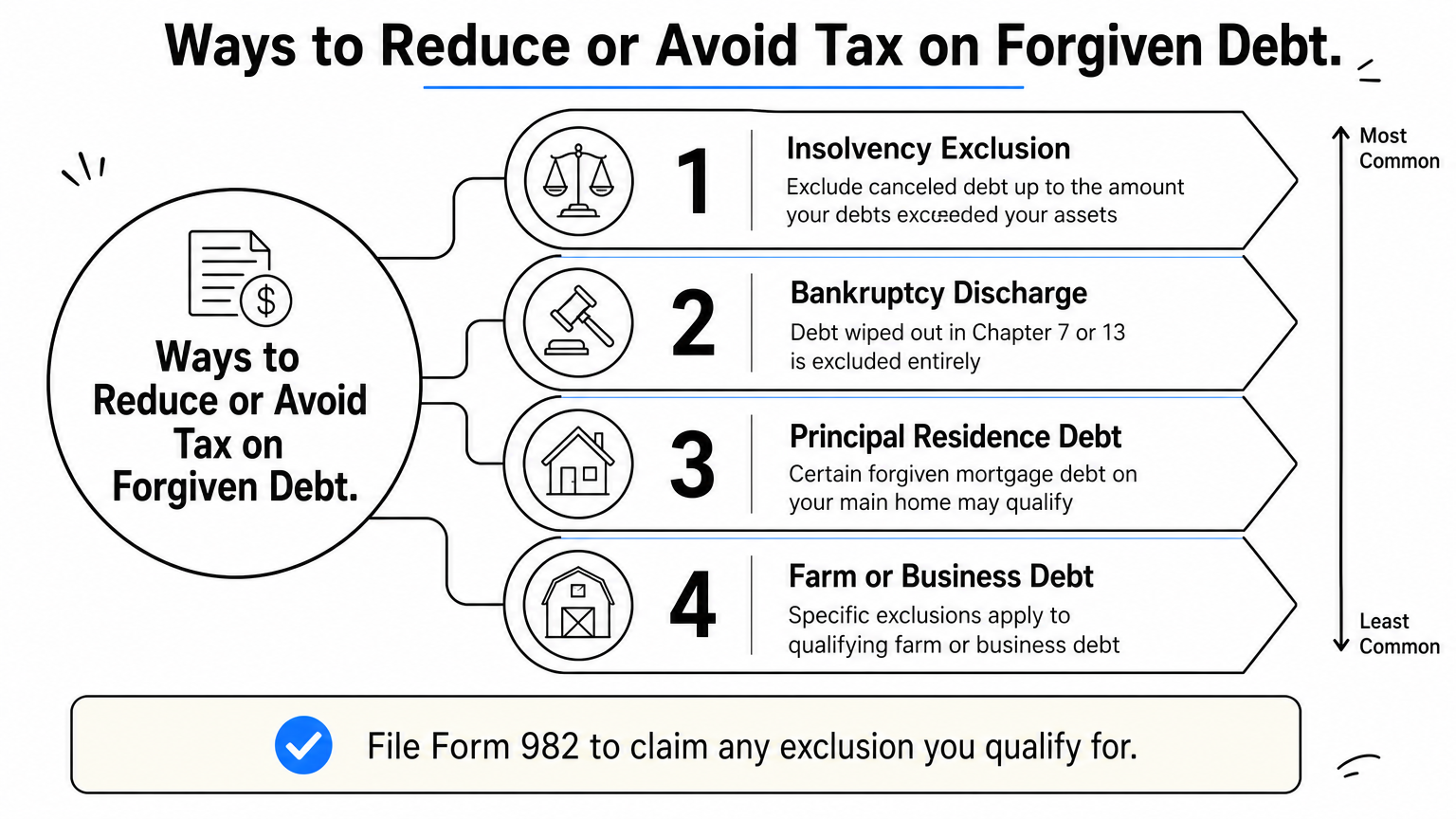
Here’s the good news buried under all that IRS math: you might not owe anything at all, depending on your financial situation at the time of settlement. The tax code carves out real, legitimate exclusions, and insolvency is the one that saves the most people money. If your total debts exceeded your total assets right before the settlement, you can exclude some or all of the canceled amount from taxable income. This is the single most important answer to how to avoid paying taxes on debt settlement, and it’s completely legal when you qualify.
Claiming the insolvency exclusion
Insolvency means your liabilities outweighed your assets immediately before the debt was forgiven. The IRS wants you to add up everything you owned, cash, retirement accounts, home equity, car value, and everything you owed, including the debt that got settled, then compare the two totals. If liabilities win, you’re insolvent, and you can exclude canceled debt up to the amount by which you were insolvent.
If your debts outweighed your assets when the settlement happened, you may owe the IRS nothing at all.
Say you had $30,000 in assets and $42,000 in total debts (including the $8,000 that got settled) right before settlement. You were insolvent by $12,000, which is more than the $8,000 forgiven, so the entire amount can be excluded. You’ll need Form 982 to claim this, filed alongside your regular return.
Other exclusions worth checking
A few less common but still important exclusions exist depending on your circumstances:
- Bankruptcy discharge: Debt wiped out in Chapter 7 or Chapter 13 is excluded from income entirely, no calculation needed, which is one reason to weigh bankruptcy or debt settlement before choosing.
- Qualified principal residence debt: Certain mortgage forgiveness on your main home may qualify, though rules have changed over the years, so check current limits.
- Farm debt and certain business debt: Specific exclusions apply if the debt was tied to a qualifying farming or business operation.
Documenting your case
None of these exclusions apply automatically. You have to claim them on your return, and you need paperwork to back it up if the IRS asks questions later. Keep a written asset-and-liability worksheet from the exact date of settlement, save your 1099-C forms, and hold onto account statements showing balances before and after. Working with a tax preparer familiar with cancellation of debt income is worth the fee here, since a mistake on Form 982 can trigger an audit flag rather than the relief you were hoping for. The IRS’s own worksheet in Publication 4681 walks through the insolvency calculation line by line, and it’s the same math a preparer would run for you.
What to do when a 1099-C shows up in your mailbox
Opening that envelope in late January is rarely fun, but panic doesn’t help you here. A 1099-C is just a reporting form, not a bill, and how you respond in the next few weeks determines whether tax season goes smoothly or turns into months of IRS letters. Treat it as a to-do list item, not a crisis, and work through it methodically.

Check the form for errors first
Before you do anything else, compare the numbers on the 1099-C against your own settlement paperwork. Creditors make mistakes more often than you’d think, especially when debt has been sold between collection agencies multiple times. Look at three things specifically: the amount in Box 2, the identity of the creditor listed, and the date of the cancellation event. If the balance doesn’t match what you actually settled, or the form lists an account you never had, call the issuer and request a corrected 1099-C in writing. Don’t just assume the IRS will catch the error for you, because their system trusts the form, not your memory of the deal.
A 1099-C is a reporting form, not a bill, so verify it before you assume you owe anything.
Filing it correctly on your return
Once you’ve confirmed the figures are right, here’s the sequence to follow when you prepare your return:
- Report the Box 2 amount on Schedule 1, line 8c, as other income.
- Calculate insolvency if you think you qualify for the exclusion, using the worksheet in IRS Publication 4681.
- Attach Form 982 if you’re claiming any exclusion, since skipping this form is the most common reason people lose an otherwise valid exclusion.
- Keep copies of every 1099-C, your insolvency worksheet, and account statements for at least three years in case of an audit.
Skipping any of these steps is how a legitimate exclusion turns into an IRS notice months later.
If you disagree with the amount
Sometimes a creditor reports a number you genuinely dispute, maybe they included fees you never agreed to or double-counted a partial payment. In that case, file your return with the correct amount, attach a statement explaining the discrepancy, and keep every piece of correspondence with the creditor. The IRS does allow you to report a different figure than what’s on the form, but you need documentation ready if they ask. Waiting and hoping it sorts itself out almost never works in your favor, so address it the same year the form arrives, not after a notice shows up demanding an explanation.
Settling debt smart, not just fast
Settlement can genuinely fix a debt problem, but only if you plan for the tax bill before you sign anything, not after the 1099-C lands. Know your insolvency status going in, save your paperwork, and file Form 982 when you qualify. Skip that step and you’ll trade one collector for another, except this one is the IRS and it doesn’t negotiate the way a credit card company does.
Before you settle a single account, run the numbers both ways: what you’d save on the balance versus what you might owe in debt settlement tax. Sometimes a debt management plan or consolidation loan gets you out of the hole without ever generating a taxable event. Other times settlement still wins, tax bill included.
If you’re weighing which route actually fits your credit profile and your budget, see the best debt settlement companies to resolve your debt before you make the call.