
You owe $18,000 across three credit cards, the minimum payments barely touch the balance, and every ad you see promises to make half that debt disappear. Before you sign anything, you need to know what a settlement of a debt actually involves, because the reality is messier than the commercials suggest.
Here’s the short answer: debt settlement is a negotiation where you (or a company you hire) convinces your creditor to accept less than the full balance as payment in full. It sounds simple, but it usually requires you to stop paying your creditors for months while cash builds up in a separate account, and that strategy tanks your credit score before it helps your wallet. Understanding how debt settlement companies work matters just as much as knowing the definition, since the process, fees, and risks vary widely depending on who’s negotiating.
In this article, you’ll get a straight explanation of what debt settlement means, how the negotiation process actually unfolds, what it costs, and how it compares to alternatives like balance transfers or debt management plans, so you can decide if it fits your situation.
Why debt settlement matters when you’re overwhelmed by debt
Most people don’t go looking for debt settlement because they’re curious about finance terminology. They go looking because they’ve done the math on their credit card statements and realized the minimum payment isn’t shrinking the balance, it’s just covering interest. When you’re carrying $15,000 to $30,000 across multiple cards at 22% APR or higher, a settlement for debt can look like the only way out that doesn’t involve filing for bankruptcy. Understanding why this option exists, and who it actually helps, matters before you dial a hotline number from a late-night commercial pitching debt relief programs.
The math that pushes people toward settlement
Credit card interest compounds daily on most cards, which means your balance can grow even while you’re technically making payments. A cardholder paying $300 a month on an $18,000 balance at 24% APR pays for over 8 years and hands the bank more than $12,000 in interest alone, based on standard amortization math the Consumer Financial Protection Bureau explains in its credit card guidance. That’s the trap debt settlement for credit cards is designed to break. Instead of paying the debt down slowly at full price, you’re negotiating the price itself.
Debt settlement exists because paying the minimum on high-interest cards can cost you more than the original debt itself.
Who settlement actually fits
Settlement isn’t a universal fix. It works best for people in a specific financial position, and it can backfire badly for everyone else. Before you consider a settlement of debt, run through this checklist honestly:

- You’re already behind on payments, or you’re close to falling behind within the next few months
- Your total unsecured debt is at least $7,500, since most settlement companies won’t take on smaller balances
- You have no realistic path to pay the debt in full within 3 to 5 years at current interest rates
- You can set aside a lump sum or consistent monthly deposit instead of paying creditors directly
- You’ve already ruled out qualifying for a 0% balance transfer or a low-rate consolidation loan
If you’re current on your payments and your credit score is above 680, settlement debt strategies usually aren’t your best move. You’d likely qualify for cheaper options that don’t require damaging your credit first. Settlement tends to make sense for people who are already in financial distress, not people trying to get ahead of it.
The credit score reality nobody advertises
Here’s what the settlement industry doesn’t lead with: creditors typically won’t negotiate until you’ve missed several payments, because your account has to look like a real loss risk before they’ll accept less than what’s owed. That means your credit score takes a hit from the missed payments themselves, separate from whatever happens once a settlement is reached. A FICO score in the mid-700s can drop 100 points or more after a few months of nonpayment, and the settled account will show as "settled for less than full balance" on your credit report for up to seven years, according to reporting standards outlined by the Federal Trade Commission.
That trade-off is exactly why understanding what is debt settlement before you commit matters so much. You’re not just negotiating a lower balance, you’re accepting a documented mark on your credit history in exchange for it. For some people drowning in debt with no better alternative, that trade is worth making. For others who still have options like a debt management plan or a consolidation loan, it’s an unnecessary hit to take.
Why this decision deserves real research
The stakes here are bigger than most financial decisions people make in a single phone call. You’re weighing immediate debt relief against years of credit damage, potential tax consequences on forgiven debt, and fees charged by whoever negotiates on your behalf. If you’re comparing your options before committing to any single path, our guide to debt settlement vs. debt consolidation breaks down how settlement stacks up against loans and balance transfers side by side, so you’re not making this call based on a commercial alone.
How the debt settlement process works step by step
Understanding how debt settlement companies work helps you spot red flags before you sign a contract. The process follows a predictable sequence, whether you hire a company or negotiate yourself, and each stage carries its own risks and timeline. Knowing the sequence in advance means you won’t be surprised when a creditor calls demanding payment while your account sits untouched in a savings account.
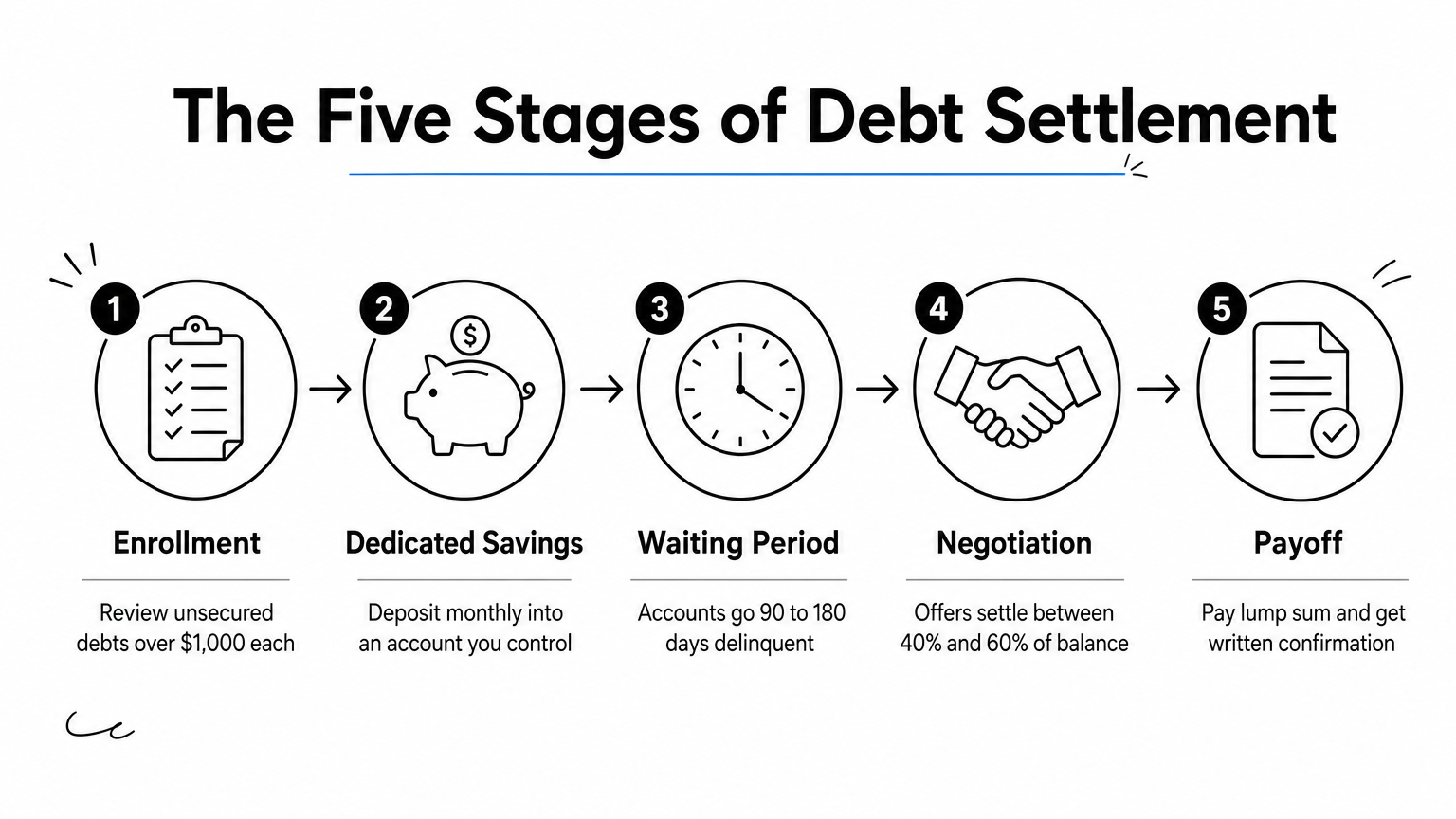
The typical stages from enrollment to payoff
Most settlement arrangements move through the same five stages, though the timeline stretches or shrinks depending on your balance size and how aggressively your creditors pursue collection.
- Enrollment and account review: you or a company evaluate which debts qualify, usually unsecured cards with balances over $1,000 each.
- Redirecting payments into a dedicated account: instead of paying creditors, you deposit money monthly into an FDIC-insured account you control.
- The waiting period: creditors typically won’t negotiate until an account is 90 to 180 days delinquent, since they need to see genuine default risk before accepting less.
- Negotiation and settlement offers: once enough cash has accumulated, offers go out, often starting around 50% of the balance and settling between 40% and 60%.
- Payoff and documentation: once you accept an offer, you pay the lump sum and request written confirmation that the debt is settled in full.
A settlement of a debt rarely closes in weeks. Most accounts take 24 to 48 months to fully resolve.
What happens inside the settlement account
During the waiting period, your money sits untouched while your creditor watches your account slide into delinquency. This is the part most commercials skip over entirely. You’re making deposits, not payments, and creditors have no obligation to negotiate on any particular schedule. Some settle quickly once an account charges off around the 180-day mark. Others sell the debt to a collection agency first, which restarts the negotiation from scratch with a new party.
How creditors and collectors respond during negotiation
Creditors evaluate a settlement on debt offer against what they’d recover through collections or a lawsuit, not against what feels fair to you. A creditor holding a charged-off account with little hope of full recovery will often accept 40 to 60 cents on the dollar rather than write off the entire balance. Collection agencies that bought the debt for pennies have even more room to negotiate, since almost any settlement beats their purchase price. This is why timing matters so much: pushing too early, before an account looks like a real loss, usually gets you rejected outright, while waiting too long risks a lawsuit landing before you’ve saved enough to settle.
How to negotiate a debt settlement on your own
Hiring a company isn’t the only route. Plenty of people handle credit card debt negotiation themselves and save thousands in fees doing it, as long as they’re organized and patient. DIY negotiation works best if you’re comfortable making phone calls, keeping detailed records, and holding firm when a representative pushes back on your first offer. You’ll need the same waiting period and dedicated savings account a settlement company would use, minus the 15% to 25% fee most companies charge on the enrolled debt.
Building your case before you call
Before you dial a single creditor, gather your financial picture. Calculate exactly how much you can realistically save each month, and know your minimum acceptable settlement percentage going in. Creditors respond to numbers, not emotion, so come prepared:
- Total balance owed on each account, plus the account’s delinquency status
- Cash available right now versus what you can save monthly over 6 to 12 months
- A target settlement range, typically 40% to 60% of the balance
- Documentation of hardship, like a job loss letter or medical bills, if applicable
The strongest negotiating position is a lump sum in hand, not a promise to pay later.
What to say and how to hold your ground
When you get a creditor or collector on the phone, ask directly whether they’ll accept a settlement for debt as payment in full, and get everything in writing before you send a dime. When haggling with your creditors, never offer your top number first. Start at 30% to 40% of the balance and negotiate upward, since most representatives are trained to counter your opening offer regardless of what it is. If the first person says no, ask to speak with a supervisor in the settlement or hardship department, since front-line reps often lack authority to approve anything below 70%. Representatives will sometimes push for a payment plan instead of a lump sum. Resist that unless you’re certain you can complete every payment, because a broken plan usually voids the settlement and reinstates the full balance plus fees.
Getting the agreement in writing
Once you reach a verbal agreement, insist on a settlement letter before you pay anything. That letter needs to state the exact amount, the payment deadline, and explicit confirmation that this payment satisfies the debt in full. Send your payment only after you have that letter in hand, ideally by certified mail or a traceable bank transfer, so you have a paper trail. Keep every document afterward, including the letter, payment confirmation, and any updated account statement. The Consumer Financial Protection Bureau recommends requesting written confirmation within 30 days of any negotiated payment, since verbal promises from a collector carry no legal weight if a dispute arises later.
Doing this yourself takes more effort than handing the problem to a company, but it puts you in direct control of the numbers, the timeline, and the paper trail. If negotiating feels overwhelming or you’re managing settlements across four or five accounts at once, that’s usually the point where hiring a debt settlement lawyer, or considering a different debt relief path entirely, starts to make more sense.
Debt settlement alternatives worth comparing first
Before you commit to a settlement of a debt, run the numbers on options that don’t require you to miss payments first. Each alternative trades speed for credit protection, or cost for flexibility, so the right choice depends on your score, your balance, and how much damage you can afford to absorb along the way.
Balance transfers and consolidation loans for stronger credit
If your credit score sits above 660 and you’re current on payments, a balance transfer card or a fixed-rate consolidation loan usually beats settlement outright. A 0% intro APR card lets you pay down principal directly instead of losing money to interest, and a personal loan locks in a predictable payment at a fraction of your current card rate. Neither option requires you to fall behind, and neither leaves a "settled" notation on your credit report. The catch is qualification: lenders want to see a track record of on-time payments, so this path closes once your accounts start slipping.
Debt management plans through nonprofit counseling
A debt management plan run through a nonprofit credit counseling agency works differently than either settlement or a loan. You still pay back 100% of what you owe, but the agency negotiates a lower interest rate with your creditors, often dropping APRs from the mid-20s down to single digits. Payments consolidate into one monthly amount, typically completed in 3 to 5 years, and your accounts stay in good standing as long as you keep up with the plan. It’s slower relief than settlement, but it avoids the credit score cliff that comes with intentional nonpayment.
Settlement is the only major debt relief option that requires you to miss payments on purpose. That alone should make you compare it last, not first.
Comparing your options side by side
| Option | Credit score needed | Typical cost | Credit impact | Timeline |
|---|---|---|---|---|
| Balance transfer card | 660+ | 3-5% transfer fee | Minimal if paid off before intro rate expires | 12-21 months |
| Consolidation loan | 640+ | Fixed interest, 6-20% APR | Minimal, improves with on-time payments | 2-5 years |
| Debt management plan | Any | Small monthly fee, reduced APR | Neutral to mildly positive over time | 3-5 years |
| Debt settlement | Any, works best under 600 | 15-25% fee on enrolled debt | Significant, 100+ point drop possible | 2-4 years |
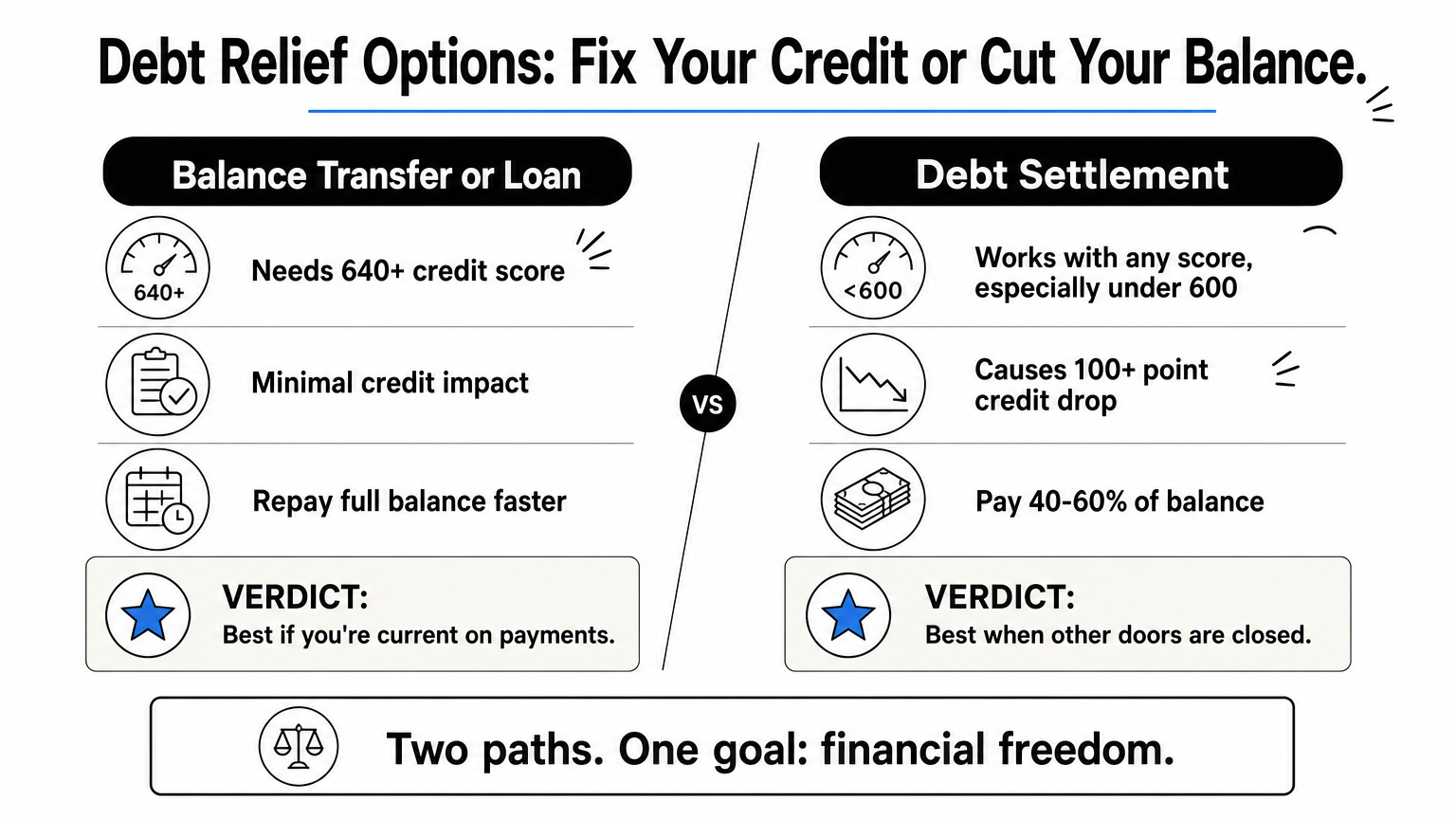
When settlement still beats the alternatives
Settlement earns its place when the other three doors are already closed. Someone with a 550 credit score and $22,000 in charged-off debt won’t qualify for a 0% card or a low-rate loan, and a debt management plan only works if you can afford to repay the full balance, just at a lower rate. If your income can’t support that, settlement debt negotiation may genuinely be the fastest realistic exit. Our breakdown of credit card debt consolidation walks through qualification thresholds for loans and balance transfers in more detail, so you can rule those out with actual numbers instead of guesswork before you accept the credit hit that settlement brings.
Choosing the right path for your debt
A settlement of a debt isn’t a shortcut, it’s a trade. You give up months of good standing on your credit report in exchange for paying less than you owe, and that trade only makes sense once cheaper, less damaging options are genuinely off the table. If you’re current on payments with a score above 660, look at balance transfers and consolidation loans first. If you’re already behind with no realistic way to repay in full, settlement or a debt management plan deserves serious consideration.
Don’t let a late-night ad make this decision for you. Run your own numbers, compare the fees, and know exactly what happens to your credit before you sign anything. The right path depends on your balance, your score, and how much risk you can absorb along the way. For a closer look at how these options stack up for your specific numbers, read our guide to debt consolidation before you commit to anything.