The best student debt relief programs are federal programs tied to your job, your income, or what your school did, so the right pick depends on which of those describes you. Public Service Loan Forgiveness suits government and nonprofit workers. Income-driven forgiveness suits borrowers with big balances and modest pay. Teacher Loan Forgiveness suits classroom teachers in low-income schools. Discharges suit people who are disabled or were misled by a school. Service-based repayment programs suit health professionals and workers whose employers help with payments.
Most borrowers searching for relief hope for a single application that wipes out the balance. That program does not exist. The broad cancellation plan announced in 2022 was struck down by the Supreme Court in 2023, and you do not request forgiveness through the FAFSA, which only covers aid for school. What exists are narrow programs with firm eligibility rules, and they mostly apply to federal loans, not private ones.
This article walks through five programs in order of how many borrowers they can help. Each one covers how it works, who qualifies, and how to apply. Our site focuses on credit card debt relief and consolidation, but the same logic holds: match the program to your situation before you spend time on paperwork.
1. Public Service Loan Forgiveness (PSLF)
How it works
PSLF cancels the remaining balance on your Direct Loans after you make 120 qualifying monthly payments while working full time for a qualifying employer. That is the equivalent of 10 years. The forgiven amount is not taxed by the federal government. Payments do not have to be consecutive, so a job gap pauses your count instead of resetting it.
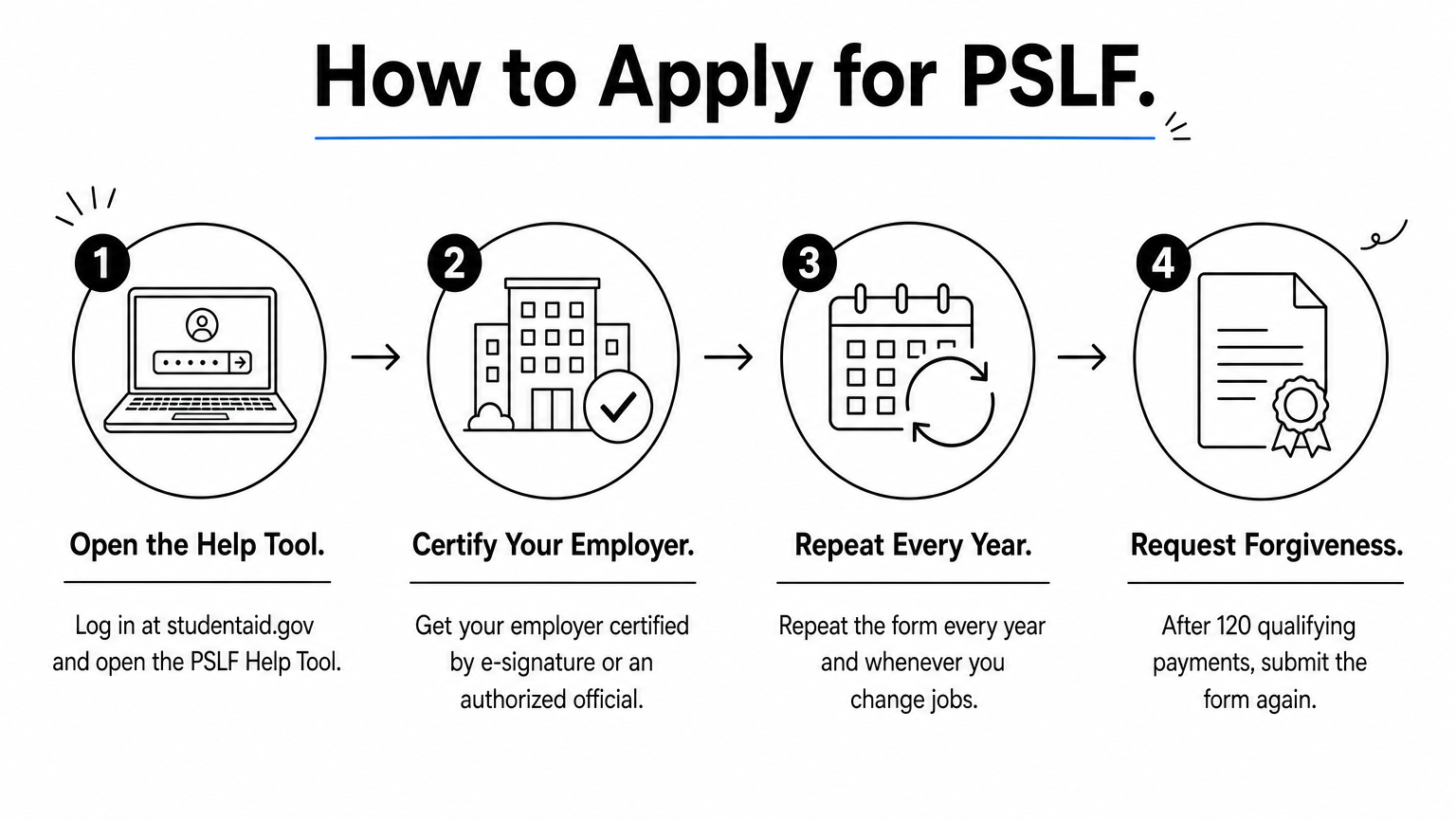
PSLF is the fastest route to forgiveness, but only if your loans, plan, and employer all qualify.
Who qualifies
You need Direct Loans. Older FFEL or Perkins loans must be consolidated into a Direct Consolidation Loan first. You also need a qualifying repayment plan and a job with a government agency, a 501(c)(3) nonprofit, or certain other nonprofits. Full time generally means 30 hours a week or more. Rules for judging employers have changed recently, so confirm yours in the PSLF Help Tool before you rely on it.
How to apply
There is no separate enrollment. You certify employment and the Department of Education counts your payments.
- Log in at studentaid.gov and open the PSLF Help Tool.
- Select your employer and get it certified, either by e-signature or by an authorized official.
- Repeat the form every year and whenever you change jobs.
- After 120 qualifying payments, submit the form again to request forgiveness.
2. Income-driven repayment forgiveness
How it works
Income-driven plans set your monthly payment as a share of your income, then cancel what is left after a fixed number of years. Older plans forgive the balance after 20 or 25 years of payments. The Repayment Assistance Plan, created by 2025 legislation and open to borrowers starting July 1, 2026, sets payments at roughly 1% to 10% of adjusted gross income and forgives the balance after 30 years.
Income-driven forgiveness is slow, and your payment shrinks or grows with your income along the way.
Who qualifies
Any borrower with eligible federal loans can enroll, and it helps most when your balance is large compared with your income. If you owe $90,000 and earn $45,000, your payments may never cover the interest, so cancellation at the end is likely. Parent PLUS loans have extra restrictions, so check your loan type first. Plan availability is changing, and borrowers on the ended SAVE plan must move to another plan.
How to apply
Apply through your loan servicer or at studentaid.gov, where the application pulls your income from the IRS if you consent. Recertify your income every year or your payment can jump to a higher amount. One caution: forgiven balances after 2025 may count as taxable federal income, so plan for a possible tax bill when the balance is cancelled.
3. Teacher Loan Forgiveness
How it works
This program forgives up to $17,500 on Direct and FFEL loans after you teach five complete, consecutive academic years at a low-income school or educational service agency. The $17,500 cap applies to highly qualified math, science, and special education teachers. Other qualifying teachers can receive up to $5,000. A math teacher with $30,000 in loans would see $12,500 left after forgiveness.

Teacher Loan Forgiveness is smaller than PSLF, but it arrives after five years, not ten.
Who qualifies
You must work full time at a school listed in the Department of Education’s directory of low-income schools, and hold the required teaching credentials. You cannot count the same years toward both this program and PSLF. A teacher with a large balance should compare the two before choosing. A teacher with a modest balance often does better taking the one-time cancellation and then moving on to PSLF for later years.
How to apply
Finish your fifth year first. Then complete the Teacher Loan Forgiveness application, have your school’s administrator certify your service, and send it to your loan servicer. Keep making payments until you get written approval.
4. Discharge programs for disability and school misconduct
How it works
Discharges cancel your loans entirely because of what happened to you, not because of how long you paid. The main types are Total and Permanent Disability discharge, closed school discharge, borrower defense to repayment, and false certification discharge. Death also discharges federal loans. Federal tax treatment of disability and death discharges is favorable.

A discharge depends on your circumstances and documents, so evidence matters more than how long you have paid.
Who qualifies
Disability discharge requires documentation of a disability that prevents substantial work, such as certification from a physician, the Social Security Administration, or the VA. Closed school discharge applies if your school shut down while you were enrolled or soon after you left. Borrower defense applies if the school misled you or broke state law. False certification covers cases like a school enrolling you without a valid diploma or ability to benefit.
How to apply
Each discharge has its own form at studentaid.gov. Gather proof first: award letters, enrollment records, or letters from the school. Submit through the Department of Education or your servicer, as the form instructs. Ask your servicer about forbearance while a claim is pending, and keep copies of everything you send.
5. Profession, state, and employer repayment help
How it works
These programs pay down your loans in exchange for work, which is a different deal than forgiveness. The National Health Service Corps and Nurse Corps repay a large share of loans for clinicians who work at approved sites in underserved areas, typically for a multi-year commitment. Many states run similar repayment programs for teachers, health workers, and lawyers. Employers can also contribute up to $5,250 per year toward your student loans, tax-free under federal law.
Service-based programs reward a specific job, so they work best when you already plan to take that job.
Who qualifies
Eligibility depends on your profession, the site where you work, and the program’s own rules. Funding and openings vary by state and year. Ask your HR department whether your employer offers student loan benefits, and check your state higher education agency for local programs.
How to apply
Each program has its own application window, so read the program’s page before you accept a job offer. Federal forms are free, and you never need to pay a company to apply for relief. Fee-charging "forgiveness centers" often file the same free forms for you at a price, or promise results that no program can guarantee.
Where to start with your loans
Student debt relief comes down to a short list of real programs. If you work for the government or a nonprofit, start with PSLF. If your income is low next to your balance, look at income-driven forgiveness. Teachers, disabled borrowers, defrauded students, and health workers each have a dedicated path. Check your loan type at studentaid.gov first, because nearly every program requires federal loans.
If student loans are only one piece of your debt, you can find step-by-step guidance on credit card payoff, consolidation, and credit repair at Credit Card Solution.