The fastest way to use a personal loan to get out of debt is to borrow at a fixed rate well below what your cards charge, pay those balances off in full with the proceeds, and repay the single loan on a set schedule. It works when the loan’s APR, fees included, beats the average rate on your current debt and you stop adding new balances. It fails when you only move the debt around.
If you carry balances at 18% to 29%, you know the problem. Minimum payments barely touch the principal, several due dates compete for your attention, and each month of interest pushes the finish line back. A personal loan can fix the math, but only if you qualify at a good rate and pick the right offer.
This guide walks you through four steps: running the numbers, checking what you qualify for, comparing lenders, and paying off the cards and the loan. Credit Card Solution is an educational site, not a lender, so you get the mechanics without a sales pitch. You’ll also find payment estimates and a short plan for anyone who already has personal loan debt.
Why a personal loan can work, and when it won’t
A personal loan is a good way out of debt when it swaps high-interest revolving balances for a lower fixed rate and a firm payoff date. If it doesn’t do both, skip it.
What a consolidation loan changes
Most personal loans are unsecured installment loans, so you don’t pledge a car or a house. You get a lump sum, a fixed APR and a set term, usually two to seven years. Credit cards work the opposite way: the rate can change, the minimum shrinks as the balance falls, and there is no end date.
That structure is the real benefit. You replace three or four due dates with one fixed payment, and you can see the exact month you’ll be debt-free. What the loan does not do is erase anything. You still owe the same principal, plus any origination fee.
A personal loan helps only when its total cost is lower than the debt it replaces.
When another route is better
Skip the loan, or compare it with an alternative, in these cases:
- Your best offer isn’t much lower than your current rates. A few points won’t cover a 5% fee.
- Your balance is small. If you can clear it in under 18 months, a 0% intro APR balance transfer card may cost less, if you qualify.
- Your cards will fill back up. Consolidating without changing your spending doubles the debt.
- Your debt is unmanageable even at a lower rate. A nonprofit credit counseling agency and a debt management plan may fit better.
Step 1. Run the numbers on your debt
List every balance, APR and minimum payment, then calculate your weighted average rate. That one number is the rate your loan has to beat.
List your debts and find your average rate
Pull the figures from your latest statements. Multiply each balance by its APR, add the results, and divide by your total debt. Here is an example.
| Debt | Balance | APR | Yearly interest |
|---|---|---|---|
| Card A | $9,000 | 27% | $2,430 |
| Card B | $7,000 | 22% | $1,540 |
| Card C | $4,000 | 19% | $760 |
| Total | $20,000 | 23.65% weighted | $4,730 |
This borrower pays about $4,730 a year in interest. A loan only makes sense if the offered APR, fees included, lands several points below 23.65%.
Compare the loan’s APR to your weighted average rate, not to your single worst card.
Estimate the payment and total cost
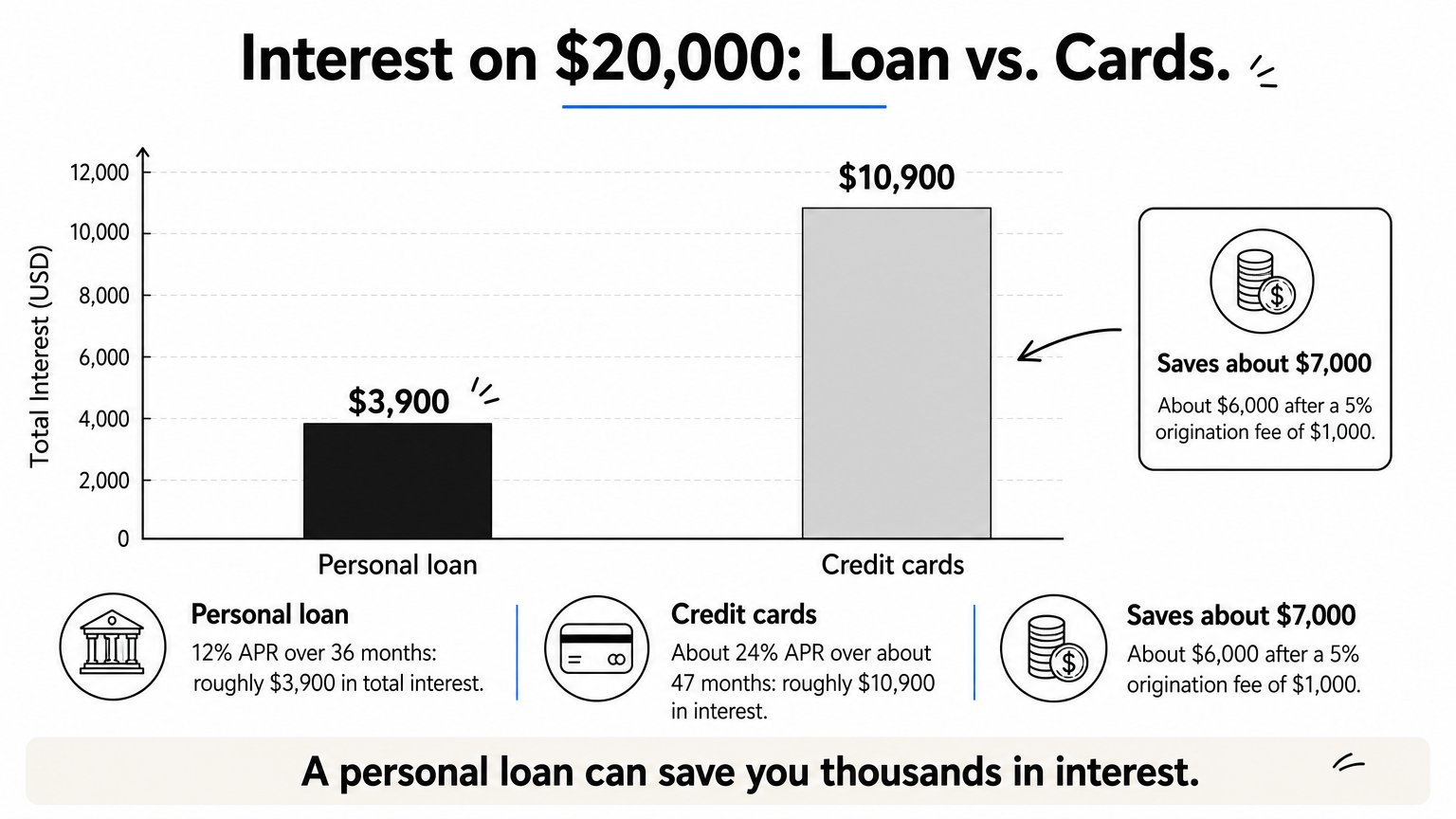
Now test a loan. Borrow $20,000 at 12% APR over 36 months and the payment is about $664 a month, with roughly $3,900 in total interest. Keep paying $664 a month toward cards at around 24% and you need about 47 months and pay roughly $10,900 in interest. That’s a saving near $7,000, or about $6,000 after a 5% origination fee ($1,000). These rates are illustrations, not offers.
Wondering what a bigger loan costs? This is the monthly payment on $30,000:
| APR | 36 months | 60 months |
|---|---|---|
| 10% | $968 | $637 |
| 15% | $1,040 | $714 |
| 20% | $1,115 | $795 |
Longer terms lower the payment but raise the total cost. At 15%, the 60-month loan costs about $12,800 in interest, against about $7,400 over 36 months.
Step 2. Check your credit and income
Pull your credit reports and scores, then calculate your debt-to-income ratio before you apply anywhere. Both decide whether you qualify and what rate you get.
Know your score and your debt-to-income ratio
You can get free reports at AnnualCreditReport.com, and many card issuers show a score in your account. Fix errors first, because a wrong late payment can cost you a pricing tier. As a rough guide, scores of 720 and up earn the best rates, 670 to 719 get competitive offers, and 580 to 669 usually mean higher APRs and more fees. Lenders differ, so treat these as general ranges.

Next, calculate your debt-to-income ratio (DTI): monthly debt payments divided by gross monthly income. If you pay $2,000 a month toward debt and earn $5,000 before taxes, your DTI is 40%. Many lenders want it at or below roughly 40% to 45%, and the new loan should push it down.
Your score mostly sets your rate, and your DTI mostly sets your odds of approval.
Options when your credit is fair or poor
Yes, you can get a $20,000 personal loan without collateral, as long as your credit and income support it. Most personal loans are unsecured. With weaker credit, try these:
- Add a cosigner or co-borrower with stronger credit.
- Apply at a credit union. Credit unions often weigh your whole financial picture, not just your score.
- Consider a secured loan, but remember you risk the asset you pledge.
- Call a nonprofit credit counselor if no offer beats your current rates. A debt management plan may beat a bad loan.
Walk away from any lender that asks for a fee before funding or promises guaranteed approval.
Step 3. Compare lenders and prequalify
Prequalify with three to five lenders, then compare offers on the same loan amount and term. Prequalifying uses a soft credit check, so it doesn’t lower your score.
Where to shop
Check banks, credit unions and online lenders. Banks may reward existing customers, credit unions can be flexible on credit, and online lenders often fund quickly. Enter the same amount and term everywhere so the quotes line up.
A formal application triggers a hard inquiry. Submit it only to your one or two best matches, and do it close together.
What to compare in each offer
| What to check | What to look for |
|---|---|
| APR | The all-in yearly cost including fees. Use it to rank offers. |
| Origination fee | Commonly 1% to 10%, often taken from the proceeds. |
| Term | The shortest term whose payment fits your budget. |
| Prepayment penalty | None, so extra payments save interest. |
| Direct payment to creditors | The lender pays your cards for you, which keeps the money on target. |
| Funding time | How soon you get the money, which matters if due dates are close. |
Fees change what lands in your account. On a $20,000 loan with a 6% fee, you receive $18,800. To net $20,000, you’d need to borrow about $21,277.
Rank offers by APR, not by the headline rate or the lowest monthly payment.
Step 4. Pay off the cards and the loan
Use the loan funds to pay each card to zero right away, then automate the loan payment and stop adding new balances. Skipping this step is how consolidation turns into double debt.
Close the loop on your cards
- If the money lands in your bank account, pay every card in full the same day. If the lender pays creditors directly, confirm each zero balance within a billing cycle or two.
- Keep no-fee cards open, since closing them can shrink your available credit and raise your utilization. Take them out of your wallet and remove saved card numbers from shopping sites.
- Set up autopay from the account where your paycheck lands. Some lenders also discount the rate for autopay.
- Start a small emergency fund so a surprise bill never goes back on a card.

The loan only pays off if the cards stay at zero.
If you already have personal loan debt
To get out of personal loan debt you already owe, pay extra toward principal, refinance at a lower rate, or ask for help before you miss a payment. Pick the move that fits your situation:
- Extra payments: Confirm there’s no prepayment penalty and tell the lender to apply the extra to principal. Even $50 a month trims months off the term.
- Refinancing: Do it only if the new APR, fee included, is lower and you don’t stretch the term so far that the total cost rises.
- Hardship options: Call before you fall behind and ask what reduced-payment or deferral programs exist.
- Credit counseling: A nonprofit counselor can review your budget and tell you whether a debt management plan fits.
Your next move
A personal loan is a good way to get out of credit card debt when the APR is meaningfully below your current average rate, the payment fits your budget, and the cards stay at zero. Run the numbers first, know your score and DTI, prequalify with several lenders, and compare by APR. Then pay off the cards and automate the loan.
If the math doesn’t work today, you still have options, from a balance transfer to a nonprofit debt management plan. To weigh them side by side, explore more credit card debt relief guides and choose the path that fits your credit.