
The best credit cards to raise credit score numbers are secured and credit-builder cards that charge little or no annual fee, report to all three bureaus, and give you a path to an upgrade. Capital One Platinum Secured is the cheapest all-round start. Discover it Secured suits you if you want rewards, and Chime Credit Builder suits you if you can’t tie up a lump-sum deposit. Credit One Bank’s American Express for Rebuilding Credit suits you if you want no deposit and accept a yearly fee.
A low score or a thin credit file leaves you with poor offers. Some cards marketed to people with bad credit carry a 35.90% APR and annual fees of $49 to $125, so you pay heavily just to start building. A good builder card costs far less than that. It only works if you use it the right way.
This list covers seven cards, with their fees, deposits, rewards, and the kind of person each one fits. After the list, you get the usage rules that actually move your score. We focus on credit card debt and credit management at CreditCardSolution.org, so we judged every pick by what it costs you and whether it helps you avoid carrying a balance.
What makes a card good at raising your score
A card raises your score when it reports to all three bureaus, costs almost nothing to hold, and lets you prove two things every month: on-time payments and low balances. Payment history makes up 35% of a FICO Score and utilization 30%, so those two habits do most of the work. The best credit card to raise credit score for you is the one that makes both habits cheap and visible.
Four features that matter
Check these before you apply. A card that fails the first one can leave you paying fees with no score benefit.
- Three-bureau reporting. Experian, Equifax, and TransUnion should all receive your activity. Some subprime issuers report to only one or two.
- A low or zero annual fee. Fees post to your balance, so on a small limit they push your utilization up.
- An affordable deposit or limit. Secured cards set your limit at your deposit, and a $200 deposit is the usual minimum.
- An upgrade path. Look for a card that reviews you for a higher limit or an unsecured card after several months of good payments.
Run the fee against your limit before anything else. A $99 fee on a $300 limit costs a third of your credit line every year.
A card that reports to all three bureaus and costs nothing to hold beats any reward rate when your goal is a higher score.
The seven picks at a glance
The table below sets the main terms side by side. Rates and fees change, so confirm the current numbers on the issuer’s site before you apply.
| Card | Type | Annual fee | Minimum deposit | Rewards |
|---|---|---|---|---|
| Capital One Platinum Secured | Secured | $0 | $49, $99, or $200 | None |
| Discover it Secured | Secured | $0 | $200 | 2% gas and restaurants, 1% else |
| Capital One Quicksilver Secured | Secured | $0 | $200 | 1.5% on everything |
| Chime Credit Builder | Secured | $0 | You choose | None |
| OpenSky Secured Visa | Secured | $35 | $200 | Retailer cash back offers |
| Navy Federal nRewards Secured | Secured | $0 | $200 | Points on purchases |
| Credit One Amex for Rebuilding Credit | Unsecured | $75, then $99 | None | 1% on select categories |
1. Capital One Platinum Secured Credit Card
Costs and key terms
This is the card most people should price first. It earns a place among the best credit cards to raise credit score because it removes almost every cost. It charges no annual fee and reports to all three bureaus.
- Annual fee: $0
- Security deposit: $49, $99, or $200 depending on your credit, for a $200 starting line
- APR: 29.24% variable
- Limit growth: your account is reviewed for a higher limit as early as six months in
Who it suits and the catch
First-timers and people rebuilding from a score in the 500s get the most from it. The low-deposit tiers make it easy to start, though the $49 or $99 deposit is offered only if Capital One approves you for it. You can add to your deposit later to raise your limit.
The catch is that there are no rewards and the 29.24% APR is steep. Treat the card as a payment-history tool, not a financing tool. Put one small recurring bill on it and pay the statement balance in full every month.
A $0 fee plus three-bureau reporting is the lowest-risk way to start building.
2. Discover it Secured Credit Card
Costs and key terms
Discover it Secured is the pick when you want cash back while you build. It has no annual fee and reports to all three bureaus, which makes it one of the best credit cards to raise credit score without paying for the privilege.
- Annual fee: $0
- Deposit: $200 minimum, refundable, and a larger deposit raises your limit
- Rewards: 2% at gas stations and restaurants on up to $1,000 in combined purchases each quarter, 1% on everything else
- First-year bonus: Cashback Match doubles all the cash back you earn in year one
- Upgrade: automatic reviews begin at about seven months
Who it suits and the catch
Steady spenders who already buy gas and food, and who have $200 or more to deposit, get the most out of it. Discover lets you check whether you’re pre-approved without harming your credit score, so you can test your odds before a hard inquiry. That alone makes it a low-risk first application.
The catch is scale. On a $200 limit, you’ll earn a few dollars a month at most, so never spend extra to chase rewards. Cashback Match also only pays off if you actually earn cash back during the first year.
Rewards are a bonus on a builder card. Your payment record is the product.
3. Capital One Quicksilver Secured Cash Rewards
Costs and key terms
Quicksilver Secured is the flat-rate rewards option for anyone who prefers one simple earning rate. It has no annual fee and follows the same Capital One approach to reporting and limit reviews as the Platinum Secured card.
- Annual fee: $0
- Deposit: $200 minimum
- Rewards: 1.5% cash back on every purchase, 5% on hotels, vacation rentals, and rental cars booked through Capital One Travel
- APR: 29.24% variable
- Limit growth: Capital One reviews responsible cardholders for a higher limit over time
Who it suits and the catch
Consistent spenders who will run groceries and bills through the card each month and pay in full suit it best. A flat rate means no quarterly categories to track. If you can spare the $200, it’s a fair choice among the best credit cards to raise credit score that also pay you back.
The catch is the math on carrying a balance. At 29.24%, a $100 balance costs about $2.44 in interest per month, which is more than the $1.50 you earn in rewards on that same $100. The $200 minimum is also higher than the entry deposit on the Platinum version, so compare the two before you pick.
Rewards only count when you pay in full. Interest erases them in a single month.
4. Chime Credit Builder Secured Visa
Costs and key terms
Chime Credit Builder is the choice when a lump-sum deposit is your obstacle. You apply without a hard credit check, pay no annual fee and no interest, and your activity is reported to the three bureaus.
- Annual fee and interest: $0
- Deposit: no set minimum, because you move your own money from Chime checking into the card’s secured account
- Spending power: whatever you’ve moved in, so you control your limit
- Requirement: a Chime checking account with qualifying direct deposit
- Rewards: none
Who it suits and the catch
People with thin or damaged files, and anyone paid by direct deposit who can’t set aside $200 at once, will like this one. You can add money in small amounts as you go. Since you only spend funds you’ve already loaded, you can’t build a balance you can’t repay.
The catch is the setup. You need the Chime account and the direct deposit, and the card has no rewards. Don’t count on an automatic upgrade to a traditional unsecured card. Plan to apply with a different issuer after about a year of clean history.
If cash up front is the barrier, a card that runs on your own balance removes it.
5. OpenSky Secured Visa Credit Card
Costs and key terms
The OpenSky Secured Visa is the fallback for applicants who get declined elsewhere. It requires no credit check to apply, and it reports to the credit bureaus, so it can help you raise your credit score even from a rough starting point.
- Annual fee: $35
- Deposit: $200 minimum, and a larger deposit raises your limit
- APR: 23.89% variable
- Approval: no credit check at application
- Rewards: cash back offers at participating retailers through the OpenSky app
Who it suits and the catch
Anyone with recent collections, a bankruptcy, or a string of denials should consider it. The no-credit-check approval removes the risk of another hard inquiry. The APR is also lower than most cards in this group.
The catch is the fee. A $35 annual fee equals 17.5% of a $200 deposit, and a no-fee card like Capital One Platinum Secured does the same job for free. Use OpenSky only after cheaper cards say no. Then plan to move on to a no-fee card once your score recovers.
Pay for a builder card only when every free option has turned you down.
6. Navy Federal nRewards Secured Credit Card
Costs and key terms
This is the credit union pick for people who qualify for membership. It carries no annual fee and earns points on purchases, which puts it among the best credit cards to raise credit score for eligible households.
- Annual fee: $0
- Deposit: from $200 up to $5,000
- Rewards: points on every purchase
- Eligibility: Navy Federal membership, open to Servicemembers, veterans, and their families
- Prequalification: available before you apply
Who it suits and the catch
Eligible members who have more than the minimum to deposit gain the most. A higher deposit gives you a bigger limit, and a bigger limit keeps utilization low. On a $1,000 limit, a $300 balance sits at 30%, but on a $200 limit, the same balance is 150%.
The catch is membership. If you aren’t eligible, skip this one. Many local credit unions offer secured cards with lower fees and flexible terms than big banks, so check what yours offers before you settle for a card with a fee.
A bigger deposit buys a bigger limit, and a bigger limit makes low utilization easy.
7. Credit One Bank American Express for Rebuilding Credit
Costs and key terms
This is the unsecured, no-deposit option on the list, and the most expensive. It asks for no security deposit, but it carries a yearly fee. Confirm that it reports to all three bureaus before you apply, as you should with any card.
- Annual fee: $75 the first year, then $99, billed monthly at $8.25
- Deposit: none
- APR: 29.74% variable
- Rewards: 1% cash back on eligible gas, grocery, mobile phone, internet, cable, and satellite TV purchases
Who it suits and the catch
Applicants with steady income who have no cash for a deposit, and who pass prequalification, are the target. You keep your cash free for other needs. Use it as a last-resort choice after the secured cards above.
The catch is the fee. A deposit comes back to you, and a fee doesn’t. Fees also post to your balance, so on a small limit the $8.25 monthly charge can push your utilization up before you spend anything. If you can spare $200, a secured card is cheaper.
A deposit returns to you. A fee never does.
How to use your card to raise your score
Pay every statement on time, keep your reported balance under 30% of your limit, and leave the account open. Those habits are what the best credit cards to raise credit score reward, and no card does them for you. The best credit card to raise your score is the one you can use this way without paying interest.
Five habits that move your score
- Automate the minimum, then pay the full balance. Autopay protects you from a late payment, which can stay on your report for up to seven years. Pay the full statement balance by hand.
- Keep utilization under 30%. On a $200 limit, that means a balance under $60, and lower is better. Many issuers report your balance near the statement date, so pay before it closes.
- Charge one small bill. A streaming subscription works. Anything more raises your risk of carrying a balance.
- Keep the account open. Even after an upgrade, an old account supports your credit history length and total available credit.
- Apply for one card at a time. Each application creates a hard inquiry, so use prequalification tools instead of applying broadly.
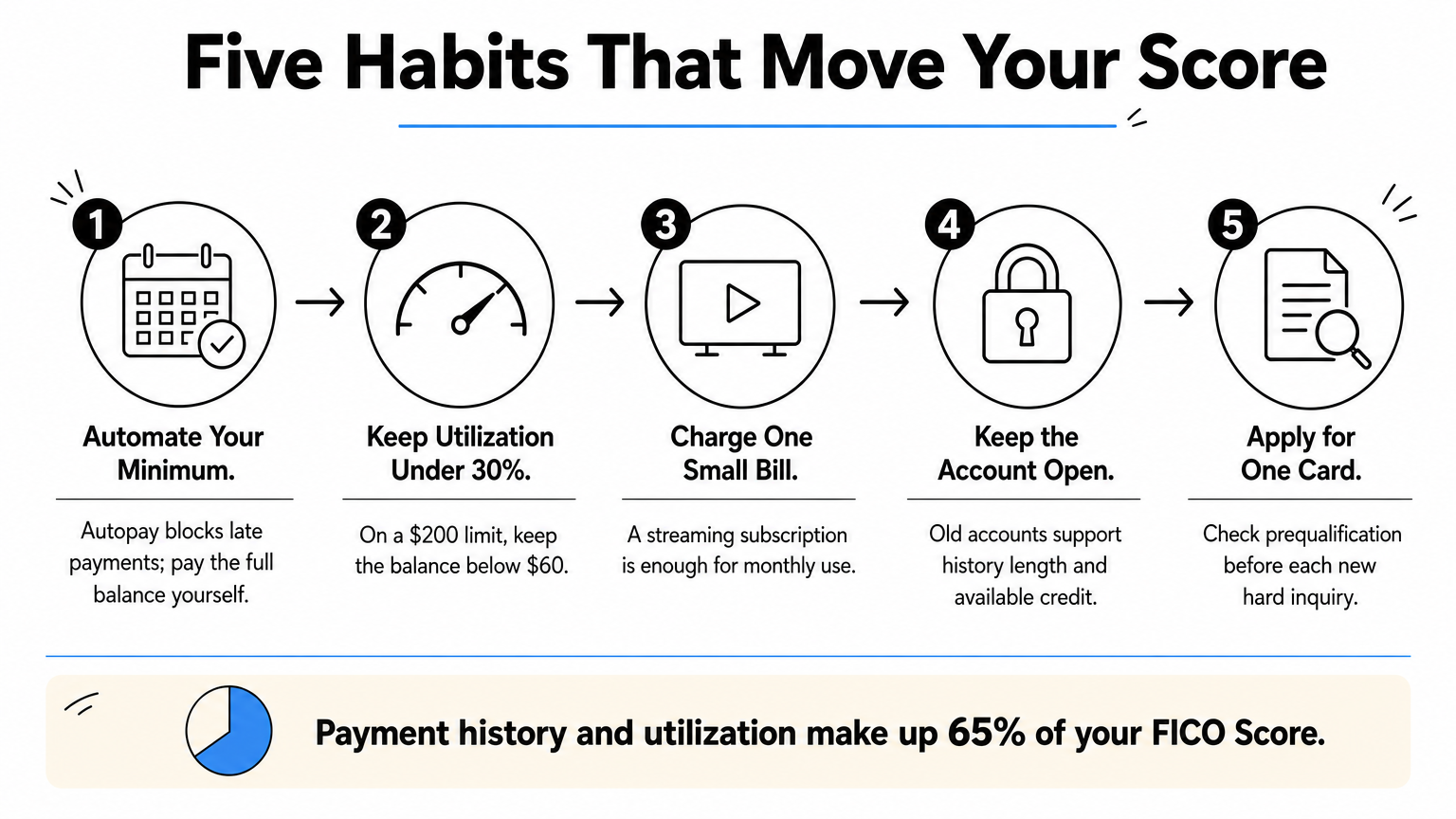
Payment history and utilization make up 65% of your FICO Score, so they are the only two habits worth perfecting.
What to expect and how long it takes
Moving from a 500 score to 670 or higher typically takes 12 to 24 months of consistent use. Lowering a high utilization rate can lift your score within a month or two, but payment history builds slowly. A jump to 700 in 30 days isn’t realistic on a builder card, so be wary of anyone who promises it.
The usual score killers are late payments, high utilization, many applications at once, and closing an old account. Avoid all four. Once your issuer offers an upgrade, take it, and you should get your deposit back.
Pick one card and let time work
The best credit cards to raise credit score are the cheapest ones that report to all three bureaus. For most readers, that means Capital One Platinum Secured, with Discover it Secured or Quicksilver Secured as upgrades if you want rewards. Chime Credit Builder fits readers without a deposit, and OpenSky and Credit One are the paid fallbacks. Whichever you choose, pay on time, pay in full, and keep your balance low.
Don’t hold more than one new card at a time. Give the account at least a year of clean history before you ask about an upgrade or apply elsewhere.
If a card balance is already getting ahead of you, start with our ways to pay off your credit card debt and get the balance under control before you add a new card.


