
Yes, most of them do, but by very different amounts. Do debt relief programs hurt your credit? Debt settlement and bankruptcy do the most damage. A nonprofit debt management plan does little direct harm. Consolidation costs a few points up front and often helps later. Debt relief means any program that reduces, restructures, or combines what you owe. The same answer applies to credit card debt relief, because cards are the debt most of these programs target.
The damage does not come from the program’s name appearing on your credit report. It comes from what happens to your accounts along the way: missed payments, closed cards, new loans, and "settled" notations. This article explains why those events lower your score, how much each option typically costs you, how long the marks last, and how to choose the option with the least damage. It also covers how to rebuild afterward.
Credit Card Solution is an educational site, not a lender or a settlement company. We explain the mechanics so you can decide before you sign anything.
Why debt relief can lower your credit score
Debt relief lowers your score when it changes how your accounts are reported, not because you asked for help. Your score reacts to behavior: whether you pay on time, how much of your limits you use, and how many accounts you open or close.
What credit scores actually measure
The FICO model weighs five factors. Each debt relief option presses on a different one, which is why the outcomes differ so much.
| Factor | FICO weight | Debt relief that affects it |
|---|---|---|
| Payment history | 35% | Settlement and bankruptcy, through missed payments |
| Amounts owed | 30% | Consolidation (lowers it), cards closed in a plan |
| Length of credit history | 15% | Closed accounts, new loans |
| New credit | 10% | Consolidation loans, balance transfer cards |
| Credit mix | 10% | Minor effect |
Payment history and amounts owed make up 65% of the score. A program that makes you miss payments hits the biggest factor directly.
Four ways debt relief touches your report
First, late payments. Settlement companies often tell you to stop paying creditors while they negotiate. Each missed payment gets reported, and the damage grows at 30, 60, and 90 days late.

Second, settled or closed accounts. A settled account is typically reported as settled for less than the full amount, which signals risk to future lenders. A debt management plan often requires you to close your cards. That cuts your available credit and shortens your account history.
Third, hard inquiries and new accounts. A consolidation loan or balance transfer card triggers a hard inquiry, which can cost a few points for a short time. Fourth, public records and legal filings. Bankruptcy is a court action, and it carries the longest reporting period of any option.
Debt relief hurts your credit through missed payments and closed accounts, not through the program itself.
How much each type of debt relief hurts your credit
Ranked from least to most damaging, the order is debt management plan, consolidation, debt settlement, Chapter 13 bankruptcy, then Chapter 7 bankruptcy. Actual point drops depend on where your score starts. A higher score generally has further to fall.
Side-by-side comparison
Use this table to compare the options. The reporting periods are the standard maximums for negative items.
| Option | Typical credit impact | Why | How long marks last |
|---|---|---|---|
| Debt management plan | Little to none directly | You repay in full and on time; cards are often closed | Plan notation removed after you finish; no derogatory mark |
| Debt consolidation | Small dip, often improves | Hard inquiry and a new account, but lower card utilization | Inquiry counts about 12 months, stays on file 2 years |
| Debt settlement | Significant | Missed payments plus a "settled" notation | Up to 7 years |
| Chapter 13 bankruptcy | Severe | Court-supervised repayment plan | Up to 7 years |
| Chapter 7 bankruptcy | Most severe | Debts discharged | Up to 10 years |
Why settlement and bankruptcy hurt most
Settlement does its damage before any deal exists. Months of missed payments get reported while the company builds up cash for a lump-sum offer. In some cases scores fall by around 100 points. Late fees and penalty interest can also grow your balance during that time, and creditors may sue. The Consumer Financial Protection Bureau warns that settlement can leave you deeper in debt than you started.

The marks stay for about seven years from your first missed payment. A first missed payment in March 2027 ages off around March 2034. Forgiven debt may also count as taxable income, so ask a tax professional before you settle. Bankruptcy stays longer, up to 10 years for Chapter 7 and up to seven for Chapter 13. It also makes new credit hard to get and expensive.
Why plans and consolidation hurt least
A debt management plan repays your full balances, usually at reduced interest, through a nonprofit credit counselor. Working with a counselor does not directly change your score. The indirect hits come from closed cards, which raise your utilization on the remaining accounts and shorten your history. On-time payments over the life of the plan push your score back up.
Consolidation works the same way in reverse. A personal loan that pays off your cards moves debt from revolving to installment, so card utilization can drop sharply. The risk is behavioral. Run the cards back up and you have doubled your debt and wasted the benefit.
The damage tracks one thing: whether the program asks you to stop paying what you owe.
How to choose the option with the least credit damage
Start with the cheapest option for your credit and move down the list only when the one above cannot work. That order protects your score and your wallet.
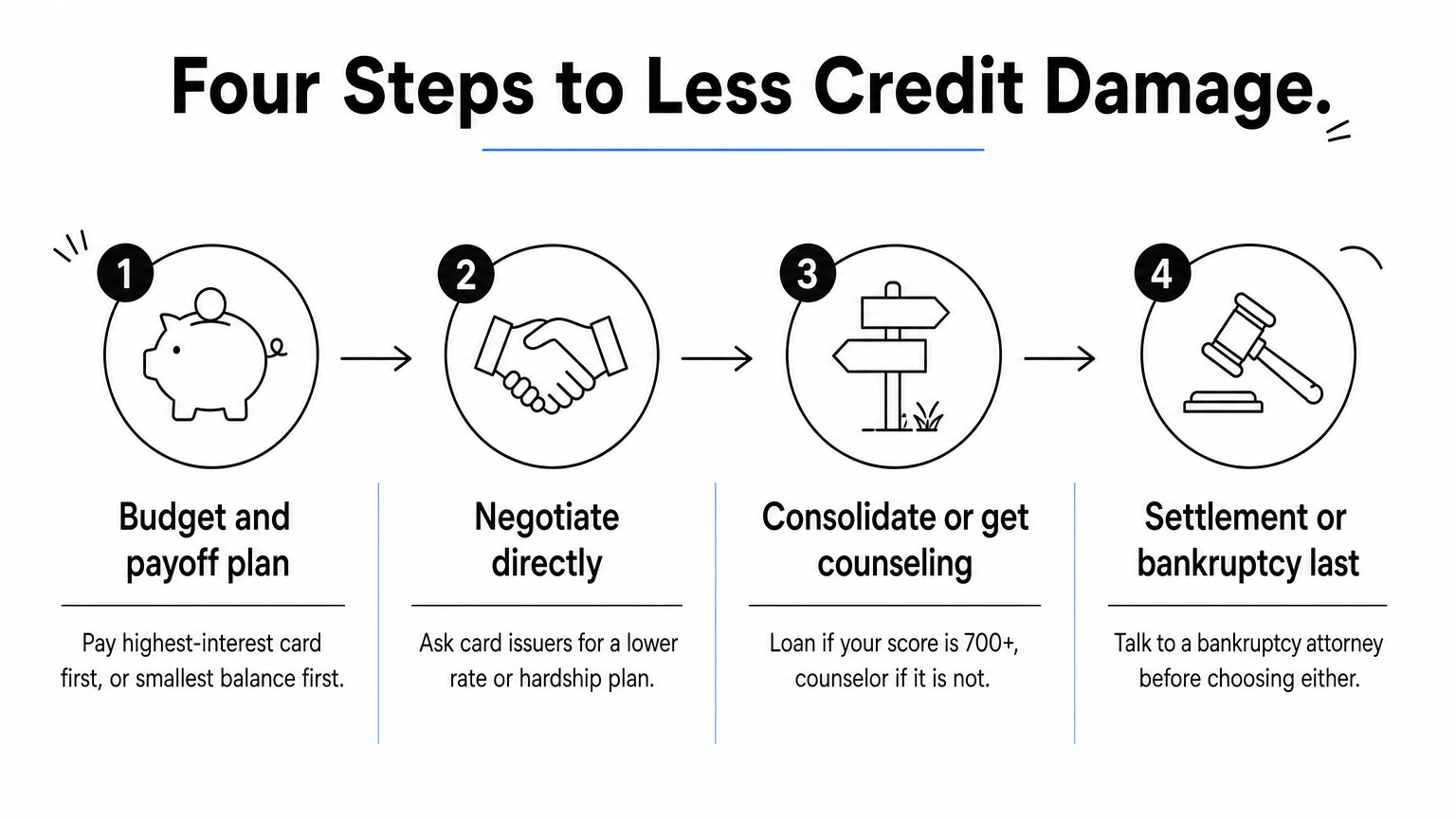
A four-step way to decide
- Try a budget and payoff plan first. The avalanche method pays your highest-interest card first. The snowball method pays your smallest balance first. Neither touches your credit report.
- Negotiate directly. Call your card issuers, explain the hardship, and try credit card debt negotiation by asking for a lower rate or a hardship plan. It costs nothing.
- Check consolidation or a debt management plan. If your score is roughly 700 or higher, a consolidation loan or a 0% balance transfer card can work. If your credit is damaged, talk to a nonprofit credit counselor about a debt management plan.
- Consider settlement or bankruptcy last. Talk to a bankruptcy attorney as well. Some offer a free first consultation.
Walk away from any settlement company that charges fees before it settles your debts, guarantees results, or tells you to stop talking to your creditors.
A worked example
Say you owe $12,000 across three cards with $15,000 in combined limits and a 690 score. You are using 80% of your available credit, so your utilization is already hurting you.
With a consolidation loan, you pay off the cards and your card utilization falls toward zero, provided you keep the cards open and unused. You take a small hit from the inquiry. You then build positive history with every on-time payment.
With settlement, you stop paying. Within three months your accounts are 90 days late, and that history stays for roughly seven years even if the deal works.
One exception is worth knowing. If you are already behind, your score is already falling. Settling can then stop further damage, and the extra hit may be small. If your credit is still healthy, the drop from settlement or bankruptcy can cost more than the relief is worth.
If your credit is still healthy, protect it. If it is already damaged, the extra cost of settling is smaller.
How to rebuild your credit after debt relief
Rebuilding your credit starts the day your plan ends, and the first goal is a clean, on-time payment record. Negative marks weigh less as they age and as positive history piles up on top of them.
Habits that move your score
- Pay every bill on time. Turn on autopay for at least the minimums. Payment history is the biggest factor in your score.
- Keep utilization low. Aim to use no more than 30% of your available credit, and lower is better.
- Open a secured card if you cannot qualify for a standard one. You put down a refundable deposit, use the card lightly, and pay it in full each month.
- Apply for new credit sparingly. Every application adds a hard inquiry.
- Check your reports. Pull them free at AnnualCreditReport.com and dispute errors. Settled accounts should show the right balance and status.
Expect progress in months, not days. After a debt management plan or consolidation you may see gains quickly. After settlement or bankruptcy, scores recover gradually over the years the marks remain.
Recovery is mostly boring consistency: on-time payments, low balances, and no new debt.
Your next step
Debt relief hurts your credit only as much as the option you choose. Debt management plans and consolidation cost little, settlement costs a lot, and bankruptcy costs the most for the longest. Work down the list from budgeting and direct negotiation, and use the heavier options only when the lighter ones cannot work.
If you are still weighing your options, compare the pros and cons of debt relief programs and read the rest of our guides on balance transfers, consolidation loans, and debt management plans at Credit Card Solution. Pick the path that fits your credit score, then stick to it.




No Responses