
People who search debt relief programs reddit want to hear from borrowers who have already enrolled, not from a sales page. A debt relief program is any structured plan to pay off credit card debt for less than a minimum-payment path would cost you. That covers a hardship plan from your card issuer, a nonprofit debt management plan (DMP), for-profit debt settlement, and consolidation. The honest summary of the threads is that nonprofit and do-it-yourself routes get recommended first, and for-profit settlement is treated as a last resort.
Reddit is useful here because posters have no commission to earn. They describe balances like $15,000 or $28,000, incomes around $35,000, and what happened after they signed. They also contradict each other, post unverified claims, and rarely share the numbers you would need to compare their case with yours.
This article gives you a way to use those threads without being misled by them. You will see what the posts agree on, how to vet any company the way experienced posters do, how the main options compare, and what real numbers look like on a $10,000 or $20,000 balance. Credit Card Solution is an educational site funded by advertising. We do not sell debt relief, so none of this steers you toward a provider.
Why Reddit threads shape debt relief decisions
Reddit shapes these decisions because it is one of the few places where people describe a debt program months after enrolling, when the sales pitch has worn off. That same openness is a weakness. You get stories, not statistics, and the stories lean toward extremes.

What the threads agree on
Across subreddits like r/Debt, r/DebtAdvice, and r/debtfree, a few points repeat. Call your card issuer first, because a hardship plan costs nothing. A nonprofit DMP beats a for-profit company in most posters’ eyes, since it is nonprofit and can lower your interest rate and monthly payment. Posters also say that programs which tell you to stop paying your cards fail often, because the people who need them are already stretched thin and cannot keep up the discipline.
Many posts describe balances between $15,000 and $30,000 on cards at high interest. That detail matters. Debt at that size is serious, but usually not so large that you need a drastic option.
The most repeated advice in these threads is simple: exhaust the free options before you pay anyone.
Where the threads mislead you
Treat every success story and every horror story as one data point. A person’s result depends on their creditors, their state, their income, and how long they stuck with the plan. None of that is visible in a comment.
Posts can also be planted. Company names that appear repeatedly in "best debt relief companies" threads deserve suspicion, because affiliates and marketers know these threads rank in Google. Trust the reasoning behind a recommendation, not the brand name attached to it.
How to vet a debt relief company like a skeptic
Vet a company by asking who gets paid, when, and what happens to your accounts while the program runs. If the answers are vague, walk away. You can do this in an afternoon.
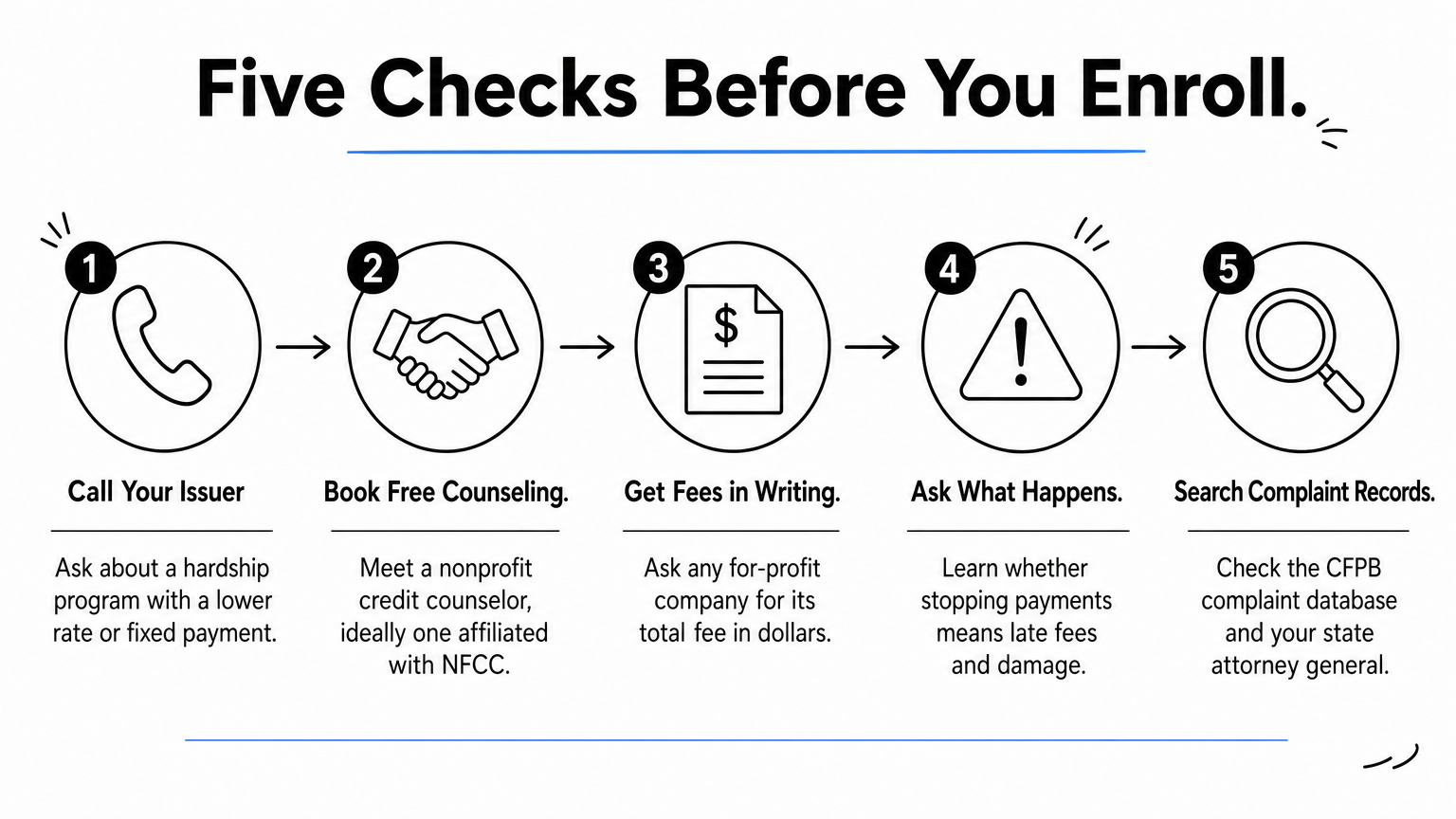
A five-step check before you enroll
- Call each card issuer and ask about a hardship program with a lower rate or fixed payment.
- Book a free session with a nonprofit credit counseling agency, ideally one affiliated with the National Foundation for Credit Counseling.
- Ask any for-profit company for its total fee in dollars, in writing. Fees are usually a percentage of the debt you enroll.
- Ask what happens to your accounts. If you are told to stop paying your cards, expect late fees, collection calls, and a damaged score.
- Search the company in the CFPB complaint database and with your state attorney general.
Never sign on the first call. A legitimate offer will still be there tomorrow.
Red flags that show up in every thread
Certain warnings come up again and again. Watch for these:
- Upfront fees. Under the FTC’s Telemarketing Sales Rule, companies selling debt relief by phone generally cannot charge before they settle a debt for you. The FTC’s consumer advice site explains the rule.
- Guarantees that your debt will vanish.
- "Government" programs. No federal program forgives ordinary credit card debt.
- Advice to stop talking to creditors without explaining the consequences.
- A fee quoted only as a percentage, never as a dollar total.
Debt relief options compared
The options differ mainly in cost, credit damage, and who they fit. Posters tend to rank them from least to most damaging to your credit, and the table below follows that order.

| Option | How it works | Typical cost | Credit impact | Best fit |
|---|---|---|---|---|
| Issuer hardship plan | Issuer lowers your rate or payment for a set period | Usually free | Mild, though the card may be closed | You are current but struggling |
| Nonprofit DMP | Agency negotiates lower rates and sets one monthly payment, typically over 3 to 5 years | Modest setup and monthly fees | Moderate, accounts stay current | Steady income, you can repay the full principal |
| Debt consolidation loan or balance transfer | New loan or 0% card pays off your cards | Loan interest, or a balance transfer fee, commonly 3% to 5% | Small, often positive if you pay on time | Good credit, roughly 700 or higher |
| For-profit debt settlement | You stop paying creditors and save for lump-sum offers | Often 15% to 25% of enrolled debt | Severe, with late payments, collections, and possible lawsuits | Serious hardship, accounts already delinquent |
| Bankruptcy | Court process, either liquidation or repayment plan | Filing fees plus attorney costs | Heaviest, stays on reports 7 to 10 years | You cannot repay in about five years |
Why posters point to DMPs first
A DMP keeps your accounts current while the agency negotiates a lower rate, so you avoid the late-payment spiral that settlement creates. The cost is that you repay the full balance and the cards are usually closed.
Settlement timelines are another sticking point. Programs commonly run two to four years, and some posters report plans stretching past four years with biweekly deposits. That is a long time to fund an account while your cards go delinquent.
A DMP asks you to repay what you borrowed. Settlement asks you to gamble that creditors accept less.
Straight answers to the questions threads keep asking
Three questions appear constantly: is there a government program, is $20,000 a lot, and can you clear $10,000 quickly. The numbers answer all three better than opinion.
Is there a real government debt relief program?
No federal program wipes out credit card debt for ordinary consumers. Anything advertised that way is a scam or a rebranded for-profit service.
Real help is more modest. Your issuer’s hardship program, a nonprofit credit counselor, and the bankruptcy courts are the legitimate routes. Student loans have their own federal programs, but those do not apply to cards.
What $10,000 and $20,000 look like in practice
Whether $20,000 is "a lot" depends on income, but the interest tells the story. At a 24% APR, $20,000 generates about $400 in interest every month. Minimum payments barely move that balance.
To pay off $10,000 in card debt in six months at 24% APR, you would pay about $1,785 a month, roughly $10,711 in total. That is realistic only with high income or savings. Otherwise a longer plan makes more sense.
Here is an illustrative comparison for $20,000. Real outcomes vary and settlements are never guaranteed.
- Settlement: a 20% fee is $4,000. If creditors accept half the debt, you pay $10,000, for $14,000 total. Forgiven debt can be taxable income, and your credit takes heavy damage.
- DMP at 8%: if the agency negotiates your rate to 8% over 48 months, you pay about $488 a month, roughly $23,400 total, plus a modest agency fee. Your credit stays far healthier.
Settlement can look cheaper on paper, but the credit damage, taxes, and risk of refusal belong in the price.
What to take from the threads
Read the Reddit threads for patterns, not for a company name. The pattern is clear: ask your issuer first, talk to a nonprofit counselor second, and treat for-profit settlement as a last resort after you have run the numbers on fees, taxes, and credit damage. Vet every offer in writing and never pay upfront.
If you want to go deeper on balance transfers, consolidation loans, and nonprofit plans, read our guide to how to choose a debt relief program.