
The top rated debt relief programs for credit card debt fall into two camps. Nonprofit credit counselors such as Money Management International and InCharge Debt Solutions lower your interest rate and do little harm to your credit. For-profit settlement companies such as Freedom Debt Relief, Accredited Debt Relief, National Debt Relief, New Era Debt Solutions and Pacific Debt Relief try to shrink the balance itself. They charge about 14% to 25% of the debt you enroll, and they can hurt your credit. If you can still make payments, start with a nonprofit. If you can’t, a settlement firm with a clean record is the realistic next step.
The hard part is that every provider calls itself the best, and the industry has real bad actors. You are probably paying 18% to 29% interest on balances that barely move, and one wrong enrollment can add fees, late charges and even a lawsuit on top of what you already owe.
This article reviews seven programs with the same checklist: what each one costs, the minimum debt it accepts, where it operates, and who it fits. We are an education site funded by advertising, and we don’t enroll anyone in a program. After the reviews, you’ll get a short guide to spotting scams, the real cost and credit impact of settlement, and what to do about the "government program" you keep hearing about.
What makes a debt relief program top rated
A top rated program charges nothing before it delivers results, states its fees in plain numbers, has a clean complaint record, and works with your type of debt. Everything below is judged against those four tests.
The five checks behind these picks
We compared each provider on five points, using its published terms and third-party ratings. Confirm current numbers before you enroll, because fees and state availability change.
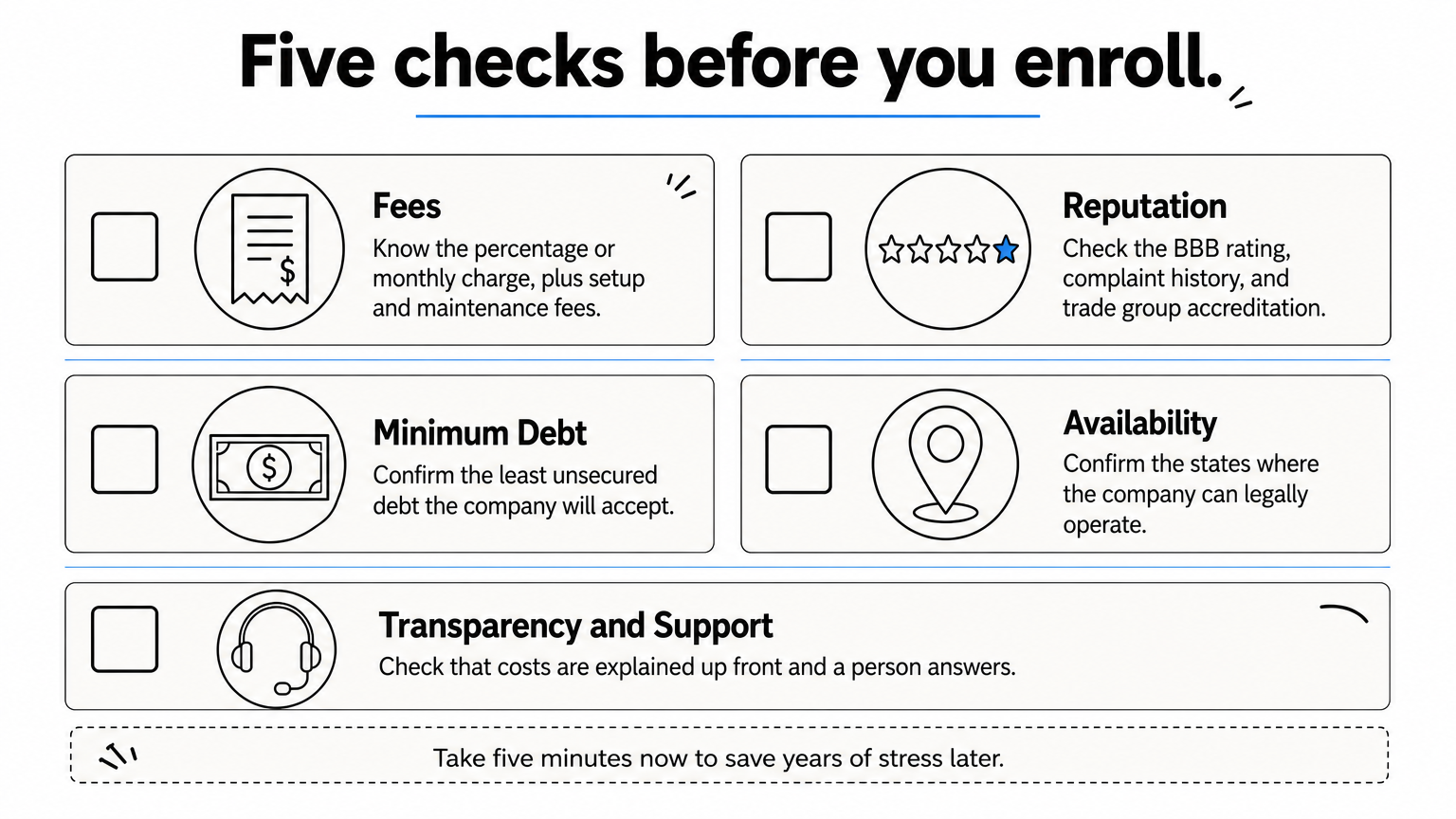
- Fees: the percentage or monthly charge, plus any account setup or maintenance fees.
- Reputation: the Better Business Bureau rating, complaint history, and accreditation by a trade group such as the Association for Consumer Debt Relief or the National Foundation for Credit Counseling.
- Minimum debt: the least unsecured debt the company will take on.
- Availability: the states where it can legally operate.
- Transparency and support: whether costs are explained up front and how easy it is to reach a person.
The best program is the one that fits your debt size, your state and your ability to keep paying.
Settlement versus management plans
Debt settlement means you stop paying your creditors and deposit money into a dedicated account. Once enough has built up, the company negotiates a lower payoff. It charges a fee based on the debt you enrolled, and your credit takes a hit while you are not paying. Programs typically run two to four years.
A debt management plan works differently. A nonprofit agency negotiates lower interest rates and waived fees, and you send one monthly payment that it distributes to your creditors. Your principal balance stays the same, but you pay less interest and finish in about three to five years. Credit damage is much smaller.
The seven programs side by side
The table shows how the seven compare on the numbers that matter most. Fee percentages apply to the debt you enroll, not the amount you finally settle for.
| Program | Type | Minimum debt | Typical cost |
|---|---|---|---|
| Money Management International | Nonprofit management plan | $0 ($2,000 for settlement plans) | $33 to $75 setup, $25 to $69 monthly |
| InCharge Debt Solutions | Nonprofit management plan | $0 | About $52 setup, $34 monthly |
| Freedom Debt Relief | Settlement | $7,500 | 15% to 25% plus account fees |
| Accredited Debt Relief | Settlement | $5,000 | 15% to 25% |
| National Debt Relief | Settlement | $7,500 | 15% to 25% |
| New Era Debt Solutions | Settlement | $10,000 | 14% to 23% |
| Pacific Debt Relief | Settlement | $10,000 | 15% to 25% |
1. Money Management International
Money Management International (MMI) is the best starting point if you can still afford payments but interest is eating them. It is a nonprofit, and its main product is a debt management plan.
How it works and what it costs
You make one monthly payment to MMI, and it pays your creditors at lower negotiated rates with reduced late fees. MMI also offers settlement-style debt resolution plans in some states.
- Minimum debt: $0 for a management plan, $2,000 for a debt resolution plan.
- Fees: a one-time setup fee of $33 to $75 and a monthly fee of $25 to $69, depending on your state and debt. MMI says the monthly fee averages about $27.
- Availability: management plans in all 50 states and Washington, D.C. Debt resolution plans are not offered everywhere.
- Reputation: an A+ rating from the Better Business Bureau.
Who it fits and the catch
This plan suits you if your income covers the payments but 25% interest keeps the balance from falling. At the $27 average, four years of monthly fees come to roughly $1,300, plus the setup fee. A settlement firm would charge $3,000 to $5,000 on $20,000 of enrolled debt.
The catch is that you must close the credit cards you enroll, and the plan will not reduce what you owe. Expect three to five years of steady payments.
If you can make payments, a nonprofit plan almost always costs less than settlement.
2. InCharge Debt Solutions
InCharge Debt Solutions is a nonprofit built around credit card debt, and it is the pick for people whose problem is almost entirely high card interest.
How it works and what it costs
InCharge builds a debt management plan, negotiates lower rates with your card issuers, and collects one payment from you to distribute. It is accredited by the National Foundation for Credit Counseling and holds an A+ rating from the Better Business Bureau.
- Minimum debt: $0.
- Fees: an average setup fee of $52 and an average monthly fee of $34, varying by state.
- Availability: all 50 states and Washington, D.C.
- Reported results: InCharge says clients cut card rates to an average of about 8% and save $75 to $300 a month.
Who it fits and the catch
It fits you if most of your balance sits on credit cards and you want a low barrier to entry, since there is no minimum. Because the plan runs on lower interest instead of forgiveness, it works best when you have steady income and a payoff goal of a few years.
The tradeoffs are modest. Its average monthly fee runs a bit above MMI’s, there is no mobile app, and the service is built around card debt, so a mixed pile of other debts may not fit. Ask exactly which of your accounts it can include before you sign.
For card-heavy debt and a steady paycheck, InCharge is a low-risk way to cut your interest rate.
3. Freedom Debt Relief
Freedom Debt Relief is the settlement company to look at if you want support seven days a week and a lower minimum than most rivals. It says it has resolved over $20 billion in debt since 2002.

How it works and what it costs
You enroll unsecured debt, stop paying creditors, and deposit into an escrow account while the company negotiates. It also offers free consultations for credit card debt.
- Minimum debt: $7,500.
- Fees: 15% to 25% of enrolled debt, depending on state and amount, plus a $9.95 escrow setup charge and a $9.95 monthly service fee.
- Availability: not offered in Colorado, North Dakota, Oregon, Rhode Island, Vermont, West Virginia, Wisconsin, Wyoming or Washington, D.C.
- Reputation: an A+ rating from the Better Business Bureau.
Who it fits and the catch
This one fits you if you owe $7,500 or more, are already behind, and want a firm that answers the phone on weekends. It also reportedly provides legal assistance to all clients at no extra charge, which matters if a creditor sues. Freedom says it will refund its fees if the settlement amount ends up higher than your balance at enrollment.
On $10,000 enrolled, expect $1,500 to $2,500 in settlement fees plus the monthly service charge. The catch is the same as with every settlement firm: stopping payments damages your credit, and some creditors won’t negotiate.
Freedom suits borrowers who are already behind and want live support and legal help included.
4. Accredited Debt Relief
Accredited Debt Relief is the easiest settlement company to qualify for, with a $5,000 minimum, and it earns some of the strongest customer ratings among its peers.
How it works and what it costs
After a free consultation, the company reviews your budget, enrolls your unsecured debt and negotiates settlements as your account builds. It also publishes free educational resources on managing money.
- Minimum debt: $5,000.
- Fees: 15% to 25% of enrolled debt, depending on your state.
- Availability: options and evaluations in all 50 states and Washington, D.C.
- Track record: founded in 2011, and says it has helped over 1.3 million clients resolve more than $15 billion in debt. Its Better Business Bureau rating averages 4.89 out of 5 across more than 2,200 reviews.
- Typical timeline: 24 to 48 months.
Who it fits and the catch
It fits you if your debt is on the smaller side, between $5,000 and $10,000, since many competitors won’t take you. It is also a reasonable choice if you live in a state where other firms don’t operate.
The downside is price. Its fees can run higher than those of some rivals, so compare quotes. At the top 25% rate, $8,000 enrolled would cost $2,000 in fees. You also need at least $5,000 of unsecured debt to enroll.
Accredited is the strongest fit for smaller balances and for borrowers who want a consultation before committing.
5. National Debt Relief
National Debt Relief is a long-established settlement firm that accepts smaller debts than most and is accredited by two settlement trade groups.

How it works and what it costs
The process is standard settlement: enroll unsecured debt, deposit into an account, negotiate once there are funds. National says clients who finish its program cut their enrolled debt by 20% to 25% on average, after fees. That is the company’s own claim, not a guarantee.
- Minimum debt: $7,500.
- Fees: 15% to 25% of enrolled debt, depending on amount and state.
- Availability: nationwide except Connecticut, Oregon, Vermont, West Virginia and Wisconsin.
- Reputation: an A+ rating from the Better Business Bureau, plus accreditation by the American Association for Debt Resolution and the International Association of Professional Debt Arbitrators.
- Typical timeline: about 34 months.
Who it fits and the catch
It fits you if you owe between $7,500 and $15,000 and want a company with trade-group accreditation. If the 20% to 25% claim held on $15,000 enrolled, you would net $3,000 to $3,750 in savings and pay about $11,250 to $12,000 in total, fees included.
The catch is availability. Five states are excluded, and settlement still carries the usual credit and tax consequences. Treat the average as a best case and ask for a written estimate for your own accounts.
National Debt Relief works well for mid-sized balances, but plan around the company’s averages, not a promise.
6. New Era Debt Solutions
New Era Debt Solutions has the lowest fee range of the settlement firms here and, by its own account, one of the shortest programs.
How it works and what it costs
New Era runs a conventional settlement program and does not charge monthly maintenance fees. It also serves Spanish-speaking clients.
- Minimum debt: $10,000.
- Fees: 14% to 23% of enrolled debt.
- Availability: nationwide except Iowa, Maine and Oregon.
- Typical timeline: the company says clients average just under 28 months to finish.
- Gaps: no mobile app.
Who it fits and the catch
It fits you if you owe $10,000 or more and want to keep fees down and finish sooner. On $20,000 enrolled, fees run $2,800 to $4,600, against $3,000 to $5,000 at a flat 15% to 25%. The monthly maintenance charge you avoid adds up over a program that lasts more than two years.
Smaller debts won’t qualify, and residents of three states are out. The 28-month figure is an average the company reports, so ask what share of clients finish and how long the slowest take.
New Era is the cheapest settlement option here for borrowers who clear the $10,000 minimum.
7. Pacific Debt Relief
Pacific Debt Relief is the broadest option by geography. It has operated since 2002 and works in every state except Oregon.
How it works and what it costs
Pacific runs a standard settlement program. It is accredited by the Association for Consumer Debt Relief and also works with Spanish-speaking clients.
- Minimum debt: $10,000, though some sources say it may make exceptions down to $7,500.
- Fees: 15% to 25%, depending on the amount enrolled and your state.
- Availability: all states except Oregon.
- Reputation: an A+ rating from the Better Business Bureau and customer reviews averaging 4.93 out of 5.
- Gaps: no mobile app.
Who it fits and the catch
It fits you if other firms don’t operate in your state and you want a company with two decades of history. Ask one question before you enroll: is the fee figured on the debt you enroll or on the amount actually settled? The two can differ by hundreds of dollars.
The $10,000 minimum is the main hurdle, and fees sit in the same range as most competitors, so Pacific wins on reach and reputation more than on price. If you owe less, ask about exceptions, but don’t count on one.
Pacific’s strength is availability and track record, so ask exactly how its fee is calculated.
How to pick a legitimate provider and avoid scams
Choose the provider that fits your debt and your state, and rule out anyone who breaks the basic rules of the business. The Consumer Financial Protection Bureau’s guidance on debt settlement is blunt about the risks.
Red flags that rule a company out
Walk away if a company does any of the following:
- Charges fees before it settles any debt.
- Guarantees it can make your debt go away or settle everything for a promised percentage.
- Touts a "new government program" to bail out credit card debt.
- Tells you to stop talking to your creditors.
- Promises to stop all collection calls and lawsuits.
Then check complaints with your state attorney general and the Better Business Bureau. A legitimate firm lets you read the contract first, explains each fee, and tells you creditors may refuse to negotiate.
What it costs and what it does to your credit
Fees are only part of the cost. On $20,000 of enrolled debt, a 15% to 25% fee means $3,000 to $5,000 on top of whatever you pay creditors. Forgiven debt can also count as taxable income, so ask a tax professional before you settle.
Credit damage comes from the missed payments. Your score can fall by as much as 100 points, according to the NFCC, and a settled account can show as "settled for less than the full amount" for up to seven years. A management plan adds no such mark, though closing cards can raise your utilization.
Government programs and alternatives
No federal program wipes out credit card debt. Treat anyone advertising one as a red flag. Real alternatives exist, though, and all of them are worth a look before you enroll in settlement:
- Call your issuer and ask for a hardship plan, a lower rate, or waived fees.
- Take a debt consolidation loan or a balance transfer card if your credit is still good.
- Talk to a bankruptcy attorney, some of whom offer a free first consultation.
Skip any offer built on a government program that supposedly erases your cards.
Pick the option you can finish
The best debt relief program is the one you can complete. If your income covers payments, a nonprofit plan from Money Management International or InCharge cuts interest at the lowest cost. If you are already behind on $7,500 or more, the settlement firms above are legitimate options, with Accredited for smaller balances, New Era for lower fees, and Pacific for reach.
Whichever route you choose, read the contract, confirm your state is covered, and never pay before results. For more step-by-step guidance on how to get out of credit card debt, browse the Credit Card Solution guides and compare your options before you commit.