
To write a settlement letter for debt, confirm who owns the debt and the exact balance, decide what lump sum you can pay, put a clear offer in writing with conditions attached, and pay only after the creditor agrees in writing. The letter should say that your payment settles the account in full and should state how the account will be reported to the credit bureaus. A copy-ready template is in Step 3.
The problem is that most people write this letter in a panic. They offer too much, admit the debt in a way that restarts a legal clock, or send money on a phone promise that the collector later denies. Card issuers and collectors have no duty to accept a settlement offer. A sloppy letter can leave you with a lower credit score, a tax bill, and the same debt.
This guide walks through the process in order. You will learn when a settlement makes sense, how to verify the debt, how to size your offer with a worked example, and what to put in a letter to a credit card company or collection agency to settle debt. You will also learn how to handle counteroffers and what to do after you pay. This is general education, not legal advice.
What a debt settlement letter does and when to use one
A debt settlement letter is a written offer to pay less than the full balance, usually as a one-time lump sum, in exchange for the creditor treating the debt as resolved. It is the paper trail of a negotiation, and it protects you if the other side later claims you never had a deal.
What the letter actually does
The letter turns a vague phone conversation into specific, provable terms: the amount, the deadline, and what the creditor promises in return. Without those terms in writing, a collector can accept your money and then bill you for the remainder.
A settlement of debt letter also sets your tone. A short, factual offer signals that you are organized and serious. A long hardship story rarely changes the number.
A settlement is only as strong as the written terms behind it.
When settling makes sense, and when it does not
Settlement fits one situation best: you cannot pay the full balance, the account is already past due, and you can raise a lump sum. Card issuers typically charge off an account after about 180 days without payment, and that is when settlements become most realistic.
If your score is still healthy and you can keep up with payments, look at a balance transfer card, a consolidation loan, or a nonprofit debt management plan first. A settled account is reported as less than paid in full, and late payments can stay on your credit report for up to seven years from the first missed payment.
What to have ready before you write
Gather these items first:
- Your most recent statement or the collector’s first letter
- Your account number, or at least the last four digits
- The name of the original creditor and the current owner of the debt
- Your cash on hand, with the exact lump sum you can raise within two weeks
- Your credit reports from AnnualCreditReport.com
Also know that forgiven debt can be taxable. When a creditor cancels $600 or more, it generally must report it to the IRS, and the IRS explains how canceled debt is treated. Ask a tax professional how this applies to you before you sign.
Step 1. Confirm who owns the debt and the balance
Before you offer anything, verify who is asking for the money and how much they say you owe. Settling with the wrong company, or on the wrong balance, wastes cash and can leave the real owner still pursuing you.

Identify the right company
Check your credit reports to see whether the account is still with the card issuer or was sold to a debt buyer. This matters because the right target for your letter is whoever owns the debt today. Debt buyers often pay only a small fraction of the face value, which is why they can accept offers far below the balance. The FTC’s debt collection FAQs explain how that works.
If the account is still with the original issuer and fairly recent, ask about a hardship plan first. Issuers prefer to collect in full and often settle only after the account goes seriously delinquent.
Request validation in writing
If a collector contacted you, you can dispute the debt in writing within 30 days of receiving its validation notice. The Consumer Financial Protection Bureau’s debt collection tools cover your rights. Send this as a separate letter by certified mail, not inside your settlement offer.
Validation also protects you from a scam. Never send money to a company that cannot show it owns the account.
One trap to avoid: on old debts, a partial payment or a written acknowledgment can restart the statute of limitations in some states. If the debt is several years old, find out whether it is time-barred before you pay or sign anything. A settlement letter should never say "I owe this debt."
Verify first, offer second. A settlement with the wrong party is a gift, not a deal.
Step 2. Set your offer, ceiling, and payment plan
Your offer should have three numbers: an opening bid, a target, and a ceiling you will not exceed. Decide them before you write, because the letter is easy and the negotiation that follows is where people give in.
Build an offer ladder
There is no official "reasonable" percentage, so treat any figure you read as a rule of thumb. Practitioners commonly see opening offers in the range of 25 to 40 percent of the balance, with final settlements often landing closer to half. Older accounts held by debt buyers tend to settle lower. Accounts in a lawsuit tend to settle higher.
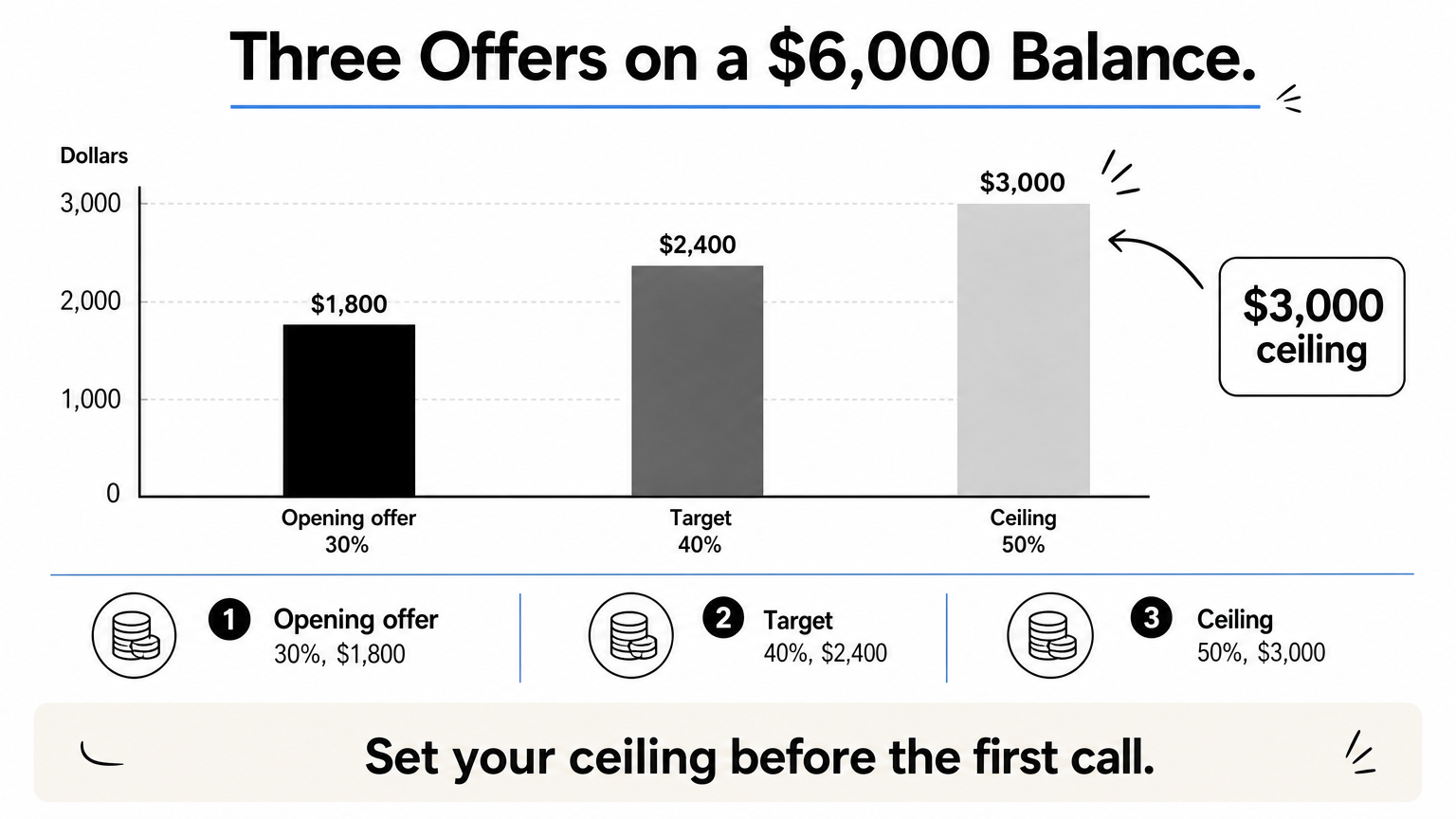
Here is a worked example for a $6,000 charged-off card balance now held by a collector:
| Rung | Percent of balance | Dollar amount | You save |
|---|---|---|---|
| Opening offer | 30% | $1,800 | $4,200 |
| Target | 40% | $2,400 | $3,600 |
| Ceiling | 50% | $3,000 | $3,000 |
Your ceiling should be money you actually have, not money you hope to borrow at a high rate. If the collector’s balance has grown with fees, base your percentages on the validated balance.
Pick your ceiling before the first call, and treat it as a hard stop.
Lump sum or installments
A lump sum is your strongest lever. A collector who can close the file this month will often take less than one who must wait on installments. If you cannot raise a lump sum, offer two or three payments within 60 days, and state each date in the letter.
Do not drain your emergency fund to settle. Do not borrow against a retirement account or put the payment on another high-interest card. Either move can leave you worse off than the debt did.
Step 3. Write the settlement letter
A good letter for settlement of a debt is one page, factual, and conditional. It states your offer, the terms you require in return, and a deadline. It makes no promises beyond the offer and no admissions about the debt.

What every letter needs
Include each of these:
- Account details: your name, the last four digits of the account number, the original creditor, and the balance they claim
- The offer: a specific dollar amount and when you will pay it
- Full and final language: your payment settles the account completely, with no leftover interest or fees
- No resale: the creditor will not sell or pursue the remaining balance
- Credit reporting: how the account will be reported, such as "paid in full" or "settled" with a zero balance
- Condition: you will pay only after receiving written acceptance
- A deadline: the offer expires on a date, usually 30 days out
- No admission: the letter is not an acknowledgment of the debt or a promise to pay
You may ask the collector to delete the account entirely, known as pay for delete. Many creditors refuse, so treat it as a request, not a requirement. Accurate reporting of "settled" is a more realistic goal.
A letter you can copy
This version works for a letter to a credit card company to settle debt or for a collection agency. Fill in the brackets.
[Your full name]
[Street address]
[City, State ZIP]
[Date]

[Creditor or collection agency name]
[Address]

Re: Settlement offer for account ending [last 4 digits]
Original creditor: [name]
Balance stated by you: $[amount]

Dear [name or "Account Representative"]:

I am writing to offer a settlement of the account above. I am unable to pay the full balance, but I can pay a one-time lump sum of $[offer amount] within [10] days of receiving your written acceptance of this offer.

If you accept, I ask that you confirm in writing that:

1. A payment of $[offer amount] will settle this account in full, and I will owe nothing further, including interest, fees, or costs.
2. You will not sell the account or pursue collection of any remaining balance.
3. You will report the account to all credit bureaus as [paid in full / settled] with a balance of $0.

This offer is not an acknowledgment that I owe this debt or a promise to pay it. It is made only to resolve the matter, and it expires on [date, 30 days from sending]. I will not send payment until I receive your signed written agreement.

Please send your written response to the address above.

Sincerely,
[Signature]
[Printed name]
One page, one number, written conditions, and no admission of the debt.
Step 4. Send it, negotiate, and get the deal in writing
Send the letter by a trackable method, expect a counteroffer, and never pay until the agreed terms are in a signed document. Most failed settlements fail here, not in the letter.
Send it so you have proof
Mail the letter by certified mail with return receipt, and keep a copy plus the receipt. If the collector offers a portal or email, use it too, and save screenshots. Never give out your bank login or let anyone set up automatic withdrawals. Send the settlement payment yourself by cashier’s check or a single one-time payment you control.
Handle counteroffers
Expect a reply that rejects your opening number and proposes a higher one. That is normal, and it means the negotiation has started. Counter once or twice, moving up in small steps toward your target, and stay below your ceiling. If a collector pressures you to decide on a call, say you will respond in writing.
Keep the logic simple: a counteroffer inside your ceiling is a real option, and one above it is not. If the collector stays above your ceiling, wait a few weeks and try again. Debts often become cheaper to settle as they age, though waiting carries its own risk. If you receive a court summons, respond on time. Ignoring it can lead to a default judgment, and you can still negotiate while the case is pending.
Pay only after written agreement, then check
Once you have a signed agreement that matches your letter, make the payment and keep proof. Record the confirmation number and the date.
Then follow up:
- Check your credit reports 30 to 60 days later to confirm the account shows the agreed status and a zero balance.
- Keep the settlement agreement and payment proof for at least several years.
- Watch for a Form 1099-C if $600 or more was canceled, and talk to a tax professional about whether it counts as income.
- Dispute any inaccurate reporting with the bureau and send the agreement as evidence.
Never pay on a promise. Pay on a signed document.
Your next move on credit card debt
A settlement letter works when you do four things in order: verify the debt, set your numbers before you negotiate, write a short conditional offer, and pay only against a written agreement. The letter matters, but the discipline around it matters more.
If your accounts are still current and settlement feels premature, there may be cheaper routes. Compare balance transfers, consolidation loans, and nonprofit plans first, and see how each affects your score. For clear, ranked options built around your credit profile, start with credit card debt consolidation and pick the path that fits your situation.


