How long does it take to raise credit score numbers? Most people see the first movement 30 to 45 days after they act, because that is how long lenders take to report new information. A gain of 10 to 20 points can arrive within one or two billing cycles. A gain of 100 points usually takes six to twelve months. Collections and bankruptcies fade over years, not weeks.
A credit score improvement timeline is the gap between the day you change a habit and the day a new score reflects it. That gap exists because scores are built from credit reports, and lenders update those reports on their own schedule. It also exists because some negative items lose weight slowly instead of disappearing.
This article explains why the gap exists, how long common fixes take, and which moves shorten the wait. It ends with a 12-month plan you can follow. Credit Card Solution is an educational site, not a lender, so the goal is to give you honest expectations instead of a promise of overnight results.
Why raising your credit score takes time
Your score takes time to rise because it is a snapshot of your credit reports, and those reports only change when lenders send updates, usually once a month. The delay is built into the system, so it affects everyone, whatever their starting score.
The reporting cycle behind the delay
Each lender chooses when it reports to Equifax, Experian and TransUnion. Most report monthly, on a date that differs from lender to lender. Your score is calculated at the moment someone requests it, using whatever is on file at that point. If you pay off a card today, the lower balance may not show up for 30 days or more.

Scores also differ by source. Each bureau holds a slightly different file, and FICO and VantageScore weigh the same data differently. A 15-point gap between two apps is normal and does not mean one of them is wrong.
What the score weighs and how fast each part moves
Under the FICO model, five factors make up your score. Each one responds at a different speed, and that speed sets your timeline.
| Factor | FICO weight | How fast it responds |
|---|---|---|
| Payment history | 35% | Slow. New on-time payments add up month by month, and old late payments fade over years. |
| Amounts owed (utilization) | 30% | Fast. It can change within one or two statement cycles. |
| Length of credit history | 15% | Very slow. Only time improves it. |
| Credit mix | 10% | Slow, and a minor lever. |
| New credit | 10% | Moderate. Inquiries matter less after about a year but stay visible for two. |
Utilization is your fast lever because it has no memory. Lower the balances, and the next report shows a lower ratio. Payment history is the heavy lever because it carries the most weight but changes slowly. That is why a good plan pulls the fast lever first while the slow one works in the background.
Utilization moves your score in weeks, while payment history moves it in months and years.
How long it takes to raise your credit score by situation
How long you wait depends on what is holding your score down. It does not follow one universal clock, and the worst item on your report usually sets the pace.
Typical timelines by cause
These ranges are general estimates. Your own profile can move faster or slower.

| What is dragging your score | Typical time to see movement |
|---|---|
| Card balances above 50% of limits, then paid down | 1 to 2 months |
| An incorrect negative item, successfully disputed | 30 to 45 days |
| Authorized user on a well-managed older card | 1 to 2 months after the issuer reports it |
| One 30-day late payment | Impact fades over a year or more, stays on the report 7 years |
| Collections or charge-offs | 1 to 2 years for solid recovery, stays on the report 7 years |
| Bankruptcy | Chapter 13 stays 7 years, Chapter 7 stays 10 years, and recovery can start within 1 to 2 years |
| No credit history | At least 6 months before your first FICO score |
The fastest wins come from things that are wrong or temporary: a high balance or a reporting error. The slowest come from things that are true and recorded: missed payments, collections, and a short history.
Point goals people ask about
Most readers want a number, so here is how the common targets play out.
- 10 to 20 points: often one or two cycles if high card balances are the main problem.
- 100 points in 30 days: realistic only if you remove a large error or your cards are maxed out and you can clear most of the balance. Anyone promising 100 points overnight is selling something.
- 100 points in general: plan on six to twelve months of on-time payments and lower balances.
- 500 to 700: usually one to three years, because you are rebuilding history while old negatives linger.
- 720 in six months: possible only if you start in the high 600s and high utilization is your main drag. From the low 600s with recent late payments, it is not.
- 0 to 600: at least six months to get a first FICO score, and the 600s often come within the first year of clean use of a starter card.
Picture a reader at 550 with three accounts in collections and one credit card. Paying the collections will not erase them. The gains come from making every other part of the file spotless, so measure progress in many months to a couple of years.
Your timeline is set by the worst item on your report, not by how hard you try this month.
How to raise your credit score faster
You raise your score faster by attacking the fast-moving factors first: utilization, errors, and missing positive data. The rest of this section ranks those moves by speed.
Cut utilization first
Utilization is your balance divided by your limit, and lenders prefer it below 30%. People with the top scores often sit under 10%.
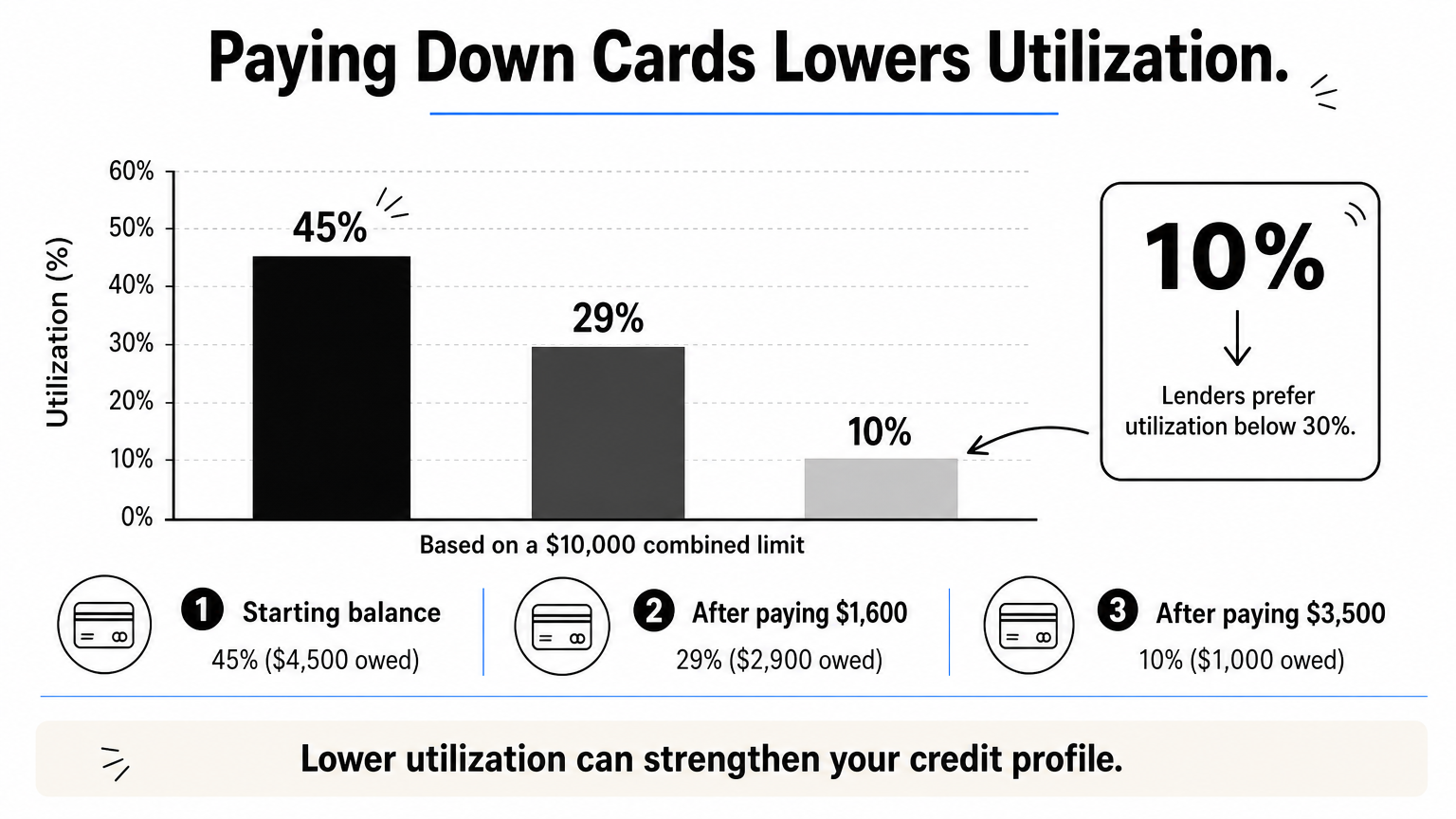
Here is a worked example. You have two cards with a combined $10,000 limit and $4,500 in balances. That is 45% utilization. Paying $1,600 brings the balance to $2,900, or 29%. Paying $3,500 brings it to $1,000, or 10%.
Timing matters too. Issuers usually report the balance on your statement closing date, so pay before that date, not just before the due date. Your reported balance is then low even if you use the card during the month.
Pay before the statement closes, and the lower balance is what the bureaus see.
Fix errors and add positive data
After balances, work through these steps in order:
- Check all three reports. Pull them from AnnualCreditReport.com and look for accounts you do not recognize, wrong late payments, and wrong balances.
- Dispute what is wrong. File with the bureau and the lender. Bureaus generally respond within about 30 days.
- Automate payments. Set autopay for at least the minimum on every account so no new late payment appears.
- Become an authorized user. Ask a family member with an older card, low utilization and perfect payments. It helps only if the issuer reports it, and a poorly managed card will hurt you.
- Report bills you already pay. Tools such as Experian Boost can add utility and phone payments, but only to your Experian file, so lenders using other data will not see them.
- Ask about a rapid rescore. A mortgage lender can request one after you document a paid balance or corrected error. It typically takes three to five business days, and you cannot order it yourself.
A 12-month plan to raise your score
A plan keeps the fast and slow levers working together. This one assumes a typical profile with high card balances and a few blemishes. Adjust it if your situation differs.
Month-by-month steps
- Week 1: Pull all three reports. Write down each card’s limit, balance and statement date. Set up autopay.
- Month 1: Dispute errors. Pay down the cards with the highest utilization, and pay before statement dates.
- Months 2 to 3: Confirm that updates posted. Hold utilization under 30%. Make no new credit applications.
- Months 4 to 6: Stack on-time payments. If your file is thin, add a secured card or credit-builder loan. Keep old accounts open.
- Months 7 to 12: Push card utilization toward 10%. Review your reports again, check your progress, and decide what to tackle next, such as a collection account.
Moves that slow progress
Several common mistakes undo months of work. Closing an old card cuts your total available credit and can shorten your average account age. Applying for several accounts at once adds hard inquiries. A single payment 30 days late can cost far more than a month of good behavior earns back.
If card balances are your core problem, a consolidation loan or balance transfer can drop utilization fast. It also adds an inquiry and a new account, and it only helps if you do not run the cards back up. Treat it as a tool for the fast lever, not a replacement for on-time payments.
The fastest way to lose progress is to fix the balances and then miss one payment.
The short answer on timing
Expect your first change in 30 to 45 days, a 100-point gain in six to twelve months, and recovery from collections or bankruptcy over years. Utilization and errors move quickly, payment history moves steadily, and account age only improves with time. Start with the fast levers, protect your payment record, and give each change a full reporting cycle before judging it.
If debt is what keeps your score down, the next step is a plan to pay it off. You can find more guides on credit card debt relief and credit score improvement to help you choose that next move.