The best Christian debt relief programs are nonprofit credit counseling plans that lower your card interest and let you repay in full. They avoid the credit damage of debt settlement. If you have steady income and mostly card debt, Trinity Debt Management, Christian Credit Counselors, or Family Credit Management’s Christian plan fit best. If your whole household budget is strained, start with NFCC faith-based counseling. If your credit is good enough to qualify, a consolidation loan from America’s Christian Credit Union can beat all of them.
The problem is that card rates of 18% to 29% swallow most of every minimum payment. Searching for faith-based help also brings up for-profit settlement firms that use Christian branding. Settlement is a different product with real credit costs, so this list leaves it out. Faith changes the tone of the counseling and the way you approach your budget. It does not change the math, so judge each option on rates, fees, and terms.
We are an information site funded by advertising, not a lender or an agency, so we have no program to sell you. The descriptions below come from each provider’s public information. Confirm current terms and fees directly before you enroll.
1. Trinity Debt Management
How it works
Trinity Debt Management runs a debt management program, or DMP. You make one monthly payment to the agency, and it pays your card issuers for you. Trinity says members start saving on interest and late fees right away. Issuers set the reduced rates, so the savings vary from card to card.
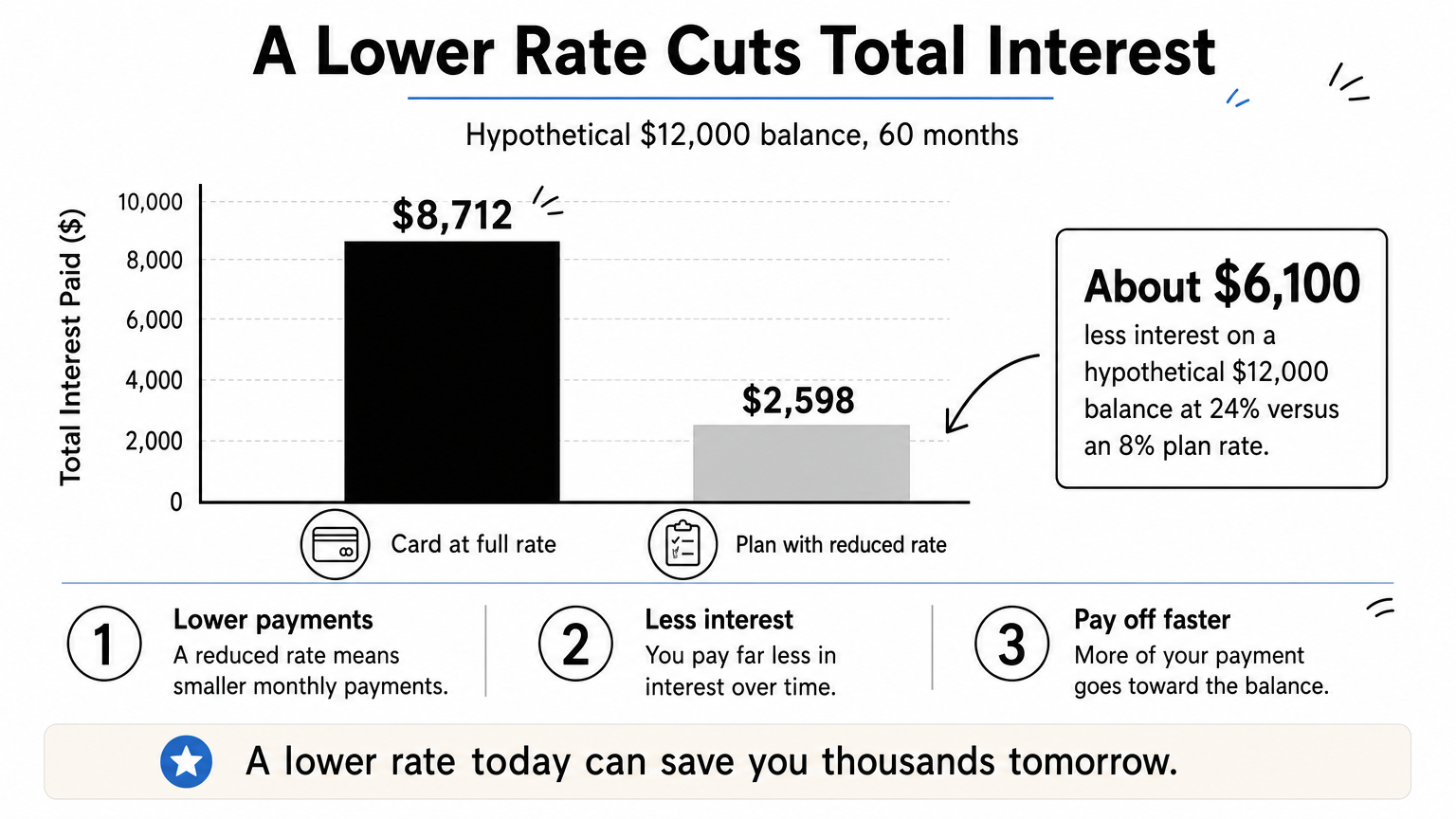
A hypothetical $12,000 balance at 24% shows how much the rate matters. The 8% plan rate below is an illustration, not a quote from Trinity:
| Scenario | Rate | Monthly payment (60 months) | Total interest |
|---|---|---|---|
| Card at full rate | 24% | $345 | $8,712 |
| Plan with reduced rate | 8% | $243 | $2,598 |
The lower rate would cut your payment by about $102 a month and your interest by roughly $6,100.
A lower interest rate, not a faith label, is what actually shrinks a card balance.
Who it suits and what to check
This option suits people with steady income who owe mostly on credit cards and want a single payment. Many people ask whether Trinity is a Christian company. The name reads as faith-based, but confirm how the agency describes its mission and whether it is a nonprofit.
Before you sign, ask for a written fee schedule and a list of which cards the plan covers. Check complaints with your state attorney general’s office and the Better Business Bureau.
2. Christian Credit Counselors
How it works
Christian Credit Counselors offers a free credit card debt analysis. The agency says it has relationships with more than 400 creditors and negotiates an unsecured debt management program for you. Crown Financial Ministries lists it among its Christian credit counselors and describes it as specializing in credit card debt.
- Start with the analysis and review the proposed plan.
- The plan covers unsecured debt such as cards.
- One payment replaces several.
Use the free analysis to see the numbers before you commit to anything.
Who it suits and what to check
This is a good first stop if you want a no-pressure look at your card balances. Among Christian debt relief programs, it is one of the few that puts the analysis up front.
The analysis may be free, but a plan usually carries fees. Ask for the monthly cost in writing, plus the rate each issuer agreed to. A reputable counselor will give both without hesitation.
3. Family Credit Management’s Christian plan
How it works
Family Credit Management offers a Christian debt management plan built to lower your credit card interest and cut the overwhelm. A counselor reviews your income and expenses, proposes a payment, and asks your creditors to accept reduced rates. Plans commonly run three to five years.

- Expect enrolled cards to be closed or frozen.
- You pay one amount each month.
- Missed payments can cancel the concessions.
A debt management plan trades card access for a lower rate and a fixed finish line.
Who it suits and what to check
Christian credit card debt relief of this kind suits readers who feel buried by several cards and want structure. A DMP generally does not require a high credit score, so it also works if your credit is already damaged. Approval depends mostly on whether your income can cover the payment.
Closing accounts can pull your score down at first. Ask how the agency reports payments, and whether you can keep one card open for emergencies. Then compare the plan’s total cost with what you would pay on your own.
4. NFCC faith-based credit counseling
How it works
The National Foundation for Credit Counseling offers a faith-based track staffed by nonprofit counselors. They build a personalized action plan for all household debt, not only cards. That can include a budget review, medical bills, and a DMP when one fits.
A counselor can also tell you whether a creditor’s hardship program is worth requesting. That matters if job loss or illness caused the debt.
Broader counseling helps most when cards are only one piece of the problem.
Who it suits and what to check
NFCC counseling fits people with mixed debts or no clear plan. You get an honest assessment instead of a sales pitch for one product.
Ask how the faith-based counseling is delivered and what the first session costs. Also ask whether the counselor will tell you when a DMP is the wrong choice. A good one will.
5. America’s Christian Credit Union consolidation loan
How it works
America’s Christian Credit Union lists a debt consolidation personal loan of up to $50,000, with terms up to 60 months and no prepayment penalty. It also lists a 0.50% discount for setting up automatic payments. You borrow, pay off your cards, and repay the credit union in one fixed monthly payment.

At an illustrative 12% rate, $12,000 over 60 months costs about $267 a month and $16,014 in total. That is a bit more than the 8% plan above but far less than staying at 24%. Your real rate depends on your credit, so check the current offer.
A loan only works if the cards stay at zero after you pay them off.
Who it suits and what to check
A loan suits borrowers with good enough credit to qualify and the discipline not to run the cards up again. Credit unions generally require membership, so confirm eligibility first. Compare the offered rate against a DMP’s.
Speed matters too. Clearing $30,000 in 12 months takes about $2,500 a month before interest. A 60-month term lowers the payment, but you pay interest for longer.
Choosing a program you can trust
Pick by your situation. A DMP from Trinity, Christian Credit Counselors, or Family Credit Management fits steady income and mostly card debt. NFCC counseling fits a tangled budget. The credit union loan fits strong credit and self-control. Whatever you choose, get fees in writing and confirm nonprofit status before you send any money.
If you want to compare these routes with balance transfers and other strategies, our credit card debt relief guides walk through each one.