The fastest way to get out of tax debt is to file every missing return, ask the IRS to remove penalties you qualify to have removed, and then set up a payment plan. If you truly can’t pay, you can apply for an offer in compromise or ask for hardship status. The same path works for debt with the IRS whether you owe $2,000 or $40,000. There is no blanket forgiveness program, so be wary of anyone who sells one.
The hard part is that IRS debt grows quietly. Penalties and interest pile on every month, notices arrive in the mail, and most people respond by avoiding the envelope. That is the most expensive move you can make. The IRS has more flexible options than most people expect, but it offers them only to taxpayers who file and respond.
This guide walks through four steps in the order that works. You will see what the charges cost, which plans exist, a worked example with real numbers, and how to spot scams. We write about credit card debt, and tax debt follows different rules, so the details below matter.
Why IRS debt grows and what the IRS can do
Tax debt grows because three separate charges stack on top of what you owe, and the IRS has legal tools to collect if you stay silent. Knowing the numbers tells you which step saves the most money.
How penalties and interest add up
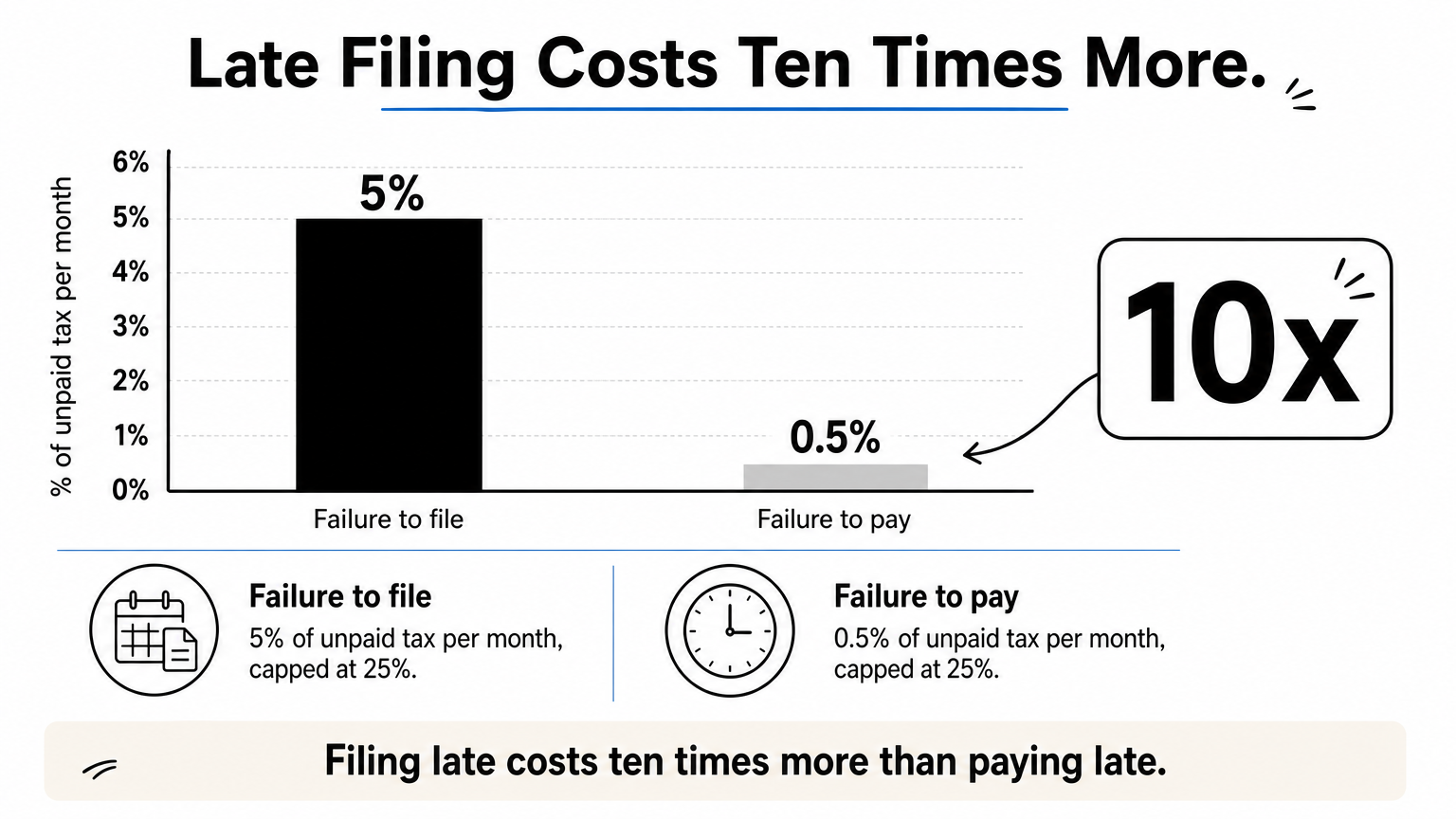
Filing late costs ten times more than paying late, so always file even when you can’t pay. Here is how the charges work:
| Charge | Rate | Cap |
|---|---|---|
| Failure to file | 5% of unpaid tax per month | 25% |
| Failure to pay | 0.5% per month (0.25% during an approved installment agreement if you filed on time) | 25% |
| Interest | Federal short-term rate plus 3 points, reset quarterly, compounded daily | None |
Interest has recently run around 7% to 8% a year. Combined with the failure-to-pay penalty, an unpaid balance can cost roughly 13% to 14% a year.
What happens if you ignore the balance
The IRS sends a series of notices, and the last one is a final notice of intent to levy. After that it can file a federal tax lien or levy your wages and bank accounts. Ignoring the debt does not make it disappear.
The IRS generally has 10 years from the assessment date to collect, and that clock pauses in some situations, such as while an offer in compromise is pending. You may see a "3 year rule" mentioned online. It generally refers to the window to claim a refund or for the IRS to audit a return, not to a point where debt is erased.
Every month you wait adds penalties and compounding interest, so the cheapest day to act is today.
Step 1. File missing returns and confirm what you owe
Start by filing every unfiled return and pulling your exact balance, because the IRS will not approve a payment plan or settlement while returns are missing.
File every missing return
The IRS generally expects the last six years of returns to be filed before it grants relief. If you don’t have your records, request wage and income transcripts from your IRS online account. File each return even if you can’t pay with it. A filed return stops the 5% monthly failure-to-file penalty, and the IRS often calculates your tax correctly when you don’t file. That calculation usually leaves out deductions and credits you could claim.

Find your real balance
Create or log in to your IRS online account to see your balance by year, your payment history, and your notices. Then check three things:
- The total owed for each tax year, split into tax, penalties, and interest
- The response deadline printed on each notice
- Whether your current withholding or estimated payments will cover this year, so the debt doesn’t regrow
You can’t negotiate a balance you haven’t confirmed, and you can’t negotiate at all with returns missing.
Step 2. Ask for penalty relief before you pay
Penalty relief can remove a large share of your balance at no cost, so request it before you commit to a plan. You can ask by calling the number on your notice or by replying in writing.
First-time penalty abatement
The IRS can remove failure-to-file, failure-to-pay, and failure-to-deposit penalties if you have a clean three-year history. You need no penalties in the prior three tax years (or any you had were removed). You also need all required returns filed and the tax paid or on a payment plan. Interest on the removed penalty goes away too, but interest on the tax itself stays. On $8,000 of unpaid tax, a failure-to-file penalty can reach up to $2,000, so this request is worth making.
Reasonable cause
If you don’t qualify for first-time abatement, you can argue reasonable cause. Serious illness, a death in the immediate family, a natural disaster, or an inability to get records can all count. Explain what happened, when it happened, and what you did to fix it, and attach documents. Claims that you were busy or didn’t know the rules rarely succeed.
Ask for penalty relief first, because every dollar of penalty you remove is a dollar you never pay interest on.
Step 3. Choose a payment plan that fits your budget
If you can’t pay in full, a payment plan is the most reliable way out. Match the plan to your balance and your monthly cash flow.
Match the plan to your balance
| Option | Best for | Key facts |
|---|---|---|
| Short-term plan | Paying in full within 180 days | No setup fee, interest and penalties continue |
| Installment agreement | Paying over months or years | Individuals owing up to $50,000 can apply online, setup fees run about $22 to $178 depending on how you apply and pay |
| Partial pay installment agreement | Those who can’t pay in full before the collection deadline | Smaller payments, the IRS reviews your finances periodically |

Here is a worked example. Say you owe $12,000 and choose a 48-month installment agreement. Your payment is $12,000 divided by 48, or $250 a month. Interest and the reduced penalty keep accruing on the remaining balance, so the total you pay ends up higher. Setting up direct debit keeps the fee lowest and prevents missed payments, which can default the plan.
Use a loan or card only if the math works
Paying the IRS with borrowed money makes sense only when your rate is below the IRS cost of about 13% to 14% a year. A personal loan at a lower rate can beat that. A credit card at 18% to 29% APR usually loses, and card payments to the IRS carry processor fees. If you consolidate IRS debt, calculate the total cost against the installment agreement before you decide.
Pick the lowest monthly payment you can keep for years, because a defaulted plan costs more than a slow one.
Step 4. Check whether you can pay less than you owe
If a payment plan is out of reach, you may qualify to settle for less or to pause collection. These options are narrower, so check eligibility before you apply.
Offer in compromise and hardship status
An offer in compromise lets you settle for less when you can’t reasonably pay the full amount. The IRS has no fixed settlement percentage. It accepts what it calculates as your reasonable collection potential, based on your income, expenses, and asset equity. Use the IRS pre-qualifier tool first, because many applications are rejected. You will file Form 656 with Form 433-A (OIC) as an individual, pay a $205 application fee unless you meet low-income rules, and include an initial payment. All returns must be filed first.
If paying would stop you from covering basic living costs, ask for currently not collectible status. Collection pauses, but penalties and interest keep accruing. If you are stuck or facing a levy that would cause hardship, the Taxpayer Advocate Service can help.
Spot tax relief scams
Be skeptical of any company that guarantees a settlement, charges large upfront fees, or promises "forgiveness." The FTC warns that you can do what these companies do for free, since you can contact the IRS yourself. If you want paid help with a complex case, hire a CPA, an enrolled agent, or a tax attorney, and get the fee in writing.
The IRS programs that truly cut a balance are few and strict, so treat a promise of easy forgiveness as a warning sign.
Start with the first filing
Getting out of IRS debt comes down to a sequence: file every return, confirm your balance, remove penalties, then choose a payment plan or, if you qualify, a settlement or hardship pause. Do the steps in that order, respond to every notice, and keep every promised payment.
Once the IRS debt has a plan, look at the rest of your balance sheet. If credit cards are also draining your budget, our debt relief guides explain consolidation, balance transfers, and debt management plans so you can build one plan that clears everything.