
Credit card companies would rather take 50 to 60 cents on the dollar than get nothing at all, and once your account is charged off, they know it. That gap between what you owe and what they’re willing to accept is exactly why how to settle a credit card debt without a settlement company is worth learning. You don’t need to pay someone a percentage of your debt to do what you can do yourself with a phone, some cash, and a little patience.
So can you settle credit card debt on your own? Yes, and in many cases you’ll get a better deal than a third-party negotiator, because creditors often distrust settlement companies and negotiate more freely with the actual account holder. The real question is what to say to credit card companies and when to say it, since timing your call to the right stage of delinquency changes your leverage completely.
This guide walks through the exact process: figuring out how much you can realistically offer, knowing which accounts are ripe for settlement, negotiating debt settlement on your own with scripts you can use word for word, and getting the agreement in writing before you send a dime. You’ll also see the tax and credit score tradeoffs nobody mentions upfront, so you go in with your eyes open.
Should you settle your credit card debt yourself?
Settling debt yourself works best when your accounts are already charged off or seriously delinquent, usually 90 to 180 days late, so it helps to understand how debt settlement for credit cards works before you start. That’s when creditors write your balance down as a loss on their books and become willing to deal. If you’re still current or only a month behind, don’t bother negotiating yet. You have almost no leverage, and the rep on the phone has no authority to discount an account that’s still performing. Debt settlement with credit card companies only gets serious once they’ve stopped expecting full payment.
When DIY makes sense
Going solo is the best way to settle credit card debt if you meet a few conditions: you have a lump sum saved (even 40-50% of the balance), you’re comfortable reading a legal document and pushing back on a phone rep, and you’re not dealing with a lawsuit already in motion. Skipping a company that settles debt for you also means skipping their fee, typically 15-25% of your enrolled debt, money that stays in your pocket and can go toward the actual settlement.
The less debt sits with a settlement company taking a cut, the more you have to actually offer creditors, and the faster you get out.
When to get outside help instead
Hiring help or weighing bankruptcy against settlement makes more sense if you’re facing active litigation, owe five or six figures across many creditors, or simply can’t set aside a lump sum no matter how you budget. A nonprofit credit counseling agency can also help if what you really need is a structured debt management plan rather than a lump-sum settlement, since DMPs lower interest rather than principal and don’t carry the same credit-score hit or tax consequences settlement does.
Step 1. Assess your debt and what you can afford
Before you dial anyone, pull your account details and figure out your real number. Assess your debt by listing each balance, the original creditor, whether it’s charged off yet, and any collection letters you’ve received. Then look at your actual cash, not your hoped-for cash. Settlement offers get accepted fastest when you can pay a lump sum within 30 days, so check savings, a bonus, or a tax refund before you assume you need monthly payments.
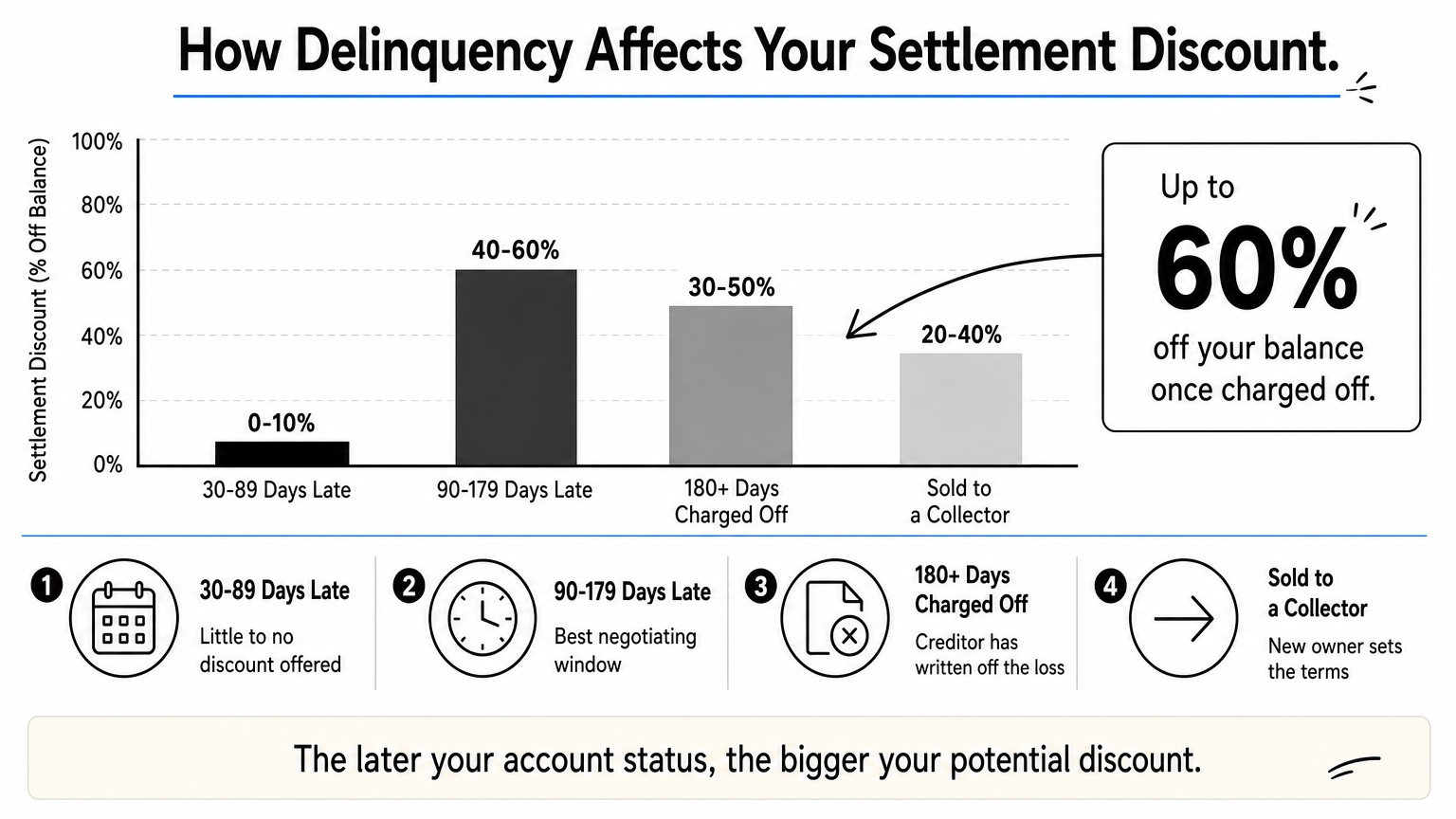
Know your lump sum before you make the call, not after, or you’ll cave to whatever number they throw at you first.
Use this rough guide based on how delinquent the account is:
| Days Delinquent | Typical Settlement Range |
|---|---|
| 30-89 days | Little to no discount offered |
| 90-179 days | 40-60% of balance |
| 180+ days (charged off) | 30-50% of balance |
| Sold to a collector | 20-40% of balance |
Start your target offer below the low end of that range. You can always come up; you can’t easily walk a number back down once you’ve said it out loud.
Step 2. Contact your credit card company or collector
Once you know your number and understand how negotiating with a credit card company actually unfolds, pick up the phone and ask specifically for the settlements department, not general customer service. Front-line reps usually can’t approve a discount; someone in collections or loss mitigation can. If your debt already moved to a third-party agency, call that collector directly instead of the original bank, since they now own the account and set the terms.

Confirm who owns the debt
Before you negotiate anything, verify the debt is accurate and still within your state’s statute of limitations. Ask for the original creditor’s name, the current balance, and confirmation in writing if this is your first contact with that collector. Paying or even acknowledging a debt past the statute of limitations can restart the clock on collections, so get this straight first.
Never negotiate before you confirm who legally owns the debt and whether they can still sue you over it.
Open the call the right way
Keep your opening simple and unemotional:
"I'm calling about account [number]. I'm dealing with a financial hardship
and want to resolve this account with a lump-sum settlement. Can you
transfer me to someone who handles settlement offers?"
That framing signals you’re serious without revealing your full budget yet.
Step 3. Negotiate your settlement offer
Once you’re through to settlements, start low and let silence do the work, because haggling with your creditors rewards patience more than persuasion. Open at 25-30% of the balance, cite your hardship briefly (job loss, medical bills, reduced hours), and stop talking. Negotiating debt settlement on your own means resisting the urge to fill quiet air with excuses or your maximum number.

Whoever speaks first after the offer usually loses the negotiation, so let the rep counter before you move.
What to say when they counter
Expect a counteroffer in the 50-70% range. Push back with a number closer to your real target, then hold there:
"I can't do that today. My hardship is real, and $X is genuinely what I
can pull together as a one-time payment. If that works, I can send it
within five business days."
If they won’t budge below your ceiling, ask about a two-payment settlement instead of walking away. Two lump sums over 60 days often unlock 5-10% more discount than a single payment ever will, since it still counts as a defined settlement rather than an open-ended plan.
Step 4. Get the deal in writing and pay it off
Request a signed settlement letter the moment you agree on a number, before you commit to sending a cent. The letter needs the account number, the exact settlement amount, the payment deadline, and a statement that this payment counts as full settlement of a debt. Verbal promises from a collections rep mean nothing if the account gets sold or the rep leaves the company next month.
If it’s not in writing, the settlement doesn’t exist, no matter how nice the person on the phone sounded.
Use this script to request it before you pay:
"Before I send payment, I need this settlement in writing, on letterhead,
stating the account number, the settlement amount, and that this payment
resolves the debt in full. Please email or fax that to me first."
Once you have the letter, pay by cashier’s check or bank wire rather than a personal check, since a check exposes your routing and account numbers to a creditor who’s already shown they’ll chase you. Keep a copy of the letter, the payment confirmation, and the canceled check or wire receipt indefinitely. You’ll need that paper trail if the account gets misreported later or a collector tries to resell the same settled balance.
Moving forward after your settlement
Settling debt yourself takes nerve, but you just walked through every step: assessing what you can afford, calling the right department, negotiating from a low anchor, and locking the deal in writing before you paid. That process works whether you owe one card or five, as long as you match your offer to how delinquent the account actually is.
Expect two things next. Your credit score will dip for a while, and you may owe taxes on forgiven debt over $600, so budget for a 1099-C at tax time. Neither is a reason to avoid settling; both are manageable with a plan.
Rebuilding starts now, not after the last settlement clears. Keep learning the strategies that got you here and the ones that come next, starting with fixing your credit score over time so you never fall into the same trap twice.