
Legal debt settlement is a negotiation led by a licensed attorney in which a creditor or debt collector agrees to accept less than you owe and treat the account as resolved. The lawyer contacts the creditor, checks whether the debt can still be collected, and puts any deal in writing. It works mainly on unsecured debt such as credit cards and personal loans, and no creditor has to say yes.
The word "legal" is what separates this from the for-profit settlement companies that tell you to stop paying and save into an account. An attorney is licensed, bound by ethics rules, and can defend you if you are sued. It still costs money, it still damages your credit, and the forgiven amount can create a tax bill.
At Credit Card Solution we rank credit card debt options, from balance transfers to debt management plans to settlement, and we attach warnings where they belong. This guide explains why legal debt settlement matters, how to do it step by step, what it costs, and when it is worth it.
Why legal debt settlement matters
What an attorney adds that a settlement company does not
Legal debt settlement matters because it puts a licensed professional between you and your creditors. An attorney can appear in court and raise legal defenses that a billing-focused company cannot. The New York Attorney General warns that many for-profit settlement companies charge hefty fees, tell clients to stop paying, and leave people worse off than when they started.

The practical payoff is control. Once a debt collector knows a lawyer represents you, it generally must deal with the lawyer instead of calling you. Your attorney can also demand proof that the collector owns the debt and check whether the statute of limitations has expired. That check can change the whole negotiation.
A settlement company sells a payment plan, while an attorney sells legal judgment, and only one of them can defend you in court.
Who benefits most
Hiring a lawyer is not necessary for every balance. It tends to pay off in a few specific situations:
- You owe tens of thousands of dollars, so the savings can outweigh the legal fees.
- You have been served with a lawsuit, or one is likely.
- The debt is old, and you are not sure the creditor can still sue.
- You cannot afford minimum payments, but you can raise a lump sum.
If you owe $2,500 on one card, legal fees may eat most of the savings. In that case, calling the creditor yourself is usually the smarter move.
How legal debt settlement works step by step
The process from consultation to final payment
A typical case moves through six steps, and the order matters. Most attorneys will not negotiate until you have a way to fund the deal.
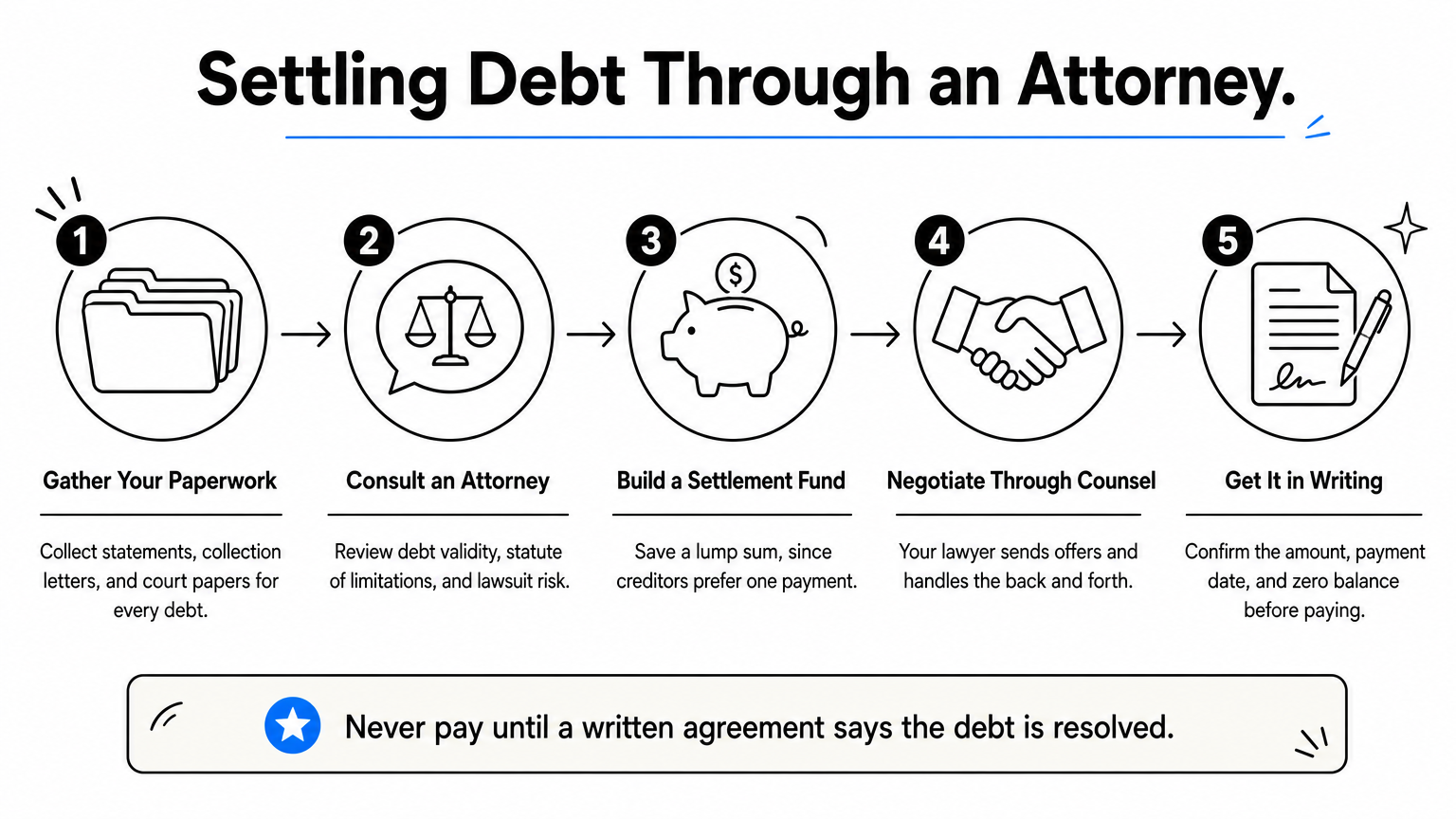
- Gather your paperwork. Pull statements, collection letters, and any court papers, and list who currently owns each debt.
- Consult an attorney. Ask for a review of debt validity, the statute of limitations, and any lawsuit risk.
- Build a settlement fund. Creditors prefer a lump sum or a short payment schedule over a long plan.
- Let the attorney negotiate. The lawyer sends an offer and handles the back and forth.
- Get the agreement in writing first. It should state the amount, the payment date, and that the account will be closed as settled with nothing further owed.
- Pay as agreed and keep proof. Save the receipts and watch for a tax form the following year.
You can settle without going to court by acting early. Negotiate before a lawsuit is filed. If you are sued, respond on time, because ignoring a summons can lead to a default judgment, and settle while the case is open. The CFPB explains what to do if a debt collector sues you.
Never pay a cent on a settlement until you hold a written agreement that says the debt is resolved.
How to find and vet an attorney
Searching online is risky, because many results are settlement companies posing as law firms. Start instead with your state bar referral service, state legal aid, or the American Bar Association. Those channels turn up debt settlement attorneys who handle consumer law and debt defense rather than marketing funnels.
Before you sign, confirm the lawyer is licensed and in good standing with your state bar. Meet with them directly, not just a sales rep. Ask for the fee formula in writing. Check state bar disciplinary records, which tell you more than a star rating on a review site.
What legal debt settlement costs
Attorney fees and how they are structured
Fee structures vary by firm and state. Common models are an hourly rate, a flat fee, or a percentage of the debt settled or the amount saved. Some firms also set a minimum balance before they take a case. Whatever the model, get the formula in writing and ask what happens if the creditor refuses to settle. If a company that sells debt relief by phone demands fees before it settles any debt, treat that as a red flag.
The costs beyond the fee
The lawyer’s bill is only part of the price. Forgiven debt is generally taxable income, and creditors report cancellations of $600 or more on Form 1099-C. You may be able to exclude some of it if you were insolvent, as the IRS explains on canceled debt. Your credit report will also show the account as settled for less than the full amount, and the negative mark can stay for up to seven years from the first missed payment.

Here is a hypothetical example to show how the math works.
| Item | Amount |
|---|---|
| Balance owed | $12,000 |
| Settlement at 50% | $6,000 |
| Attorney fee, 20% of the $6,000 saved | $1,200 |
| Possible federal tax on $6,000 forgiven at 22% | $1,320 |
| Total out of pocket | $8,520 |
| Real savings | $3,480 |
That tax figure drops to zero if you qualify as insolvent. Still, the example shows that real savings run well below the headline discount.
A 50% settlement rarely saves you 50%, so subtract fees and taxes before you decide.
Is legal debt settlement worth it?
When it pays off
Legal debt settlement is worth it when you cannot realistically repay the balance within about five years, you have or can raise a lump sum, and a lawsuit or old-debt question makes legal advice valuable. It is a poor fit when you can still qualify for a cheaper fix. Being sued is the strongest reason to hire a lawyer, because a default judgment can lead to wage garnishment or a frozen bank account.
When another option fits better
Compare settlement against the alternatives before you commit.
| Option | Best for | Main trade-off |
|---|---|---|
| Direct negotiation | Smaller balances, no lawsuit | You handle the talks yourself |
| Debt management plan | Steady income, damaged credit | Usually repays in full over three to five years |
| Balance transfer or consolidation loan | Good credit | Needs approval and discipline |
| Legal debt settlement | Large balances, lawsuit risk | Fees, taxes, credit damage |
The CFPB publishes tips for negotiating a settlement with a collector if you want to try it alone first. My position is simple: try the cheaper options first, and hire an attorney when a lawsuit, a very large balance, or a time-barred debt is in play.
What to do next
Legal debt settlement means a licensed attorney negotiates a smaller payoff, protects you from collectors, and defends you if a creditor sues. It is not cheap or painless. Fees, taxes, and credit damage all count, and no creditor has to accept your offer.
Check your numbers, vet any lawyer through your state bar, and demand a written agreement before you pay. If you want to see every route out of card debt side by side, compare your debt relief options on Credit Card Solution and choose the one that fits your balance and credit score.