Yes, debt settlement hurts your credit. When you settle a credit card debt for less than you owe, the missed payments before the deal and the "settled" label after it pull your score down. Both can stay on your credit report for about seven years. That is the short answer to does debt settlement hurt credit. The damage is real but not permanent. It weighs less each year, and it is usually smaller than the damage from ignoring the debt.
Debt settlement means you and a lender or collector agree that you will pay less than the full balance, and the lender treats the debt as resolved. It sounds like a clean exit, but it leaves a mark that future lenders read as a loan not repaid as agreed.
This guide explains why settlement lowers your score, how long the mark lasts, and how settling compares with paying in full or doing nothing. It also shows how to settle with the least damage. Credit Card Solution is an initiative of financial experts who write about credit card debt, and we do not sell settlement services. The advice here is not built around a fee.
Why debt settlement hurts your credit score
Settlement hurts your score because lenders usually agree to it only after you have stopped paying. The account then ends with a "settled" label instead of "paid as agreed."
What happens when you settle a credit card debt
Most creditors will not negotiate on an account that is current, so settlement usually requires falling behind first. Here is the sequence that shows up on your report:
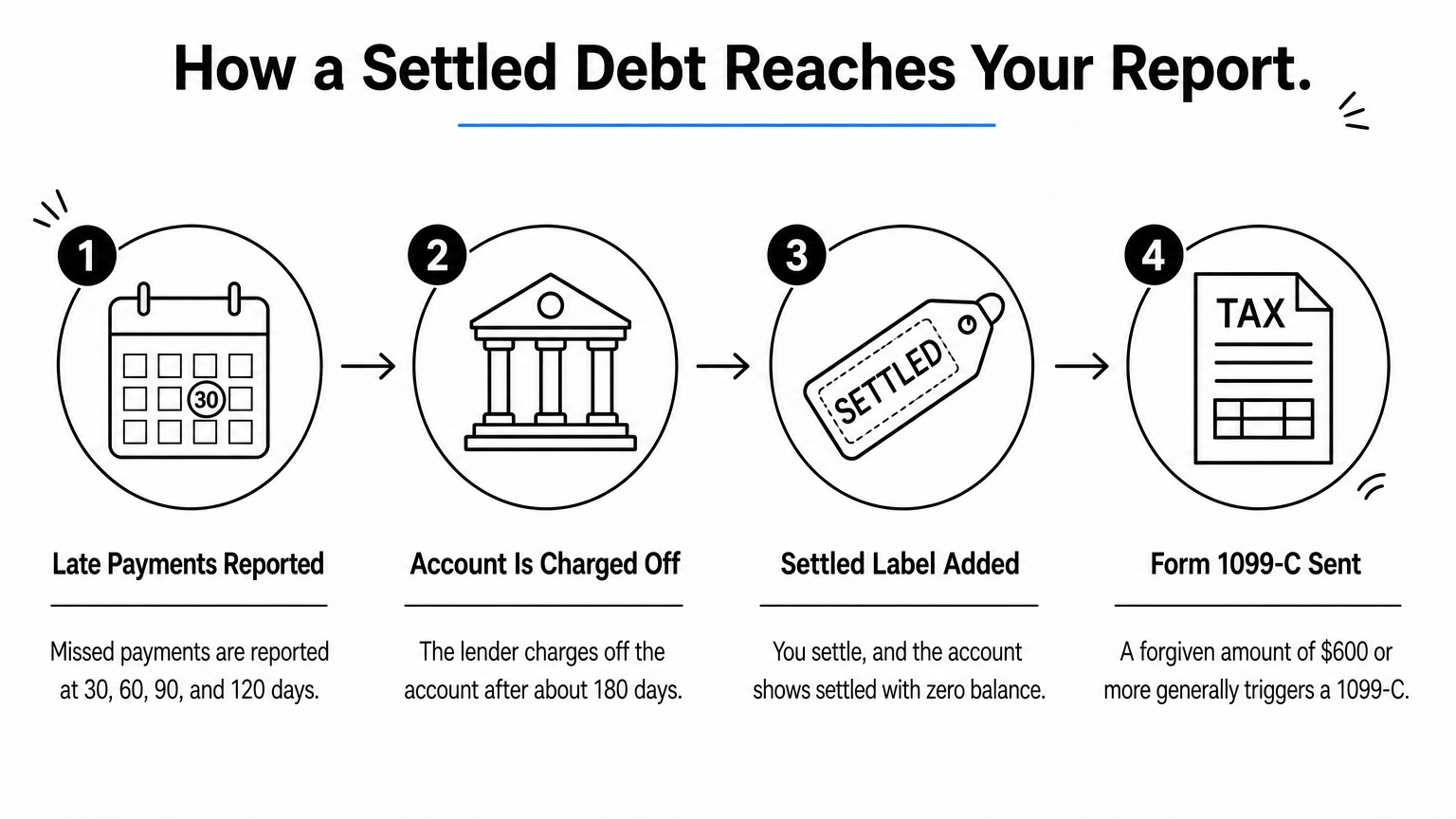
- Late payments are reported at 30, 60, 90, and 120 days.
- The lender charges off the account, usually after about 180 days without a payment, and may sell it to a collector.
- You settle, and the account is updated to "settled" or "paid settled" with a zero balance.
- If the lender forgives $600 or more, it generally sends you and the IRS a Form 1099-C, and the forgiven amount can count as taxable income.
How big the score drop is
Payment history is the largest factor in a FICO score, at about 35%. So the months of missed payments do most of the damage. The settled label then adds one more negative mark that tells lenders you did not repay the full amount. This is how a settled credit card debt affects your credit score most in the first year.
The size of the drop depends on where you start. The higher your score, the further it can fall. A 740 score can lose 100 points or more. An account already deep in collections loses less, because much of the damage has already happened. Settling also brings the balance to zero, which helps your utilization, but that gain is small next to the negative marks.
The settlement is only the last mark on your report, and the missed payments before it do most of the damage.
How long a settled debt stays on your credit report
A settled account stays on your report for about seven years, counted from your first missed payment and not from the day you settle.
The seven-year clock
The Fair Credit Reporting Act limits most negative items to seven years. The clock starts at the date of first delinquency, which is the first payment you missed and never made up. Settling does not restart it. If you first missed a payment in March 2026, the account should fall off around 2033, whether you settle in 2026 or 2028. Settling sooner still helps, because it stops new late marks and collection activity.

How the damage fades over time
Scoring models weigh recent behavior most, so old negative marks matter less each year. Your score will not jump right after you settle. Recovery comes from new on-time payments, not from the settlement itself.
| Time after settling | What to expect |
|---|---|
| First year | The mark carries the most weight, and new credit is harder or costlier to get |
| Years 1 to 3 | The impact fades as on-time payments build, and approvals get easier |
| Years 3 to 7 | The mark is still visible but weighs much less |
| Around year 7 | The account drops off your report automatically |
If you plan to buy a home, tell the lender about the settlement early. Waiting periods and score minimums vary by lender and loan type, so ask the lender directly instead of trusting a general rule.
Settling never resets the seven-year clock, which starts with your first missed payment.
Settlement vs. paying in full vs. ignoring the debt
Paying in full hurts your credit least, settlement sits in the middle, and ignoring the debt does the most harm.
How the three options compare
The table sets the outcomes side by side.
| Option | Effect on your credit | How it appears on your report | Biggest risk |
|---|---|---|---|
| Pay in full, never late | None, or a gain over time | Paid as agreed | Needs cash or a payoff plan |
| Pay in full after falling behind | Moderate | Late payments stay, account shows paid | Late marks last up to 7 years |
| Settle for less | Significant | Late payments plus "settled" status | Forgiven amount may be taxable |
| Ignore it | Most severe | Charge-off, collection account, possible judgment | Lawsuit and a court judgment |
Ignoring a debt is worse than settling because the account still ends up charged off and in collections. You also get no deal, so the full balance stays collectible and the lender can sue.
When settlement still makes sense
Settlement fits when the debt is large and already overdue, and you cannot realistically pay it in full. Your score is already damaged at that point, and settling at least ends the debt and the collection calls. If you are still current, try a balance transfer, a consolidation loan, or a nonprofit debt management plan first. Those avoid the missed payments that settlement depends on.
Zero-balance collections also matter for scoring. Newer models such as FICO 9 and VantageScore 3.0 and 4.0 ignore collection accounts with a zero balance. Many mortgage lenders still use older FICO versions that do not.
Settlement beats ignoring the debt, but it never beats paying in full or avoiding the missed payments in the first place.
How to settle a credit card debt with less credit damage
You cannot settle without leaving a mark, but you can keep it small by documenting everything and checking your reports afterward.
Steps that protect your report
Say you owe $10,000 and settle for $5,500. You save $4,500, but the lender may send a 1099-C for that $4,500, and the account still shows "settled" for years. These steps keep the outcome clean:

- Pull your reports at AnnualCreditReport.com to see which accounts are delinquent and who owns each debt.
- Offer a lump sum, since lenders often accept less when they get cash fast.
- Get the agreement in writing before you send any money, including the amount and that the debt will be treated as resolved.
- Ask how the account will be reported. Some creditors agree to report a zero balance, but do not count on deletion.
- Pay with a traceable method and keep every record.
- Check your reports 30 to 60 days later and dispute any leftover balance or wrong dates.
- Talk to a tax professional if you receive a 1099-C, because forgiven debt can be taxable unless an exception such as insolvency applies.
Rebuilding and avoiding scams
An accurate settled account cannot be removed early, so do not pay anyone who promises to erase it. You can only dispute errors. Be careful with settlement companies too. Federal rules bar them from charging fees before they settle a debt, and any company that tells you to stop paying is adding to the damage.
After settling, keep every other account on time and your card balances under 30% of their limits. A secured card can rebuild your payment history if you have no open accounts left.
Get the agreement in writing before you send a dollar.
The bottom line on settling and your credit
Debt settlement hurts your credit, mostly through the missed payments that come before it and the settled label that follows. The damage lasts up to seven years from your first missed payment, and it fades as you build on-time history. Settling beats ignoring the debt, but paying in full and catching the problem early with a balance transfer, a consolidation loan, or a debt management plan will always protect your score better.
If you are weighing your choices, compare your debt relief options at Credit Card Solution before you stop paying anyone.