
Debt relief programs Oregon residents can use are structured ways to pay down, reduce, or restructure debt you can’t manage alone. They fall into five groups: nonprofit credit counseling with a debt management plan, consolidation loans, debt settlement, bankruptcy, and doing nothing when your income is legally protected from collectors. Each one trades a different cost for a different kind of relief.
This guide explains why the choice matters, compares every option side by side, and shows how to vet a provider before you share any financial details. It also works through the numbers on a typical card balance and answers the questions people ask most, including whether a government program exists.
Credit Card Solution is an informational site written by people with a finance background. We don’t lend money or enroll you in anything. Use it to understand your options before you talk to a counselor or an attorney.
Why debt relief programs matter for Oregon residents
A debt relief program matters because card interest of 18% to 29% can turn a manageable balance into one you never finish paying. The right program stops that before collections, lawsuits, or garnishment start.
What high interest does to your payments
Interest does the damage quietly. On a $10,000 balance at 24% APR, you owe about $200 in interest every month. If your minimum payment is $250, only about $50 reduces the balance. Once an account goes to collections, interest can keep accruing, so the amount you owe can grow even when you stop spending.

Interest, not spending, is what keeps most card balances alive.
Why the provider matters as much as the program
Oregon’s Division of Financial Regulation notes that debt management companies and credit counselors can help you reduce or manage debt and build a spending plan. The same market also includes for-profit companies that promise fast fixes and charge high fees. The program you pick matters, but who runs it matters just as much.
When you may not need a program at all
Some people are what lawyers call collection-proof. If your only income is Social Security, disability, unemployment, or public assistance, and you own little a creditor can take, collectors may have nothing they can legally reach. Your situation can change, and creditors can still call or sue you, so this is a reason to get advice rather than a reason to ignore the debt.
The main types of debt relief programs in Oregon
Oregon debt relief programs fall into four paid or formal options: debt management plans, consolidation, settlement, and bankruptcy. Start with the lowest-risk option your finances can support, and move down the list only when it fails.
Counseling and consolidation: the lower-risk paths
A debt management plan (DMP) runs through a nonprofit credit counseling agency. The counselor reviews your budget, asks your card issuers to lower interest rates or waive fees, and you make one monthly payment to the agency. Plans usually last three to five years, and the cards you enroll are typically closed.
Consolidation replaces several balances with one new debt. That means a personal loan, often from a bank or local credit union, or a balance transfer card with a 0% introductory period, commonly 12 to 21 months. It works best with good credit, often 670 or higher, and a plan to pay it off. Watch for transfer fees of about 3% to 5% and rate jumps when the intro period ends.
Settlement and bankruptcy: the higher-risk paths
Debt settlement means negotiating to pay less than you owe, usually after you stop paying and build up a lump sum. It damages your credit, companies often charge a percentage of the debt, and forgiven debt of $600 or more may count as taxable income. Creditors can also sue while you wait.

Bankruptcy discharges or reorganizes debt under court supervision. It can stop lawsuits and collection, but it does not erase child support, most student loans, or some taxes. Chapter 7 stays on your credit report up to 10 years, and Chapter 13 up to 7. An Oregon attorney is worth a consultation before you file.
Side-by-side comparison
| Option | How it works | Credit needed | Typical timeline | Main risk |
|---|---|---|---|---|
| Debt management plan | Nonprofit negotiates lower rates, one monthly payment | Any score | 3 to 5 years | Enrolled cards usually closed |
| Consolidation loan or balance transfer | New loan or 0% card pays off old balances | Good, often 670+ | 2 to 5 years | Fees, rate resets, new debt |
| Debt settlement | Lump sums paid for less than owed | Any, but expect damage | 2 to 4 years | Fees, lawsuits, taxable forgiven debt |
| Bankruptcy | Court discharges or reorganizes debt | Any | Months (Ch. 7) to 3 to 5 years (Ch. 13) | 7 to 10 years on your report |
How to choose a program and a trustworthy provider
To choose among debt relief programs in Oregon, match the option to your credit and cash flow first, then verify the provider. A good program from a bad company can cost more than no program.
Match the option to your situation
- Score near 700 or higher, steady income: try a balance transfer card or consolidation loan.
- Damaged credit, steady income, but payments are crushing: ask a nonprofit about a debt management plan.
- Behind on payments and cutting rates won’t be enough: talk to a bankruptcy attorney before considering settlement. The Oregon State Bar Lawyer Referral Service and Legal Aid Services of Oregon can point you to low-cost or free consultations.
- Only protected income and few assets: confirm with legal aid whether you are collection-proof.
The right program is the cheapest one you can actually finish.
Vet the provider before you share data
Check these five things before you give a company your account numbers:
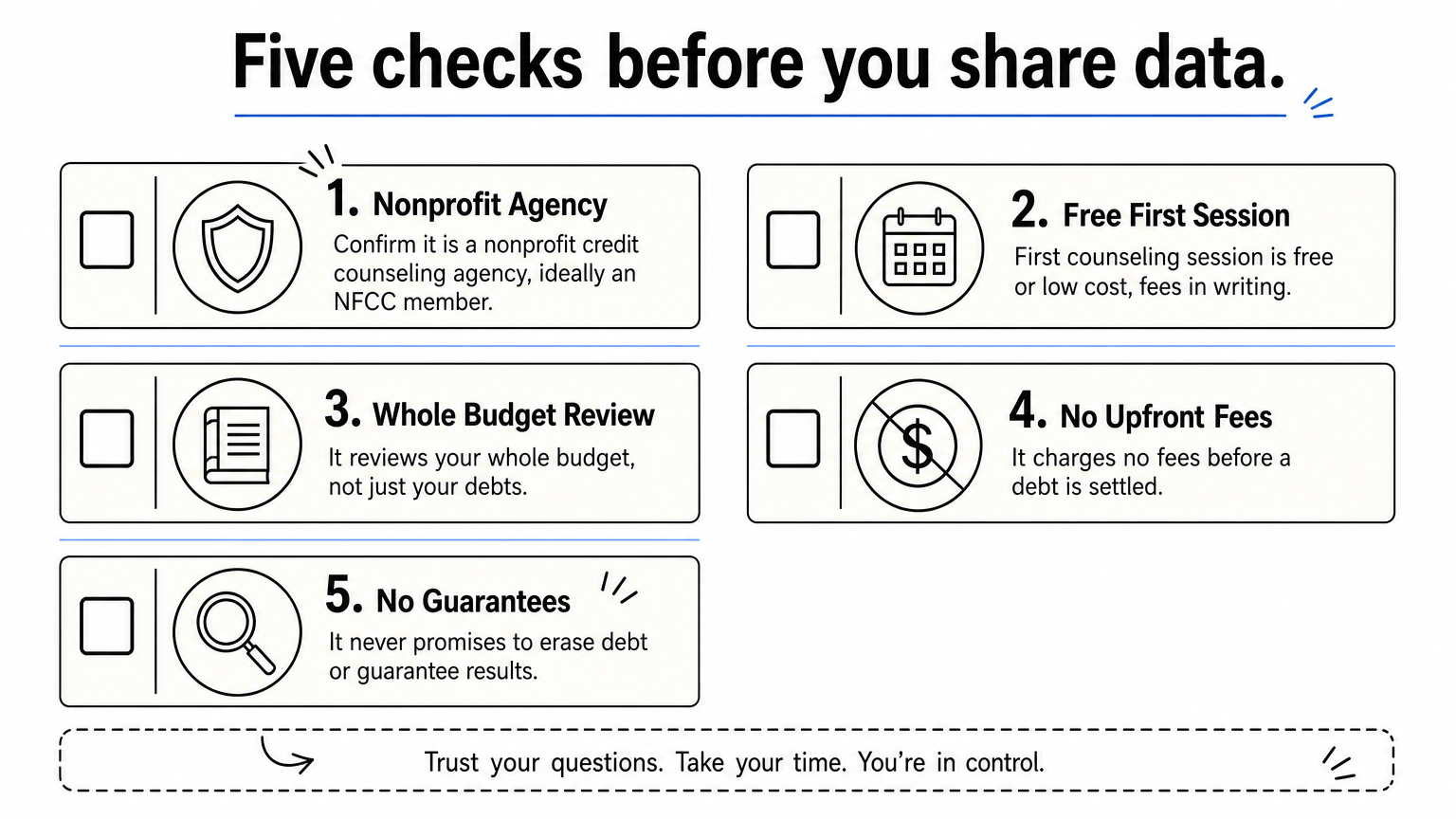
- It is a nonprofit credit counseling agency, ideally a member of the National Foundation for Credit Counseling.
- The first counseling session is free or low cost, with fees explained in writing.
- It reviews your whole budget, not just your debts.
- It does not charge fees before it settles a debt. Federal rules bar this for telemarketed settlement services, as the Federal Trade Commission explains.
- It does not promise to erase your debt or guarantee results. The CFPB lists the warning signs.
A worked example with real numbers
Say you owe $15,000 at 24% APR and can pay $450 a month. In the table below, the second row assumes a debt management plan lowers your rate to 8%. Real rates vary by creditor.
| Scenario | Months to pay off | Total interest |
|---|---|---|
| 24% APR, $450 a month | About 56 | About $10,000 |
| 8% APR, $450 a month | About 38 | About $2,000 |
Same payment, about $8,000 less interest and 18 months sooner. That gap is what a good program buys you.
Common questions about Oregon debt relief programs
Most people searching for debt relief programs in Oregon want to know if free government help exists, what hardship plans are, and whether any of it is worth the cost. The short answers follow.
Is there a government program, and what is a hardship plan?
No general government program erases credit card debt for ordinary consumers. Ads that use the word "government" are a red flag. What does exist is free or low-cost help from nonprofits, legal aid, and your own card issuers.
A hardship program is run by the issuer itself. After job loss, illness, or a medical bill, you call the number on your card and ask for a temporary lower rate, waived fees, or reduced payments. It costs nothing, so try it before you pay anyone.
Is a program worth it, and can you clear $30,000 in a year?
A program is worth it when it lowers your total cost or stops collection and the provider’s fees are clear and modest. It is not worth it if it only delays payment while fees pile up.
Paying off $30,000 in 12 months at 24% APR takes about $2,840 a month. If you can’t do that, a 3-to-5-year plan is the realistic route.
Where to start
Debt relief in Oregon comes down to one rule: pick the lowest-risk option you can finish, and confirm the provider is legitimate before you hand over any information. Start with a free nonprofit counseling session and a hardship call to your issuers, and save settlement and bankruptcy for when those fall short.
For more plain-English breakdowns of balance transfers, consolidation loans, and debt management plans, explore Credit Card Solution’s guides on credit card debt relief and weigh the pros and cons of debt relief programs before you commit.