
A collection notice feels like an emergency, but it is a problem with a process. Collectors count on panic, and panic leads to bad moves like paying the wrong company or sending money on a debt that is not yours. If you want to know how to get debt out of collections, the first step is to slow down and learn what you can actually control.
There are three real paths. You can dispute the debt if it is wrong, old, or unverified. You can pay or settle it, ideally with a written agreement first. Or you can get it removed from your credit report, either through a dispute or a pay-for-delete deal. Which path fits depends on whether the debt is valid, how old it is, and how much you can pay. You also have rights under the Fair Debt Collection Practices Act, including the right to demand validation and to tell collectors to stop calling.
This guide walks through each step in order: verifying the debt, using your rights, negotiating, getting paid accounts off your credit report, and stopping unwanted contact. You will also see what to avoid, so you do not make a costly mistake along the way.
What it means when a debt is in collections
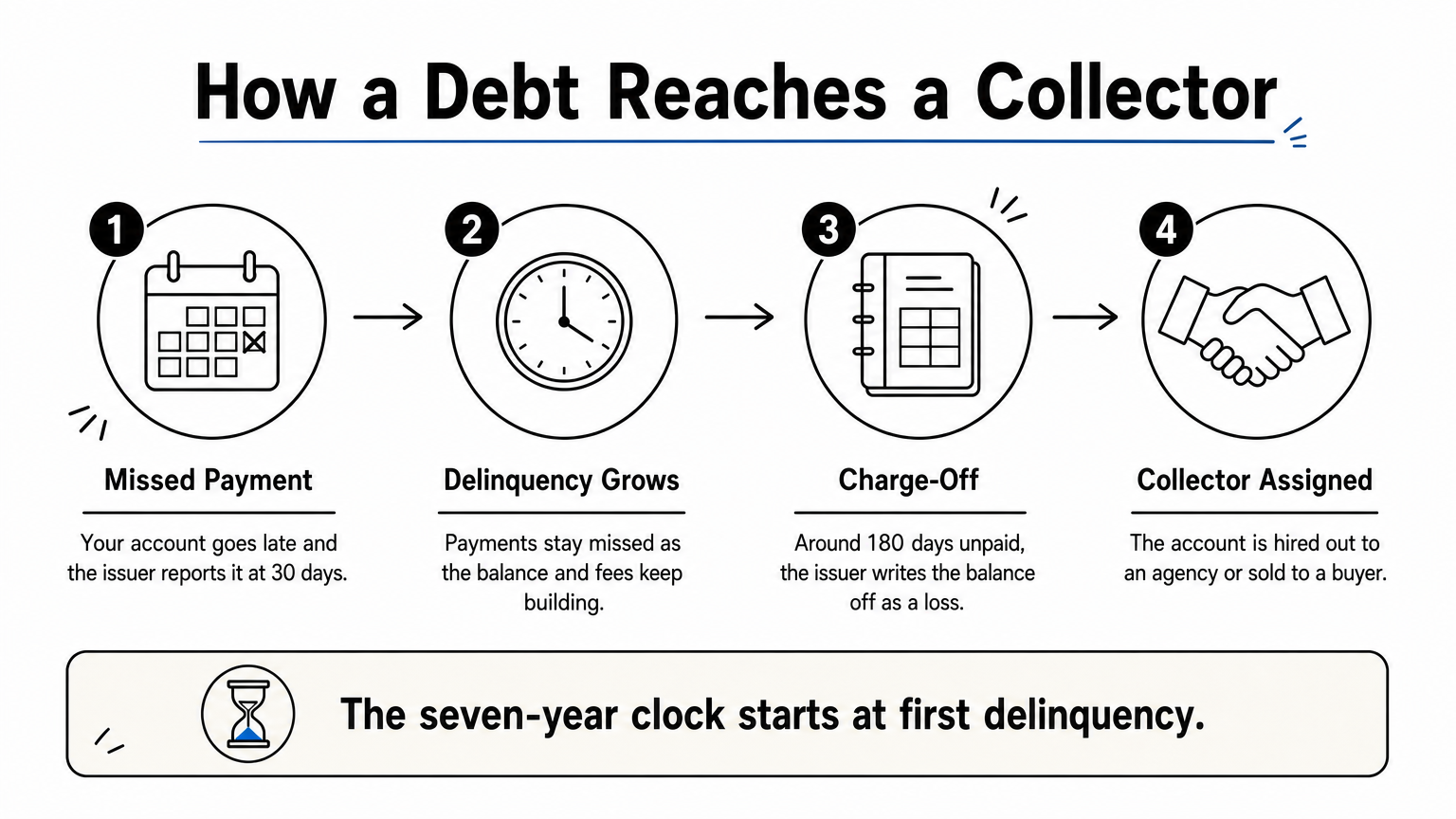
How a debt lands with a collector
Missed payments start the clock. After about 30 days late, your card issuer reports the delinquency. Around 180 days without a payment, it usually charges off the account, which means it writes the balance off as a loss. Then it either hires a collection agency or sells the account. Knowing which one happened is the first move in how to get out of collections debt.
| Who holds the debt | How they got it | What to know |
|---|---|---|
| Original creditor | Still owns it and collects in house | Often the easiest to negotiate with |
| Collection agency | Hired for a fee or a cut of what it recovers | Can only accept what the creditor allows |
| Debt buyer | Bought the account for a fraction of its face value | Must be able to prove it owns the debt |
Debt buyers often pay just pennies on the dollar, which is why many will take less than you owe. It also means account records get lost or garbled in the sale. That gap is what you will use in Step 1.
What collections does to your credit and your life
Collection accounts hurt. One can drop your score by dozens of points, and it stays on your credit report for seven years from the date of first delinquency. That date is when you first fell behind with the original creditor. It is not the date a collector bought the debt, and a new collector cannot restart it.
Selling the debt or paying it does not reset the seven-year clock, so the date of first delinquency is the number you should check first.
Paid collections do not always disappear. Newer scoring models such as FICO 9 and VantageScore 4.0 ignore paid collections, but many lenders still use older versions that count them. That is why removal, covered in Step 4, matters if you plan to apply for a mortgage or auto loan soon.
You are not powerless here, either. Under the Fair Debt Collection Practices Act, collectors cannot call before 8 a.m. or after 9 p.m., threaten arrest, or lie about the amount you owe. Anyone asking how to get out of paying a debt collector should start from this point: you can’t ignore a valid debt, but you can make the collector prove it and follow the rules.
Step 1. Verify the debt and know your rights
Before you pay a cent, make the collector prove the debt is real. Under the FDCPA and the CFPB’s Regulation F, a collector must send a validation notice within five days of first contacting you. It lists the amount, the creditor, and how to dispute. This is the starting point for how to get out of a debt collection that is wrong or poorly documented.
Send a written validation request
Timing matters. You have 30 days from receiving the notice to dispute in writing, and the collector must pause collection until it mails you verification. Send your letter by certified mail with return receipt, and keep a copy.
A collector that cannot validate your debt has to stop collecting until it can.
[Date]
[Collector name and address]
Re: Account # [number]

I dispute this debt and request validation under 15 U.S.C. § 1692g. Please send proof that you own or are authorized to collect it, an itemized balance, and a copy of the original statement or agreement. Please contact me in writing only.

[Your name and address]
Check what they send back
Look at the response line by line. Mismatches are common, especially after a debt has been sold more than once.
- Your name, address, and last four account digits are correct.
- The original creditor is a card or lender you recognize.
- The balance is itemized into principal, interest, and fees.
- The date of first delinquency is shown and makes sense.
- The collector can show it owns the debt or has permission to collect.
Finally, keep every conversation on paper. On the phone, never confirm the debt is yours and never hand over bank account details. Both can hurt you later, and a written record protects you if the collector breaks the rules.
Step 2. Dispute errors or time-barred debts
If validation turns up problems, push back in writing. Disputing is the cleanest answer to how to get out of debt collection when the account is wrong, and it works on two fronts.
Dispute errors with the collector and the bureaus
Compare the paperwork against your own records and look for these problems:
- The debt belongs to someone else, or to a mixed file or identity theft.
- The balance includes fees you never agreed to.
- You already paid or settled the account.
- The dates are wrong, or the same debt is listed twice.
Send your dispute letter to the collector and to Equifax, Experian, and TransUnion, with copies of proof such as bank statements or a payoff letter. The bureaus generally have 30 days to investigate, and an item they cannot verify must come off your report. Pull your free reports first so you know exactly what is listed and under whose name.
Check whether the debt is time-barred
Every state sets a statute of limitations on debt lawsuits, usually three to six years, though some states allow longer. Once it expires, the debt is time-barred. A collector may still ask for payment, but it cannot sue or threaten to. The clock generally runs from your last payment or default, so look up your state’s rule.
Never make a payment on an old debt until you know whether the statute of limitations has run out.
In some states, even a small payment or a written acknowledgment can restart the clock. That is why paying "just to show good faith" is a trap.
And if you are ever served with a summons, respond before the deadline. A time-barred defense is not automatic, and you have to raise it yourself. Ignoring the suit usually means a default judgment, which can lead to wage garnishment. A consumer attorney or local legal aid office can help you answer.
Step 3. Negotiate and settle the debt in writing
If the debt is valid and not time-barred, settling is often the fastest answer to how to get out of a collection debt. Do it on paper, and only after you have the validation from Step 1.
Decide what you can offer
Debt buyers paid pennies for your account, so they have room to negotiate the settlement. Open at 25% to 30% of the balance, and expect to settle somewhere near 40% to 60%. Offer only what you can pay in one lump sum, because lump sums earn the deepest discounts. If you can’t pay that much, ask for a short payment plan instead.
Get the deal in writing before you pay
Never pay on a verbal promise. Send a written offer marked "for settlement purposes only," then wait for a signed reply. The agreement should state:

- The exact amount that settles the account in full.
- That the balance will show as zero, and that the collector will not sell or transfer it afterward.
- A request to delete the account from your credit reports, if you can get it (Step 4).
- The payment deadline and the method.
No written agreement, no payment.
Pay with a cashier’s check, money order, or credit card so you control the transaction. Never give the collector access to your bank account. Once the money clears, ask for a paid-in-full letter and file it with your certified-mail receipts.
One more thing to know. If a creditor forgives $600 or more, it may send you a 1099-C, and the IRS can treat forgiven debt as income. Check with a tax pro before you file.
Step 4. Get the collection off your credit report
Paying a collection ends the collector’s claim, but the account can still sit on your report for years. Work these options in order to get the listing removed or at least marked paid.
Ask for pay-for-delete
In a pay-for-delete deal, the collector agrees to ask the bureaus to erase the account once you pay. Collectors don’t have to agree, and many refuse. Raise it during settlement and get it in writing before you send money.
Payment alone does not erase a collection, so ask for deletion before you pay.
Upon receipt of $[amount], you agree to treat this account as settled in full and to request deletion of all related entries from Equifax, Experian, and TransUnion.
If they refuse, ask for the status to change to "paid in full." That still helps with lenders who use newer scoring models.
Dispute inaccurate entries and send a goodwill letter
Wrong information is your strongest lever. Under the Fair Credit Reporting Act, bureaus must remove entries that are inaccurate or unverifiable. Dispute each one online with your proof attached. If the original creditor still owns the account, try a short goodwill letter asking it to remove a late mark. A polite request works more often than you would expect.
Stop the contact
Send a written request telling the collector to stop contacting you. After that, it may only write to confirm the request or notify you of specific actions, such as a lawsuit. This is the quickest way to get out of debt collectors’ daily calls, but it does not erase the debt, and it does not prevent a lawsuit. Use it alongside Steps 1 to 3, not instead of them.
Your next move with collections
Getting debt out of collections comes down to order. Verify the debt first, dispute what is wrong or time-barred, settle only in writing, then work on your credit report. Skip a step and you risk paying a debt you do not owe, or one a court could not enforce.
Anyone learning how to get out of debt collections should also remember that paper trails win. Keep every letter, certified-mail receipt, and signed agreement. They protect you if a collector breaks the rules or a dispute drags on.
Start today. Pull your free credit reports, find the date of first delinquency, and mail your validation letter before you spend a dollar. Once the collection is handled, you can focus on paying down what is left and rebuilding your score. For more help with balance transfers, consolidation loans, and credit repair basics, explore the credit card debt relief and consolidation guides at Credit Card Solution.



No Responses