
True 0% APR credit cards with no balance transfer fee are rare, and most of them come from credit unions and small banks. Among national issuers, the closest you can get is a card that cuts the fee to 3% for a short window, such as the Citi Simplicity, Discover it Cash Back, Chase Freedom Unlimited and Citi Double Cash. If you can clear the debt in about a year, a credit union card lets you pay nothing to move it. If you need 18 to 21 months, a 3% card is the cheaper compromise.
The reason this matters is simple. A card charging 18% to 29% APR eats a large share of every payment, so moving the debt makes sense. But a 5% fee on a $6,000 balance is $300 gone on day one. This article ranks seven options by what the transfer costs you, works through a $6,000 example, and shows you how to match a card to your payoff timeline.
Credit Card Solution is an educational site, not a lender, so nothing here is an application pitch. Rates and fees change and your offer can differ, so confirm the terms on the issuer’s page before you apply.
1. Credit union cards with no transfer fee
Credit unions are the most reliable place to find a 0% interest card that charges nothing to move a balance. Many of their cards skip the transfer fee entirely, which none of the national cards below does.

Key terms
Terms vary by credit union, so treat this as a checklist of what to look for rather than one offer.
- 0% period: Usually shorter than the 18 to 21 months national issuers advertise. Some credit unions offer a low promotional rate instead of a true 0%.
- Transfer fee: $0 at many credit unions. Confirm it in the rate and fee table.
- Ongoing APR: Federal credit unions cannot charge more than 18%, well under the 27% to 28% top of national card ranges.
- Membership: You join through where you live, work or serve, or through an affiliated association.
Who it fits and the catch
This route suits you if your balance is modest and you can clear it within a year. On $6,000, a 12-month offer with no fee means $500 a month and zero upfront cost. That is $180 cheaper than a 3% card and $300 cheaper than a 5% card.
The catch is access. You have to qualify for membership, and credit limits can be smaller than at big banks, so the card may not absorb your whole balance. Also check whether the fee waiver applies only to transfers made in the first weeks after you open the account.
A $0 fee beats a longer 0% period when you can pay off the balance within a year.
2. Citi Simplicity Card
The Citi Simplicity Card pairs an 18-month 0% window on transfers with a reduced 3% fee, and it is the most forgiving card on this list. It suits people who worry about slipping on a payment.
Key terms
The offer is built for debt payoff, not rewards.
- 0% period: 18 months on purchases and balance transfers.
- Transfer fee: 3% (minimum $5) on transfers completed in the first four months, then 5% (minimum $5).
- Ongoing APR: 17.74% to 28.49% variable.
- Annual fee and rewards: $0, no rewards.
Who it fits and the catch
The standout feature is that the card charges no late fees and no penalty APR. Pay on time anyway, but that cushion matters when you are rebuilding your budget. The 0% purchase period matches the transfer period, so you are not punished for a small purchase.
The catch is the clock. You must transfer within four months to get the 3% fee, and there are no rewards to keep you using the card afterward. On $6,000, the fee is $180.
Move your debt within the first four months, or this card’s fee jumps from 3% to 5%.
3. Discover it Cash Back
Discover it Cash Back with the 18-month transfer offer gives you the longest low-fee window of any card here. It suits people who will move debt in stages or later than the first few weeks.

Key terms
The fee structure is the unusual part.
- 0% period: 18 months on balance transfers, 6 months on purchases.
- Transfer fee: 3% on balances that post during the first 18 months the account is open, then 5% on later promotional transfers.
- Ongoing APR: 17.74% to 26.74% variable.
- Rewards: 5% cash back in rotating categories you activate (up to $1,500 in spending per quarter), 1% on everything else. Discover matches all cash back you earn in your first year.
Who it fits and the catch
Most cards give you 60 days or four months to hit the low fee. Here, you have the whole 18-month promotional period, so you can transfer one card now and another later. On $6,000, the fee is $180. The similar Discover it Chrome has the same transfer terms with 2% back on gas and restaurants, on up to $1,000 a quarter.
The catch is that 0% on purchases lasts only six months. Keep new spending off the card until the transferred balance is gone. The category activation is also a small chore.
If you will transfer debt in stages, Discover is the only card here that keeps the 3% fee for the full 18 months.
4. Chase Freedom Unlimited
Chase Freedom Unlimited is the pick if you want a card you will keep using after the debt is gone. Its 0% window is shorter, but its rewards are the strongest everyday package on this list.
Key terms
Here is what the offer includes.
- 0% period: 15 months on purchases and balance transfers.
- Transfer fee: 3% or $5, whichever is greater, in the first 60 days. After that, 5% or $5, whichever is greater.
- Ongoing APR: 18.49% to 27.99% variable.
- Annual fee and rewards: $0, with 1.5% cash back on most purchases, 5% on travel booked through Chase and 3% at restaurants and drugstores.
Who it fits and the catch
This card fits you if you can pay off the debt in 15 months or less and want a long-term card for dining and travel. On $6,000, the fee is $180 and the monthly payment to finish in 15 months is $412. Matching 0% periods on purchases and transfers also give you room for one planned expense.
The catch is the 60-day window for the 3% fee, the shortest on the list. The 15-month runway is also three to six months shorter than the Citi and Discover offers. Avoid it if you are unsure you can finish that fast.
Choose Chase Freedom Unlimited when you will still want the card in two years, not just for the 0% period.
5. Citi Double Cash Card
The Citi Double Cash Card is a low-fee transfer card with simple rewards. It works only if you keep spending off it until the transferred debt is paid.
Key terms
The offer is stronger on transfers than on purchases.
- 0% period: 18 months on balance transfers. There is no 0% period on purchases.
- Transfer fee: 3% or $5, whichever is greater, in the first four months, then 5% or $5, whichever is greater.
- Ongoing APR: 18.49% to 28.74% variable.
- Rewards: 2% cash back on purchases, 1% when you buy and 1% when you pay.
Who it fits and the catch
This card suits a disciplined payer who wants a flat 2% back with no categories to track. On $6,000, the fee is $180 and the payment to clear it in 18 months is $343.33.
The catch is the missing purchase offer. While you carry a transferred balance, you get no grace period on new purchases, so they start costing interest right away. Use a different card for spending until the debt is gone, then switch this one to everyday use.
The Double Cash card rewards you after you pay off the debt, not while you are paying it.
6. Citi Diamond Preferred Card
Citi Diamond Preferred offers the longest 0% runway on this list at the 3% fee tier. It suits larger balances where time matters more than perks.
Key terms
The card is deliberately plain.
- 0% period: 21 months on balance transfers, 12 months on purchases.
- Transfer fee: 3% (minimum $5) in the first four months, then 5% (minimum $5).
- Ongoing APR: 16.74% to 27.49% variable.
- Annual fee and rewards: $0, no rewards.
Who it fits and the catch
The card is listed for excellent credit, and it fits you if you have a bigger balance and need nearly two years to clear it. On $6,000, the fee is $180 and clearing it in 21 months takes $294.29 a month. That beats the 5% cards with the same runway, which cost $300 a month.
The catch is the short purchase window and the lack of late-fee protection, which the Simplicity card has. There are no rewards either. Once the debt is gone, plan to move your spending to a card that pays you back.
If you need 21 months, this card gets you there for 2 percentage points less than the 5% alternatives.
7. BankAmericard, Wells Fargo Reflect and U.S. Bank Shield
These three cards offer the longest 0% periods but charge the full 5% fee. They matter when the cheaper cards decline you or you miss a low-fee window.
Key terms
All three are no-frills, $0 annual fee cards with no ongoing rewards to speak of.
- BankAmericard: 0% for 21 billing cycles on purchases and on transfers made in the first 60 days, with a 5% fee. Ongoing APR roughly 15% to 26%.
- Wells Fargo Reflect: 0% for 21 months from account opening on purchases and qualifying transfers, with a 5% fee (minimum $5). Ongoing APR of 17.74%, 24.24% or 28.49%.
- U.S. Bank Shield Visa: 0% for 21 billing cycles on purchases and transfers, with a 5% or $5 fee, whichever is greater. Ongoing APR 17.24% to 28.24%.
Who it fits and the catch
Use these when a long runway is the only thing that matters and a 3% card turned you down or its fee window has closed. On $6,000, the 5% fee is $300, and clearing it in 21 months takes $300 a month. The Reflect also includes cell phone protection, and the Shield earns 4% on prepaid travel booked through U.S. Bank’s rewards center.
The catch is cost. You pay $120 more than the Citi Diamond Preferred for the same 21 months. Apply to the 3% cards first and treat these as the fallback.
A 5% fee only makes sense when no lower-fee card will give you the time you need.
How to choose the right card for your balance
Choose by payoff timeline first, then fee, then by what the card does after the 0% period ends. Divide your balance by the months you can realistically pay, and make sure the 0% window is at least that long.
Compare what $6,000 costs on each card
The table assumes a $6,000 balance, the fee tier named, and equal payments across the full 0% period. The monthly figure is $6,000 plus the fee, divided by the months of 0%. The credit union row uses a 12-month offer as an example, since terms vary.
| Option | 0% on transfers | Fee tier | Fee on $6,000 | Monthly payment |
|---|---|---|---|---|
| Credit union card (example) | 12 months | $0 | $0 | $500.00 |
| Citi Simplicity | 18 months | 3% (first 4 months) | $180 | $343.33 |
| Discover it Cash Back | 18 months | 3% (first 18 months) | $180 | $343.33 |
| Citi Double Cash | 18 months | 3% (first 4 months) | $180 | $343.33 |
| Chase Freedom Unlimited | 15 months | 3% (first 60 days) | $180 | $412.00 |
| Citi Diamond Preferred | 21 months | 3% (first 4 months) | $180 | $294.29 |
| BankAmericard, Reflect, Shield | 21 months | 5% | $300 | $300.00 |
Is paying a fee worth it at all? At 24% APR, $6,000 costs about $120 a month in interest. A 3% fee equals roughly 1.5 months of that interest and a 5% fee about 2.5 months. If you would otherwise carry the balance for more than a few months, the transfer wins even at 5%.
Match the card to your payoff timeline
Use your monthly budget to narrow the list quickly.
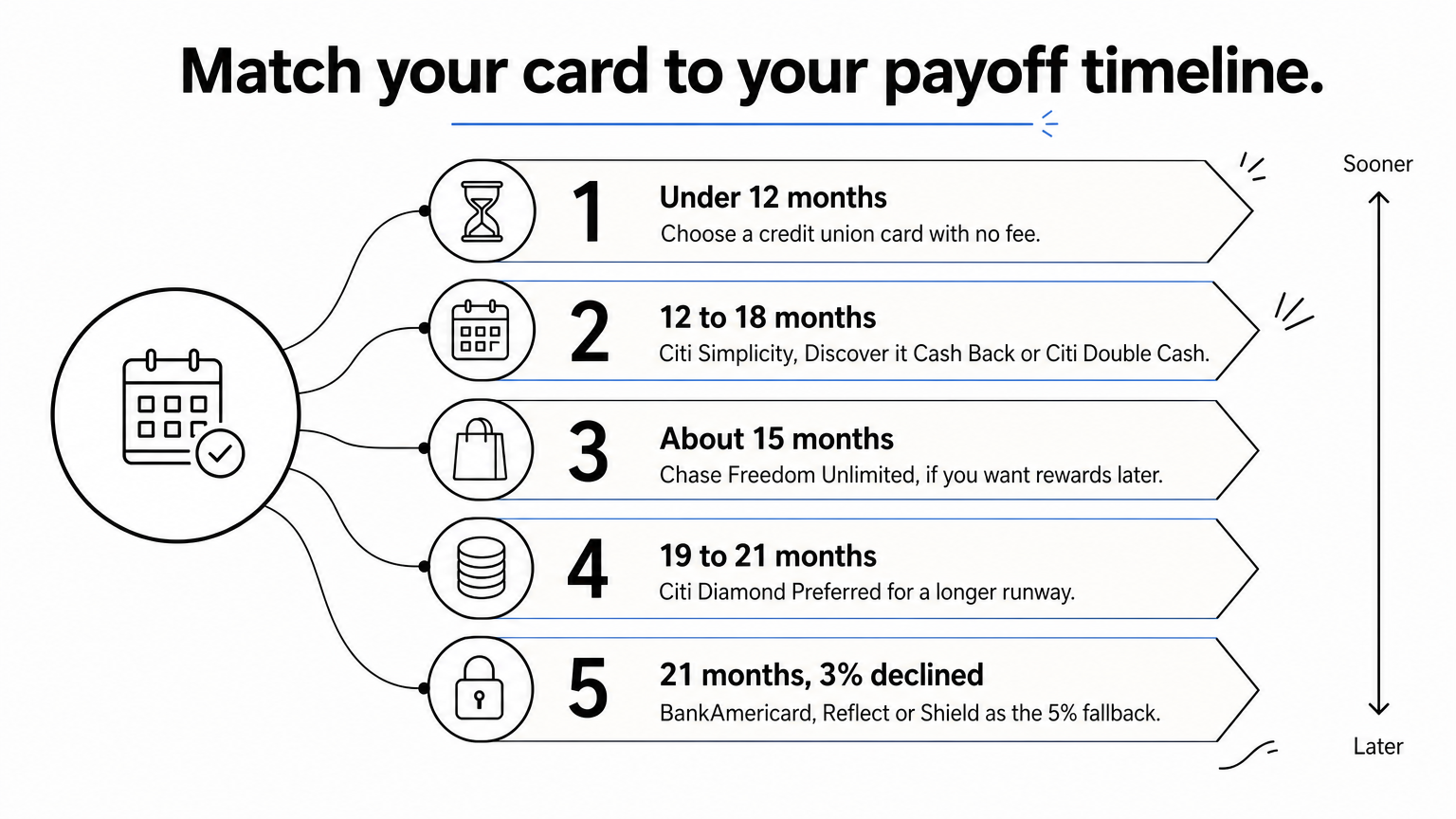
- Under 12 months: a credit union card with no fee.
- 12 to 18 months: Citi Simplicity, Discover it Cash Back or Citi Double Cash.
- About 15 months, and you want rewards later: Chase Freedom Unlimited.
- 19 to 21 months: Citi Diamond Preferred.
- 21 months and a 3% card said no: BankAmericard, Reflect or Shield.
Check the rules before you apply
A few rules can block a transfer or cost you the 0% offer, so read them first.
- Same issuer: you generally cannot transfer debt between two cards from the same bank.
- Approval and limit: you need good to excellent credit, roughly a 670 score or higher for these cards. The limit you get may cover only part of your balance.
- Timing: a transfer can take from 2 to 21 days, so keep making the minimum payment on the old card until it clears.
- Fee window: the 3% rate applies only to transfers inside the stated window, so start the transfer right after approval.
- Late payments: many issuers can end a promotional rate after a missed payment, so set up autopay.
Start the transfer the day you are approved, because the low fee is tied to a clock.
What to do if no card fits your credit
If your credit score is too low for these cards, you still have options that cut interest, though not at a true 0%. Compare them before you accept a high-fee transfer or a debt settlement pitch.
Cheaper options for lower credit scores
A fixed-rate personal loan replaces revolving card debt with one payment and a set payoff date. Some lenders charge an origination fee and others do not, so compare the total cost with a 3% transfer. A nonprofit debt management plan works when your credit is damaged. A credit counseling agency negotiates lower interest rates with your issuers and you make one monthly payment to the agency. Expect modest set-up and monthly fees.
Free moves before you apply
Call your current issuer and negotiate for a lower rate or a hardship program. It costs nothing, and some issuers agree. Then pay down the card with the highest APR first while you wait on any application. A hard inquiry can cost you a few points, so apply to one card at a time.
If you cannot qualify for 0%, a lower fixed rate or a counseling plan still beats minimum payments at 25%.
Pick the fee you can live with
A true $0 balance transfer fee with a 0% promotional rate is mostly a credit union offer, and it fits payoffs of about a year. For longer timelines, the best national cards charge 3% in a short window, and the 5% cards are a fallback. Work out your monthly payment on your balance, match it to the 0% period, and move the debt as soon as you are approved.
Whichever card you choose, the transfer only saves money if you stop adding to the balance. For step-by-step help with your next move, read more guides on getting out of credit card debt.