
You’re behind on credit card payments, the balances aren’t shrinking, and every option you’ve found so far involves paying back every dollar plus interest. That’s the situation where debt settlement for credit cards usually gets mentioned, either by a company calling you or a friend who tried it. It’s a real strategy, but it’s also the most misunderstood one in the debt relief world, and getting it wrong can cost you thousands.
Here’s the direct answer: credit card debt settlement means you or a company negotiate with your card issuer to accept less than the full balance as payment in full, usually after you’ve stopped making payments and saved up a lump sum. It works, but it wrecks your credit for years, isn’t guaranteed, and comes with tax consequences most people never see coming.
In this article, you’ll get a full breakdown of how debt settlement works step by step, what it does to your credit score, when it makes sense versus a debt management plan or consolidation loan, and how to negotiate a settlement yourself instead of paying a company a cut of your savings.
Why credit card debt settlement matters
Most people don’t go looking for debt settlement for credit cards until the minimum payments stop making a dent and the usual ways to get out of credit card debt fast stop working. You send in $200 a month, and the balance barely moves because $150 of that goes straight to interest. That’s not a spending problem anymore, it’s a math problem, and settlement exists specifically for people trapped in that math.
The math behind why balances never shrink
Run the numbers on a typical $12,000 balance at 24% APR with a 2% minimum payment. You’d pay for over 25 years and hand your issuer more than $17,000 in interest alone, according to repayment calculators used by the Consumer Financial Protection Bureau. Compounding interest turns a manageable debt into a decades-long sentence, and that’s before a job loss, medical bill, or rate hike makes the minimum payment itself unaffordable. This is the gap settlement of credit card debt is designed to close: instead of paying the full $12,000 plus interest, you might settle the account for $6,000 to $7,000 in a single negotiated payment.
Who this option is actually built for
Settlement isn’t for someone who’s a little tight this month. It’s built for people who are already behind, already seeing collection calls, or realistically headed there within a year. If you can still make minimum payments and your credit score is intact, a balance transfer card or personal loan will almost always cost you less and hurt you less. Settlement makes sense when:
- You’ve missed payments already or expect to soon
- Your income dropped and won’t recover to prior levels anytime soon
- You’d otherwise consider bankruptcy
- You can gather a lump sum, even a partial one, within 12 to 36 months
Debt settlement isn’t a shortcut around debt, it’s a last-resort trade: your credit score for a smaller payoff number.
What’s actually at stake
Here’s what tends to surprise people who only hear the sales pitch. Credit card debt settlement stops the interest clock, but it starts a different one: the clock on how long collectors can sue you, how long the missed payments sit on your credit report (seven years), and how long you’ll wait before qualifying for decent loan rates again. Weigh that against the alternative, which is often years of payments that barely touch principal.
| Path | Typical total cost on $10,000 debt | Credit impact | Timeline |
|---|---|---|---|
| Minimum payments only | $18,000+ | Minimal if paid on time | 20+ years |
| Debt management plan | $11,000-$12,500 | Moderate, short-term dip | 3-5 years |
| Debt settlement | $5,500-$7,000 | Severe, lasts years | 2-4 years |
Seen this way, settle credit card debt decisions come down to a trade you’re making with eyes open, not a rescue that arrives with no cost attached. The next sections walk through exactly how that trade plays out, starting with how to negotiate it yourself instead of handing a company a cut of the savings.
How to negotiate credit card debt settlement yourself
Negotiating your own settlement saves you the 15% to 25% fee that settlement companies charge, and debt settlement companies aren’t doing anything you can’t do with a phone, a savings account, and some patience. If you’re wondering how to negotiate credit card debt settlement yourself, credit card debt negotiation breaks into three phases: stop paying and save, make the call, get the deal in writing.
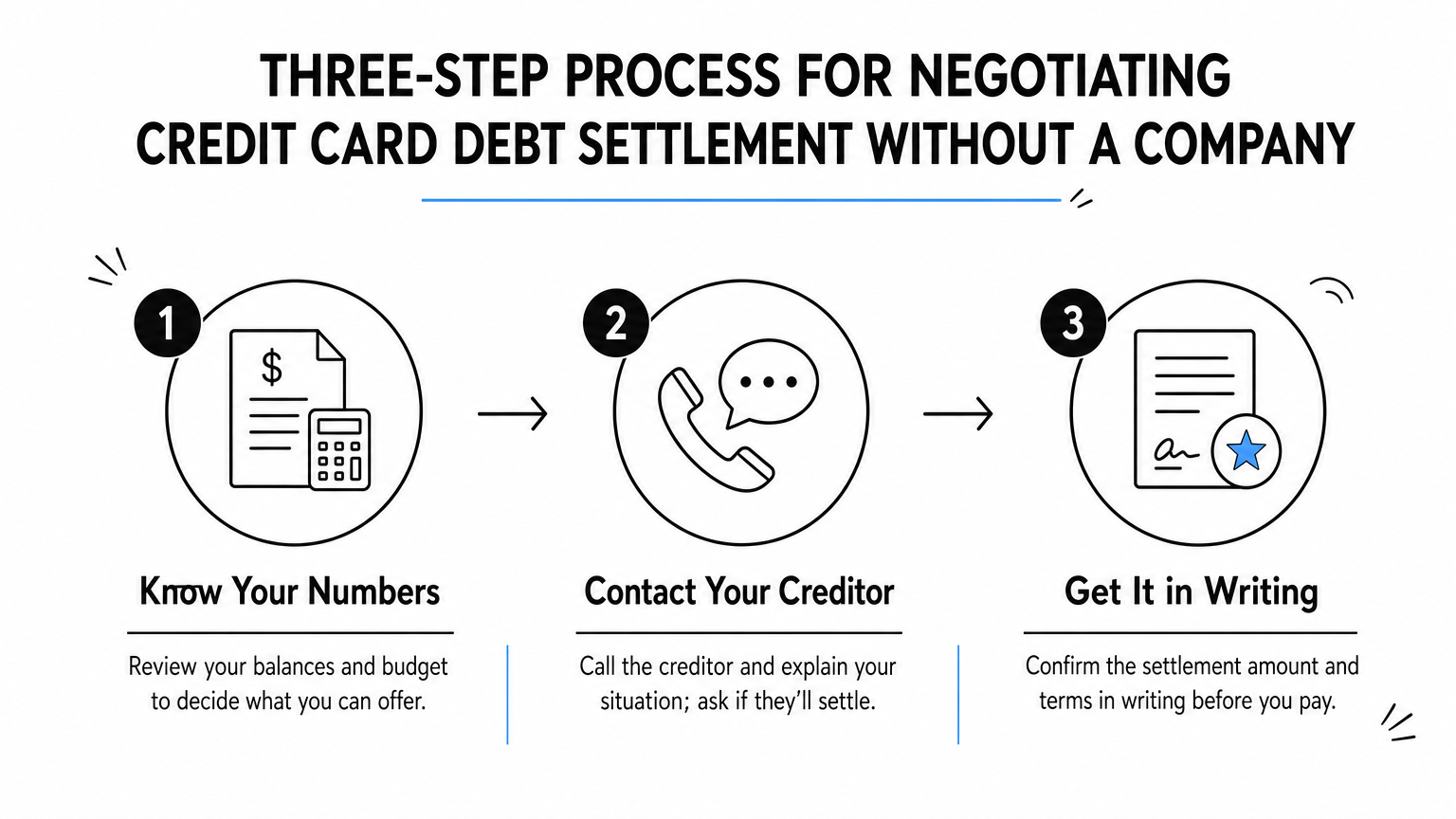
Stop paying and build a lump sum first
Creditors rarely settle with someone who’s still current on the account, because you haven’t shown them you’re actually at risk of never paying. Most successful settle a credit card debt negotiations happen after three to six months of missed payments, once the account has been charged off or handed to an internal collections team. Redirect what you were paying toward a separate savings account instead of spending it, since that lump sum is your only leverage at the table.
What to say when you call
Call the number on your last statement or collection letter, not a general customer service line, and ask for the settlement or recovery department directly. Keep the conversation short and unemotional:
"I'm dealing with a financial hardship and can't pay this balance in full.
I can offer a one-time payment of $X to settle this account permanently.
Can we get that agreement in writing before I send payment?"
Start your offer around 40% of the balance, since most issuers won’t go below 40% to 50% without several rounds of haggling with your creditors. Never give bank account access for a scheduled draft; send a cashier’s check or one-time ACH only after the letter arrives.
Never send a settlement payment until you’re holding a signed letter that says the balance is paid in full.
Get it in writing before you pay
This is where self-negotiators lose the most money. Verbal agreements mean nothing once you’ve paid, because a representative can claim the deal was never approved. Insist on a settlement letter that lists the account number, the agreed amount, the payment deadline, and a written statement that the payment satisfies the debt in full. Fax or email works fine, but keep a copy permanently. If the rep won’t send one, hang up and call back, since settlement on credit card debt deals without paperwork have a way of turning into disputes months later.
How much your creditors will realistically settle for
Every ad promising to erase your debt for "pennies on the dollar" is technically true and mostly misleading. The real number depends on who owns the debt, how late you are, and how much cash you can put on the table right now. Settlement for credit card debt typically lands between 40% and 60% of the balance, not the 10% to 20% figures thrown around in marketing copy.
What actually moves the number
Original creditors like Chase or Capital One settle less aggressively than third-party debt buyers, because they still see some chance of recovering the full amount through internal collections. Once an account gets charged off (usually after 180 days late) and sold to a collection agency for a fraction of its value, that agency has far more room to negotiate, since almost any payment beats none. Accounts that are 90 to 180 days delinquent tend to land the middle range, while accounts already assigned to outside collectors or law firms often settle lowest, because those buyers paid pennies to acquire the debt in the first place.
| Account status | Typical settlement range | Why |
|---|---|---|
| Current or 1-2 payments missed | 70%-90% | Creditor still expects recovery |
| 90-180 days delinquent | 50%-65% | Charge-off approaching, leverage rising |
| Charged off, in-house collections | 40%-55% | Creditor writing off as a loss |
| Sold to third-party debt buyer | 20%-40% | Buyer paid cents on the dollar |
The later an account is in the delinquency cycle, the lower the number you can realistically negotiate.
Why your lump sum size matters more than your story
Creditors don’t care much about your explanation for the hardship; they care whether you can actually pay. A debt credit card settlement offer backed by cash sitting in your account today gets taken more seriously than a payment plan spread across six months, because collectors know promises fall apart. If you can only offer a partial lump sum, expect the percentage to land higher, closer to 55% or 60%, since the creditor is pricing in the risk that a smaller upfront payment is all they’ll ever see. Building the largest lump sum you can before you start negotiating is the single biggest lever you control in this entire process.
Multiple accounts rarely settle at the same rate, so negotiate each one separately and expect the numbers to vary by issuer and by how far each account has drifted into delinquency.
How debt settlement affects your credit and taxes
Settling an account never happens without a cost, and that cost shows up in two places you won’t fully feel until months later: your credit report and your tax return. Settlement credit card debt deals get marketed as a clean break, but the fine print includes a score drop that can last years and a tax bill on money you never actually received.
The credit score hit and how long it lingers
Once you stop paying to build your lump sum, your score takes the first hit from the missed payments themselves, often 60 to 100 points depending on where you started. The settlement notation itself, "settled for less than owed," stays on your credit report for seven years from the date of the first missed payment, not from the date you finally pay. Lenders reading that file see it as a red flag on any new credit application, especially mortgages, where underwriters specifically ask about settled accounts.
A settled account tells every future lender you didn’t pay what you agreed to, and that label doesn’t come off early no matter how promptly you pay the settlement itself.
Recovery isn’t instant, but it’s not permanent either. On-time payments on other accounts, low utilization, and time itself rebuild the score gradually, and our guide to reaching an 850 credit score walks through the exact rebuilding sequence once your settlements clear.
The 1099-C tax bill nobody warns you about
Here’s the surprise that catches people off guard every year: the IRS treats forgiven debt as income. If a creditor forgives $3,000 or more, they’re required to send you a 1099-C form, and that forgiven amount gets added to your taxable income for the year, according to the Internal Revenue Service. Settle a $10,000 balance for $5,000, and you may owe income tax on that $5,000 difference, depending on your bracket and whether you qualify for an insolvency exclusion.
Example: $10,000 balance settled for $5,000
Forgiven amount: $5,000
Potential tax owed (22% bracket): ~$1,100
Working with a tax professional before you finalize any settlement, or at minimum before filing, keeps that 1099-C from becoming its own emergency the following April.
Debt settlement companies vs going it alone
Hiring one of the best debt settlement companies to handle debt settlement with credit cards buys you convenience, not necessarily a better outcome. These firms collect your monthly deposits into a dedicated account, negotiate on your behalf once enough cash accumulates, and charge a fee, usually 15% to 25% of the enrolled debt or the amount saved. That fee comes straight out of what you were supposed to be saving, which is why the math often favors doing it yourself if you have the time and stomach for collection calls.
What you actually get for the fee
Justifying the cost means looking at what a company brings that you can’t easily replicate. Reputable firms, especially those accredited by the American Fair Credit Council, have relationships with certain creditors and know which departments respond to which offers. They also absorb the stress of fielding collector calls, which matters if you’re the type to cave under pressure and pay more than you should. None of that changes the fact that they’re negotiating with your own money, using a script you could learn yourself.
Paying someone else to make the phone call you’re capable of making yourself is the single most expensive convenience fee in debt relief.
Side-by-side comparison
| Factor | Going it alone | Using a settlement company |
|---|---|---|
| Cost | $0 beyond the settlement itself | 15%-25% of enrolled debt |
| Time investment | High, you make every call | Low, company handles calls |
| Speed to first settlement | Often faster, no enrollment period | Slower, funds must accumulate first |
| Risk of scams | Low if you follow the process | Higher; some firms take fees before settling anything |
| Best for | Confident negotiators, single or few accounts | People with multiple accounts, low tolerance for collector calls |
Red flags that mean walk away
Scrutinize any company that asks for fees before it settles a single account, since that practice violates Federal Trade Commission rules for telemarketed debt relief services. Watch for guarantees of a specific percentage reduction, pressure to stop paying immediately without discussing your full financial picture, or refusal to put fee structures in writing. Solid companies explain the credit damage, the tax consequences, and the timeline honestly before you sign anything, not after.
Smarter alternatives to debt settlement
Before you stop paying anything and brace for years of collection calls, run through the options that don’t require trashing your credit first, starting with how debt settlement compares to debt consolidation. A debt management plan (DMP) through a nonprofit credit counseling agency consolidates your cards into one monthly payment, often at 6% to 9% interest instead of 24%, without the settlement notation on your report. Nonprofits like those accredited by the National Foundation for Credit Counseling negotiate lower rates directly with issuers, not lower balances, so you pay back what you owe, just faster and cheaper.
When a balance transfer or consolidation loan beats settlement
Qualifying for credit still matters here, and if your score sits above 650, one of the top cards for balance transfers with a 0% introductory rate for 15 to 21 months can wipe out your interest entirely while you pay down principal. Compare that against a fixed-rate personal loan, which locks in one predictable payment and a payoff date, both of which our guide to debt consolidation strategies breaks down by credit tier. Neither option tanks your score the way a missed-payment settlement does, and both keep you off the seven-year settled-account list entirely.
If you still qualify for a 0% balance transfer or a low-rate consolidation loan, take it before you ever consider settlement.
Bankruptcy as the honest comparison point
Sometimes the debt is too large for any of the above, and that’s where Chapter 7 or Chapter 13 bankruptcy actually beats settlement on both speed and finality. Bankruptcy discharges debt in months rather than years, stops collection calls immediately by law, and, despite the stigma, often causes less long-term credit damage than a string of settled accounts because it’s a single event rather than repeated derogatory marks. Weigh these options side by side before committing to any single path:
- DMP: best if you can afford roughly 100% of principal at a lower rate
- Balance transfer or loan: best if your credit score still qualifies you
- Settlement: best if you’re already delinquent and want to avoid bankruptcy
- Bankruptcy: best if the total debt exceeds what any settlement could realistically resolve
Getting an honest read on where you fall in that list matters more than which option sounds least scary on paper.
Choosing your next step
Settling credit card debt can genuinely cut what you owe, but it’s not free money. You trade years of credit damage and a possible tax bill for a smaller payoff number, and that trade only makes sense once you’ve already fallen behind or expect to soon. If you’re still current and your score holds up, a balance transfer or consolidation loan almost always beats settlement on cost and credit impact. If you’re already missing payments, negotiating credit card debt settlement yourself, following the steps above, saves you thousands compared to hiring a company to make the same phone call.
Whatever shape your debt takes, don’t guess your way through it. Compare your real numbers, your credit score, your balances, and your timeline against every path in this article before you commit to one. Start by comparing debt relief programs to match your situation to the right strategy.