
The short answer to most debt settlement legal questions is yes. You can negotiate with a creditor or collector to pay less than you owe, either on your own or through an attorney or settlement company. The creditor accepts a smaller amount as payment in full. Federal law limits how collectors treat you and when settlement companies can charge you. Nothing forces a creditor to say yes, and nothing stops them from suing you while you negotiate.
Credit Card Solution is an educational site, not a lender or a settlement provider, so none of this is legal advice. Settlement carries real risks, because the legal rules are easy to miss and the costs show up later. Knowing your rights before you make an offer keeps you from paying twice or signing away protections.
This article covers why the legal side matters and how to negotiate settlement yourself, including a letter you can copy. It then explains what to do if you are sued and when hiring a debt settlement attorney makes sense.
Why the legal side of debt settlement matters
The law decides what collectors can say, what settlement companies can charge, and what happens when you stop paying. Settlement itself is legal. A bad move during negotiation, such as ignoring a summons or paying without a written agreement, can still cost you thousands.
What the rules allow and what they limit
Several layers of law apply at once, and who is collecting determines which layer protects you. The Fair Debt Collection Practices Act covers third-party collectors and debt buyers, but generally not the original creditor collecting its own debt.
| Rule | What it means for you |
|---|---|
| Debt settlement itself | Legal. Creditors may accept less, but they never have to. |
| Fair Debt Collection Practices Act and Regulation F | Collectors must send validation details and cannot harass you. They cannot call before 8 a.m. or after 9 p.m. More than seven calls in seven days about one debt is presumed excessive. |
| FTC Telemarketing Sales Rule | A settlement company cannot collect a fee until it settles a debt and you make a payment under that agreement. |
| Federal tax law | Forgiven debt is generally taxable income. Creditors send a 1099-C for $600 or more. |
| State law | Sets the statute of limitations, your deadline to answer a lawsuit, and how some states license or restrict settlement companies. |
Legal does not mean safe: the law regulates how settlement works, not whether it hurts you.
Costs the law does not remove
A settled account is reported to the credit bureaus as a negative entry, and late payments or a charge-off can stay on your report for up to seven years. If you are already deep in collections, the added damage is smaller. If your score is still decent, it is larger.

Taxes catch people off guard. The IRS generally treats forgiven debt as income, so settling an $8,000 balance for $4,000 can mean a 1099-C for $4,000. An insolvency exclusion may reduce or remove that tax if your debts exceeded your assets just before the settlement, so ask a tax professional before filing.
How to negotiate a debt settlement yourself
Negotiating directly is legal and costs no fees. Verify the debt, make a lump-sum offer, and get the agreement in writing before you pay. Each step has a legal reason behind it.
Confirm the debt before you offer anything
Collectors must give you details about the debt, generally in writing, within five days of first contacting you. You then have about 30 days after receiving the notice to dispute it. If you dispute in writing within that window, the collector must pause collection until it verifies the debt.
Three checks matter before you offer a dollar:
- Who owns it now. If the debt was sold, you owe the new owner only if the debt is valid. Ask for proof of ownership.
- Whether the amount is right. Compare the balance with your own statements.
- Whether the statute of limitations has expired. In many states, a small payment or written acknowledgment can restart the clock, so check first.
Make the offer and get it in writing
Creditors accept less when they think you may otherwise pay nothing. There is no standard percentage, so start low and expect a counteroffer. On an $8,000 balance, you might open at $2,400 (30%) and settle at $4,000 (50%). That leaves $4,000 forgiven, which may be taxable.
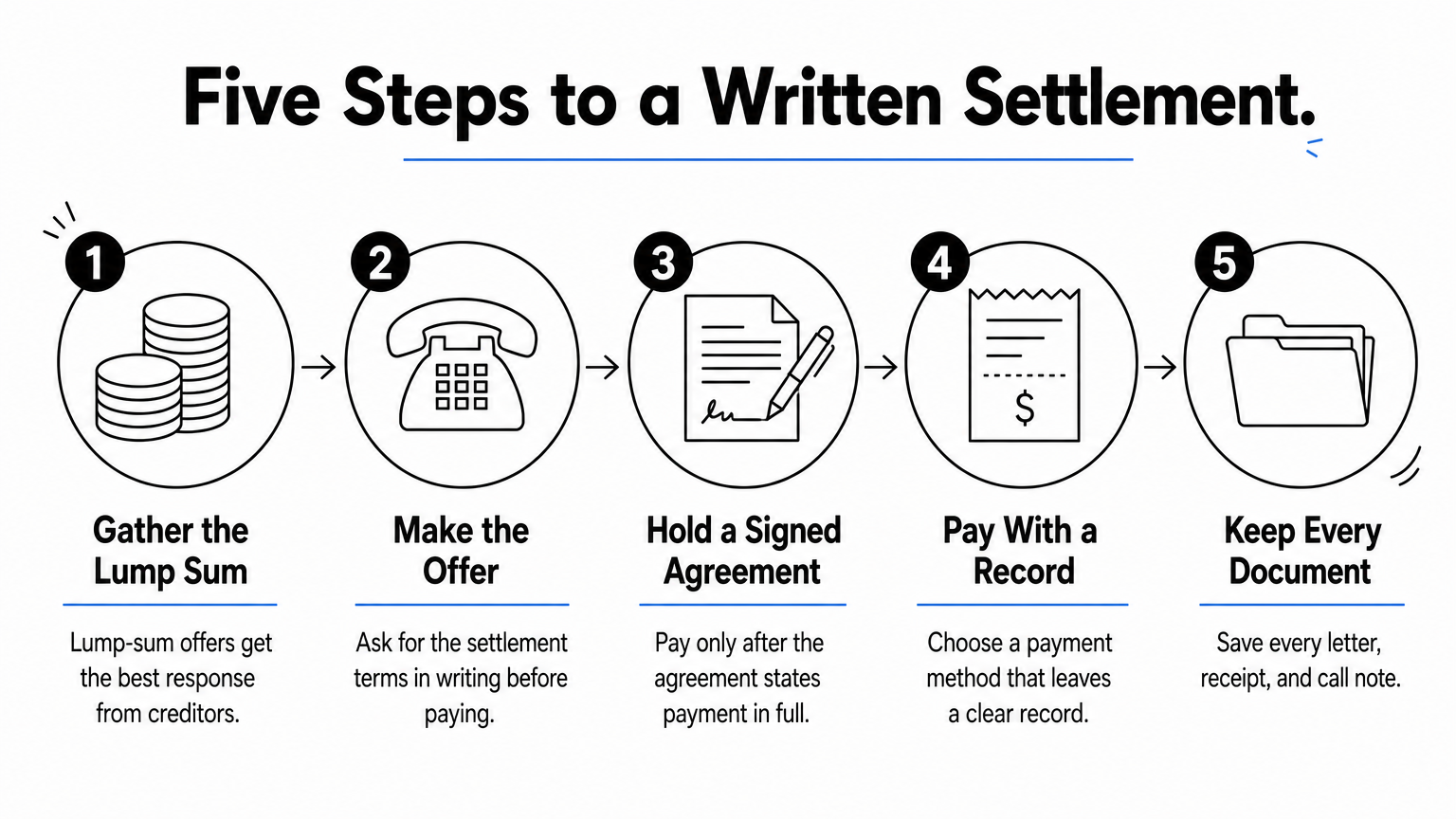
- Gather the lump sum before you call, because lump-sum offers get the best response.
- Make the offer, then ask for the terms in writing.
- Pay only after you hold a signed agreement stating the amount is payment in full.
- Pay by a method that leaves a record, and never give a collector open access to your bank account.
- Keep every letter, receipt, and call note.
Never pay a settlement until you have the agreement in writing.
A settlement letter you can copy
Send this by certified mail and keep a copy. It makes an offer without admitting the debt is valid or current.
[Date]

[Collector name and address]
Re: Account [number], original creditor [name]

This letter is an offer of settlement. It is not an acknowledgment
that I owe this debt or that it is within the statute of limitations.

I offer $[amount] as payment in full and final settlement of this
account. I will pay by [method] within [number] days of receiving
your written acceptance.

Before I send any payment, please confirm in writing that:
1. You accept $[amount] as full satisfaction of the debt.
2. You will report the account accurately as settled or paid.
3. You will stop all collection activity on this account.

Do not withdraw funds from any of my accounts.

[Your name and address]
What to do if a collector or law firm sues you
Respond to the summons before the deadline, because ignoring it usually leads to a default judgment. Depending on your state, a judgment can lead to wage garnishment or a bank levy. Settlement stays possible after you are served, but you need to answer the lawsuit first.
Respond first, then negotiate
The summons lists your deadline, which is commonly a few weeks and varies by state. File your answer with the court on time. Then you can negotiate with the collector’s law firm, which acts as the collector’s agent. Most debt lawsuits settle before trial, and a settlement can include dismissal of the case.

Get the dismissal terms in writing. Ask that the case be dismissed with prejudice, which means the collector cannot refile. Do not skip a court date until the dismissal is actually filed.
When fighting beats settling
You should settle if you owe the debt, the amount is right, and you can afford the offer. Consider fighting if the collector may not be able to prove its case. The plaintiff carries the burden of proof, and debt buyers often lack complete records.
- The debt is not yours, or the amount is wrong.
- The statute of limitations has expired.
- The plaintiff cannot show it owns the account.
- The collector broke the collection rules, which may give you a counterclaim.
Being sued does not end your leverage. It raises the stakes on a deadline.
Legal aid groups and nonprofit consumer clinics often help people in debt lawsuits, so look for one before you pay for representation.
Should you hire a debt settlement attorney?
Hire a debt settlement attorney if you have been sued, you owe a large amount, or a collector keeps breaking the rules. For a single card balance and no lawsuit, doing it yourself is free and just as legal.
Attorney, settlement company, or doing it yourself
The three routes differ mainly in cost and in protection. Say you enroll $8,000 with a company that charges 25% of enrolled debt, a common range being 15% to 25%. A $4,000 settlement plus a $2,000 fee costs $6,000 in total. Doing it yourself costs $4,000.
| Option | Typical cost | Best for |
|---|---|---|
| Do it yourself | No fee | One or two debts and a lump sum ready |
| Settlement company | 15% to 25% of enrolled debt | Rarely a first choice, since programs tell you to stop paying and your balances grow |
| Settlement attorney | Varies by firm, so get the fee structure in writing | Lawsuits, large debts, or collector violations |
An attorney can appear in court and answer a summons for you. A company cannot.
How to find and vet an attorney near you
Start with your state bar’s referral service, then confirm the attorney is licensed in your state. State law controls deadlines, limitation periods, and what a settlement company may do, so local knowledge matters. Your state attorney general’s office can tell you how settlement companies are regulated where you live.
Ask these questions before you sign:
- Will you appear in court if I am sued?
- How do you charge, and when do fees come due?
- Who actually negotiates my accounts?
- What happens if a creditor refuses to settle?
Walk away from anyone who guarantees results, asks for upfront settlement fees, or tells you to cut off all contact with creditors. If your balances are mostly credit cards, a nonprofit credit counselor and a debt management plan are a safer first step.
Know your rights before you make an offer
Debt settlement is legal, but the law protects you only if you use it. Verify the debt, keep every promise in writing, answer a summons on time, and treat any company that wants fees upfront as a warning sign. Remember the tax bill and the credit hit, which no agreement erases.
If you can negotiate yourself, do it. If you are sued or the debt is large, a licensed attorney in your state earns the fee. Either way, settlement should be the last option you try, not the first. To compare it with balance transfers, consolidation loans, and debt management plans, read our guides on credit card debt relief programs.