The fastest way to get out of medical debt is to attack the bill before you pay a cent. Check it for errors, apply for hospital financial assistance, negotiate the balance, get an expert to help, and know your rights if it reaches collections. Auditing and assistance suit almost everyone. Negotiation suits people who can offer a lump sum or steady payments. Advocates and counselors suit people who feel buried by paperwork. The collections and bankruptcy options suit people who are already being sued or contacted.
Medical bills are not like other debt. They are often wrong, they are often negotiable, and providers frequently accept far less than the number printed on the statement. Most people never test that, pay in a panic, and put the balance on a credit card at 18% to 29% interest. That turns a manageable bill into a long-term problem.
This guide covers five ways to cut, settle, or erase what you owe, in the order that usually works best. We cover every topic related to credit cards, so we also flag the mistakes that push medical bills onto high-interest cards. Work through the steps in order, because each one makes the next one easier.
1. Audit the bill and fix errors
Start by asking for an itemized bill and comparing it with your insurer’s explanation of benefits. This step costs nothing and often shrinks the balance before you negotiate anything.

How it works
Medical bills commonly include duplicate charges, services you never received, wrong billing codes, or claims your insurer should have paid. An itemized bill lists every charge with its code. Your explanation of benefits (EOB) shows what the insurer approved and what you owe. If the numbers differ, the difference is your dispute.
Never pay a medical bill you have not checked against your explanation of benefits.
Who it suits
Everyone, but insured patients gain the most, since denied or miscoded claims are often fixable with one call. Do this first even if you plan to negotiate. You should also ask the provider to pause collections while you dispute.
How to start
- Call the billing office and request an itemized bill with codes.
- Get your EOB from your insurer’s website or by phone.
- Mark duplicates, services you did not receive, and charges the insurer already covered.
- Dispute in writing and keep a log of names, dates, and call details.
2. Apply for financial assistance
Hospital charity care and public insurance can wipe out or sharply reduce a bill, and you do not need to be destitute to qualify. If you want to get out of medical debt without paying the full amount, this is your strongest option.
How it works
Nonprofit hospitals must have a written financial assistance policy under federal tax rules. Eligibility is usually tied to household income relative to the federal poverty level, and the cutoffs vary widely by hospital. Some discount bills heavily for middle-income households. You can also apply for Medicaid, and some states cover bills from before your application date. Ask whether yours does. The federal government’s page on help with medical bills explains how charity care works.
A hospital’s financial assistance policy can erase a bill that no negotiation would touch.
Who it suits
It suits uninsured and underinsured patients, people who lost income, and anyone whose bill is large compared with annual earnings. Apply even if you think you earn too much. Many people never ask and never find out.
How to start
- Ask the billing office for the financial assistance application and policy.
- Gather pay stubs, tax returns, and proof of household size.
- Submit before paying anything, and ask that the account be paused.
- Apply for Medicaid through your state in parallel.
3. Negotiate a discount or payment plan
Providers accept less than the billed amount more often than most people expect, especially for a lump sum. A good offer works because the provider would otherwise sell the account to a collector for pennies on the dollar.
How it works
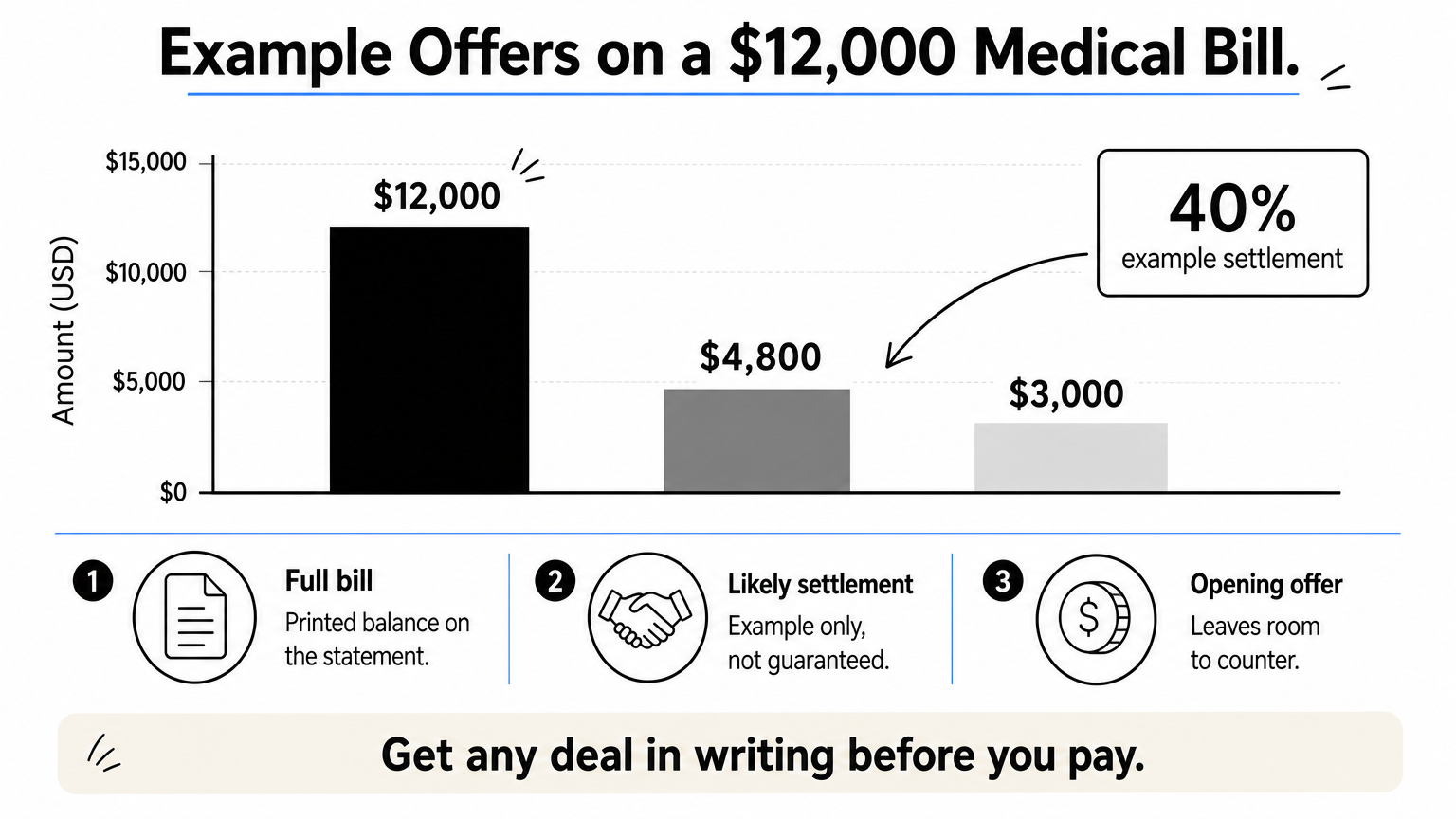
Start with the fair price for the service, using your insurer’s allowed amounts or public price lookup tools as a benchmark. Then offer a lump sum below what you can really pay and expect a counteroffer. No fixed percentage applies. Many people open around 25% and settle between 40% and 50%, but results depend on the provider and your situation. For a payment plan, ask for zero interest, since most provider plans can be interest-free. Get any deal in writing before you pay.
| $12,000 bill | Amount | Notes |
|---|---|---|
| Opening lump-sum offer (25%) | $3,000 | Leaves room to counter |
| Likely settlement (40%) | $4,800 | Example only, not guaranteed |
| 24-month plan | $500 per month | Ask for 0% interest |
| 36-month plan | about $333 per month | Lowest monthly strain |
Open low, ask for zero interest, and never pay without a written agreement.
Who it suits
It suits people who do not qualify for charity care but can raise some cash or make steady payments. Do not charge the bill to a credit card. A 0% provider plan beats a card at 18% to 29%.
How to start
- Decide your maximum lump sum and monthly payment.
- Call the billing office and ask for a supervisor or financial counselor.
- State your offer, then stay quiet and let them respond.
- Request a signed letter stating the amount settles the account in full.
4. Get a billing advocate or credit counselor
If the process overwhelms you, an expert can do the audit and negotiation for you. The right help saves money. The wrong help costs you more.

How it works
A medical billing advocate reviews your bills, disputes errors, and negotiates with the provider. Fees vary, from hourly rates to a share of what they save you, so ask before you sign. A nonprofit credit counselor helps if medical costs have spilled onto credit cards, building a budget and, if needed, a debt management plan. Legal aid offices help low-income patients with disputes and lawsuits.
Pay for help only after you understand exactly how the advocate gets paid.
Who it suits
It suits busy or overwhelmed patients, people with multiple providers, and anyone whose medical bills sit alongside card balances. Avoid any company that demands large upfront fees to "settle" your debt. Federal rules generally bar debt settlement companies from charging before they settle a debt.
How to start
- Ask the advocate for a written fee structure.
- Look for nonprofit credit counseling agencies and check their credentials.
- Contact local legal aid if you have been sued or threatened.
- Walk away from guarantees to "erase" your debt.
5. Handle collections and last-resort options
Even a collections account is negotiable, and ignoring it is the worst move. Know your rights, respond to every legal notice, and keep bankruptcy as a backup.
How it works
You can send a debt validation letter within 30 days of the collector’s first notice, which forces them to prove the debt and the amount. Never ignore a court summons. You cannot be jailed for unpaid medical debt, but skipping court can lead to a default judgment and, in some cases, an arrest warrant for missing the hearing. Judgments can lead to wage garnishment, with limits that vary by state. The major credit bureaus have also changed how they treat medical collections, including removing paid ones, so check the current rules for your report.
Respond to every collector and every court notice, because silence is how a bill becomes a judgment.
Who it suits
It suits people with accounts already in collections, lawsuit threats, or balances too big for any other fix. Bankruptcy can discharge medical debt and is worth a consultation if your total debt is unmanageable. Talk to a bankruptcy attorney before deciding.
How to start
- Send a validation request by certified mail and keep the receipt.
- Offer a settlement in writing and get the terms confirmed before paying.
- Answer any summons by the deadline.
- Book a free bankruptcy consultation if nothing else solves the problem.
Where to start today
Getting out of medical debt comes down to order. Audit the bill, apply for aid, negotiate what is left, bring in help if you need it, and respond to collectors and courts. Do not rush to pay or charge it to a card.
If medical bills have already pushed you into credit card balances, you have more options than the minimum payment. Our guides at Credit Card Solution explain consolidation loans, balance transfers, and debt management plans so you can pick the right one for your credit score.