Here is how to get out of 20k debt: list every balance, cut your interest rate with a 0% balance transfer, a consolidation loan, or a nonprofit debt management plan, then pay the balances down with the avalanche or snowball method. Raise your monthly payment with extra income as you go. At a typical 22% APR, about $1,040 a month clears $20,000 in 24 months, and about $1,870 a month does it in 12.
Most people stall because of the interest. At 22%, $20,000 costs you roughly $367 in interest the first month, so minimum payments feel like running in place. Add embarrassment, and plenty of people stop opening their statements. That makes it worse, because the balance keeps growing while you look away.
This guide gives you a four-step plan with real numbers. At Credit Card Solution, we write about credit card debt relief and consolidation, so the options below run from lowest cost to last resort. Every example assumes a 22% APR unless noted, so swap in your own rate to see your numbers.
What $20K costs and how long payoff takes
Paying off $20,000 in credit card debt takes a fixed monthly payment and a finish line you can calculate. The only variables are your interest rate and how much you pay each month.
What the interest does to you
At 22% APR, the first month of interest on $20,000 is about $367. If the balance never dropped, that would be about $4,400 a year in interest alone.
Minimum payments are built to keep you paying. They are usually a small percentage of the balance plus interest, so they shrink as the balance falls and stretch payoff out for many years. Is $20,000 a lot? Yes, it is a serious balance. It is also fully solvable if your income can support the payments below.
Payoff time by monthly payment
Use this table to see which timeline your budget supports. The figures assume a fixed 22% APR and no new charges.
| Approximate monthly payment | Time to pay off | Total interest paid |
|---|---|---|
| $1,870 | 12 months | about $2,460 |
| $1,040 | 24 months | about $4,900 |
| $765 | 36 months | about $7,500 |
| $550 | 60 months | about $13,100 |
Pick the row you can sustain without missing a payment. If $1,040 is out of reach, do not give up. Steps 2 and 4 exist to close that gap.
Your monthly payment, not your balance, decides how long this takes.
Step 1. List every balance and stop new charges
Write down every card’s balance, APR, minimum payment, and due date, then stop adding to the debt. You cannot pay down a balance that keeps growing.
List every card and its terms
Pull the numbers from your latest statements. Then check your free credit reports at AnnualCreditReport.com, in case an old account or collection slipped your mind. For each debt, record:

- The current balance
- The APR
- The minimum payment
- The due date
Find your real monthly payment
Subtract essentials from your take-home pay: housing, utilities, food, transportation, insurance, and the minimums on any non-card debt. What remains is your debt payment. Compare it with the table above to see where you land.
Before you send everything to the cards, build a $1,000 starter emergency fund. Without it, one car repair goes right back on a card. Then remove saved cards from your phone wallet and shopping sites, and use debit or cash until the balances are gone.
Freeze new charges first, because a growing balance cancels every payment you make.
Step 2. Cut your interest rate
Lowering your APR is the biggest lever in a plan to get out of 20k debt, and it matters more than the payoff method you choose later. The right option depends mostly on your credit.
Match the option to your credit
| Option | Best fit | Cost to know | Payoff window |
|---|---|---|---|
| 0% balance transfer card | Good to excellent credit | 3% to 5% transfer fee | Promos of 12 to 21 months are common |
| Debt consolidation loan | Fair to good credit | Rate set by your credit, possible origination fee | Fixed term, often 2 to 5 years |
| Lower-rate or hardship request to your issuer | Anyone, especially after job loss or illness | Free to ask | Varies by issuer |
| Nonprofit debt management plan | Damaged credit, steady income | Small monthly fee, cards usually closed | Typically 3 to 5 years |
A worked example
Say you move $20,000 to a 0% card with a 3% fee. You owe $20,600, and clearing it in 18 months takes about $1,145 a month. With a 5% fee, the monthly figure is about $1,167. Card limits are often below $20,000, so you may need to split the balance across cards. Any balance left after the promo ends reverts to the regular rate.
A consolidation loan at 12% APR over 36 months costs about $664 a month. You pay about $3,900 in interest, compared with about $7,500 if you stayed at 22% for the same 36 months. That saves roughly $3,600. Check for an origination fee, because lenders usually deduct it from the amount you receive.
If your credit is damaged
Start with a phone call. Ask your issuer for a lower APR or a hardship program, and have your budget ready. Next, talk to a nonprofit credit counseling agency about a debt management plan, which bundles your cards into one payment, often at a reduced rate.
Treat debt settlement as a last resort. It can damage your credit, and forgiven debt may count as taxable income. Federal rules generally bar settlement companies from charging fees before they settle a debt, so walk away from any that ask for money up front.
A lower rate can save thousands of dollars before you change a single habit.
Step 3. Pick a payoff method and automate it
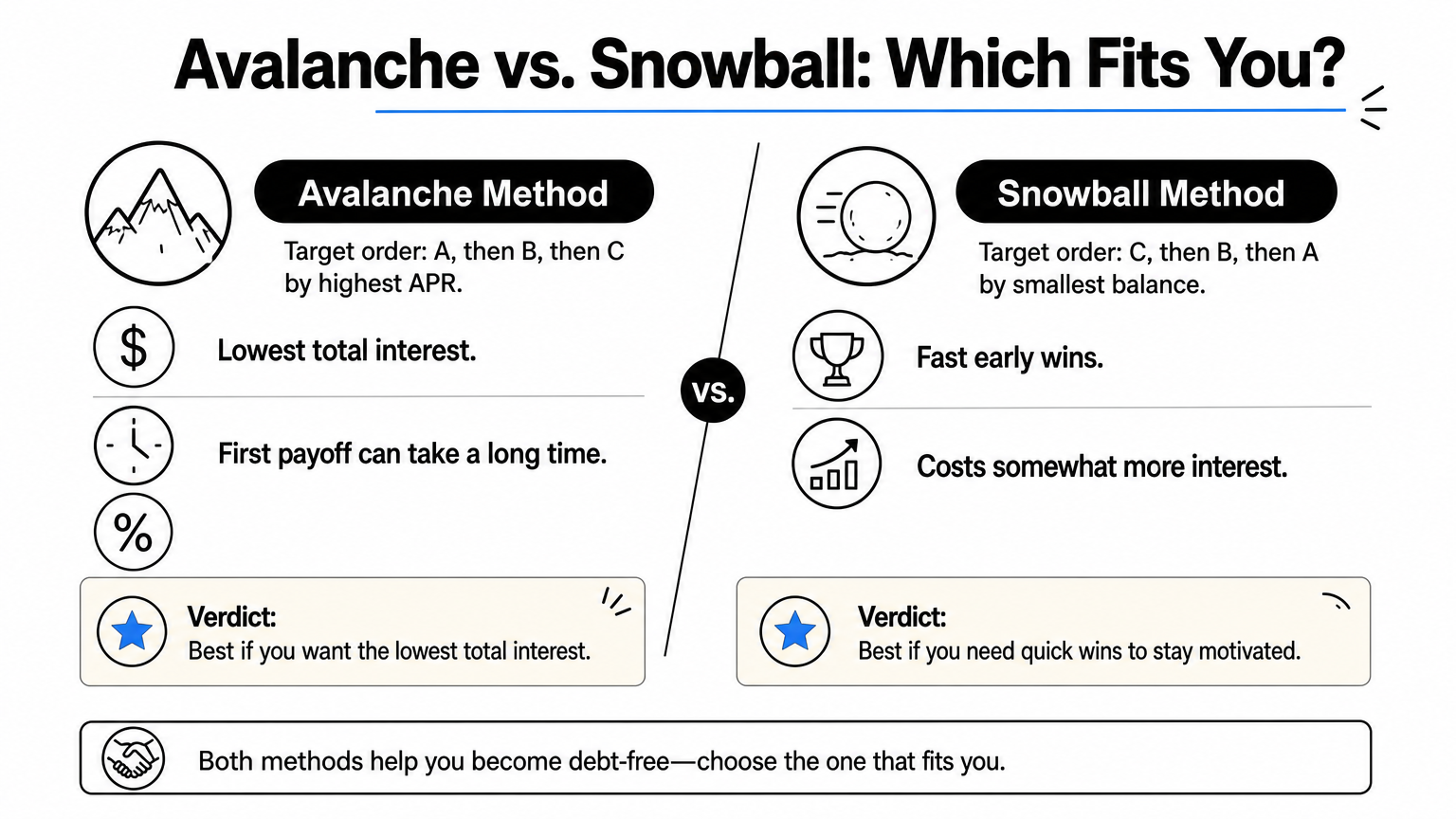
Use the avalanche method if you want the lowest total interest, and the snowball method if you need quick wins to stay motivated. Both work the same way: pay the minimum on every card, and send all extra money to one target card.
Avalanche vs. snowball
Imagine three cards: A at $9,000 and 27%, B at $6,500 and 22%, and C at $4,500 and 18%.
| Method | Target order | Strength | Weakness |
|---|---|---|---|
| Avalanche | A, then B, then C (highest APR first) | Lowest total interest | First payoff can take a long time |
| Snowball | C, then B, then A (smallest balance first) | Fast early wins | Costs somewhat more interest |
If you consolidated into one loan or one 0% card, you can skip this choice. Just never miss a payment.
Automate it
Set autopay for every minimum so a late fee never undoes your progress. Then schedule the extra payment for the day after payday, before the money drifts elsewhere. When a card hits zero, roll its old payment into the next target. That rollover is what makes the later balances fall fast.
The best method is the one you will keep doing for 24 months.
Step 4. Raise the amount you pay each month
You can get out of 20k debt fast by raising your monthly payment, either by trimming costs or earning more. Each extra $100 a month takes months off the finish line.
Cut and negotiate
Skip blanket frugality and go after a few big bills. Shop your car insurance, call your internet and phone providers for a lower rate, and cancel subscriptions you forgot about. Even $300 a month adds up quickly.
Add income
Overtime, delivery or rideshare shifts, freelance work, tutoring, and selling unused items all work. The rule is simple: every new dollar goes to the target card, not into daily spending. Here is how it can add up:

- $300 a month from cuts
- $500 a month from side income
- $200 a month moved from your current budget
- Total of $1,000 a month
At 22% APR, $1,000 a month clears $20,000 in about 25 months. Add a one-time $2,000 from a tax refund or sold items at the start, and the finish line moves to about 22 months. Pair this with a rate cut from Step 2, and you land well under two years.
Treat every extra dollar of income as debt money from the day you earn it.
Start with the list, then lower the rate
To get out of $20,000 in debt, know your numbers, stop new charges, cut your interest rate, choose the avalanche or snowball method, and push your payment as high as you can. Your timeline comes from the payment you can sustain, and the table shows where each payment level leads.
You do not need a perfect plan to start. Write the list of balances and call one issuer about a lower rate. If you want to compare balance transfer cards, consolidation loans, and debt management plans in more depth, read our guides on credit card debt relief and consolidation.