
The most reliable way to get out of payday loans debt has four moves. Stop renewing the loan, ask your lender for an extended payment plan, replace what you still owe with cheaper credit such as a credit union payday alternative loan, and bring in a free nonprofit credit counselor if the numbers still don’t work. Most people only need the first two or three. Each one starts with a phone call or a short application.
The trap is built into the product. A payday loan comes due in two to four weeks, usually with a fee near $15 per $100 borrowed. If your paycheck can’t cover the loan and your rent, you renew, pay the fee again, and still owe the full amount. After a few rounds you have paid a large share of the original loan in fees and the balance hasn’t moved.
At Credit Card Solution, we write about debt relief and consolidation, and the math is the same as with credit cards. The cheapest dollar is the one you stop paying in fees. This guide walks through four steps in order, with real numbers, a script to use with your lender, and the warning signs to watch for. It also covers what happens if you stop paying and how to keep from landing back here.
Why payday loan debt is so hard to escape
Payday loan debt is hard to escape because the full amount is due in one lump sum within weeks, and every renewal charges the same fee again without reducing what you owe. Understanding that mechanism tells you what to fix first.
How a $600 loan eats your paycheck
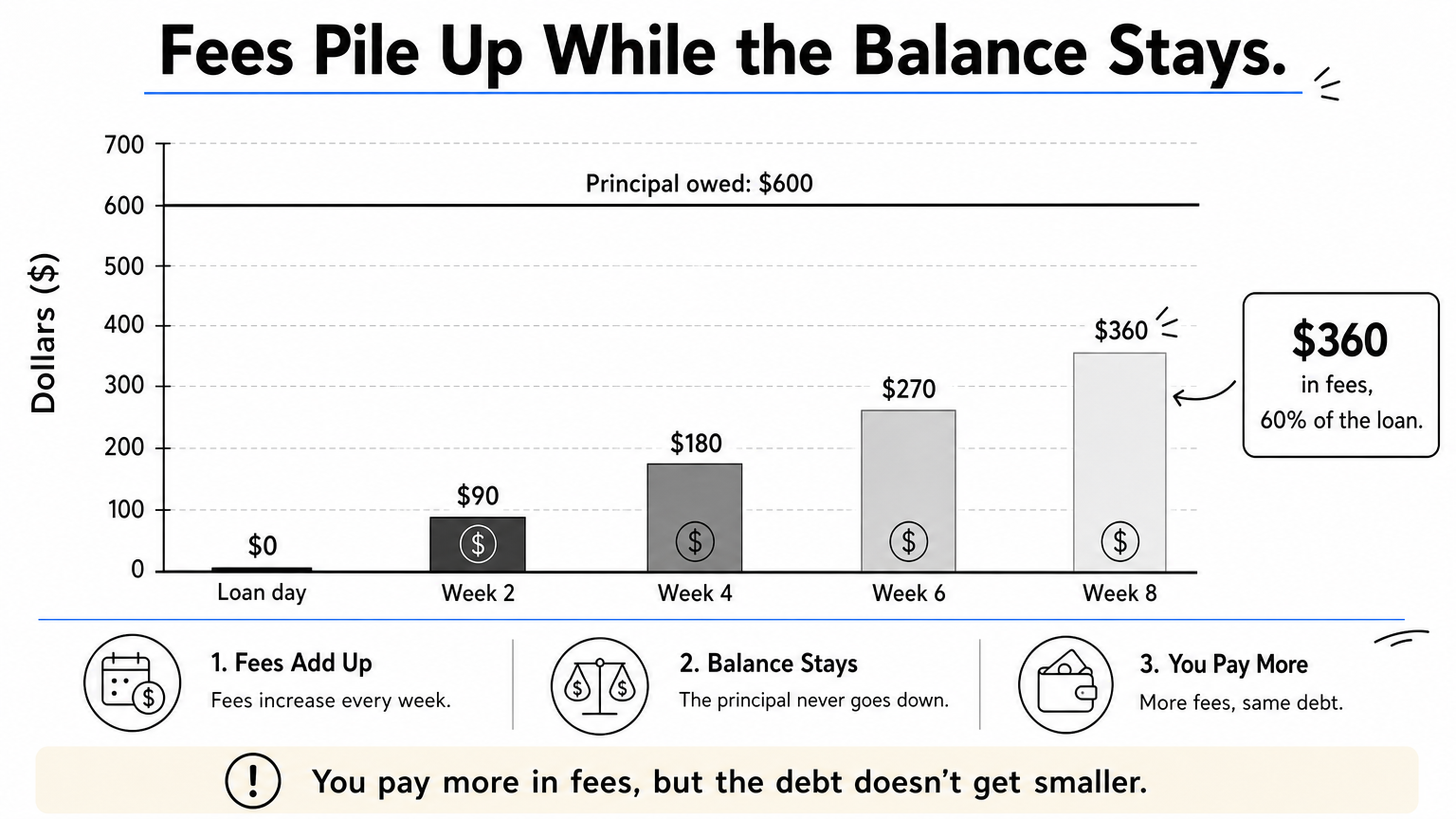
A typical fee of $15 per $100 sounds small, but it is charged every two weeks, which works out to an annual percentage rate near 390%. Say you borrow $600. The fee is $90, and if you can only afford the fee on payday, you renew. Here is what that looks like:
| Point in time | Fees paid so far | Principal still owed |
|---|---|---|
| Loan day | $0 | $600 |
| Renewal 1 (week 2) | $90 | $600 |
| Renewal 2 (week 4) | $180 | $600 |
| Renewal 3 (week 6) | $270 | $600 |
| Renewal 4 (week 8) | $360 | $600 |
After two months you have paid $360 in fees, which is 60% of the amount you borrowed, and you still owe all $600.
Renewing buys you two weeks and costs the same fee every time, so the balance never shrinks until you pay down principal.
What happens if you stop paying
Skipping payments is not a plan. Most payday lenders don’t report to the credit bureaus, but a debt sent to collections can damage your credit and stay on your report for years. The lender or collector can also sue you, and a court judgment can allow wage or bank account garnishment.
If you can’t pay, contact the lender before the due date and ask for options. The Consumer Financial Protection Bureau gives the same advice. The next four steps are the options, in the order that usually works best.
Step 1. List every loan and stop the rollovers
Before you call anyone, write down every payday or cash advance loan you owe and stop renewing them. A renewal is the one move that guarantees you stay in debt, so ending it comes before any other fix.
Build a one-page debt list
Put it on paper or in a spreadsheet. For each loan, record:

- Lender name and phone number
- Amount borrowed and the fee per renewal
- Due date and whether the lender debits your account automatically
- The state where you took the loan, since state rules decide what the lender must offer
Then subtract your essential bills (rent, utilities, food, transport, insurance) from your take-home pay. What’s left each paycheck is the most you can realistically put toward the debt. That number drives every choice below.
Protect your bank account
If the lender pulls payment automatically, you can revoke that permission. Tell the lender in writing and tell your bank as well. Under federal rules, the bank generally must stop the debit if you notify it at least three business days before the scheduled withdrawal.
Revoking does not erase the debt. Do it together with Step 2, not instead of it, or the lender may send the loan to collections. If the lender keeps draining your account on payday and you keep overdrawing, consider moving your direct deposit to a new account at a different bank once your plan is in place.
The goal of Step 1 is to know exactly what you owe and to make sure no lender can empty your account before you have a plan.
Step 2. Ask for an extended payment plan
Call your lender and ask for an extended payment plan (EPP). An EPP splits what you owe into smaller installments over a longer period, so you finish without renewing and without new fees. This is often the cheapest way out of payday loan debt, because it costs nothing to ask.
What to say to the lender
Many states require lenders to offer an EPP, and lenders who belong to the Community Financial Services Association of America pledge to offer one. Availability still depends on your state’s law and the lender’s policy, and some states require you to ask before the loan comes due. Call early, and use a script like this:
Hello, my name is [your name] and my loan number is [number].
I can't repay the full amount on [due date] without borrowing again.
I'm requesting an extended payment plan under my state's rules.
Please confirm in writing: the number of installments, the amount
of each payment, the due dates, that no additional fees or interest
will be added, and that automatic withdrawals will be limited to
these plan payments.
Get the terms in writing
Do not rely on a verbal promise. Ask for the plan by email or mail, and keep a copy of everything. Then make every installment on time, and don’t take a new loan from the same lender while the plan runs, because that can void the arrangement.

If the lender refuses, check your state’s rules with its bank regulator or attorney general. If it still says no, or the installments are more than your budget allows, move to Step 3.
Ask for the plan before the due date, ask for it in writing, and don’t accept any version that adds fees.
Step 3. Replace the loan with cheaper credit
If no plan is available, pay the payday loan off in one payment with cheaper credit, then repay the cheaper loan in installments. This is also the closest thing to a fast exit, because one payment ends the fee clock.
Compare your cheaper options
| Option | Cost | Amounts and terms | Credit check |
|---|---|---|---|
| Payday alternative loan (PAL I), federal credit unions | Max 28% APR | $200 to $1,000, 1 to 6 months | No, but you must be a member for 30 days |
| PAL II, federal credit unions | Max 28% APR | Up to $2,000, 1 to 12 months | No, and you can apply right after joining |
| Personal or debt consolidation loan | Depends on credit, many lenders top out near 36% | Often 12 to 60 months or longer | Yes |
| Employer paycheck advance | Often little or no interest | Taken from your next paychecks | No |
Cash advance apps are another route, but they charge fees or ask for tips, so work out the total cost before you use one. Avoid any lender that wants a fee up front or promises guaranteed approval.
Here is a worked example. You pay off a $600 payday loan with a $600 PAL at 28% APR over six months. The payment is about $108 a month, roughly $650 in total, so about $50 in interest. Six weeks of rollovers on the payday loan would have cost $270 in fees with the $600 still owed.
Pay several loans in the right order
If you owe more than one loan, one debt consolidation loan below 36% APR usually beats juggling them. If you can’t qualify, put the minimum on each and send the extra to the loan with the highest fee per $100 first, the avalanche method. Choose the smallest balance first, the snowball method, only if you need a quick win to stay motivated. The same order applies to a credit card cash advance, which has its own high APR.
Move the debt to a loan with a rate under 36% and a fixed end date, and the fees stop compounding.
Step 4. Get free counseling and build a buffer
If steps 2 and 3 don’t fit your situation, talk to a nonprofit credit counseling agency. Then change your budget so the next emergency doesn’t send you back to a payday lender. The counselor handles the debt you have, and the buffer handles the debt you might have.
Use a nonprofit counselor and a debt management plan
Nonprofit agencies, including members of the National Foundation for Credit Counseling, offer free or low-cost counseling. A certified counselor reviews your budget and your debts, and can set you up on a debt management plan (DMP). In a DMP you make one monthly payment to the agency, and the counselor negotiates with creditors for lower rates or fees.
Two cautions apply. Payday loans are not always eligible for a DMP, so ask before you enroll. DMPs also usually carry setup and monthly fees and may require you to close credit cards. Be wary of any company that charges upfront fees to "erase" payday debt or pushes you to stop paying everyone. Verify that the agency is a legitimate nonprofit first.
Build the buffer that keeps you out
Start with a stripped-down budget. A 50/30/20 split may not fit when money is tight, so cover essentials first and aim for even $20 per paycheck into savings through an automatic transfer. A first goal of $300 to $500 covers many small emergencies. Call your utility, medical provider, or landlord about payment plans, and check local assistance programs for food, health coverage and utility bills.
If thin credit pushed you toward payday lenders, a secured credit card or credit-builder loan can start a payment history that helps you build your credit score. Over time, better credit opens cheaper borrowing options and lowers the odds you’ll need a payday loan again.
A small automatic savings habit does more to prevent the next payday loan than any single budgeting rule.
Where to start
Payday loan debt is a fee trap, not a character flaw, and the way out is to stop the fees. List what you owe, stop renewing, ask for an extended payment plan, switch to cheaper credit if you need to, and use a nonprofit counselor when the math still doesn’t work. Then build a small buffer so a car repair or a medical bill doesn’t undo the progress.
The hardest part is the first phone call to your lender, so make that one before anything else. For a wider plan that covers high-interest balances of every kind, from debt consolidation to nonprofit programs, read our step-by-step guide on how to get out of debt.